

Select Comparisons
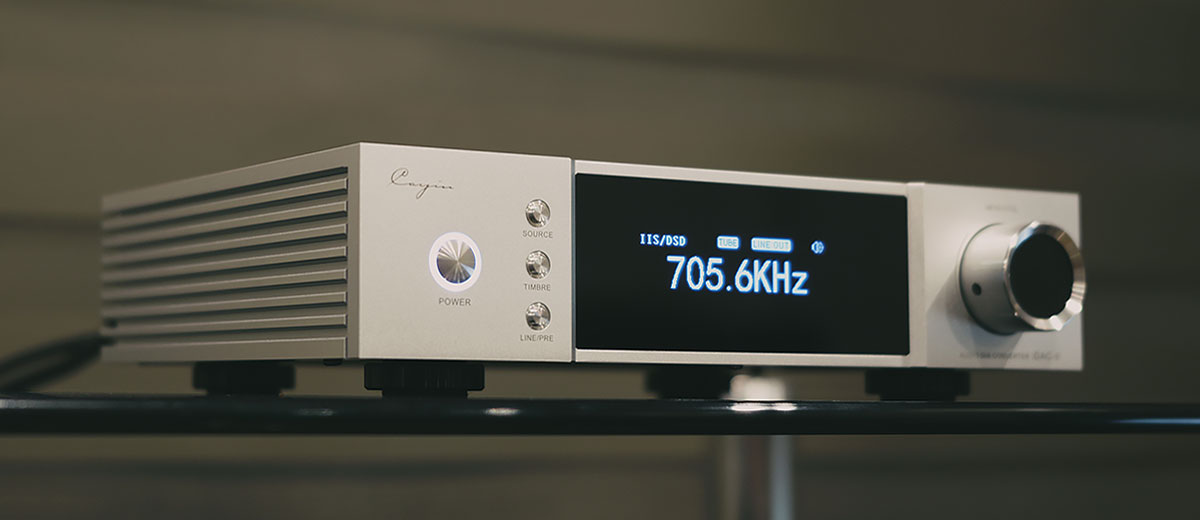
The following comparisons to the Cayin iDAC-8 were completed using a mix of the iHA-8 headphone amplifier and the iDAP-8 desktop streamer. Primary headphones included the Austrian Audio The Composer, Audeze’s LCD-5, and the ZMF Headphones Atrium (open).
Cayin iDAC-6 MK2
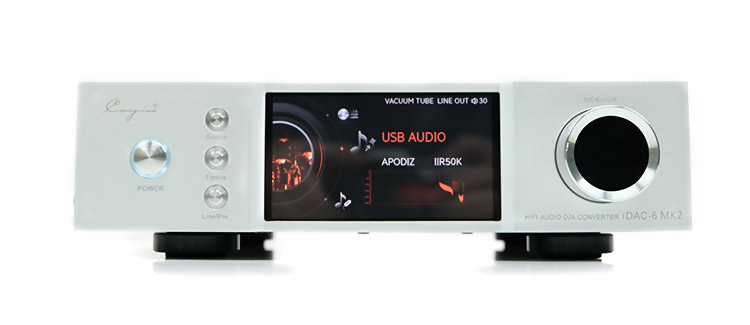
The Cayin iDAC-6 MK2 is the only original “i-Series” component to have received a refresh, with the original iDAC-6 discontinued sometime around 2020.
Technical
Both are Delta-Sigma equipped with a 4 dual Triode 6H16b-B tube buffer. The iDAC-6 MK2 uses the more dated ES9028PRO in a single chipset implementation as opposed to the flagship AKM AK4191 digital processor, and a dual AK4499EX chipset operating in mono mode inside the iDAC-8.
Decoding rates are similar at PCM 32BIT/768kHz and native DSD512 via USB and I²S. Both units also have dual coaxial (BNC and RCA) and optical inputs, and these also have matching decoding rates of 24BIT/19kHz (coaxial) down to 24BIT/176.4kHz (optical).
There is no decoding advantage when comparing these two DACs. Rather, it’s more about the DAC ‘flavor’ and performance, such as the dynamic range with the iDAC-8 analog output up to 5 dB superior to the iDAC-6 MK2.
The line-level analog output Vrms for both DACs are matching at 2.2V and 4.4V for single-ended and balanced, reinforcing the dynamic range difference when A/B’ed.
However, the maximum Vrms for the PRE output has dropped a little on the iDAC-8 at 6V SE and 12V balanced as opposed to the iDAC-6’s 7V and 13V on the same outputs.
The other update is the software, and I must say I miss the aesthetics of the more colorful but smaller OLED display of the iDAC-6 MK2 over the larger but plainer iDAC-8 OLED dot matrix display.
The available options are slightly changed due to the differing DACs, meaning alternative filter choices with frustratingly speedy menu timeouts on both devices.
There is also no brightness option on the iDAC-6 MK2, and the iDAC-8 has dispensed with the output select OS feature, which is redundant given there is a mechanical switch on the front panel with the same functionality.
Design
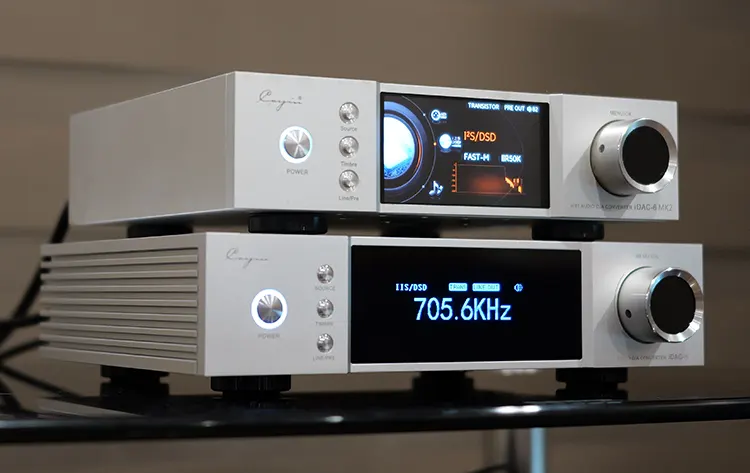
Consistent with all of the components in the 888 Series, the iDAC-8 is the bigger and heavier unit when set beside the iDAC-6 MK2.
It also has a more aggressive design language with the heatsink side panels compared to the boxier compact visual appeal of the iDAC-6 MK2. I would have said the larger screen is more visually impressive, but it’s a lot plainer than the iDAC-6 MK2.
The iDAC-8 screen upgrades are more on the functional side in terms of enhanced legibility from further away or more extreme angles compared to the busier but small and harder to read display on the IDAC-6 MK2.
Functions and controls are the same, with both using a multifunction dial for (PRE) volume and menu control, and the mechanical button array on the left side for source, output mode, and timbre control.
The iDAC-8 rear panel looks tidier than the iDAC-6 MK2. Courtesy of the enhanced real estate space, the iDAC-8 port alignment is neater and better spaced out than the cramped iDAC-6 MK2 arrangement.
However, there is no quantitative difference in available sockets and input/output options between the two DACs.
Performance
There are two fundamental differences and perhaps 1 to 2 similarities between these two DACs. The key differences focus on staging, separation, and timbre coloration, especially on voicing.
Just to be clear, I was working both DACs through the iHA-8 using I²S via the iDAP-8, so what differences could be heard came from the DACs.
In this instance, the ESS overtones were very clear from the iDAC-6 MK2 in transistor and vacuum mode. In both modes, the iDAC-8 sounded smoother, more endearing, with a natural level of note decay and a much wider and more spacious soundstage.
The iDAC-6 MK2 sounded drier, and more so in transistor mode, with a noticeably enhanced treble overtone in the vocal timbre that teases out more sibilance in brightly recorded tracks.
The iDAC-8 handles the same tracks in a more pleasing and even manner, with excellent control of the harmonic balance throughout. If you own a brighter headphone, such as the Composer, or a vocal-forward headphone such as the LCD-5, then the iDAC-8 makes for a more euphonic listening experience.
I would also argue that dynamic range gaps are noticeable, with a narrower soundstage and slightly mushier instrumental placement from the iDAC-6 MK2 making dramatic moments in recordings a little flatter-sounding.
The iDAC-8 spreads everything out wider and taller than the more compressed-sounding iDAC-6 MK2, which is far more preferable with headphones such as the Atrium. With the additional space, more nuanced background instruments and delicate sequences are much easier to pick out.
Chord Electronics Qutest
The Chord Electronics Qutest was launched in 2018 and is still one of Chord’s most popular DACs today, so it has stood the test of time. It was also our Top Gear Best Desktop Pure DAC Award winner for the same year.
Technical
Though imbued with the same purpose, to decode, the Qutest is a vastly different technical proposition from the iDAC-8.
Instead of the iDAC-8’s flagship Delta-Sigma AKM dual DAC and digital process setup, the Qutest decoding is an entirely in-house FPGA FIR Filter-based design based on a 10-element pulse array program using a Xilinx Artix 7 chipset.
The working principle of the Qutest DAC is based on taps using the Watts Transient Aligned filters (WTA) tap length as a guide to performance. The more taps there are, the longer the filter, the more finely the conversion response can be tuned.
To the average consumer, however, the decoding output of both DACs is the same at native DSD512 and PCM 32BIT/768kHz via USB. Bear in mind the Qutest was launched in 2018, so its future-proofing has been supreme.
Because the Qutest is modular with dual BNC, decoding can be further enhanced by plugging it into the M Scaler, which will upsample lower resolution audio to a maximum of 705.6 kHz or even higher at 768 kHz.
What the Qutest lacks, however, is balanced or PRE output. Chord is on record as largely rejecting balanced topologies on principle, so this is unlikely to change. Yes, you can change the rated line level Vrms from 1V to 3V, but at 3V the resulting output can sound a little ‘stressed’.
It is also entirely solid-state, so there are no timbre controls similar to the iDAC-8 options. Though it does have some filter options, the effect is subtler compared to the tube output from the iDAC-8.
Design
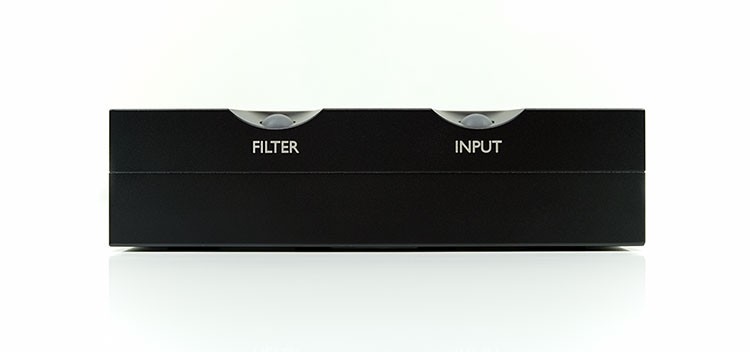
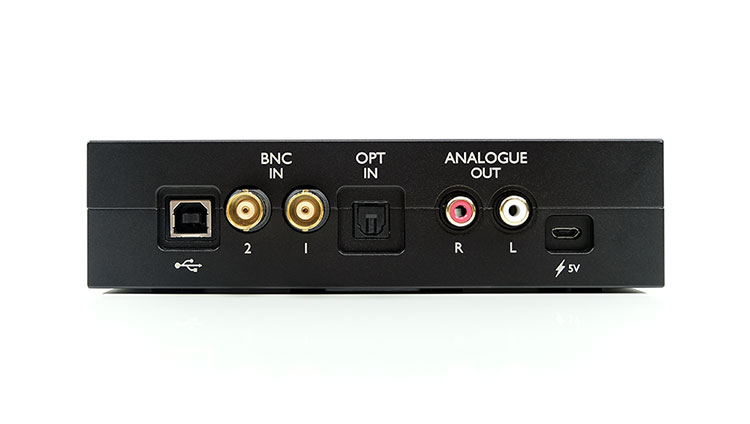
The Qutest is tiny compared to the iDAC-8, with a very minimalist design and only available in black. The iDAC-8 is classed as a desktop unit, but the Qutest takes the definition of small to new levels.
Despite its diminutive stature, the single aluminum billet Qutest chassis is built like a tank. I would argue it can withstand more knocks and bumps than even the fairly sandblasted aluminum housing of the durable iDAC-8.
Some of that reasoning is down to the relative simplicity of the Qutest I/O. Everything, save for the BNC sockets, is neatly recessed into the Qutest body, ensuring excellent protection from accidental drops.
There are some sacrifices to get down to that size, sacrifices that make the iDAC-8 a more intuitive and accessible device to use. Options such as a lack of screen, a lack of balanced XLR to complement the dual RCA, and no I²S reduce the flexibility of the Qutest compared to the iDAC-8.
One might argue that a stackable system needs only to answer to the other devices in the series for complete compatibility, but that has never been the case with the Qutest. It came out a long time before the Anni and Huei, so many owners have it hooked up via USB, BNC, or optical to 3rd party sources.
I cannot finish without mentioning the Orb system of the Qutest. It’s not as easy to use as the LED display and clearly labelled buttons on the iDAC-8, even if the short Cayin menu system timer management is akin to ‘whack a mole’.
Performance
Overall, the Qutest delivers a more V-shaped response than the smoother, warmer, and comparatively more mid-centric iDAC-8.
With the Atrium, when paired with the iHA-8 and the iDAP-8 as source and amplification, I got a distinctly more elevated bass shelf from the Qutest mixed with some enhanced treble extension and a neutral set of mids with a clean vocal and instrumental timbre.
The iDAC-8 sounds more balanced across the range, save for the treble, which is more relaxed, giving it a euphonic, sweeter tone. Switching to the tube mode enhanced the warmth considerably over the drier Qutest sound and brought some enhanced lower-mids bloom into the mix.
I have to say I prefer the transistor mode of the iDAC-8 when compared to the Qutest using warmish-sounding headphones. I like a bit of clarity in the Atrium, for example, and the Qutest does quite well in this regard.
However, the vocal presence is not quite as strong as the iDAC-8, and though the staging depth is excellent, the width is slightly narrower compared to the iDAC-8 using the same headphones and setup.
Because of the enhanced treble presence from the Qutest, it will deliver on perceived speed and articulation. The iDAC-8 has plenty of resolution, but it’s more about listening than monitoring, so it’s more blended, with the standout being the richer vocal texture and presence.
If I am pairing, I would pick the Qutest if I am after a stronger fundamental and want a cleaner tone with warm recordings and headphones. If I am pairing with the iDAC-8, I am generally looking for something more emotional, more vocal-driven recording-wise.
Ladder Schumann
The Ladder Schumann is a similarly priced desktop DAC launched in 2023. This is arguably an offshoot of the Denafrips R-2R engineering approach, alongside Musician Audio.
Technical
Another change in DAC implementation with R-2R instead of Delta-Sigma. There will be fans of both.
The Schumann is a discreet-engineered balanced R-2R backed by an Altera Cyclone IV FPGA implementation and combined with a dual crystal oscillation for noise-shaping and jitter control.
It uses a 24-bit resistor ladder array for multi-bit PCM decoding, and most likely a separate rail for 6BIT DSD decoding, but documentation is light on the precise breakdown.
In my original review, I had no clear picture of its official decoding limit, but subsequent fresh data would indicate a higher decoding limit for the Schumann over the iDAC-8 at DSD1024 and PCM 1535 kHz for USB and I²S, high rates indeed.
All other outputs, including coaxial and optical, are similarly matched at 24BIT/192kHz for coaxial down to 176.5kHz for optical.
There is some element of filter control with the Schumann offering a standard OS/NOS switch and the iDAC-8 digging into its AKM chipset for a wider range of subtler digital filter tweaks. OS/NOS always gets my vote in terms of audible changes to the sound.
One advantage the iDAC-8 has is variable volume PRE analog output capability, something which the Schumann lacks. The Ladder design only provided line-level output at 2Vrms single-ended and 4Vrms balanced, which is shade under the 2.2Vrms and 4.2Vrms maximum from the iDAC-8.
The dynamic range of the Schuman has a vague 121 dB rating, so I have to presume that is the maximum A-weighted from its balanced output, and as such, it’s about 5 dB less than the iDAC-8’s equivalent benchmark rating.
Design
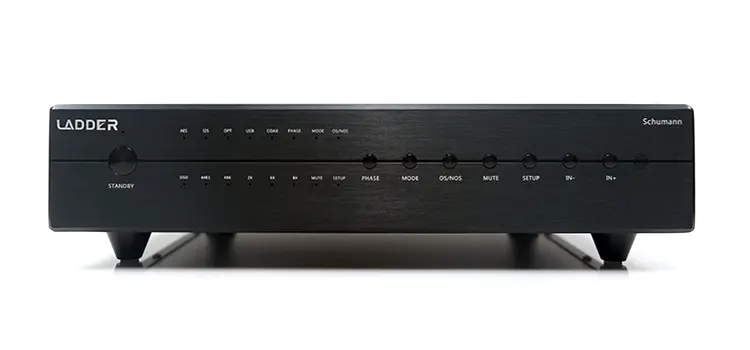
The Schumann follows a design pattern shared by Denafrips and Musician Audio (Pegasus and Aquarius). It’s a little bit bigger than the iDAC-8, though the gap isn’t huge, but it’s more about the aesthetics with a very utilitarian front facia full of mechanical buttons and lights, and no iDAC-8 screen.
Some prefer that, and since neither has a remote control, you will find yourself getting up off the couch or reaching across the desk to change modes and filters anyhow.
However, the iDAC-8’s large OLED dot matrix display makes life a lot easier, and to be honest, the understanding of what each button does and how it affects the status is much easier to understand on Cayin’s clearly labeled unit.
The Schumann control system is fairly easy to learn on a superficial level. However, without reference to the manual, you would never know that there are quite a few ‘control combos’.
Combos are a combination of either mode or phase buttons (hit in sequence), which will allow you to dig a bit deeper into the Schumann DAC features.
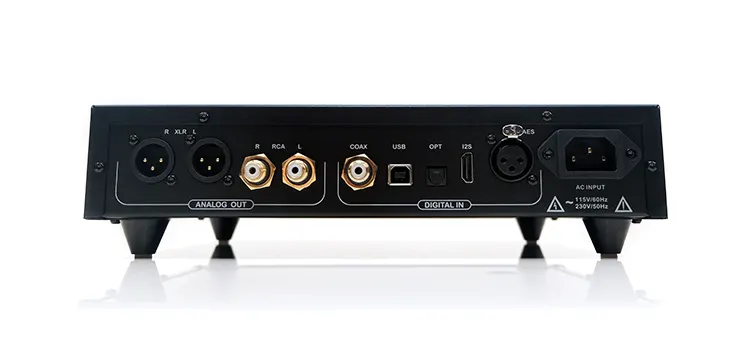
The I/O on the Schumann lacks the IDAC-8’s additional BNC coaxial digital input, but otherwise, the options are fairly matched with both offering dual analog SE/balanced outputs, USB, coaxial RCA, optical, and I²S.
For those using Cayin’s N6ii, N7, and N8ii, the Schumann I²S is compatible with these devices’ mini-HDMI output port, which is a bonus.
Performance
Both of these DACs deliver a very natural sound via the iHA-8 using the iDAP8. But there are shades of natural, with the Schumann veering off to a more analog sound with a slightly darker, denser tone, and the iDAC-8 delivering a sweeter, more euphonic tone, especially in tube mode.
There is also a perceived dynamic range or Vrms gap between these two DACs when testing their respective analog outputs.
The Schumann either has higher resistance or a slightly lower Vrms output than the livelier-sounding iDAC-8 equivalent. So much so, I had to constantly adjust volume on the iHA-8 to compensate for the quieter Schumann presentation.
I would describe the Schumann bias as a bit heavier and denser on the lows, particularly in its sub-bass performance. In NOS mode, it has a more vivid but rawer vocal coloration. It is not quite as polished as the Delta-Sigma sound of the iDAC-8, but some do like that ‘unvarnished’ appeal and feel it is truer to the recording.
Certainly, the Schumann vocals sound ‘bigger’, but they also lack a little bloom. I would not call it a rounded tone, just not as ‘creamy-sounding’. The treble extension is good, but not as sparkling as the highs produced from the iDAC-8.
Staging-wise, the iDAC-8 pushes a bit more from the mids to the highs with my paired headphones, but in a pleasing manner.
It can deliver a comparatively airier, almost ethereal tone, especially in tube mode. Whereas the Schumann sounds more grounded and weighty to my ear, pulling me more to the instrumental and vocal fundamental frequencies.

My Verdict
The Cayin iDAC-8 is a lovely little desktop DAC that successfully takes the company’s previous timbre control vision to the next level. Compared to the iDAC-6 MK2, it’s a more natural and spacious-sounding decoder, and to my ears, it is more true to the current Cayin house sound.
Of course, Cayin wants you to pair it with the iHA-8 amplifier, but if the budget is tight, it’s a worthy standalone DAC for almost any other amplifier, particularly with its PRE controls, which give it a little bit of additional control over stepped-only attenuators.
If there is criticism, it is more to do with the function set around the new menu system and the plainer OLED monitor. Yes, it is bigger and easier to read, but the shortened menu pop-up timer combined with the blander visuals makes you wonder if more could be done here.
Otherwise, this is a competitive offering, superior to the now 6-year-old iDAC-6 MK2, and should provide a worthy demo option for anyone looking for a decent, smooth-sounding delta-sigma DAC for their system.
Cayin iDAC-8 Technical Specifications
- DAC: AK4191 Digital A Modulator + (2x) AK4499EX (Mono Mode)
- Vacuum Tube
- RCA: (2x) 6H16b-B
- XLR: (2x) 6H16b-B
- Volume Control: NJW1195AV 4-channel electronic controlled analog volume
- Display: 3.12″ 256 x 64 OLED Dot-matrix
- Digital Inputs: 3S, USB Audio, Coaxial (RCA),
- Coaxial (BNC), AES/EBU, + Optical
- Analog Outputs: (2x) BAL XLR + (2x) SE RCA
- Output Modes: Fixed Level: Line Out, Variable Level: Pre Amp Out
- Power Supply: 45W Toroidal Transformer
- Power Management: 29,200uF Nichicon filtering capacitors + LDO + Regulators
- Weight: 10.14 lbs
- Dimensions: 270mm x 215mm x 70mm
- Analog Outputs (Line Out) Output Level
- RCA SE: Solid State + Vacuum Tube 2.2V + 2.2V
- XLR BAL: Solid State | Vacuum Tube 4.2V + 4.2V | 4.1V + 4.1V
- Analog Outputs (Pre Out) Output Level
- RCA SE: Solid State + Vacuum Tube 6V + 6V
- XLR BAL: Solid State | Vacuum Tube 12V + 12V | 10V + 10V
