

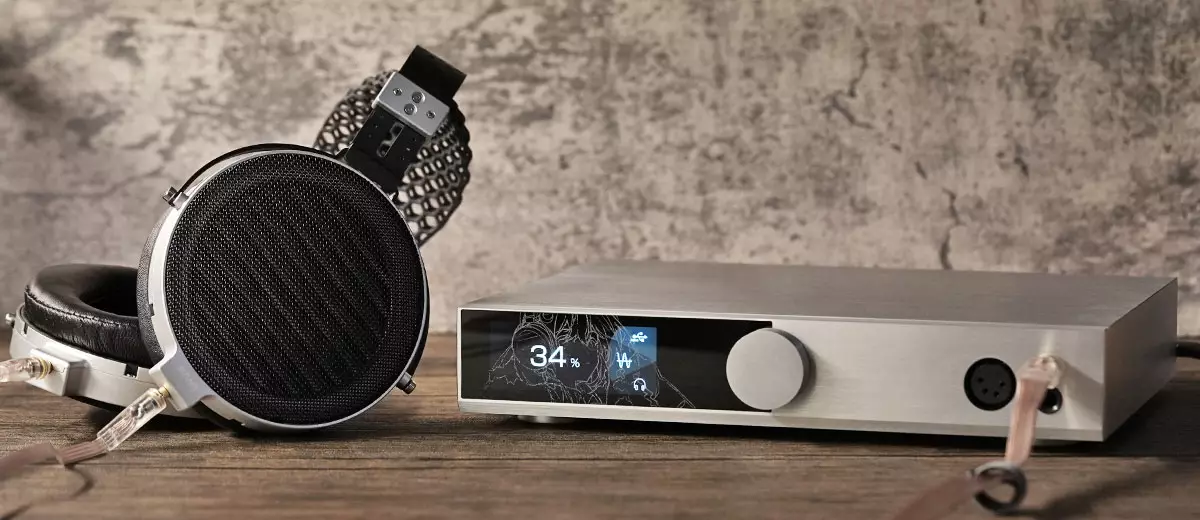
James reviews the SMSL X MOONDROP DHA15, a collaborative dual CS43198 DAC and 7.5W-capable headphone amplifier with interactive DSP. It is currently priced at $649.99.
Disclaimer: I received this sample in exchange for my honest opinion. Headfonics is an independent website with no affiliate links or partnerships. Thank you to Shenzhen Audio, MOONDROP, and SMSL for their support.
Click here to learn more about the SMSL and MOONDROP products previously reviewed on Headfonics.
This article follows our current scoring guidelines, which you can find in more detail here.

The DHA15 is a collaborative desktop DAC and headphone Amplifier from SMSL and MOONDROP priced at $650 USD.
The intention here is clear: the DHA15 is a powerful Class A amplifier and decoder with low output impedance, and hardware PMEQ features for its USB input. It also has a library of presets to switch between during use.
This is exactly what MOONDROP headphones and many planars need to sound more engaging, and it offers more interactive features than what SMSL typically provides in similar products.
The decoding solution utilizes dual CS43198 DACs, which is a pretty standard yet mature choice that provides a decent foundation for noise and distortion control before the amping stage.
I will assess how it pairs with various MOONDROP headphones and other brands, as well as its overall decoding performance compared to the FiiO K17 and the Luxsin X8 in my full review below.
Features
Amplification
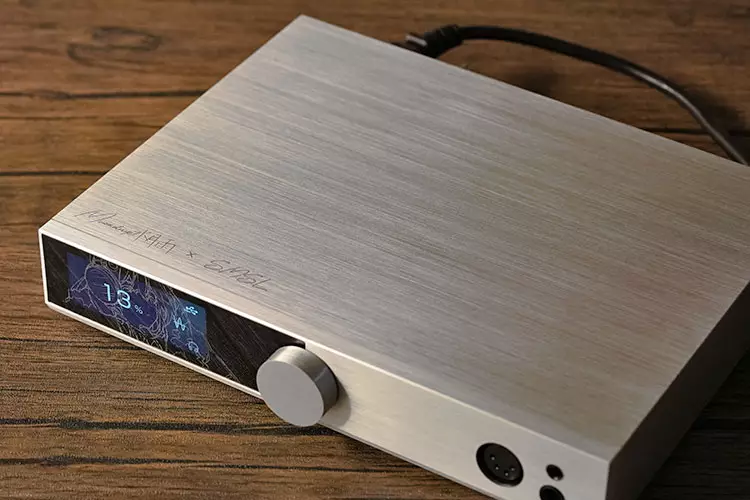
The DHA15 is one of the sleekest Class A amplifiers in the current market, not to mention it packs in decoders and DSP features.
It features a discrete Class A circuit, capable of outputting 15W per channel on a 16Ω load and 1000mW on a 300Ω load, which means there is plenty of power for almost every headphone.
The output impedance is close to zero as claimed by SMSL, and both SNR and dynamic range score 131dB, with excellent THD+N performance as well, pretty much going beyond human hearing threshold.
If you trace back to other SMSL products, you may notice the power rating being quite similar to SMSL’s H400, but the DHA15 seems to offer more value with a lot more features packed in.
The DHA15 works as a pure amplifier. You can hook it up with XLR/RCA cables to another transport. Note that the DSP features apply only to the digital input, as the DSP chip is located entirely upstream of the decoder chipset.
Hardware PMEQ
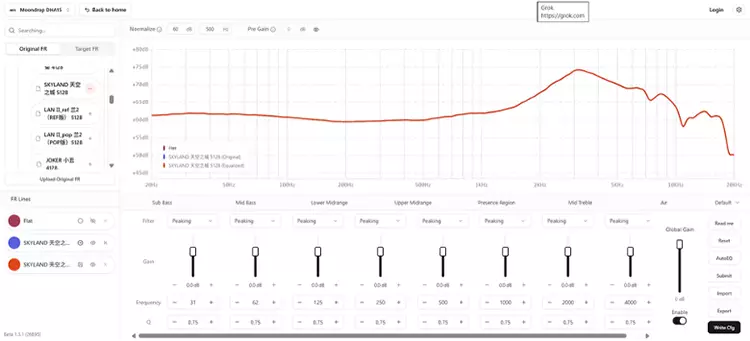
Powered by the proprietary USB controller chipset MOONDROP UA01, these are what make the DHA15 powerful and versatile.
You can easily adjust the tuning via a graphical UI using either the mobile app or through a web browser interface, to apply various curve presets or use custom profiles shared by other members of the community. And of course, you can also apply your own PMEQ with adjustable Q values.
You can also select your own headphone’s curve in the database and try to mimic the curve of another headphone by selecting the other headphone’s curve, such as the HD 800. The effect is audible and more than just fun.
DAC
The Cirrus Logic decoding solution is quite standard and satisfactory for the price, supporting native DSD256 decoding alongside 32-bit/384kHz PCM playback.
One interesting observation is the complete omission of other digital inputs, and the lack of Bluetooth receiving capability. This is likely due to size and cost constraints, or simply because the device is strictly targeted at PC users who will place the DHA15 on a desktop.
It feels almost like a pure amplifier that was modded to include USB decoding similar to those on a dongle, and with DSP capabilities.
The design is focusing heavily on its amplification performance rather than a sprawling feature set on connectivity, but it would be nicer if the DSP also applies to analogue input.
Design
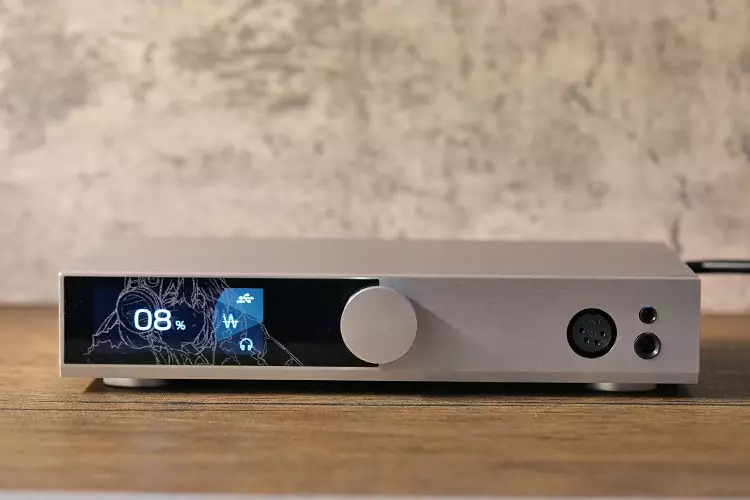
This is a beautifully machined device, and the photos don’t do it justice. I am quite surprised that the build and design actually impress me, as the DHA15 feels very sleek yet solid at over 2kg.
The entire metallic body is brushed, which is quite uncommon and feels rather premium, and the overall assembly feels very rugged and dense, yet smooth to the touch.
The color scheme provides excellent contrast, and all the screws are hidden on the back panel, which keeps the design clean.
Since this is a collaboration product with MOONDROP, we also have the mascot lasered onto the front glass panel, and collaborative signatures on the upper side. It is quite subtle and feels like a nice touch that decorates the metallic design.
I/O
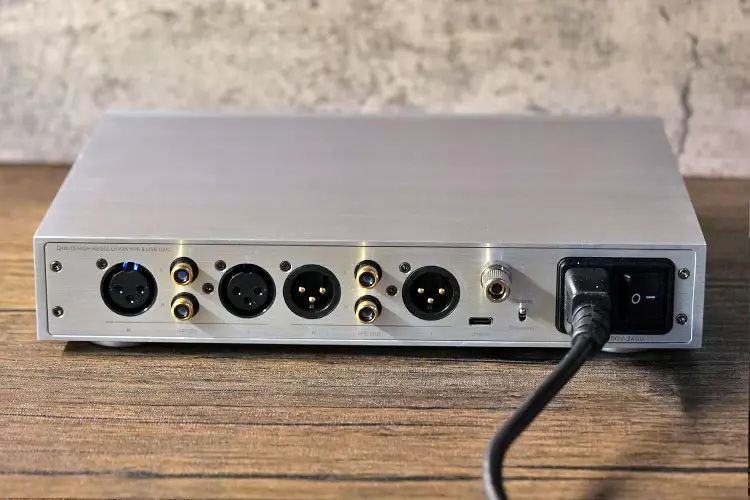
As mentioned above, the DHA15 focuses more on the amplification function and features both XLR and RCA inputs.
It also works as a pre-amp, providing RCA and XLR outputs as well. Aside from that, it includes a grounding switch and a USB-C jack for decoding.
Again, it feels like we are missing streaming capabilities and COAX/Optical inputs. However, if you do not use these features and mainly listen from a PC or another USB source, such as the Eversolo DMP A6 that does not have a headphone out but supports USB output, this design is more cost- and space-efficient.
This allows the device to focus entirely on what it does best, so this may not necessarily be a caveat.
Controls
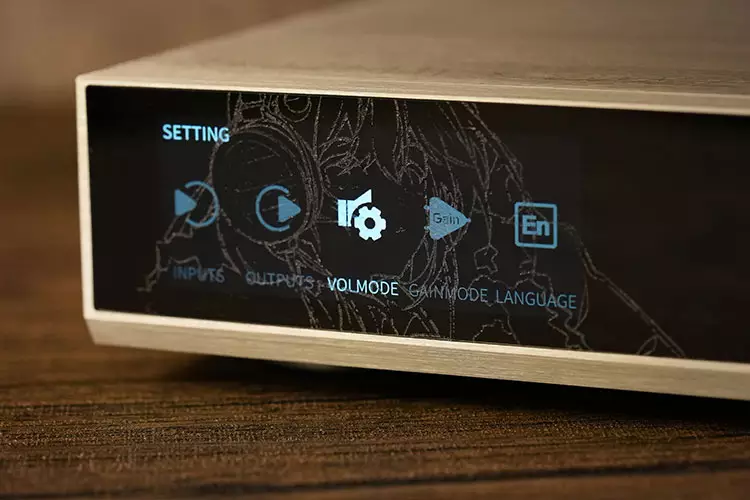
You can use the multi-function knob to control most features. When not pressed, it serves as a 99-step volume control, which is finely stepped for sensitive IEMs to work well without a big jump in volume each step.
When short-pressed, it cycles through different input sources and chooses between headphone output and preamp. You can also adjust the gain, the backlit LED dimmer, and the behavior of the volume to be softer or more responsive.
Aside from the intuitive single-knob control, you will find a remote in the package. I like how they inserted a mute button on it so you can instantly turn off the music when you need to speak to someone around.
For volume control, the front knob has an electronic relay, and even at low volume, the L/R channels are still balanced, which allows it to work better with very sensitive gear.
Packaging & Accessories
Waifu cover packaging is standard for MOONDROP products, and inside we will find a power cord, the remote, a USB-C cable that feels quite sturdy, and user manuals.
There is sufficient protection for the package, and you probably don’t need the menu to figure out the controls, but for the graphical interface, it is easier to follow instructions in the manual.
The DHA15 is also pre-installed with rubber legs so you don’t need to worry about this block of metal scratching the tabletop.
Software
Things get much easier when you don’t need to adjust the Parametric EQ on a tiny screen. When there are plenty of presets to pick from, it’s not very practical unless you know exactly what flaws you need to fix. To hook up to a PC, you will need a USB-C cable.
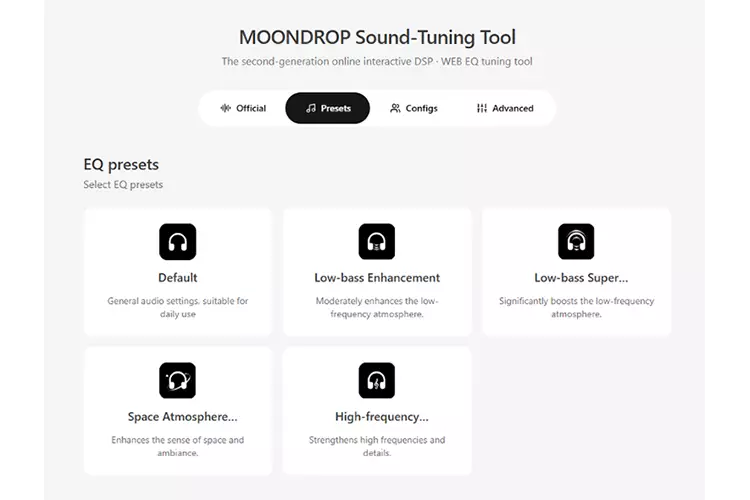
MOONDROP’s software interface allows adjustments to be made via a web browser or mobile app.
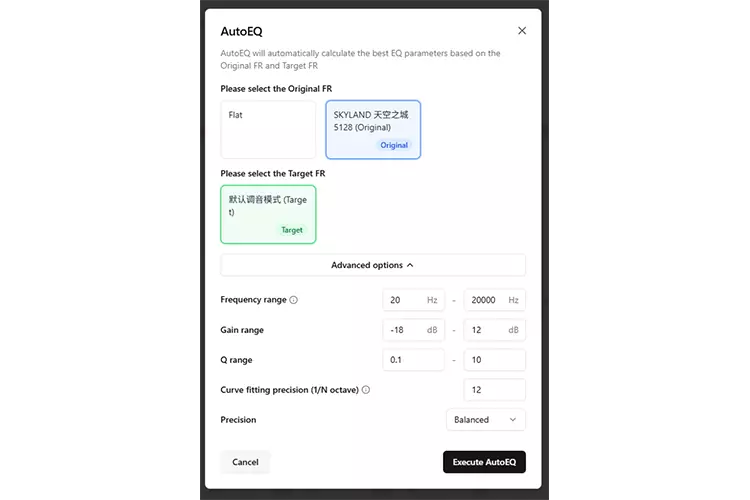
It displays a live frequency response curve that you can manipulate. This allows you to select target curves and apply them with just a single click. That is why they call it one-click-auto-EQ.
The best part is that you can select your current headphone’s curve and apply another headphone’s curve on it.
The web UI can automatically calculate the optimized compensation for this to happen. My unit has the profile names in Chinese, so I hope they will add English labels at some point.
Sound Impressions
I gave the SMSL X MOONDROP DHA15 a week of burn-in, pushing it to the limits with the MOONDROP COSMO, Skyland, the Sennheiser HD 800S, and other popular choices of headphones, while also testing it against other amplifiers such as the FiiO K17 and Luxsin X8.
Summary
Despite its small size, the DHA15 delivers impressive power, way more than it looks. It gives clean, impactful driving power over its Class A circuitry.
The base tuning is quite dynamic, yet it might still feel a bit neutral and lacking color in the mids.
However, by applying DSP profiles, it does sound more vivid and meaty, catching up with the upper vocal penetration power to deliver a more realistic and intimate presentation.
Without DSP applied, the stock setting feels quite balanced and neutral in tone when listening with MOONDROP planar headphones. That also makes it a good starting point for pairing with other decoders on analogue input.
The 6.3mm output feels less powerful, whereas the balanced output delivers firmer, more textured bass that enhances dynamics.
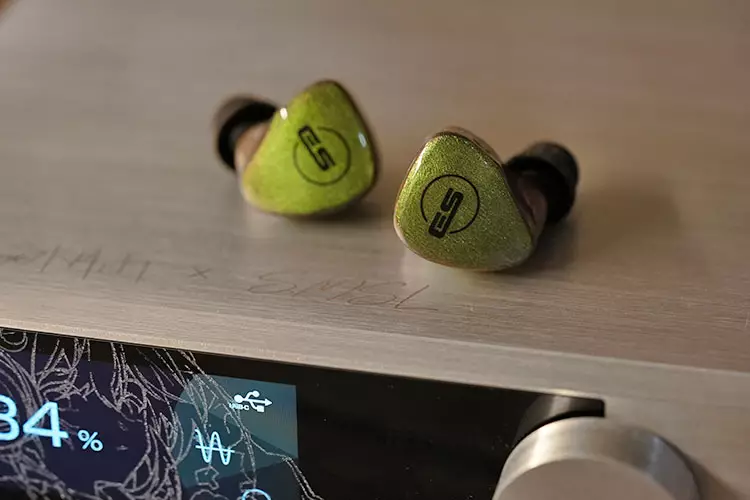
On a fun note, the lowest gain level is well attenuated, so sensitive IEMs like the HiBy Zeta II also sound pretty dynamic, articulated, and very quiet in the background.
Timbre
Out of the box, the DHA15 delivers a clean, neutral, and transparent signature with decent extension at both ends of the spectrum. The upper registers are powerful yet well-controlled and non-piercing.
While this stock presentation is neutral, applying PMEQ, especially by pushing up the mid-bass, helps enhance dynamics and engagement by suppressing raw spikes and enhancing overall tonal balance.
On USB decoding, the bass presentation is fast, adequately textured, and firm, though it sits marginally shy of optimal neutral weight.
It works nicely with bassier gears and not so much for gears with an analytical tuning style, as a slight low-end boost provides a more cohesive overall balance.
For the midrange, upper vocals and cymbals have a slow roll-off that preserves staging air while keeping harshness in check.
High-pitched female vocalists and general pop tracks sound articulate. However, authoritative voices benefit from a slight boost in the fundamental frequencies, and a faster vocal roll-off combined with elevated mid-lows would yield a rounder, more balanced vocal body.
Amplification power is a major strength with the DHA15. The potent current supply of the Class A output can sufficiently power demanding planar headphones to deliver solid bass punch and a smooth upper end.
This reminds me of classic gear like the Luxman P1, but delivering a sharper focus, a darker background, and intuitive DSP capabilities.
With an external DAC, there is clearly more potential to unlock. Hooked up with the FiiO R9 and RME ADI-2 Pro, I get a deeper, more intricately layered low end with a stronger sense of density, power, and depth.
The SMSL D1 with ROHM decoders introduces a smoother, low-end-leaning and more mellow presentation. Across all setups, utilizing balanced inputs and outputs yields sharper image outlines and superior clarity over standard RCA connections, working better for instrumentals.
Staging & Dynamics
The output delivers a lot of power and good air, benefiting the stage and sounding more expansive.
The Class A architecture and gain design allow the DHA15 to sound dynamic and layered even at the lowest gain level. However, you might find the higher gain levels sound meatier with stronger openness, raw power delivery, and sharper transients.
With the built-in DAC, the stage is moderately wide and nicely defined. The vocal has good separation power and sounds quite naturally delivered, especially for lighter, higher-pitched voices, while darker voices may appear more laid-back.
The bass is slightly flat in its stock tuning, especially at the lowest gain level. However, after pumping it up with equalizers, the depth feels enhanced.
In general, there is satisfactory separation between the vocalist and the backing tracks. The vocalist is always positioned very intimately in front and has a sharper image when you switch to a stronger external DAC.
The built-in DAC is doing fine, especially after PMEQ, and with just a few clicks you can apply different profiles to make the output more engaging, which works well for casual listening sessions.
If you have a stronger DAC, there is clearly good room for future upgrades on the decoding side, which can make very audible differences.
For example, hooking up the RME ADI-2 PRO with the DHA15 allows them to complement each other beautifully. This synergy yields better bass density and a more powerful, cleaner bass attack than the original outputs from either standalone device.
Furthermore, the resolution and transients are more clearly presented, with the vocal image becoming more clearly centered, stereophonic, and distinctly separated from the mix.
Click on page 2 below for my recommended pairings and selected comparisons.
