

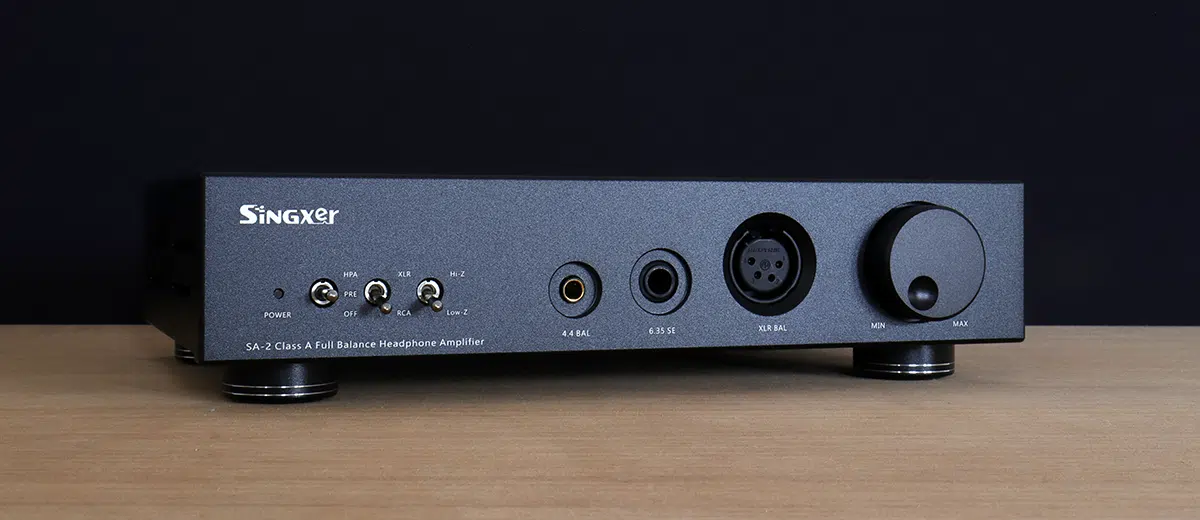
Louis reviews the Singxer SA-2, a second-gen desktop headphone amplifier featuring a fully balanced Class A topology and 10W of output power. It is currently priced at €495 excl. VAT.
Disclaimer: I received this sample in exchange for my honest opinion. Headfonics is an independent website with no affiliate links or status. I thank Magna HiFi for this opportunity.
Click here to read more about the amplifiers previously reviewed on Headfonics.
This article follows our current scoring guidelines, which you can read in more detail here.
A lot of really good audio gear is being launched from the east, including our next product up for review. On my desktop sits the €495 (exc. VAT) Singxer SA-2, the sequel to the SA-1 and the SA-1 V2 desktop amplifiers from Singxer.
Singxer are based in Guangzhou, China, and was founded in 2011. I’m surprised that I didn’t find out about them until last year.
If you look around, they make a lot of gear, starting with headphone amplifiers, DACs, USB purifiers, digital interfaces, and specialty cable assemblies.
Their motto is “bridging silence and sound”, so I’m expecting transparency and a silent operating amplifier foremost.
That’s what most of the audiophiles are looking for nowadays anyway. An amplifier that stays out of sight while it’s presenting the audio input feed.
How does it perform and compare to the likes of the Topping A90 and SMSL SH-X? I found out in my full review below.
Features
I consider the Singxer SA-2 a powerful, but simple headphone amplifier with a couple of intricacies.
For example, the SA-2 has a rather unconventional placement of the gain function alongside a low-Z and high-Z output impedance selector, which is a rare feature. Everything else is standard fare.
It wears the same clothing as the SA-1 in all respects. All the buttons, headphone output taps, volume knob, and the same I/O with preamp functionality carry over, except for one switch, which was added to the mix.
So what has changed from the SA-1? The switch is a new ground or lift feature that resides on the rear panel. It’s a trivial feature, until you pick up hum from interconnected components within the same loop.
Hum can be an issue due to ground loops, and this was Singxer’s way of addressing it. I can mention some other models with a similar feature.
Or perhaps we can say that Singxer just wanted to be competitive since there are some amplifiers in this price range and type that have the feature.
Amplification
The SA-2 can run in pure Class A, but according to their literature, it remains operating in Class A only above 64Ω. It’s a hybrid design nonetheless.
The Singxer SA-2 is capable of up to 10 watts @32Ω, and 15 watts @ 20Ω, but not in Class A operation, since these figures are lower in Class A to almost 800mW at 32Ω.
The SA-2 uses a Singxer proprietary design that uses high-current ON output transistors and a copper block for efficient cooling.
Circuitry optimizations were also made, along with a new DC servo design, which promises to bring noise levels down even further compared to the older SA-1.
Almost twice as much power was also obtained at the headphone outputs as with the previous model, all while maintaining a cool operating temperature. Personally, I never felt this amplifier go past lukewarm.
Design
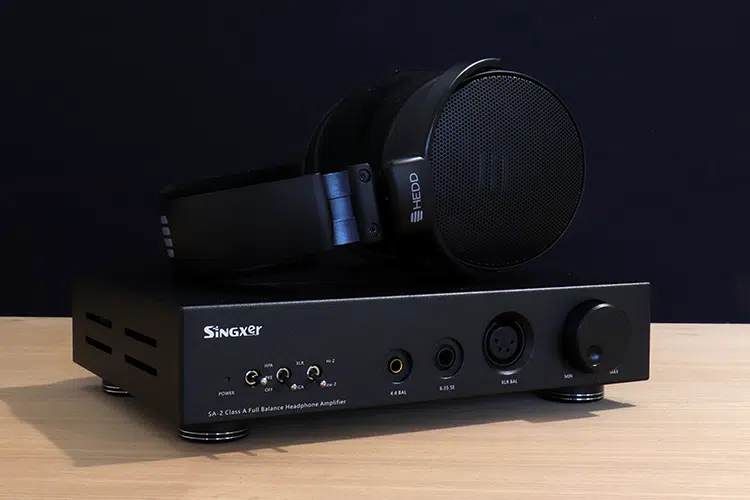
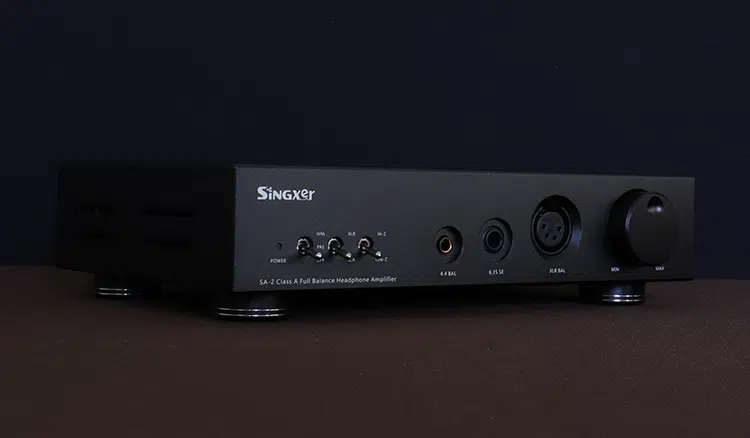
Singxer decided to use the same cookie-cutter on the SA-2 because, as previously stated, nothing has changed visually. Even the slit-like vents on the side panels remained.
To be honest, the overall design is almost old school. It’s a plain black chassis, but I must say, it’s one of the utmost quality, since the metal is thick and heavy, and is finished with a black coating that is fortunately not such a fingerprint magnet. Well, just a little bit.
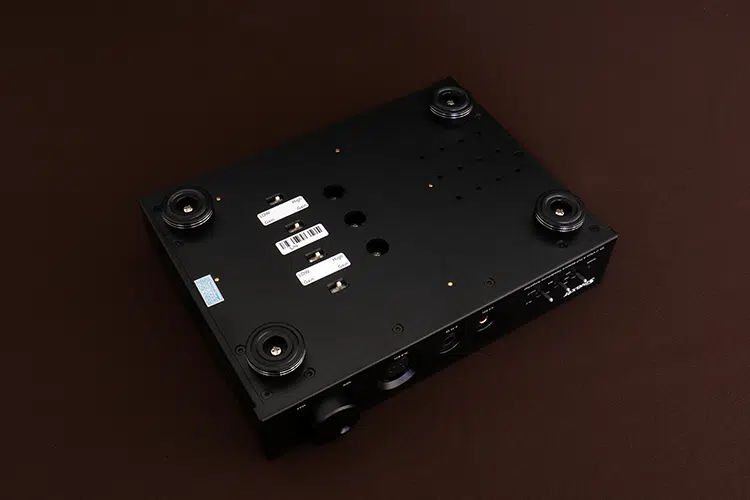
The chassis sits on four color-matched feet, giving the chassis a lift for some under-chassis ventilation. Not that it needs a lot of ventilation because it seems to run cool all the time, surprisingly so for a Class A amplifier.
The volume knob is silent in operation, both mechanically and electrically, but it’s rather firm and stiff to operate. That’s probably due to tight tolerances, which I’m all for, but it should be easier to operate.
Another nitpick I can come up with is that companies that insist on mounting a power button on the rear panel should always mount it on the outer side, not behind the power cord and past the fuse holder.
So when you reach behind the unit to engage the power button, you have to somehow wiggle your way past the power cord to get to the power button.
It’s a small detail that would have improved ergonomics in a sense. You can always leave it on all the time and use the front-mounted standby switch.
I/O
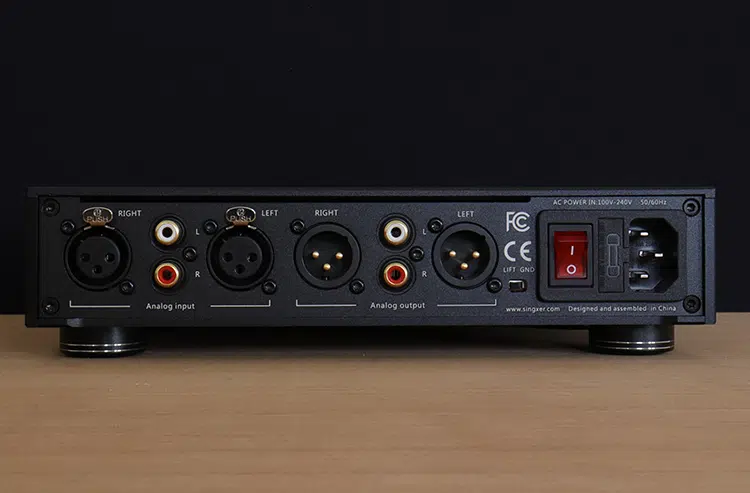
Again, standard fare. Three headphone taps upfront, and a rear I/O panel with two inputs and two outputs.
The front panel houses a 4-pin XLR connection, a 4.4mm Pentaconn, and a standard 6.35mm connection, which, by using an adapter, can be used with 3.5mm-equipped headphones or IEMs alike.
The rear I/O consists of a four-set 3-pin XLR connection for left and right inputs and outputs. Another set of RCA inputs and outputs adorn the rear panel.
The inputs are selectable upfront and use high-performance ROHM input transistors, and the circuitry attempts to avoid EMI interference. It would be difficult for stray interference to enter via the thick metal chassis.
Controls
The Singxer SA-2 employs a pure analog signal path all the way up to the Alps-designed volume control. My only criticism is the previously stated firmness of the volume knob adjustment.
My feeling is that the overall design is old school, and what makes it so are those three toggle switches on the front panel. I know lots of manufacturers still use them. However, what I’m referring to is that there are no modern push buttons or touch screens either.
The first toggle controls the internal amplifier or the rear outputs. What I found odd was that the outputs appear to be dead when on HPA, not even a fixed output. But the moment you put the SA-2 on pre, then the variable outputs work and are controllable via the volume knob.
The second toggle is a source selector that switches between the XLR and the RCA inputs.
The third toggle is the Hi-Z or Low-Z selector that acts as an impedance match feature. Most of the time, I left this feature on high Z because I felt it provided a smoother response.
Packaging & Accessories
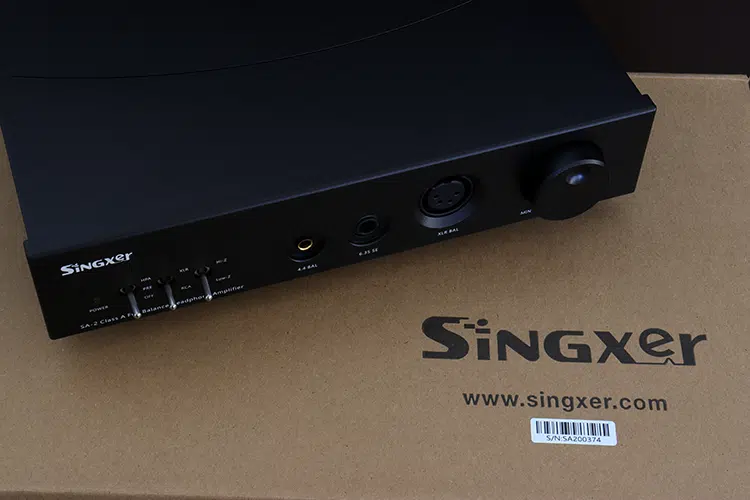
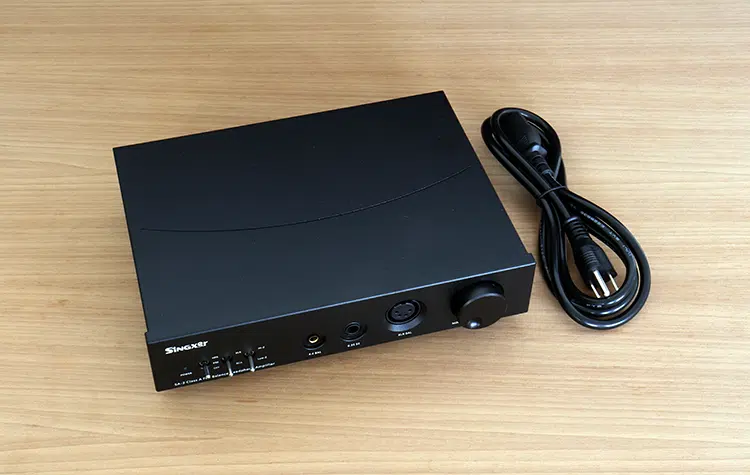
I would have expected the Singxer SA-2 to come inside a nicer box, but it came in a plain corrugated box with the Singxer name on it and their website location upfront.
The inside has a custom foam mold where the SA-2 will sit during transport. Inside, you’ll find the SA-2 and a heavy-duty power cord, and that’s it. My unit didn’t even come with an instruction manual or anything else.
Sound Impressions
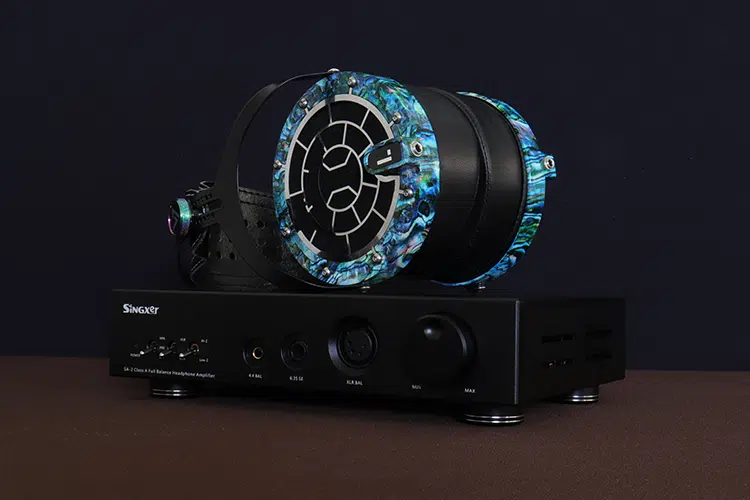
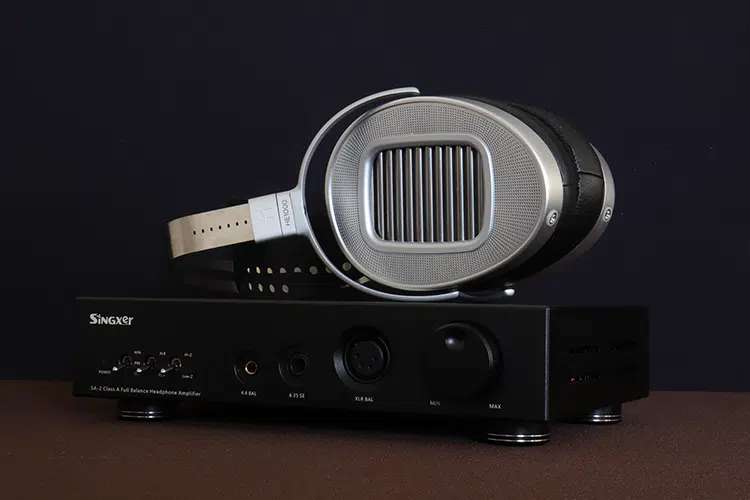
I used the HIFIMAN HE1000 Unveiled, the HEDD Audio HEDDphone D1, the Verum Audio Verum 2, and the Sennheiser HD 490 PRO Plus. I also used the HIFIMAN Svanar, the ORIVETI Grand Supremacy, and the FiiO FA19 for IEM pairings.
As a DAC source, I mainly used the Topping Centaurus, but I also used SMSL’s SU-X, the iFi audio xDSD Gryphon, and the iFi audio iDSD NEO 2.
Summary
The overall and general description I would give the SA-2’s sonic character is natural-sounding and well-layered. The first thing that hit me was the clean aspect of the presentation and the super quiet background, perfect for painting music onto.
The SA-2 sort of gets out of the way and lays out the source in a fairly nonpartisan way due to the very low noise floor and the neutrality it ultimately aims for.
One can say that here’s another studio-like tuned amplifier that is transparent, resolute, and spot on when it comes to timbre and balance.
The SA-2 is a faithful reproducer of the source, but it doesn’t add any flavoring of its own. It’s a vanilla cup, hold the chocolate sauce and nuts type of presentation, so you might want to pair it with a source that allows some coloration adjustment.
But if you’re looking for clean neutrality, the SA-2 delivers in spades. It presents the listener with a clear window through which the view is the source, and a highly dynamic listening experience that will work for those who are also looking for revelation.
But it’s an almost unimpressive presentation that doesn’t produce a wow factor type of presentation. It gives you what you feed it, in a lean manner with nothing added. But on the right recording, the SA-2 can sound quite luscious. But it will bite you if you feed it junk.
Timbre
I would put the Singxer SA-2 in the neutral, bright category as far as tonality. The high frequencies certainly flourish on this amplifier. The SA-2 produces an airy, but well-defined top end that blends in with the convincing midrange it also produces.
The midrange area also shines convincingly. Again, you can pick out nuances, and it smoothly portrays the source without sounding too blunt. It does lean into musical instead of a reference-type character a bit, and is well-balanced.
The bottom end is a bit neutral for me, and I often reach for coloration from the DAC source to add some extra low-end thump, since the SA-2 has nothing for that.
The midrange is smooth, well-controlled, and articulated, and just like the highs, is to my liking in output levels.
I find the bass response is subordinate at times, but clean and powerful enough that no distortion occurs when you bump up the bass via coloration with an EQ, XBass feature, or something similar, preferably a parametric EQ. When you feed the SA-2 the right amount of bass, it produces lots of body and weight.
The bass is reproduced immaculately, well-defined in a sense that it produces every bass note distinctly.
The SA-2 is actually a good monitoring amplifier since it’s very revealing. It doesn’t lose much detail in the translation of the source, it seems.
Staging & Dynamics
I spent hours listening to different feeds, or DACs as we call them, and the SA-2 showed a keen ability to show how wide the source really sounds. In other words, the Singxer SA-2 is an amplifier that reveals the overall panorama of the source’s soundstage.
If you feed it with a DAC that portrays a smaller, personal space, then the SA-2 will deliver that.
It’s capable of a very wide sounding soundstage with a strong placement capability that allows the listener to pick up on small placement nuances with a minimum amount of smear.
It can produce a holographic soundstage if you feed it such a source, and it can portray a wide and deep amount of depth.
Click on page 2 below for my recommended pairings and selected comparisons.
