

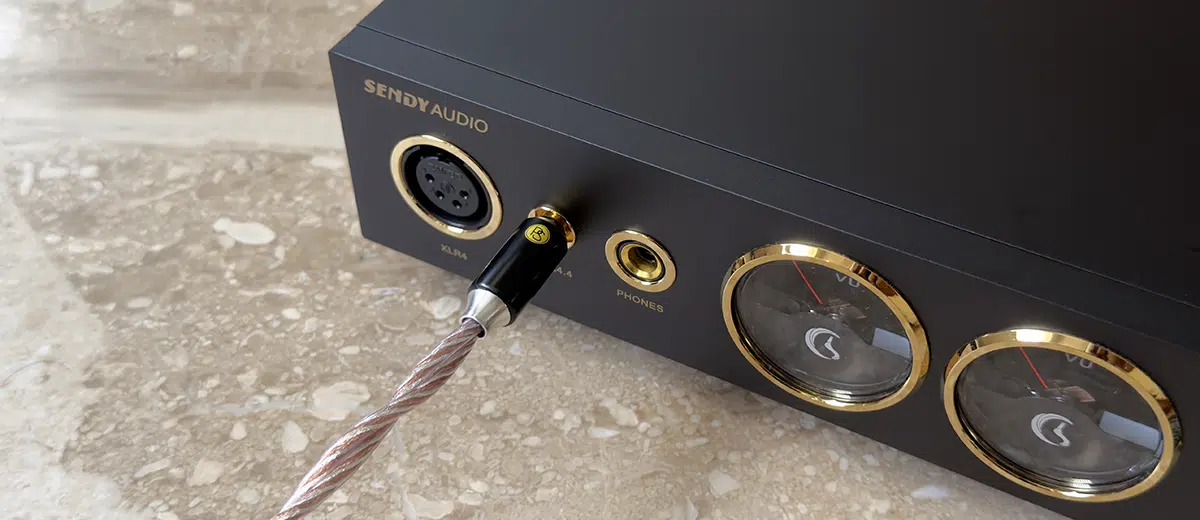
Nihal reviews the Sendy Audio KYLIN, a new desktop integrated ES9038Q2M DAC, preamp, and Class A 1W-capable headphone amplifier. It is currently priced at $1499.00.
Disclaimer: This sample was sent to me in exchange for my honest opinion. Headfonics is an independent website with no affiliate links or status. I thank Sendy Audio for their support.
Click here to learn more about Sendy Audio products previously reviewed on Headfonics.
This post follows our current scoring guidelines, which you can read in more detail here.

Most of us know Sendy Audio for its headphones. They have built a good name in the planar space with releases like the Peacock, Aiva 2, and the recently released Egret.
These sit more on the mid-to-higher-tier side of the market, and Sendy Audio has mostly been seen as a headphone-focused brand.
This time, though, they have moved into a different category. Sendy Audio launched the KYLIN, a desktop DAC and headphone amplifier, in February 2026.
This has been in development for a long time. I remember trying a near-production unit at CanJam Singapore in April 2025, and Marcus also spotted it at SIAS 2025 in Shenzhen in August.
Even back then, it looked quite promising. I was excited to see it come out soon, but Sendy Audio clearly took its time to refine the product.
The pre-release showing at CanJam New York 2025 also felt positive. It gave the impression that KYLIN was not just a side project but something Sendy Audio had put proper effort into.
In this review, I will take a closer look at what the KYLIN brings to the table. I will also compare it with a few other notable DAC/Amps to see where it stands.
Features
The Sendy Audio KYLIN is an all-in-one desktop DAC and headphone amplifier. It follows a Class A purism approach, integrating the whole chain from digital input to amplified headphone output as one unit.
On the digital side, KYLIN uses an XMOS USB platform along with an ESS ES9038Q2M DAC chip. It can decode audio files up to native DSD512 playback from compatible sources.
I agree, the ES9038Q2M is an older ESS chip, and on paper, it does not look all that exciting anymore. We will get a better idea of how KYLIN performs once we move into the sound impressions section.
The amplification section is built around a dedicated Class A output stage. KYLIN uses a Japanese Hitachi 2SB649/2SD669 complementary transistor setup in its Class A amplification stage.
For the supporting audio circuit, KYLIN uses a dual Burr-Brown OPA604 op-amp configuration. The capacitor selection also looks decent, with WIMA capacitors from Germany and Nichicon capacitors from Japan used in the design.
The KYLIN’s output figures are quite muscular, rated at up to 10W into 30Ω, stepping down to 1W into 300Ω and 500 mW into 600Ω.
That suggests a strong voltage swing of roughly 17.3 Vrms, giving it plenty of headroom for both low-impedance planars and high-impedance dynamic headphones.
Overall, KYLIN keeps things focused. It is not trying to be just a small DAC with a basic amp stage added later. The design feels more integrated, with proper attention given to the DAC section, power delivery parts, and the Class A headphone output.
Design
The Sendy Audio KYLIN has a very old-school charm to it. Not the flashy kind of desktop DAC/amp design we see a lot these days.
This looks like something you’d pull out of your dad’s stereo cabinet from, like 1989, just cleaned up and made to actually fit on a modern desk.
The body is made from aluminum. The whole unit looks sleek and compact, but it weighs over 3 kg, so when you pick it up, you feel it. No toy-like feeling here. KYLIN comes in black for the international market, which gives it straight-up vintage vibes.
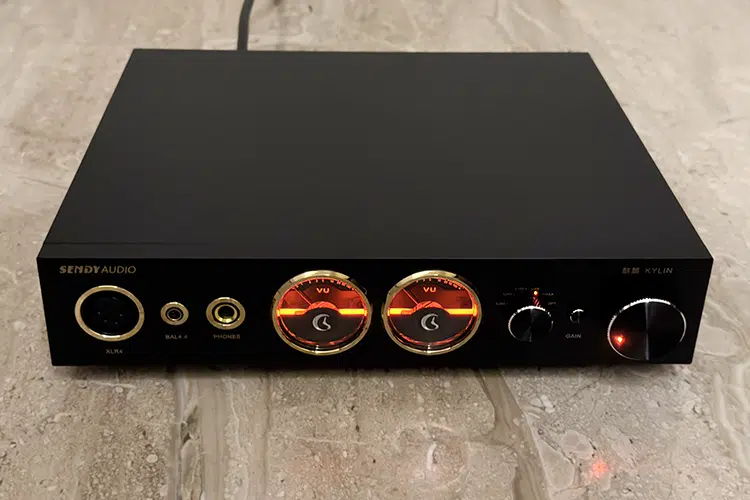
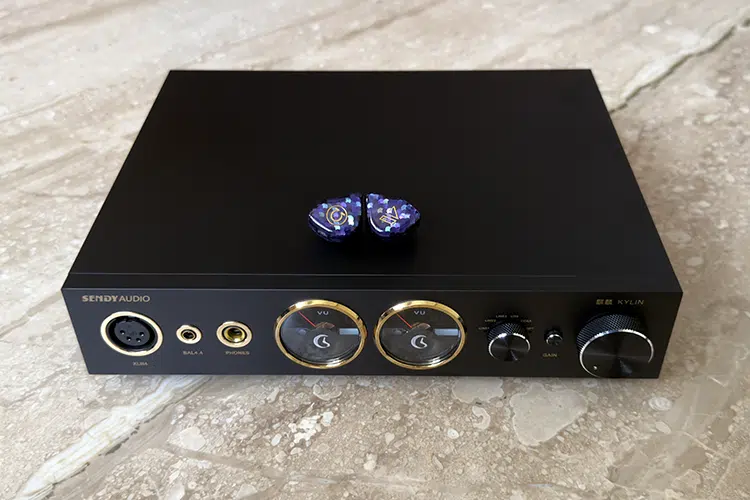
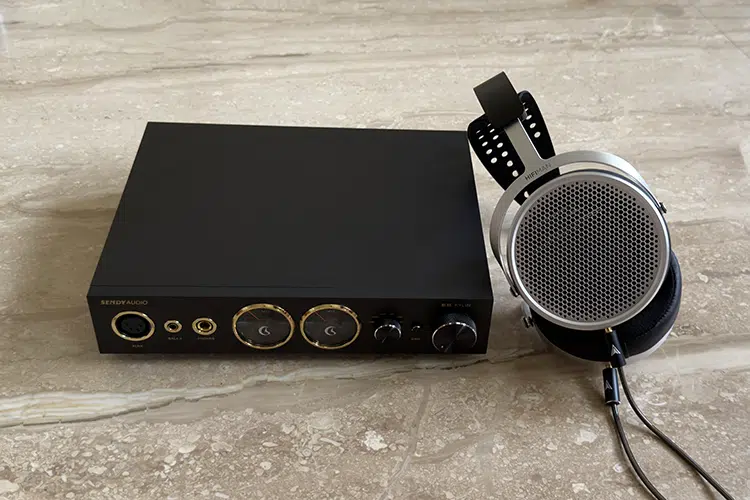
The front panel is where most of the characters sit. The dual analog VU meters look lovely and bring a proper retro flavor to the unit.
When the unit is running, they glow with a dark orangish light underneath, which looks especially nice in a low-lit room. This gives the KYLIN a lot of personality.
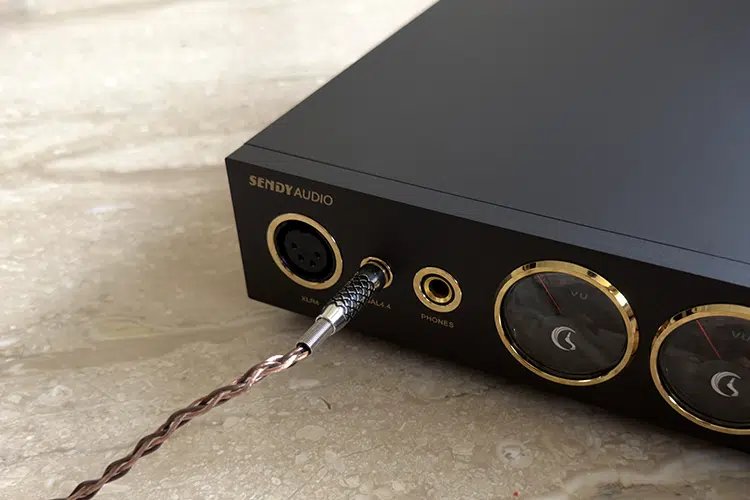
The layout is also very straight to the point. You get three headphone outputs on the front: 4-pin XLR balanced, 4.4mm balanced, and 6.35mm single-ended.
The headphone outputs and the VU meters are framed with gold-finished rims. Matches quite well with the black body and adds a nice premium touch without making the design look too loud.
The source selector, gain button, and volume knob are all placed cleanly. Nothing feels overcrowded. Nothing feels overdone.
The knobs, ports, and front-panel elements feel well-machined and nicely finished. That is one thing you notice. KYLIN may look minimal, but it does not feel basic.
It has this calm, classy, no-nonsense design language. Almost like it is not trying too hard to look premium, but still does.
I/O
KYLIN keeps the I/O side neat and very easy to understand. Nothing feels overcomplicated here. No menu diving, no screen, no extra drama. Just press and move on.
The front panel gives you the three main headphone outputs: 4-pin XLR balanced, 4.4mm balanced, and 6.35mm single-ended.
Alongside that, you get the input selector, a small gain button, and the volume knob. The gain control is simple, handled through a small button-like selector.
The input selector is actually one of the more useful parts of the KYLIN. It lets you switch between three analog line inputs and three digital inputs from the same front knob.
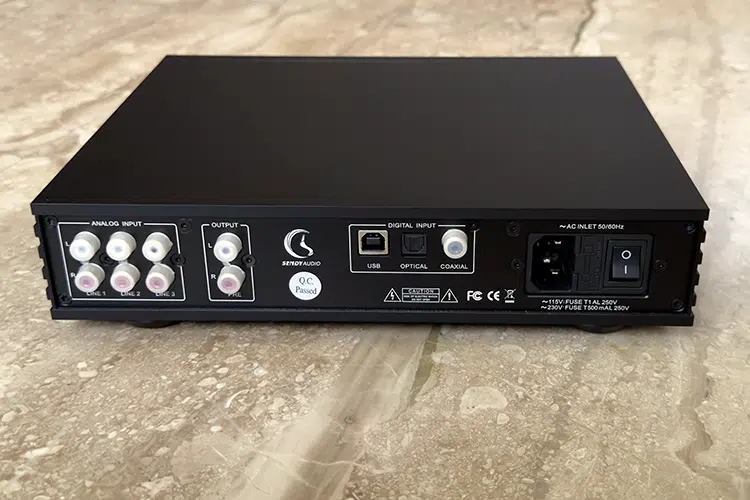
The digital side includes USB-B, optical, and coaxial. So in a small desktop chain, you can keep a few sources connected and just rotate the selector when needed.
The rear panel is laid out in a very clean manner, with all the analog inputs are grouped together and clearly labelled as Line 1, Line 2, and Line 3.
The digital inputs sit in their own section, again marked properly. You also get an RCA pre-out at the back, which adds a bit more flexibility if you want to use KYLIN as a pre-amp in a speaker setup.
Overall, the options are limited. A bit old-school vibes, but laid out quite well in a practical way.
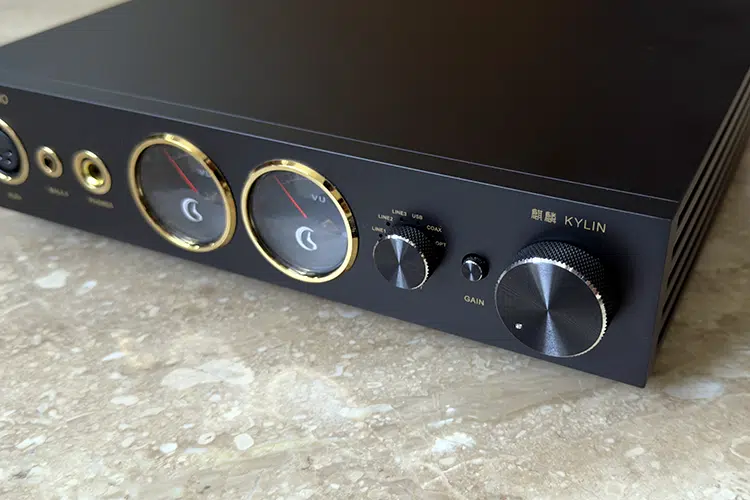
Volume Control
Aesthetically, the KYLIN volume dial has a refined and premium look, helped by the subtle orange LED embedded into the knob.
Engineering-wise, Sendy Audio has opted for a Japanese ALPS potentiometer, designed to deliver accurate volume adjustment, high reliability, and minimal impact on sound quality.
In daily use, the potentiometer feels very stable and consistent, with no obvious imbalance or looseness during adjustment.
The same attention to detail extends to the physical controls, with the knobs and buttons feeling solid, precise, and well-built. It gives the KYLIN a strong sense of mechanical quality and careful engineering from Sendy Audio.
Packaging & Accessories
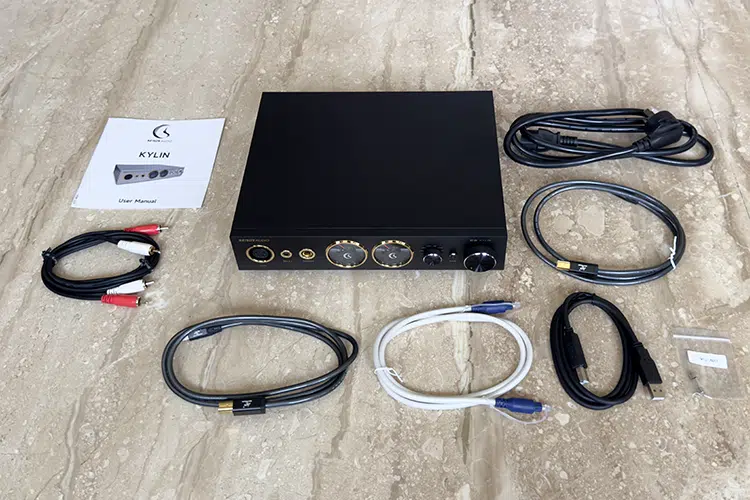
The packaging and accessory lineup for the Sendy Audio KYLIN is fairly standard for a desktop HiFi amplifier, though the bundle itself is quite generous.
The retail box is the usual HiFi-style brown boxing, and while everything was packed securely enough for my unit to arrive safely and in perfect condition, the internal protection did feel a little light for a premium amplifier.
For something as premium as the KYLIN, it surely needs a bit more reinforcement with the foams inside.
Inside, you get the KYLIN amplifier, a power cable, and a user manual. Basic stuff covered. What stands out more is the number of supplied cables. Sendy Audio includes an optical cable, a USB to Type-C cable, a USB to Lightning cable, a USB to USB-B cable, and a dual RCA cable.
A few of the digital cables appear to come from Zephone, a Chinese cable brand that has a good reputation among some audio users for producing quality aftermarket cables. So, while the packaging itself is fairly no-frills, Sendy Audio has not cut corners with the included cable selection.
Overall, it is a practical and useful accessory set, especially for users who want to get the KYLIN connected to multiple digital and analog sources straight out of the box.
Sound Impressions
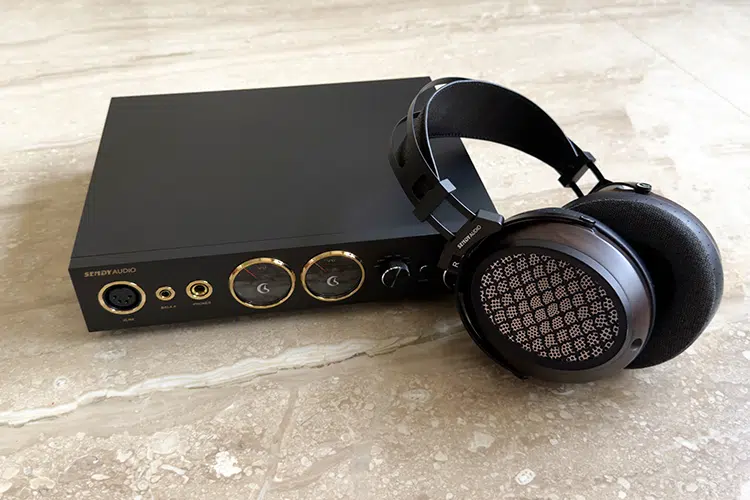
The following sound impressions of the Sendy Audio KYLIN were completed with a USB source through my MacBook. Headphones used included the HIFIMAN HE600, Sendy Audio’s Aiva 2, and the SIVGA SV023.
Summary
KYLIN offers tons of power. That’s easy to notice. I could easily sense plenty of headroom and dynamic range with harder-to-drive or high-impedance headphones.
With easier headphones, it almost felt overpowered. I hardly had to move the volume knob before reaching a proper listening level.
In a nutshell, I would relate the sound to a laid-back and smooth presentation. The first thing that came to mind was that analog flavor.
Not the sharp, ultra-crisp, hyper-digital kind of sound. It feels a bit relaxed, a bit rounded, and easy to sit with for longer sessions. There is a nice sense of body in the notes, so the presentation does not feel dry or thin.
There is a slight upper treble lift, though. Not the harsh or piercing types, but it does make its presence known. And honestly, that works in its favor. Without that bit of lift, KYLIN could have leaned slightly dark because of its smoother nature.
That extra openness gives the sound some air and space and keeps it from becoming too sleepy or overly mellow. So, the tuning finds a nice middle ground. Smooth and relaxed, but not closed in. Vintage in flavor, but not dull.
With IEMs, KYLIN does not really make a lot of sense to me. There is just too much power on tap, and with most sensitive IEMs, it quickly turns into a hiss machine.
None of the IEMs I own paired cleanly with it, apart from the Alpha Omega Omega and Ra. The rest had a very noticeable background hiss, even at the lowest usable volume levels.
So, for IEMs, I would not really look at KYLIN as an ideal pairing. It feels more at home with proper headphones that can make use of all that power.
Timbre
I would describe KYLIN as a slightly warm, analog-sounding unit. Not warm in that thick, gooey, bass-heavy way. It is not trying to push extra bass or make everything sound fat.
The warmth here is more like a soft coloration in the body of notes. A little bloom around the lower mids and mid-bass region. That kind of relaxed musical coating, which makes the sound feel less digital and less dry.
The Class A amplification defines how KYLIN presents its notes. It has that easy, relaxed flow. The sound does not feel forced or tight-fisted. Instruments come out with a decent body, and the overall presentation has a laid-back character.
I won’t label it a hyper-clean, ultra-sharp type of sound. It is more on the musical side. Smooth in attitude, but not fully smooth in execution.
Bass does not get an obvious lift; rather, it feels supported. You’d find a bit more ease and fullness down low. I love the punches it offers when the headphone asks for it, and because the power reserve is massive, it does not sound compressed or weak.
The midrange is where the analog flavor is easier to catch. Vocals and instruments have a slightly rounded body. I don’t find it overly lush, but yes, there is a slight sweetness in the tone.
Treble is the more interesting part, and also where I feel KYLIN is not perfect. On the balanced outputs, both XLR and 4.4 mm, the upper end has a bit of splash. The 6.35mm single-ended output feels a bit smoother to me.
Overall, I find the output quite expansive and lively. I love how the low end is rendered here, but a cleaner treble is surely a nitpick for me.
Staging & Imaging
The soundstage was one of the first things I noticed on KYLIN. It opened up almost instantly once I plugged in proper headphones.
The stage has good width, but it is not just that usual left and right spread. There is enough height and depth, and together it gives the whole thing a slightly holographic feel. Not fake wide. Not artificially stretched. Just spacious enough to let the music breathe.
The delivery feels effortless to me. Nothing sounds cramped or boxed in. Notes have a rounder shape, and the lower end carries a bit more impact. It has that softer, bigger hit rather than a sharp slam.
The slight treble energy also helps here. It adds some air on top and makes the stage feel more open. Images are clean and fairly sharp, but not hard-edged. I do not hear that overly etched kind of placement. There is still some ease in how instruments sit around the stage.
Dynamics also benefit from the power reserve. KYLIN does not feel strained when the track gets busy or when the headphone asks for more current. It keeps a good sense of swing and scale. That is one of the things I liked about it. It never feels like the amp is trying too hard.
Vocals take up more space on the stage. They have a fuller and more intimate presence, which feels quite absorbing. KYLIN gives you space and openness, but still keeps the music close enough to pull you in.
The gain switch on KYLIN does not dramatically change the presentation. Both settings keep a similar loudness behavior, and the dynamics do not suddenly open up on high gain. I feel this design choice is because KYLIN already has enough drive in the lower settings.
Click on page 2 below for my recommended pairings and selected comparisons.
