

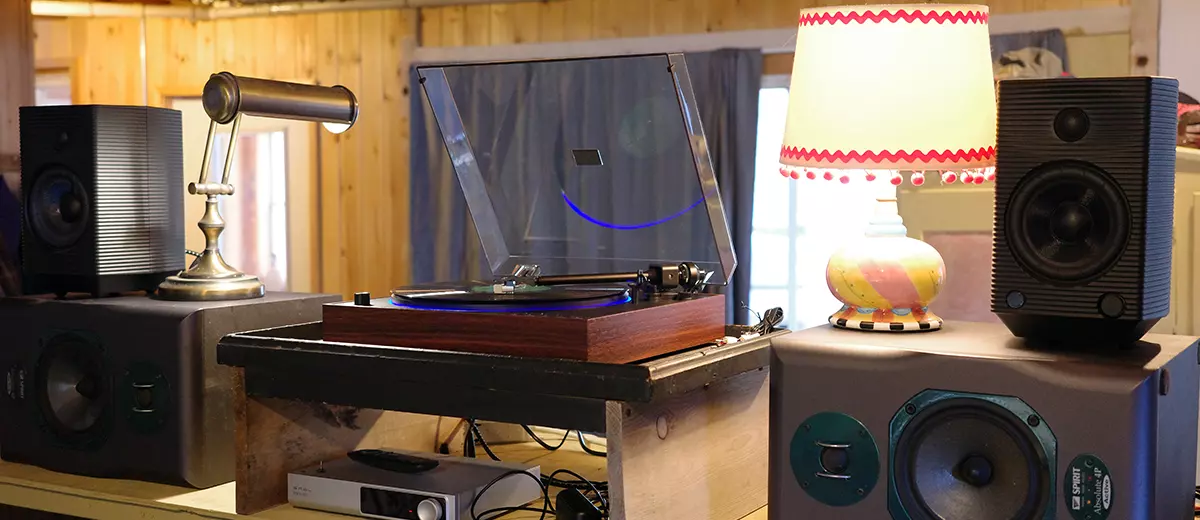
Lynn reviews the FiiO TT11, a new fully automatic entry-level turntable with a swappable cartridge capability, phono outputs, and Bluetooth integration. It is currently priced at $174.99.
Disclaimer: I received this sample in exchange for my honest opinion. Headfonics is an independent website with no affiliate links or services. I want to thank FiiO for their support.
Click here to learn more about the FiiO audio products previously reviewed on Headfonics.
This post follows our current scoring guidelines, which you can read in more detail here.
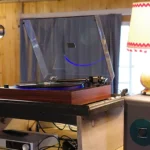
It seems FiiO is trying to keep retro gear alive and kicking while producing some top-quality new products. While they are not alone, the trends kicked up by the company continue to impress.
It seems that FiiO also takes notes on the release of their “retro” products to improve future products. The TT11 is the result of pushing the TT13 concept further forward, giving it a more traditional look while keeping its fully automatic functionality.
The TT11 also comes in at a lower price, but with a user-changeable cartridge to go along with the fully auto features, something I greatly appreciate since there are so many choices out there for the vinyl enthusiast.
Having reviewed the TT13, there will be a natural comparison between both, and especially the targeted competitor, the Audio-Technica LP60XBT-USB, which does come in at a slightly higher price point.
FiiO has the aim of making an affordable, fully functional automatic turntable with top-quality sound to draw in more vinyl users, and they may very well have succeeded.
Features
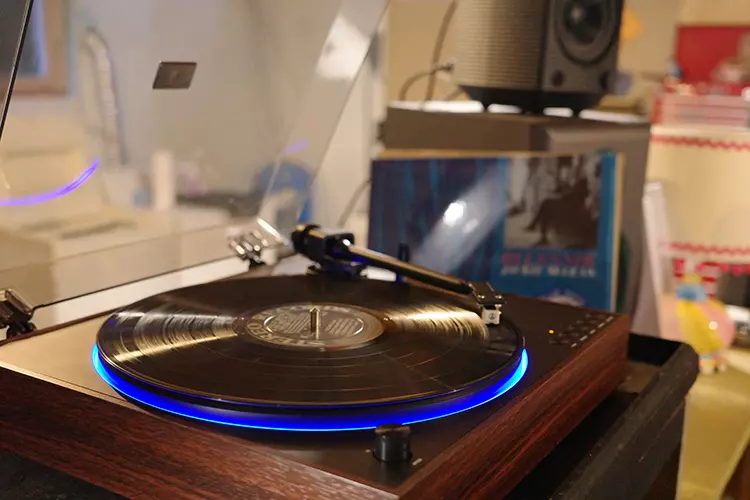
The FiiO TT11 runs two NE5532 op-amps and an AC6951C Bluetooth chip. With a wow and flutter of less than 0.2%, it is also right up there with the best in class.
A signal-to-noise ratio (SNR) of greater than 70dB in Line Out (LO) is impressive, while the greater than 57dB in Phono Output is fairly normal.
I could tell the budgetary nature of the components, but this did not lessen the enjoyment. With THD (Total Harmonic Distortion) of less than 3.5%, the FiiO falls into the typical range in class, too.
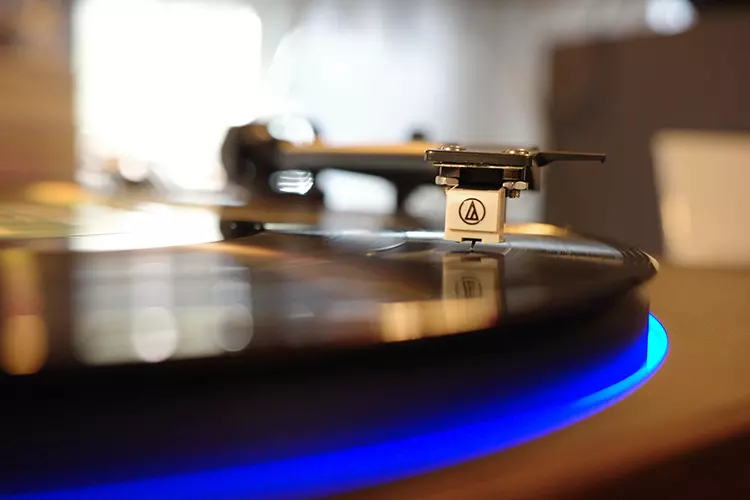
The stock AT3600LA cartridge, which is again a budget MM cartridge with a devoted following, feeds directly into one opamp chip (powered by one LDO) and then into a second opamp (powered by another LDO) when running in BT mode.
The benefit of the TT11 over the TT13 (to me) is that you can change to a different cartridge if you desire. With the capability to use cartridges that need as much as 4.0g in force and anti-skate, the user will have plenty of options.
I had intended to change to one of my spare cartridges, but due to other obligations could not. Changing cartridges is as simple as it might be on a higher-end turntable, as long as you properly align and balance them. Most will have the necessary vinyl tools to do so.
The force needed, once balanced first, is 3.5g, with an anti-skate set at 3.0g first. More below on setup, though.
In phono out, the signal goes directly through the RCA connection, giving the advantage of using external pre-amplifiers, integrated amplifiers, and receivers such as you would find in a two-channel system.
That is, as long as they have a phono stage built in, or you use an external phono stage before entering the amplification stage.
Design
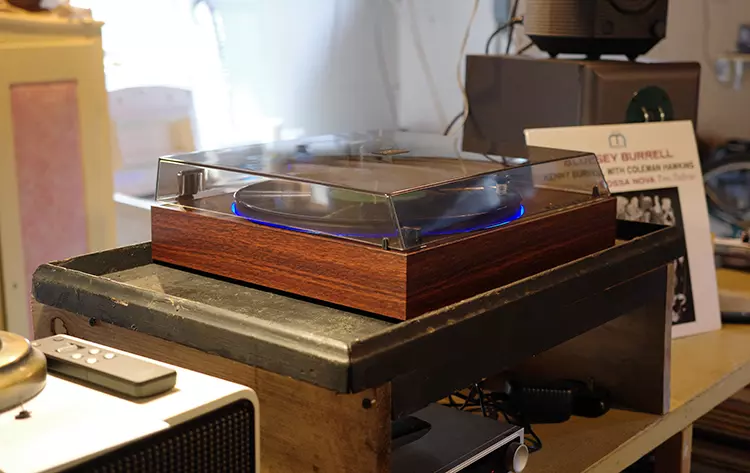
The TT11 comes across with a more mainstream look than the TT13 (a unit I will frequently compare it to besides the comparison). With two choices in black and brown, my unit came in brown.
The frame is made of thinner wood veneer with a lighter aluminum platter, which isolates vibrations to a point. While the cartridge never skipped, you could hear the thumps when tapping on the frame or lid. Normally, you would not do that, though.
All controls are within the area of the cover when dropped, but most will only need those for beginning each side. The buttons functioned with minor pushes and never failed to accentuate. The feel was top quality.
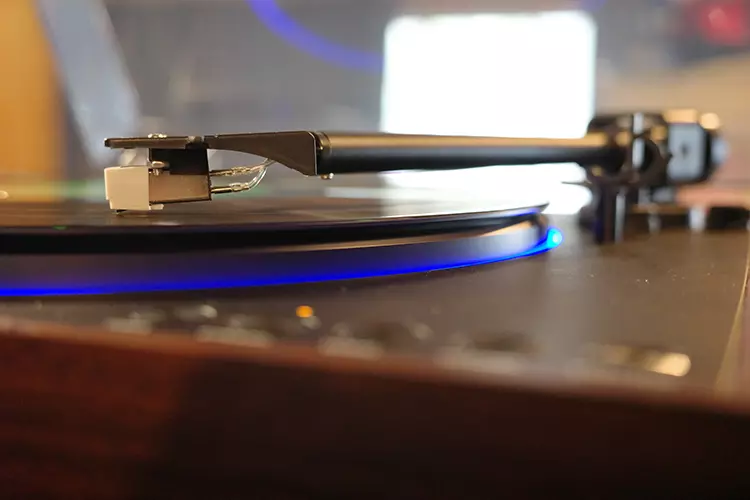
A straight tone arm has the AT3600L cartridge attached, and when at rest, it can be locked in place. Thankfully, there is a safety mechanism if one forgets to unlatch the arm after you push the start/stop button. Good thinking, FiiO. I appreciated it.
Just like the TT13, the rim under the platter can be set to various colors for effect.
The TT11 comes across as both modern and with a vintage look that will not be out of place in your main system or desktop. The TT13 took some getting used to. Not so with the TT11.
I/O
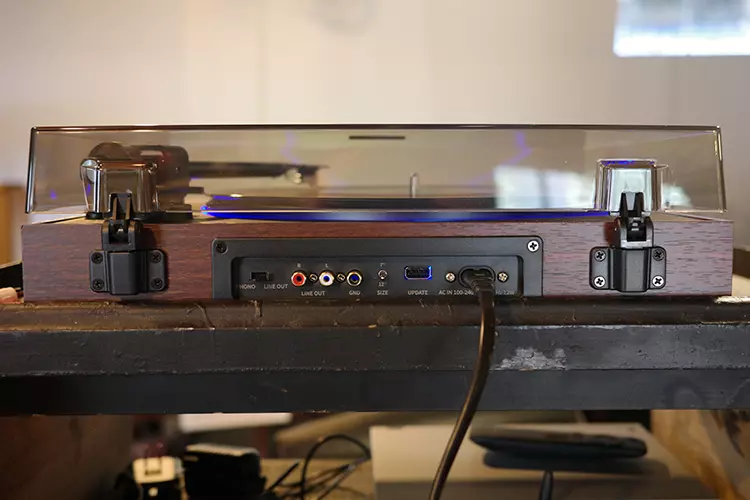
Just like its bigger sibling, the TT11 has all connections out back.
Left-to-right, there is the phono/line switch for use when going between both outputs, the RCA line out and ground connection (cable included, with three RCA on the head end, and the typical ground wire connection on the other).
There is a toggle for 7” and 12” albums, a USB-A port for firmware updates only, and a power connection for the included cord. I do wish the labeling had been placed above each connection, though.
Many will probably agree since we often reach over to connect to different sources.
Connectivity
Bluetooth
Pairing was straightforward with any of the sources or BT speakers used, with only minimal delay. I ran into problems pairing the xDuoo TA-32, but realized my iPhone automatically connected to it. Once cleared, I was able to connect the two (TT11 and TA-32) on the second try.
Pairing to the FiiO SP5 was even easier and took about 8 seconds from pairing mode to connection. I think this is a matter of being careful between the two.
Once connected, I was listening to music through both sources within the time it took me to place an album and clean it.
RCA
I used my Cambridge Audio Alva Duo for connecting to an external phono stage, then into the same Dynaco/xDuoo setup.
I briefly hooked the TT11 directly to my McIntosh MA6100 integrated amplifier and Klipsch Forte IIs without issue, but most of my two-channel listening was through the Dynaco/xDuoo.
Having the ability to connect to an external phono stage, whether a unit such as the Cambridge or to a comparable amplifier, makes good use of the TT11.
Simply flip the switch on the back between line out and phono for BT connection, and you can keep the TT11 in a single place.
Controls
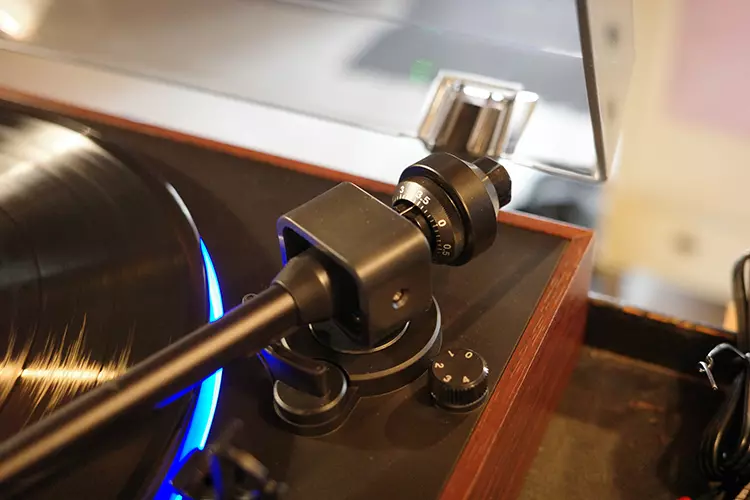
The FiiO TT11 comes with five buttons set on the front right corner of the suspended platform. To the left, also on the front, is a rotating knob to go between 33 and 45rpm.
From left to right, you have the power button with a light above it indicating the unit is on, the BT pairing button (hold for 2 seconds to pair), a repeat button for playing a side over and over, the up/down button for raising the tone arm, and the start/stop button.
As with the TT13, none of the buttons are accessible with the dust cover lowered. I will also note that the motor for raising/lowering and moving the tone arm is fairly loud, so be prepared for that.
Packaging & Accessories
The TT11 comes well protected, with the platter tucked neatly below the deck. The dust cover sits above in a well-protected recyclable cardboard cutout.
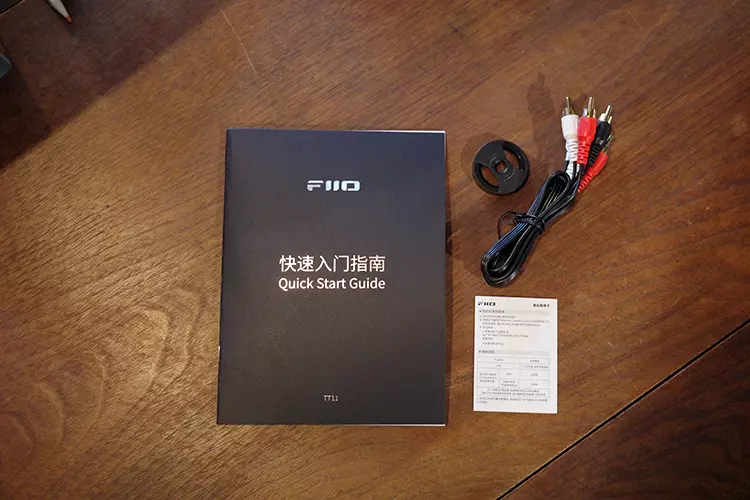
Included gear is the power cord, a tri-jack RCA cable (dual on the other end with a regular phono ground cable), a 45rpm adapter, a felt mat, the counterweight, dust cover hinges, and a quick start guide.
Detailed instructions for setup, which are easy to read, with good pictures for help, are also included.
Set up
Upon unpacking, I left the protective plastic on the dust cover to prevent potential scratching. The counterweight was easy to put on first, with only minor consternation until an audible click was heard when set properly.
After the click, there is enough fore & aft movement to balance the tonearm and counterweight properly.
Once balanced, and you really should take your time or use a balance gauge (which I did not have), simply rotate the smaller, numbered dial counterclockwise until you reach 3.5g. Then rotate the antiskate dial to 3.0g.
Why the difference? Because FiiO asks that you start there. If there is distortion in the left channel, increase the antiskate towards 3.5g. If there is distortion in the right channel (denoting too much push inward), rotate the dial lower than 3.0g.
I did play around with that, especially when using my Dynaco/xDuoo alternate home system, and ended up right at 3.5g. Alignment of the cartridge was excellent from the factory, too.
The hardest bit for me was attaching the belt over the spindle, even with the paper ribbon for use in stretching the belt over the drive spindle.
Even though I have done it numerous times, the process did not work for me. It was my fault, and I quickly rectified the situation, but just something to be aware of.
Once the belt is on, the felt mat is placed on top, and you are ready to play. Connect to your chosen source, and you are good to go.
Sound Impressions
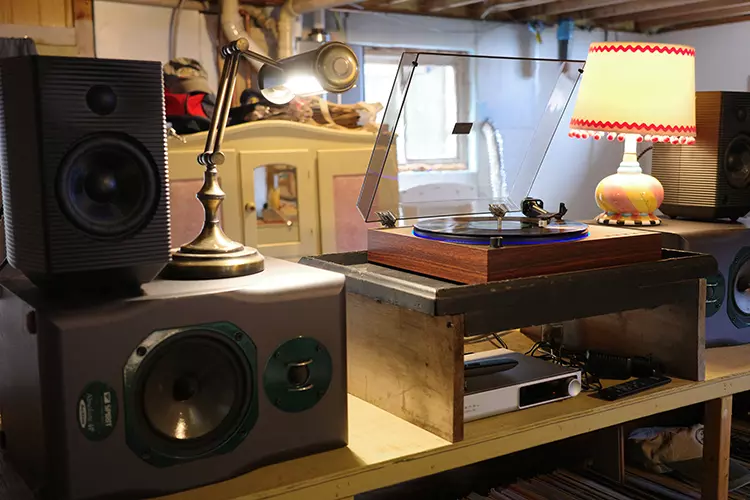
The FiiO TT11 was used mostly in two settings: connected via BT and RCA through my Dynaco ST70 paired to the xDuoo TA-32 (for both BT and RCA when used with the Cambridge Audio Alva Duo) and Dynaco A25s, and BT to the FiiO SP5 powered speakers. Usage between the two was probably 60/40 Dynaco to SP5.
Summary
Just like the TT13 opening, the cartridge probably has as much to say about the sound as any of the other parts.
The difference here is that you can replace the cartridge. A good eventual upgrade from the venerable AT3600L would be the AT95 series or Sumiko Ranier. The Sumiko has replaceable needles, which makes it quite versatile. The AT95 series comes in many flavors, though.
That said, the AT3600L presents a full sound, if a bit bass-light in response to both setups. But detail retrieval is decent, if not outstanding. Playing the TT11 through higher-quality gear helps a good bit, and the AT3600L does a decent job at presenting the vinyl experience.
Typically, conical-tipped needles are lacking in clarity, and the TT11 follows that suit. But there is enough weight in the midrange to help keep the sound pleasantly listenable.
Timbre
The TT11 comes across as smoothly vinyl-like in character, without the finer details present in high-end turntables. But as a gateway into the vinyl path, the TT11 presents a richer signature than its higher brethren.
That warmer signature conveys musicality to the sound, but that conical tip rolls off the true top end. I did find that when I played higher quality pressings, such as 180g vinyl, there was better extension, with greater detail present.
Both the A25s and SP5 speakers presented good listening, with the warmer setup of the Dynaco settling into the more “vinyl mode” of listening.
The SP5s presented better transient response, mostly due to their cooler signature. However, the detail retrieval did not minimize the note weight as one might expect.
I enjoyed having the ability to quickly bounce between two distinct tuning situations, and this allowed for two very different flavors, making the TT11’s versatility come across positively.
Staging & Dynamics
Soundstage is where the AT3600L continues to shine. Excellent width and depth make for excellent sonic qualities, even in a medium to large-sized listening room.
The balanced approach of the AT helps to even the soundstage out in all three dimensions, but with a larger setup.
Instead, the controlling of that balance makes for a full stage without becoming bloated down low, or too far forward in the mids or highs.
The appeal of the 3600 becomes quite apparent the more you listen. Put quality in, and you do indeed get quality out.
Paired via BT with powered speakers, the limitation might be the speakers, and of course, placement. But for those with modern tastes, the TT11 paired to the SP5 speakers to present a soundstage that, while not quite as open as the Dynaco, presented an accurate sound, which helped dynamically more so.
For sheer ease of use, the BT is indeed the easier choice, and those who value simplicity will still appreciate the sound qualities offered.
Again, the choices between the two systems complemented each other, giving me two distinct sound signatures that were both pleasant and conveyed the vinyl sound musically.
Click on page 2 below for my recommended pairings and selected comparisons.
