

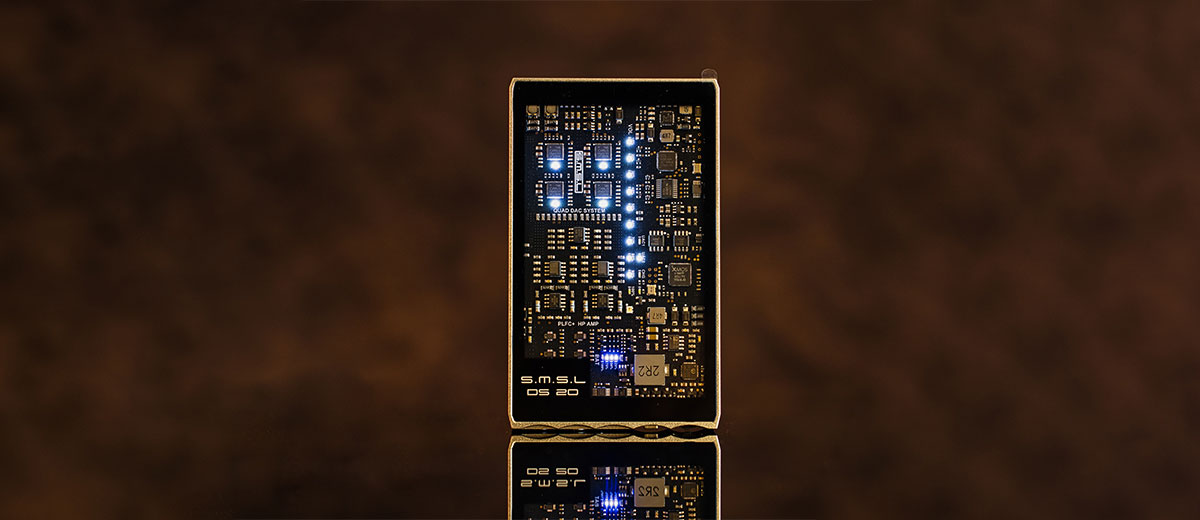
Marcelo reviews the SMSL DS20, a portable quad CS43131 DAC and integrated balanced amplifier capable of up to 500mW of output power. It is currently priced at $189.99.
Disclaimer: I received this sample in exchange for my honest opinion. Headfonics is an independent website with no affiliate links or partnerships. Thank you to Shenzhen Audio and SMSL for their support.
Click here to learn more about the SMSL products we have previously reviewed on Headfonics.
This article follows our current scoring guidelines, which you can find in more detail here.
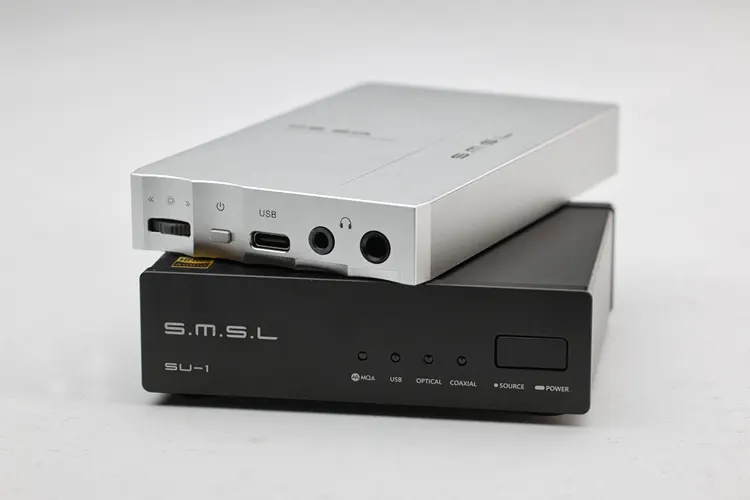
I’ve heard some of SMSL’s desktop DACs and headphone amplifiers at a recent HiFi show, and they sound clean. Even one of their least expensive desktop DACs, the SMSL SU-1 ($80), which I use for my spare PC setup, is no exception.
The $189.99 SMSL DS20 is their first battery-powered portable DAC/ amplifier. It uses four Cirrus Logic CS43131 DAC chips for better performance compared to just one, a fully balanced amplifier section, and a huge 6000mAh battery, with up to 500mW of output power.
Their product page for the DS20 includes great measurement results and outstanding performance specs. Which I consider plausible, based on their excellent track record at a third-party testing site with their previous products.
But all these excellent specifications and measured performance results mean nothing if the audio product doesn’t sound good, so how does the SMSL DS20 sound?
Especially when compared to the vacuum tube-equipped MUSE HiFi M5 Ultra, which I reviewed recently, and the venerable Topping G5? Find out in my full review below.
Features
As mentioned earlier, the DS20 uses four well-known Cirrus Logic CS43131 digital-to-analog converter chips, which are widely used today, and 500 mW headphone amplifiers with an SMSL-designed feedback system per channel.
The DS20 uses the 3rd generation XMOS XU-316 asynchronous USB audio receiver, which supports up to 32-bit/768 kHz PCM digital audio signals and DSD256 digital audio signals. This means it is compatible with just about any digital source today.
In addition to the ubiquitous USB 2.0 support, it conveniently supports USB 1.1 for use with gaming consoles such as the PS5 and the Switch, extending its versatility.
The DS20 has a big 6000mAh lithium-ion battery, which is great for long use. This is barely worth mentioning due to its unpopularity, but it has MQA 8x decoding support.
Design
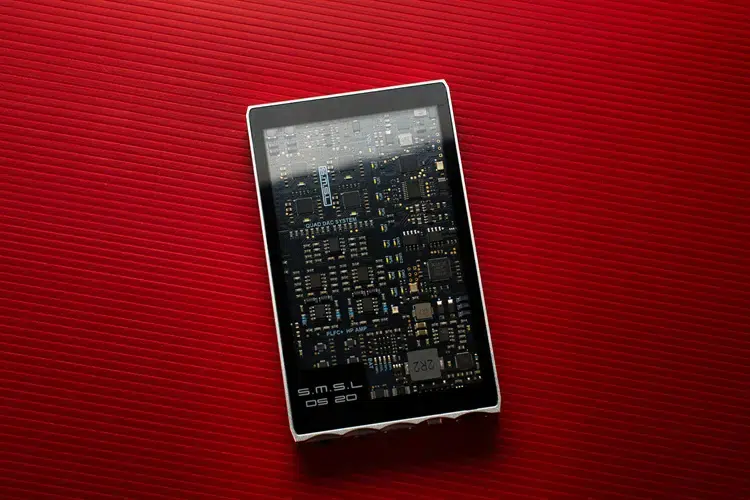
The DS20 chassis is wholly machined out of solid aluminum alloy, as I can see no seams in all its exterior metal parts. A clear tempered glass covers the front, letting the user see the neatly laid-out circuit board and the high-quality surface-mounted parts.
I love the solid feel of the body that doesn’t make any rattling noise when shaken; it has a nice weight to it, making it feel like a high-quality, expensive product.
The DS20’s flat, cuboid-shaped body is plain on all sides except at the bottom, where the I/Os and controls are located, which is machined into a lovely, scalloped shape with a similar design language to some of their higher-end desktop products.
Regarding battery-powered DAC/ amplifiers, the DS20 is considered medium, with dimensions of 71mm x 17mm x 118.5mm (WxHxD). It is between the Topping G5 and Muse HiFi M5 Ultra, which will be compared later in this review.
The circuit board is populated with bright LEDs, which I find annoying and will discuss in the control section below.
I/O
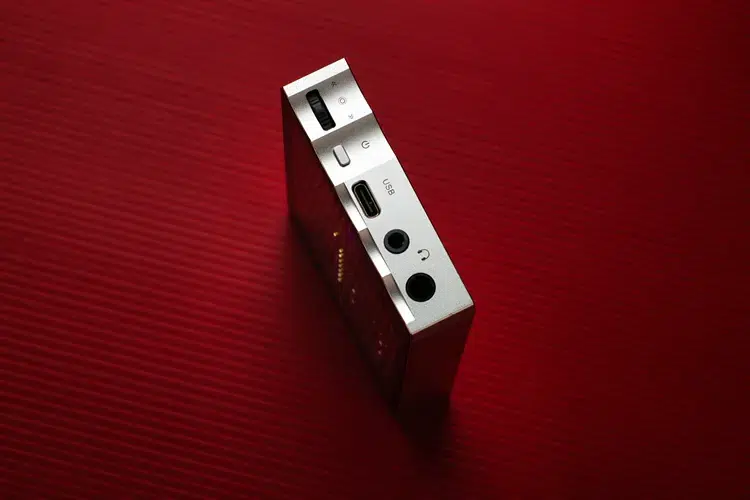
All the I/O’s are located at the bottom of the DS20, with only two output jacks: the 4.4mm balanced and 3.5mm single-ended. I’m glad they didn’t include a 2.5mm output jack, as it would only waste space because it is an irrelevant and obsolete connection.
I would have loved it more if it included two USB-C ports, separating the charging and data transfer like its competitors: the Topping G5 and the Muse HiFi M5 Ultra.
Instead, it only has one that serves both purposes. This is not too bad, but using it while charging is a big bonus when you have two.
Connectivity
Thanks to the third-generation XMOS XU-316 asynchronous USB audio receiver, the DS20 connects instantly with all the sources I tried: PC, Laptop, phones, and DAPs, with no hiccups.
Under no circumstances did the DS20 require a driver, but if the PC or laptop is too old, you won’t be able to use it, as no driver is available. But you should be able to use it as long as your PC is at least Windows 7.
Controls
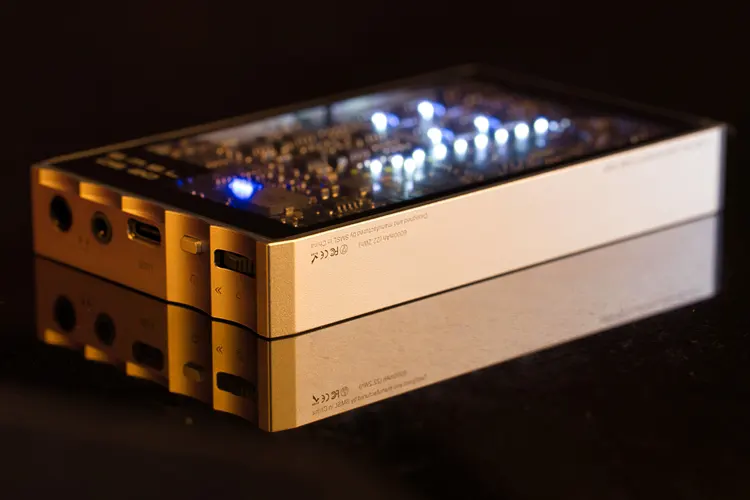
The DS20 has only two controls: an on/off switch and a pressable volume control wheel. Its simple protocol makes it easy and intuitive to use.
A half-second press of the on/off button turns it on, a quick press puts it into standby mode, another quick press takes it out of standby mode, and a 3-second press turns it off.
One press of the volume wheel allows you to select between USB 1.1 and 2.0. Turning it steers you to the setting, one more press confirms it, and that’s all the control there is; it’s that simple.
The bright LEDs on the circuit board are annoying and cannot be dimmed or turned off.
There are four white LEDs, one for each CS43131, 15 other white LEDs to indicate the volume and connection, and another 4 smaller blue LEDs to indicate the battery level. I wish the LEDs could be dimmed.
Battery
SMSL never published the DS20 battery life and charging time, but based on my observation, it is equal to the other DAC/ amplifiers, which should last more than 10 hours, and about 2 hours or less of charging time.
The DS20 charges with every USB-C connection, including power delivery (PD), QC 3.0, old Type-C charger, and ordinary Type-A charger.
Battery life varies based on how loud the person is listening and how difficult the IEM or headphones are to drive.
Packaging & Accessories
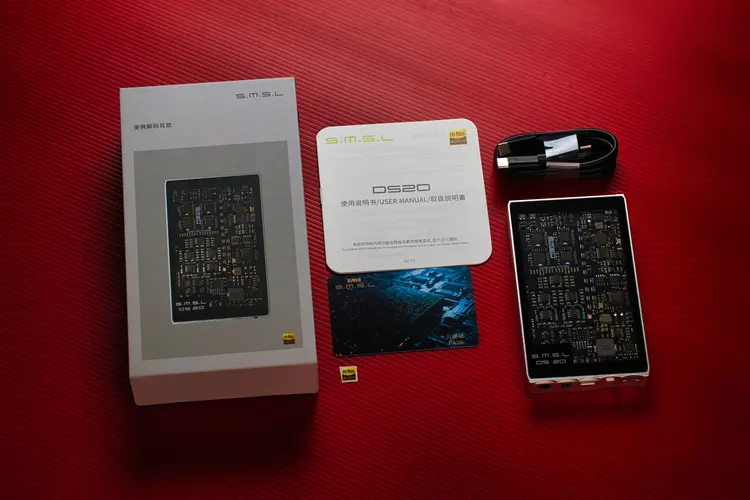
The DS20 packaging is practical; it’s a white-gray box that is easy to open and has foam linings inside to protect the DS20. It also includes a manual, a calling card, a small Hi-Res sticker, and a meter-long USB-A to USB-C cable.
Sound Impressions
I did my SMSL DS20 listening impressions using my MacBook Pro laptop, PC, Samsung S21 Ultra Android phone, FiiO M15s DAP, and Shanling M3X DAP.
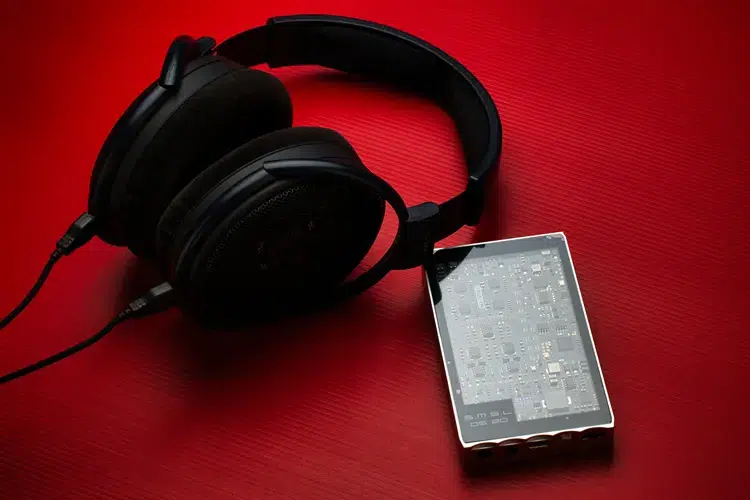
My tested IEMs and headphones included the Sennheiser HD 6XX, DUNU’s Falcon Ultra Ti, the Kiwi Ears Astral, and the Xenns Mangird Top. With balanced 4.4mm connections to maximize the available output power.
Burn-in time was about 24 hours before serious listening was done.
I used the UAPP music player App on my phone and DAPs; no EQ and other sound enhancements were used.
Summary
The DS20 sounds dynamic and lively, with a clear and slightly forward sound presentation when listening at medium to high volumes.
I’m hearing extra energy at bass below 300 Hz and treble above 5 kHz, making its tonality slightly V-shaped. This contributes to its energetic and engaging sound.
Of course, it has a flat frequency response when measured, but this subjective assessment is based on my comparison with other DAC/amplifiers that I have heard.
The DS20 has a powerful-sounding bass with excellent depth and tightness. I heard more textured rumble than I have with the other DAP/amplifiers in this review. It has a fast attack yet also renders slow-decaying bass very well, making it sound articulate.
While neutral in temperament, the midrange is clear and coloration-free. It has a clean background decay, causing the midrange instruments and vocals to sound realistic.
The treble is energetic with a slightly forward presentation. Adding to the overall clarity and vividness of the DS20’s sound.
Coloration
In addition to its slightly forward treble presentation, I hear some emphasis around the DS20’s 8 kHz region when using the Kiwi Ears Astral. The DS20 exacerbates the hump in the Astral’s frequency response in that region, which doesn’t happen with the other DAC/ amplifiers in this review.
This is not bad, though; it is not obvious, just a minuscule subtlety I heard from critical listening and comparisons.
Staging & Dynamics
The DS20 has a wide and spacious soundstage, which is wider than it is deep in its shape, with extreme left-to-right panning of the instrument, but not as much front-to-back layering.
The front-to-back spaciousness is not bad, though. It is not flat, and there is still a lot of perceptible zooming in or out and layering of the images.
There are ample spaces between the instruments, and the images are well defined with good separation, especially the center vocals.
That said, the perceived resolution is high, and so are the details. I’m hearing a lot of nuances from the music delivered with good balance between subtleties and boldness, transient response and decay, preventing it from sounding analytical and cold.
Click on page 2 below for my recommended pairings and selected comparisons.
