

Wireless Connectivity
Bluetooth
The M7T can function as both a transmitter and a receiver, supporting LDAC, SBC, and AAC codecs when transmitting. As a receiver, it offers even more codec options, which you can toggle in the settings to optimize playback hours, latency, or audio quality.
In terms of connectivity, the M7T has an excellent RSSI (Received Signal Strength Indicator) rating, consistent with other Shanling designs.
I tested it in a packed train while connected to TWS earphones, and the performance was smooth and stable for over an hour, with no clipping or connection loss.
WiFi
Using the WiFi meter app, the M7T shows similar strength to the M8T when receiving Wi-Fi signals.
Even while walking around and moving behind walls, the connection remains strong, likely aided by the buffering provided by streaming apps and AirPlay.
Overall, the Wi-Fi connection is stable, allowing for high-resolution file playback without noticeable delays.
Wired Connectivity
USB-DAC
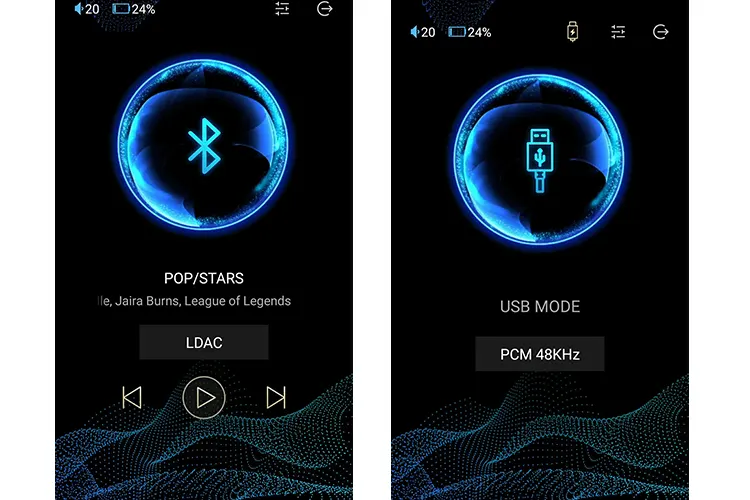
This has become a standard feature for DAPs to double as a USB-DAC, but not all manufacturers allow switching off charging while listening.
That said, you can turn off charging while using USB-DAC mode, which is better for the battery’s health. The USB decoding quality is consistent with local playback, and all EQ and filtering settings remain applicable during use.
USB-OTG
The USB port on the M7T supports connections to portable drives, card readers, and other USB devices. With more decoders featuring USB-C ports, this functionality can be quite handy for connecting the M7T to your home system.
I also use this feature for temporary file storage, which allows copying files from the camera’s SD card to free up memory space when needed.
Synergy
Efficiency
It takes around 2 songs’ duration for the tubes to stabilize, and the hiss in the background isn’t that strong unless you use sensitive CIEMs.
After the warmup time, you may still hear a faint hiss, but when the music is playing, it is negligible, and probably not noticeable with common dynamic IEMs or headphones.
Switching to transistor amping, which takes a more modernistic approach, the background is quieter and will better match lower impedance, multi-BA designs.
Power
The M7T is capable of outputting 980mW into 32Ωloads on a balanced connection and 245mW into 32Ω loads for an SE connection. This is more than sufficient for most IEMs and small headphones.
There are two gain steps, and switching to the higher gain will sound firmer, more strongly outlined in the upper vocal range than in the lower gain mode. Obviously, the Balanced output is more powerful and has stronger separation power and dynamics.
With the SE output, it also sounds quite enjoyable with sensitive gears such as the Meze Audio 105 SILVA, with the bass sounding quite punchy and textured.

Pairings
It is very fun to switch back and forth to hear the difference and find out how these modes best match with various gears. With the 2-in-1 amping design and the neutral-warmish tuning, it is easy to pair with different IEMs to deliver full-bodied bass with good clarity.
The Tube mode works well with reference sounding, or less colored IEMs and headphones, especially dynamic driver-based designs, to add more warmth and color, boosting the harmonics and sweetness, and thickening soft voices.
With a slight reduction in speed and definition, this introduces more texture and fullness into the lower end and makes you feel much more relaxed.
I tried it with the Earsonics SWITCH 300 PRO, the Westone Audio MACH 80, and the BQEYZ Winter.
All of them get gently colored to sound lusher and fuller in the fundamental vocal frequencies on this setup, while maintaining decent dynamics even at lower volume and on low gain, which is sometimes not the case for tube-equipped devices.
The Transistor mode is more like unleashing full, modern decoding and amplification power, with stronger technicalities and balance that helps step up the overall detail retrieval and layering effect.
With multi-BAs or higher impedance designs, this mode is more efficient in driving them to full force, and when there are more instruments in the mix,
Transistor mode can deliver better resolving power, or a better sense of control with sharper roll-off filters that favor Classical music and other recordings with more complex bass lines.
Select Comparisons
Shanling M7
Technical
The Shanling M7 is based on Android 10 and is equipped with the ESS ES9038PRO DACs, which support decoding up to DSD 512 and 32-bit/768kHz for PCM.
The M7 features a Qualcomm 665 MCU as well and comes with a 7000mAh battery.
The M7T is more power efficient, as the original M7 only supports up to 8.5 hours of playback on balanced output, and the M7T gives you nearly 50% more playback time.
I am going to find out how that affects the amplification quality below, as the output power is similarly rated.
Design
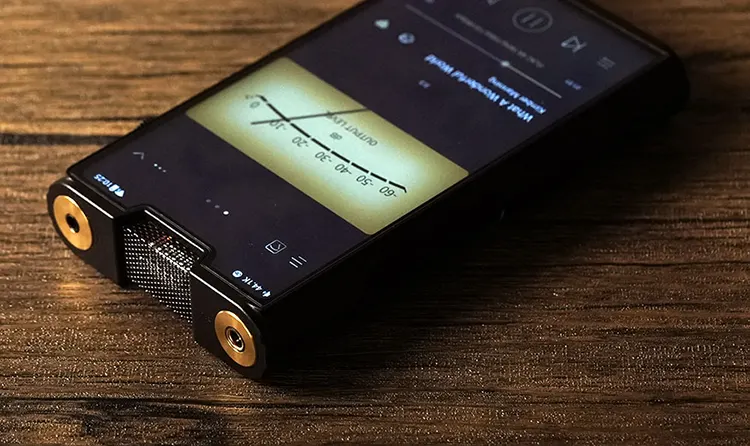
The M7 looks curvy and unique on the side, but the M7T is quite a step up with the Tube viewing window and more muscular curves.
The rest is similar, but with a newer Android 13 OS on board, the M7T feels much more up-to-date, akin to the system on more recent phone releases.
On another note, the M7T’s build quality is also stepped up, in terms of detailing and design, as well as the quality of the finishing.

Performance
The M7T and M7 have some common traits in the tuning. Comparing them when switching to Transistor amplifying mode on the M7T, both devices sound resolving, punching with good air and power in the bass, and are naturally extended.
Testing with the Earsonics SWITCH 300 PRO, the M7T is marginally more contrasty in tuning, with clearer transients presented while being more organic in tone.
The original M7 feels slightly tighter in the bass with higher load, and not as full-bodied, despite the fact that the M7T has longer playback hours.
With the Meze 105 SILVA, the advantage of the M7T is more prominent, as the Transistor mode may sound a bit too clean on both devices with this pairing.
Switching to Tube mode gives the bass more body and the vocal more attention, which complements the signature on the 105 SILVA better to deliver dense, powerful bass punch with transparent treble.
The M7 has a slightly more V-shaped, cooler impression, which may not pair as well with clean-sounding gears as the M7T.
Without factoring in the tube sections, the M7 comes quite close and has a similar tonality but focuses more on clarity and texture. With the inclusion of Tube mode and filters, it is more fun, polished, and practical at the same time to test which profile works best.
Overall, the newer M7T is much more competitive with the newer system features, and it offers more fun and better value with the dual sound profiles.
Shanling M8T
Technical
The Shanling M8T is the current flagship device, and before the M7T came in, it had the latest OS features in the line and comes with the Tube features, as denoted by the T in its name.
The key differences here are the amplifying stages, which are more elaborate in the M8T and with higher output power.
The M8T also has two dedicated Tube modes, namely Triode and Superlinear mode, which are like a blended option with negative feedback for more precision and lowered impedance.
Design
The difference in cosmetics is obvious, and I like the fact that Shanling is giving the two different styles in design.
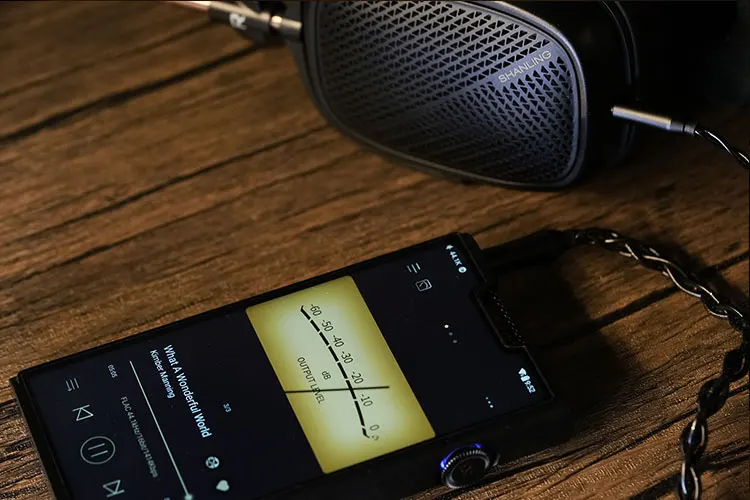
The M7T feels more modern, and the M8T has a stronger character, though it may also get dusty with the unblocked cover on the Tube unit.
The newer design on the M7T is more appealing to me, but you may still like the retro style on the M8T.
Performance
The M7T’s price is close to the M8T’s, so I expected their performance to be comparable. In terms of technicalities and detail retrieval, the M8T, equipped with the AKM4499 and a more advanced amplification stage, still holds a stronger edge.
This becomes more apparent with demanding loads, where the M8T’s bass remains highly defined yet organic at high volumes, while the M7T feels more relaxed and marginally smoothened in detail retrieval.
But with sensitive designs, the gap is less prominent, and you may find the M7T as competent, with a comparatively more mid-centric tuning that helps strengthen streamed content to sound more vivid.
Testing with the HW600 planar headphones, both devices produce similar soundstage sizes. The M8T feels more balanced overall, impacting cleaner, and the M7T sounds more vivid, relaxed, with more elaborate bass punch and with more power given to the mid-bass.
The M8T still has a marginal technical edge over the M7T, but it won’t be very discernible outdoors and feels more like a matter of preference in the presentation.
Using IEMs to test, including the Effect Audio GAEA, Earsonics SWITCH 300 PRO, and the Westone Audio AM Pro X20. The M8T sounds controlled with great layering in the bass, and can retrieve more details at both ends of the spectrum.
The M7T feels relatively more focused on the mids, which gives better intimacy to the vocals for pop, jazz, and other vocal works. However, it may feel less spread out and expansive than the M8T for larger ensembles.
On another note, pushing to high gain may help the treble sound more defined, capturing finer nuances. While the M8T is superior in layering, the M7T feels more relaxed, lush, and airier in the bass.
My Verdict
The Shanling M7T is a successful update to the M7 Android DAP and a fun variant of the M8T, redefined in form and tuning to blend modern aesthetics and technicalities, newer OS features, and a stronger “Tube signature” packed within an even more compact design.
The sound tuning adopts an energetic, lush approach, making it a greater candidate for pop and trending music.
There is sufficient power and control to drive multi-driver hybrids and sensitive planar headphones, even ones with 3.5mm termination, to sound engaging, fast, and vivid in tone, regardless of the smaller output numbers.
If only there were one more gain level, a middle step for matching with moderately power-hungry gear, then it would be even more handy.
For those who want adaptability to different genres and the capability to switch sound between a more technically proficient or a lusher, more vocal-oriented tube sound profile, the M7T offers solid performance that sounds great out of the box without the need for tweaks.
Shanling M7T Technical Specifications
- Dimensions: 129mm x 77mm x 21mm
- Weight: 310g (0.68 lbs)
- Decoding: DSD 256/128/64, PCM 32bit/384kHz
- USB DAC Support: DSD 256/128/64, PCM 32bit/384kHz
- DAC Support: AKM AKM4493EQ
- Bluetooth Version: 5.0
- Bluetooth Codecs: SBC, APTX, APTX HD, LDAC
- Battery Capacity: 7000mAh
3.5mm Single-Ended Output (Transistor Mode)
- Output Power: 200mW (32Ω)
- Low Gain Output: 2.8mW (32Ω)
- THD+N: 0.005%
- Frequency Response: 20Hz – 20kHz
- Signal to Noise Ratio: 120dB
4.4mm Balanced Output (Transistor Mode)
- Output Power: 600mW (32Ω)
- Low Gain Output: 5.6mW (32Ω)
- THD+N: 0.005%
- Frequency Response: 20Hz – 20kHz
- Signal to Noise Ratio: 120dB
