

Selected Comparisons
The following selected comparisons to the Shanling EC Zero T were completed with a mix of the Noble Audio Ronin, the Campfire Audio Solaris Stellar Horizon, the PMG Audio Apx, and the ABYSS JOAL.
Shanling EC Mini
The Shanling EC Mini was launched in late 2023, with our review following in Q1 2024. It marked the company’s debut in the modern portable audio CD player segment.
Technical
The EC Mini is more than a portable CD Player. The lower cost and additional digital features seem beneficial, but it’s more of a halfway house. True CD Player fans will see the top-loading, silent-running EC Zero T as the superior option.
The Philips slot-loading CD drive of the EC Mini is quite noisy, generating fears of stuck disks that fail to read or physical scraping, as well as being difficult to clean.
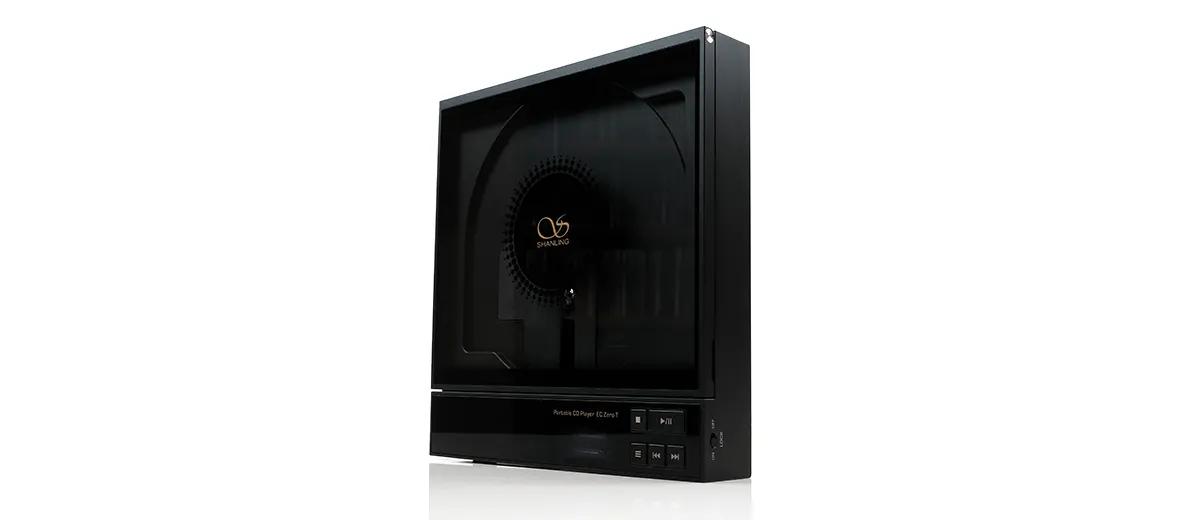
The newly designed top-loading mechanism of the EC Zero T is more accessible, though CDs are not fixed in place, so tipping it upside down will result in playback interruption.
The dual ES9219 chipset inside the EC Mini is not as capable as the EC Zero T’s 24-BIT R2R DAC. Decoding rates are lower at PCM 32BIT/385kHz and native DSD256 compared to 768kHz and DSD512 when used as a USB-DAC.
There are some DAC filter options inside the EC Mini, but nothing as satisfying as the EC Zero T NOS/OS effect, and no tube amplification/transition switchable modes.
Its dual RT6863 opamps are weaker than the EC Zero T’s amplification output for headphone users at 40mW balanced and 140mW SE on a 32Ω load. If you have more demanding headphones, the EC Zero’s balanced 1.2W high-gain DC-powered ceiling is preferred.
Both have Bluetooth, but only the EC Mini supports LDAC, which the EC Zero T should have. Both players have analog lineouts. The EC Mini has a traditional dual RCA SE pre-amp, and the EC Zero T offers 4.4mm and 3.5mm fixed Vrms alternatives.
The one feature of the EC Mini that the EC Zero T lacks is a memory card slot for local file playback and Eddict App integration, giving it a modern audiophile digital media slant.
Design
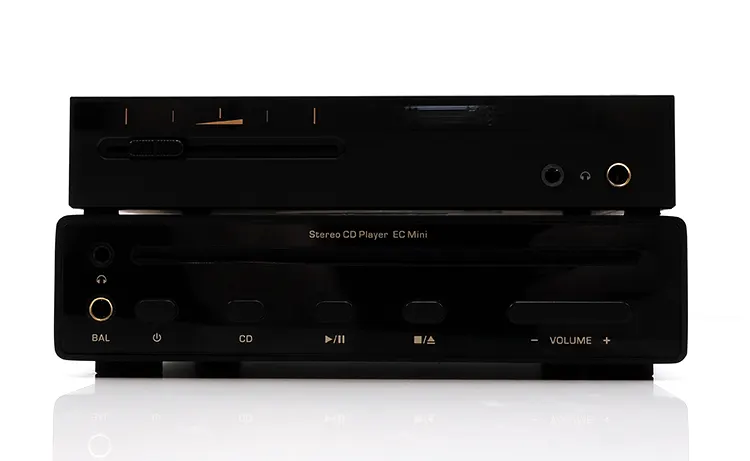
No question the EC Zero T has the more evocative external design. The EC Mini feels like a carry-over from Shanling’s previous desktop streamers with a decidedly non-descript boxy design, a halfway house between a desktop player and a 1-DIN head unit.
The EC Zero T captures the modern retro craze with more passion and commitment, and also rights a few wrongs in the EC Mini Design, like a transparent lid top-loading mechanism and a screen and set of controls that are closer to each other visually.
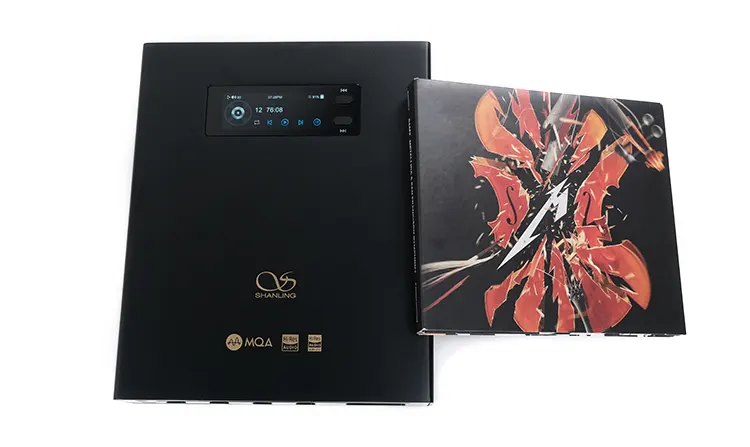
The EC Mini has a larger screen at 2.3″ compared to 1.8″ and can display more information. However, given that it offers a much deeper digital media experience, it’s handicapped by the amount of swiping to access everything.
For simple CD playing, the options on the EC Mini are straightforward enough, though the read speeds from this laser seem slightly slower than the newer mechanism inside the EC Zero T.
Quick access controls on the front-facing panel are at an angle that is slightly obscured on the EC Mini when closed up. I prefer the top-down control suite for the EC Zero T in terms of legibility.
Both have 4.4mm/3.5mm PO ports at the front, with the EC Mini offering a more optimal sub-ohm impedance rating for IEMs compared to the 4-6Ω level of the EC Zero T’s output.
Both players have independent USB-C charging and data transfer ports on the rear panel, though the EC Mini’s switch is for in-vehicle mode, a feature not included on the EC Zero T.
Performance
I went through every single listed IEM and headphone with both units and came to the same conclusion each time.
The EC Mini has some nice warmth and a relatively laid-back sound, but it’s a digital sound with a degree of dissonance in the upper harmonics, most notably in the mids and highs of the IEMs.
The EC Zero T can get close to that high-contrast sound with the OS mode on and the tube mode off, but it’s still a more natural, life-like tuning with my brighter IEMs, especially on percussion note decay.
Once you flick on the tubes and switch to NOS on the EC Zero T, it becomes much smoother and richer-sounding, though not as clean and dry as the EC Mini.
At times, I do hear a little more low-end weight on the EC Mini, which does offer good energy on the lows, but I prefer the naturally fuller sound through the mids and highs of the EC Zero T.
Staging-wise, the EC Mini sounds a shade flatter through the mids. The EC Zero T does not have quite the sub-bass presence in any of its modes, but sounds more open in the mids with improved body, especially in NOS Mode.
Headphones work well with the EC Zero T, less so with the EC Mini. The JOAL in high-gain DC mode sounded fuller and more dynamic, whereas the EC Min sounded thinner and hollower through the mids.
MOONDROP DISCDREAM 2 Ultra
The MOONDROP DISCDREAM 2 Ultra was launched sometime in 2023, but didn’t get traction until early 2024 due to some manufacturing issues with the debut DISCDREAM.
It was also our Top Gear 2024 Best CD Player Award Co-Winner, along with the SMSL PL200.
Technical
The DISCDREAM 2 Ultra is more of a true portable CD player than the EC Mini’s wider digital media center pitch. As such, I would place it as a direct competitor to the EC Zero T, albeit at a slightly lower price point.
With a lower price point comes a few compromises, including a vanilla delta-sigma DAC chipset, the ubiquitous dual CS43131 DAC implementation seen in a ton of other affordable decoding releases.
There are no additional user-controllable filters, such as the EC Zero T’s 24-bit R2R DAC’s NOS/OS option, and no tubes, so it lacks amplification switchable operational modes.
The DISCDREAM 2 Ultra’s decoding maximums are lower at PCM 32BIT/384kHz and DSD256 compared to the EC Zero T’s 768kHz and DSD512 in USB-DAC mode.
The Ultra has no dedicated pre-amping and lineout capability. However, it does have an SPDIF output similar to the EC Zero T, so both units can act as pure transports, but only the EC Zero T can fit into a HiFi system with its analog line level outputs.
Both units have balanced and unbalanced PO jacks (3.5mm and 4.4mm), but at 222mW@32Ω (BAL Out) and 112mW@32Ω (SE Out), the Ultra is the weaker of the two for power and more suited to IEM playback.
Both have CD mechanisms with decent read speed, but they operate a little differently. The Ultra will not automatically play when you close the lid, but will spin and play with the lid open once you manually press play. It will automatically play a CD if you switch from its PC mode to CD Player mode.
The EC Zero T will automatically read when the lid is closed, but you have to press play to start playback, and it will automatically stop when you open the lid.
Design
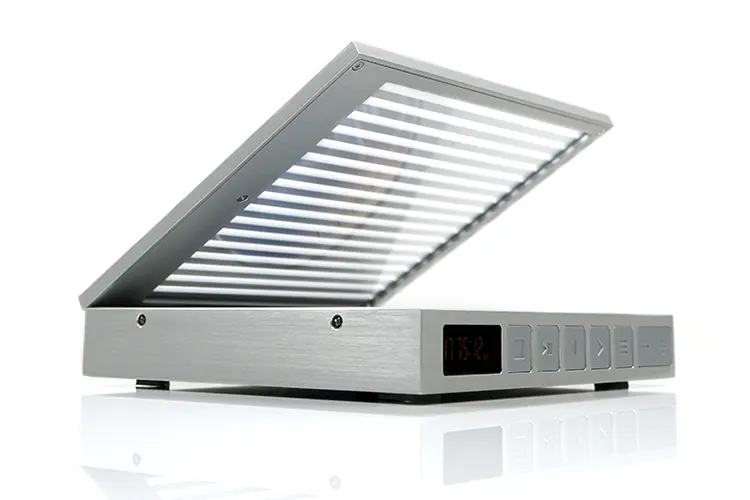
Along with the DUNU Concept R, the DISCDREAM 2 Ultra aesthetics is bordering on iconic to my eyes.
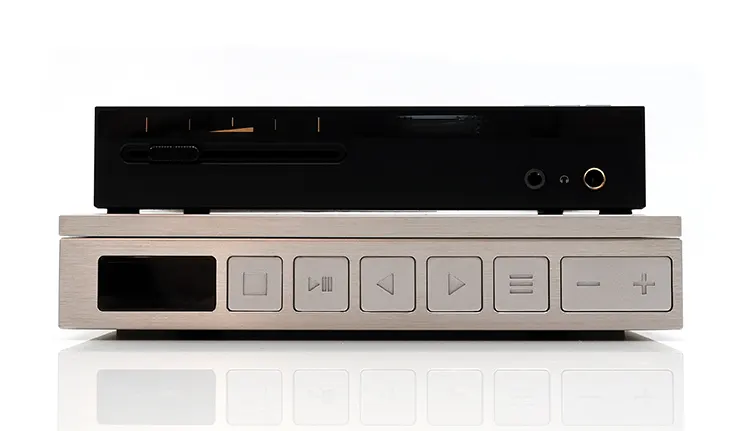
It is one of the most beautifully designed portable CD players on the market, with that brushed aluminum top grill plate and transparent glass underneath, to the huge 80s’ style button controls and OLED display panel on the side.
The EC Zero T is a big step up from the EC Mini styling, with its transparent top-loading lid mechanism, volume slider, and tubes proudly on display, but it does not have quite the stylistic pop of the Ultra’s finish.
There is some pragmatism in the EC Zero T design that the Ultra misses, though. For one, the top-loading lid has no lock mechanism. You will need to buy the additional carry bag to keep it in place when on the go.
The Ultra also has a tight spring-loaded spindle, which can make me a little weary when pressing down on the CD in terms of durability. However, unlike the EC Zero T’s gentler resting mechanism, CDs will not move if you hold the DISCDREAM 2 Ultra upside down.
The Ultra has a wider form factor but is slightly shallower in depth and shorter in height. In truth, neither of these devices are diminutive, but outside of FiiO’s DM13, most modern portable CD players are fairly bulky.
The Ultra UI is very simple and easy to understand. It does not have Bluetooth, pre-amp, filters, and amp modes, so its screen readout is legible but minimalist compared to the colored screen and menu options on the EC Zero T.
Its 3500mAh battery is smaller than the 5500mAh one inside the EC Zero T, but both are rated at around 8 hours of playback time.
Performance
These two are almost the polar opposite in sound signatures and will pair well with very different IEMs and headphones.
The Ultra is as clean as a whistle, leaning neutral to bright with a strong note attack emphasis, short decay, with linear lows.
There isn’t a huge amount of FR emphasis, perhaps a slight bias to the mids and highs courtesy of that neutral bass response, but I would avoid pairing it with a bright monitor such as the Stellar Horizon.
It pairs better with the warmer Ronin, but if you want to flesh out the lows, you will be disappointed. This player is more suited to IEMs with a darker, warmer signature that you want to liven up.
The EC Zero T is a 180 on the Ultra. It’s smoother, deeper-sounding with more bass presence and a richer set of mids and highs. It’s not as neutral, with a distinctly analog instrumental and vocal timbre, biasing to the sweeter, softer side with the tube mode on.
Even in OS mode with the tube mode turned off, the EC Zero T sounds the thicker of the two sound signatures and is definitely more suited to pairing with neutral IEMs such as the Stellar Horizon.
With headphones, it’s the same scenario, but with the additional power of the EC Zero T in DC Mode, it can drive the JOAL far better than the thinner-sounding Ultra. The MOONDROP does well in keeping the sound clean, but it’s too thin and shallow-sounding for my liking.
Overall, you get more tuning options with the EC Zero T, giving it a higher degree of flexibility over the DISCDREAM 2 Ultra. All tuning options have a warmer, deeper, and more analog overtone, making it a more forgiving sound signature.
My Verdict
The Shanling EC Zero T is probably the most complete portable CD player I have tested to date. It has the power, the analog, smooth sound desired by retro-enthusiasts, and plenty of I/O to satisfy headphone and hi-fi fans alike.
Granted, it has a beefy form-factor, but to be honest, I have yet to see a really compact modern portable CD player of late, save for the FiiO DM13, which is essentially a budget player with lower-end internals.
And yes, I have yet to test the DUNU Concept R, which, on paper, could give the EC Zero T a real run for its money. I also suspect that in 2026, there will be even more options similar to the DUNU.
However, considering what is stuffed inside, such as the tubes, the R2R DAC, and its far superior top-loading CD mechanism, and combined with its external retro design vibe, the EC Zero T brilliantly ticks a lot of boxes in terms of capturing the spirit of the ’80s in a modern CD player.
Shanling EC Zero T Technical Specifications
- DAC and Amp Components: Custom 24bit R2R DAC, 2x JAN6418 tubes, 2x TPA6120A2 Op-Amps
- 3.5mm headphone output
- Transistor Low Gain: 57mW@32Ω, High Gain: 158mW@32Ω, High Gain: 330mW@32Ω (DC power)
- Tube Low Gain: 47mW@32Ω, High Gain: 158mW@32Ω, High Gain: 268mW@32Ω (DC power)
- 4.4mm Balanced headphone output:
- Transistor Low Gain: 195mW@32Ω, High Gain: 551mW@32Ω, High Gain: 1220mW@32Ω (DC power)
- Tube Low Gain: 195mW@32Ω, High Gain: 551mW@32Ω, High Gain: 1087mW@32Ω (DC power)
- 3.5mm Line Out
- 4.4mm Line Out
- 3.5mm SPDIF Coaxial/Optical output
- USB-C Power Input
- USB-C DAC Input
- Bluetooth 5.3 (SBC, aptX, aptX Adaptive)
- Battery Life: Up to 8 hours (5500 mAh Battery)
- Supported CD Formats:
- Redbook audio CDs
- HDCD
- CD player of SACDs
- CD-R data disc (WAV, MP3)
- CD-R audio disc
- USB DAC: 768kHz/32bit, DSD512
- Features:
- Gapless playback
- USB-DAC functionality
- CD ripping (direct to thumb drive)
- Electronic Shock Protection (ESP)
- Desktop Mode (battery bypass)
- Case and Dimensions:
- 158 x 150 x 28mm
- Weight: 669g
