

Select Comparisons
Sennheiser ACCENTUM Plus
Features
The ACCENTUM Plus uses a 37mm dynamic driver and supports 3.5mm audio for wired connectivity, as well as USB-C, like the ACCENTUM. It has a BT 5.2-capable internal chipset for wireless connectivity.
The headphones are capable of receiving and decoding from SBC and AAC up to aptX and aptX Adaptive codecs, much like the HDB 630. Both scale quite naturally.
The hybrid ANC technology is adaptable through Sennheiser’s Smart Control app using the slider for the “hybrid effect,” but on the ear cup, either ANC is on, or full transparency; there is no middle ground. The HDB 630 adds the custom option using Smart Control Plus, allowing the user to scale ANC.
Sennheiser has a history of good ANC quality in its wireless options, so it should be worthy of the moniker. The ACCENTUM Plus takes on the more traditional ANC approach, while the HDB 630 is biased towards audio quality first.
Design
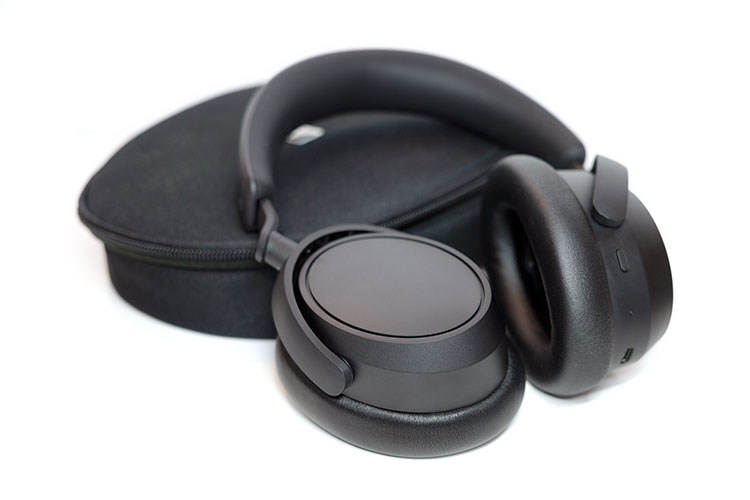
The ACCENTUM Plus follows Sennheiser’s subtle and understated look in most of its recent Bluetooth models. Smaller in size than the HDB 630 (but not by much), the unit only folds flat, just like the HDB 630.
The cup size is medium-small, and those with larger ears will most likely suffer from the pads pressing on their ears. Stuffed with memory foam, the pads are comfortable for moderate use but have no waterproof rating. Both models are eminently comfortable, though.
The ACCENTUM Plus is made primarily of plastic, and the headband carries over in one piece with a memory foam insert underneath for head relief.
While the fit and materials are on the budget side, they do follow the market segment. The HDB 630 feels and looks more luxurious than the Plus, with better build quality.
That padding only goes halfway down the band in a somewhat odd shape while supporting the top of your head. Those with larger heads may find that the pad/hard plastic interface could hinder comfort. The same pattern is on the HDB 630, but that unpadded headband area does not lie upon any part of the head, so comfort is not compromised.
Vent slots sit on top of each cup, while two microphone holes sit on the face and side of the right cup, closer to where they are needed. The HDB 630 is similar.
Instead of tactile buttons, there is a swipe gesture system on the right earcup. Similar to other models, with swipe gesturing, the controls become intuitive with little effort.
Here, the HDB 630 benefits from the technology coming through a second iteration and functions more smoothly, once connected.
Performance
The ACCENTUM Plus deviates from an introduction to Sennheiser’s fabled signature approach with a more detailed response and a bit more clarity than the previous model.
This could be construed as a more forward bass response as well, with a brighter signature adding to the perceived detail and clarity. The ACCENTUM Plus comes across as brighter, with a bit less note weight than the HDB 630, which comes across as more musical, with a smoother signature.
Where the Plus is bent towards a more fun signature, the HDB 630 presents an overall more musical, natural tonality that provides better detail response. Two different flavors, with both showing Sennheiser’s take on music.
Noble FoKus Apollo
Features
The FoKus Apollo is a set of supra-aural wireless hybrid driver headphones. It features a first-of-its-kind dual driver consisting of a 40mm dynamic driver coupled with a 14.5mm planar variant. The HDB 630 uses a single 42mm dynamic driver.
The dynamic driver handles the lows with the smaller 14.5mm planar driver mids and highs to bring the known strengths of the dynamic natural decay, weight, and planar speed and clarity into one package.
With QCC3084 BT5.3 capability, the Apollo can handle a wide range of wireless codecs, including LDAC, AAC, aptX, aptX HD, and SBC. The HDB 630 uses BT5.2, with similar codecs, lacking only LDAC.
The Apollo also has hybrid noise-canceling technology consisting of microphones on both the outside and inside of the headphones.
This setup combines the feedback and feedforward processes for ANC, allowing for more precise and quicker noise pickup. Pure isolation is better in the Apollo, but that comes forth with more bass quantity.
Full ANC provides up to -35dB in isolation, without diminishing audio quality. The Apollo can also be used with the included 3.5mm cable for wired listening. The HDB 630 does not present as much pure isolation but also intrudes less on the signature.
Design
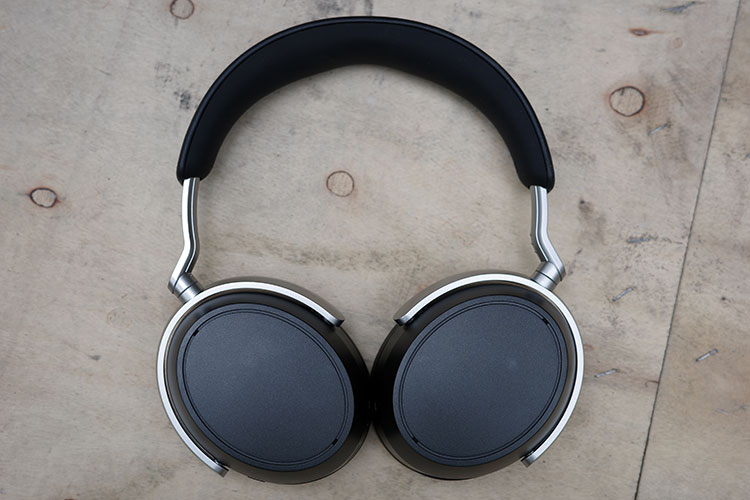
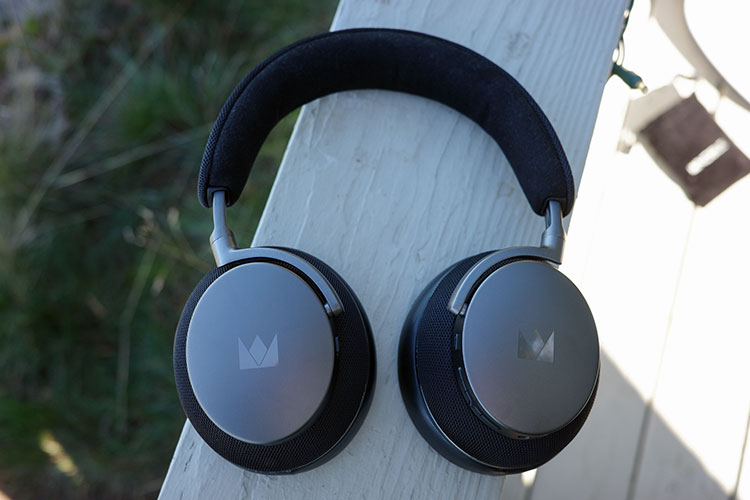
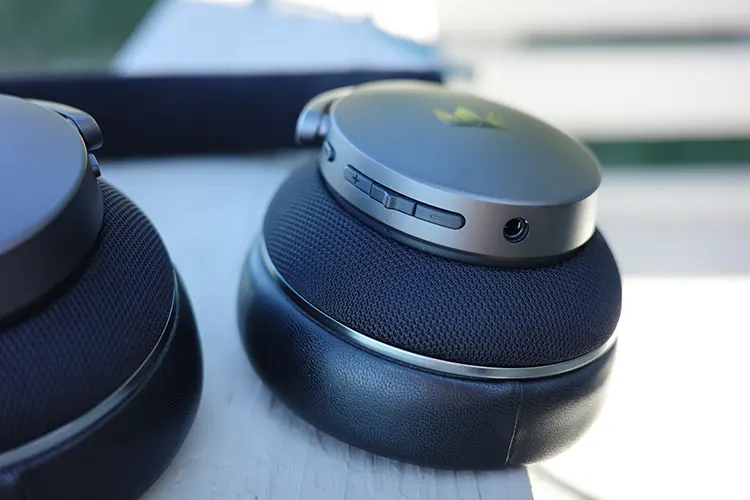
The overall feel and design of the Apollo fit comfortably into a flagship role. On looks and feel alone, the Noble wins.
The frame is made of anodized aluminum with a tasteful silvery-gray finish, which combines nicely with the darker grays and black of the cups, pads, and headband. The HDB 630 has a premium build, but material-wise falls behind the Apollo.
The soft, black, cushy ear pads provide plenty of cushion, and with the slightly larger cups allow for some breathing within the sound chamber.
Combined with the black mesh pattern behind the cup, the fit and feel were very good, with excellent tactility. I never felt like the Apollo was slippery or cheap-looking, either.
The HDB 630 is lighter and has an excellent fit, even with the slightly smaller ear cups. While both units can be worn for extended periods, the Apollo felt “better” after extended listening sessions of five hours each.
I will note that for proper fit, I had the stanchions pulled out to within two notches of the maximum. This is the first wireless headphone that I have almost maximized for proper fit. The HDB 630 gives me more versatility in finding a proper fit.
Control buttons lie on the right cup, and once acclimated to their proximity, are easily accessible. The ANC button, which moves between open, transparency, and full-on ANC, is separated enough so there isn’t confusion.
The left cup carried a single switch for activating the boom mic, which also attaches to that cup. The swipe features of the HDB 630 give it a leg up, due to the second “generation” of this technology.
Performance
A preponderance of bass highlights a rich, full-noted signature from the FoKus Apollo, especially with ANC engaged.
There is a bit of bleed into the lower midrange, but this can also be construed as a deft ability to add weight to the lower mids, masking what might be considered a bloated upper bass region.
That good heft down low translates into plenty of rumble when called upon. The lower “quantity” of bass coming from the HDB 630 does mean there is no bleed into the mids, which is good here.
The upper midrange and treble notes deliver a distinct level of detail and clarity that is neither too thin in weight nor too elongated in either attack or decay.
A succinct character carries the top end, presenting a mostly open sound signature that can add spatiality to the character. The HDB 630’s midrange is eminently musical in tonality and presents a more detailed sound than the Apollo.
With a more vibrant character to it, you immediately recognize the strengths of the Apollo across the board. But the HDB 630 presents itself with a bit more clarity, if less musicality to it.
Where detail retrieval might be slightly better in the HDB 630, the Apollo gives off a better emotive effect, which to me becomes more engaging.
Sennheiser MOMENTUM 4 Wireless
Features
Immersion using ANC technology is at the forefront of this model. The MOMENTUM 4 Wireless functionality with active noise canceling is a match for the best ANC headphones that currently exist in the world.
Using a 42mm dynamic driver, the ease with which the MOMENTUM 4 Wireless can be driven makes it usable across most sources. The same can be said of the HDB 630.
Both use the Beamforming technology for microphone use, providing the user with an isolating “envelope” to hear calls.
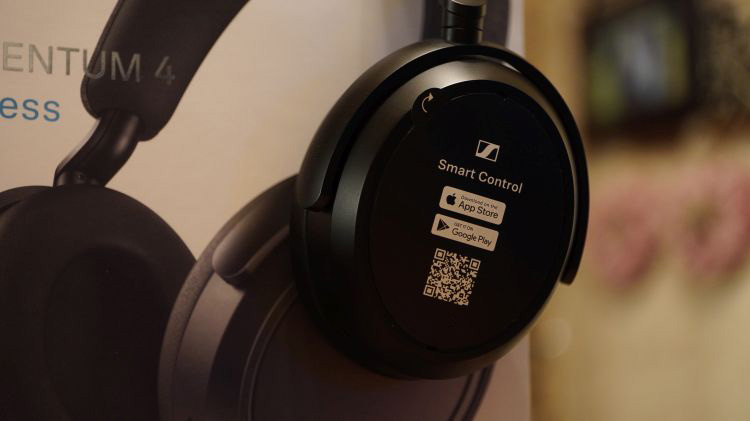
The 4 uses pinch-to-zoom features on the same right-side cup that allows the owner to reduce or increase the amount of desired ANC. This was the first (I believe) of the Sennheiser models to do so. The HDB 630 benefits from that legacy, with better results.
Both models provide up to 60 hours of listening, but of note is that a 10-minute charge yields up to 7 hours of listening on the HDB 630, where a five-minute charge gives only four hours. An increase in technological development.
Design
The MOMENTUM 4 Wireless design is extremely well thought out. The angles of the headband end up relieving pressure on the top of your head, despite the mostly plastic use of materials. The familial lineage is clearly obvious, with the HDB 630 as the more refined younger sibling.
This is a headphone intended for active users, so the use of materials was by choice. The headband arc is aluminum, and it feels slightly pliable and able to bend a bit outward directly before bouncing back to shape when you play with it. There is a more solid feel to the HDB 630.
The ear pads are circumaural but on the smaller side of “full size”. Both ear cups rotate and swivel around enough to allow for a perfect fit for me. Similar in size and feel, the ear pads on the 630 do give a more luxurious feel overall to the unit.
The refinement in the HDB 630, build-wise and in quality, shows Sennheiser took the best of the 4 and raised the bar for the level befitting of the HDB 630.
Performance
This was Sennheiser’s attempt to match Sony’s vaunted WH-1000XM5 in sound but especially ANC technology. They mostly succeeded, putting the marque back on par with the best out there.
The wireless mode adds more bass, more boom, and more depth. Wired mode removes that bass depth and replaces it with more clarity and a different texture.
The HDB 630 not only adds clarity like the 4 but also presents better control (and a bit more) in the bass department.
The cabled method of listening sounds audibly cleaner than the already very good wireless mode, similar to the HDB 630, but with more effect.
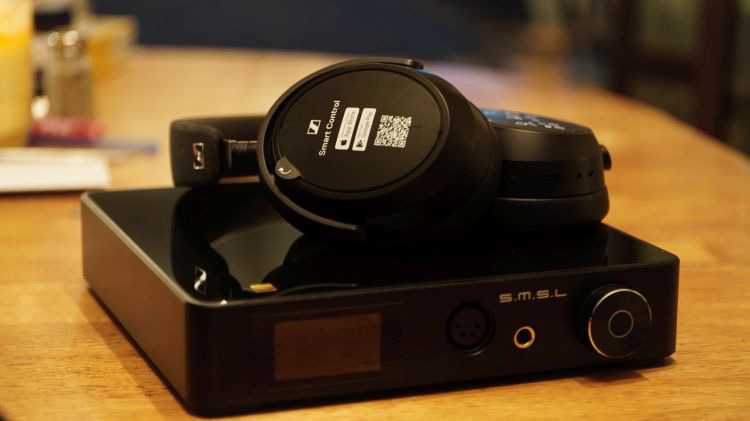
Add a great portable amp or use a powerful source, and you will benefit from each model. But with the HDB 630 less so, which means the evolution of BT vs wired has shortened even more.
The MOMENTUM 4 Wireless mids are relaxed with a wide feeling, but they lack the forwardness that the 630 has. Quite different when swapping to the slightly forward mids of the HDB 630.
The MOMENTUM 4 Wireless top side is quite good. Better extension may not be for all, but the 4 presents excellent extension, at very little expense of note weight. A neat trick.
The lower treble is clean too, and vocals become close to what the HDB 630 can present. But not quite.
The MOMENTUM 4 presents great dynamics with a fun signature, much like the ACCENTUM Plus. As a result, this is a very good alternative to the HDB 630.
My Verdict
It is clear Sennheiser is trying very hard to regain its place at the top of the ANC gang, but not at the expense of musicality.
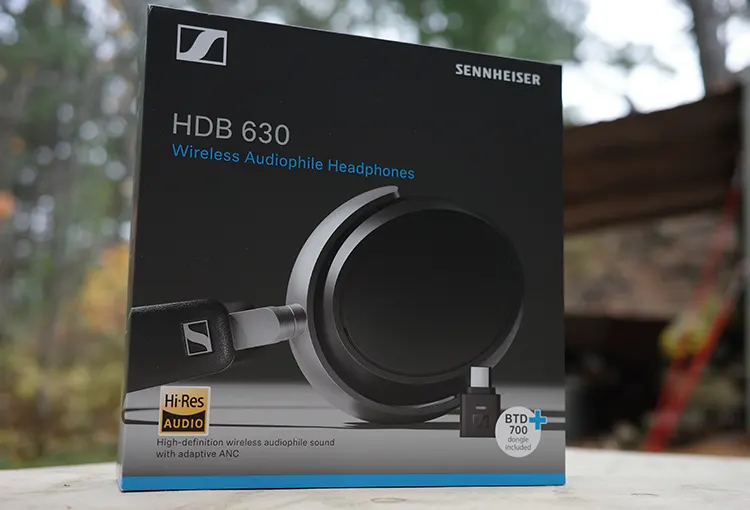
Instead, focusing on sound first and foremost, the HDB 630 represents Sennheiser’s latest attempt to mimic their outstanding wired headphones in tone quality, with looks to back that up.
Initially, the HDB 630 presented a competent sound quality to me, but did not wow me. These came across as very good sound-wise, with less-than-stellar ANC. Sennheiser seemingly came close to the balance of mixing excellent ANC and audio qualities, but fell slightly short.
I would have appreciated a bit more ANC in busy backgrounds, like the Noble FoKus Apollo provides, while still presenting excellent sonics.
That said, the HDB 630 presents itself as a thoroughly engaging listen, with a midrange that sings in appreciation of the music. The precision with which the Sennheiser presents the music does indeed mimic their wired headphones, and this should be applauded.
Add in a long battery life, and the improved swipe features for use, and it is obvious the direction Sennheiser wants to provide.
If they can find a way to meld both excellent ANC qualities while providing the musical nature of the Sennheiser HDB 630, it could very well be near the top of the highly competitive wireless headphone market. As for now, this is a very good try that falls a bit short.
Sennheiser HDB 630 Technical Specifications
- Charging time: Approx. 2 hrs. for a full charge.
- 10 min charging for up to 7 hrs. playtime;
- Battery type: Built-in Lithium-Ion rechargeable batteries 700 mAh
- Power supply 5 V⎓, 750 mA max, USB charging via USB-C socket
- Temperature range Operation: 0°C to +40°C
- Charging: +10°C to 40°C
- Storage: -20°C to 60°C
- Magnetic strength field: 6.25 mT
- Product weight: Ca. 311 g (11 oz)
- Product dimension (folded flat): 180 x 195 x 51 mm (7 x 7.67 x 2 in)
- App supports the Sennheiser Smart Control Plus app for iOS™ and Android™
- Connectivity Bluetooth 5.2 compliant, class 1, 10 mW (max)
- Transmission frequency /modulation: 2,402 MHz to 2,480 MHz; GFSK, π/4
- DQPSK /8 DPSK: Supported profiles A2DP, AVRCP, HFP
- Supported codecs: SBC, AAC, aptX™, aptX™ HD, aptX adaptive™
- Speaker type: dynamic driver, 42 mm diameter
- Speaker frequency range USB: 6 Hz to 40kHz
- Analog & Bluetooth®: 6 Hz to 22 kHz
- Speaker sensitivity: 105 dB SPL (1 kHz / 0 dB FS)
- Speaker THD: <0,2% (1 kHz / 100 dB SPL)
- Speaker impedance Active: 480 ohms
- Active Noise Cancellation: Hybrid Adaptive ANC
- Mic principle MEMS: Mic frequency range 50 Hz to 10 kHz
- Mic pick-up pattern: 2 mics per side, beamforming for noise reduction
- Battery lifespan: Up to 60 hrs. music playtime via Bluetooth and with ANC (test condition: iPhone, mid volume level)
