

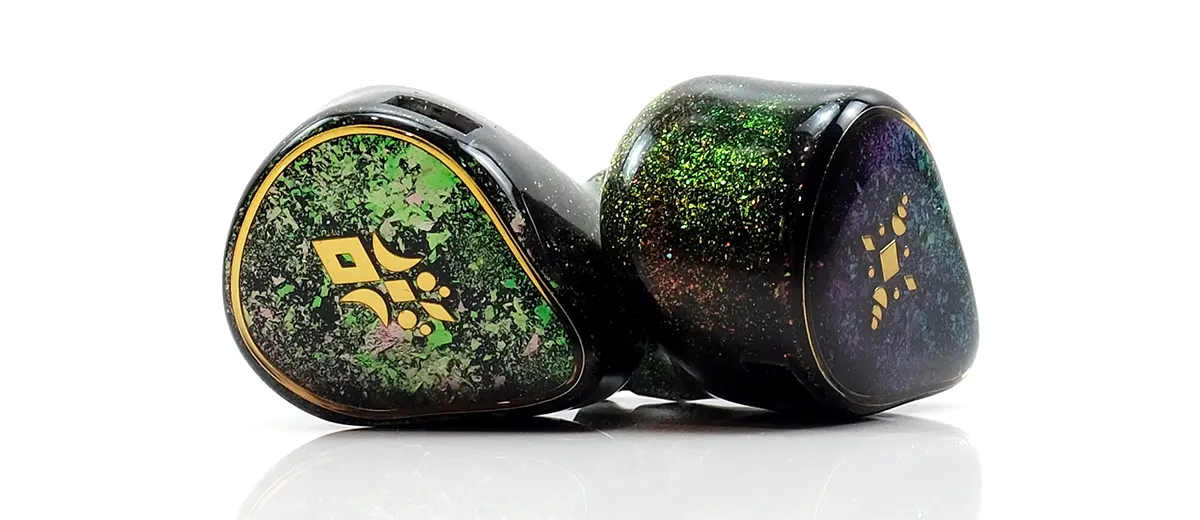
Marcus reviews the Rossi&Wing Lua Synchronicity, a new Taiwanese-made hybrid multi-driver universal IEM aimed at detail-oriented audiophiles. It is currently priced at $790.00.
Disclaimer: This sample was sent to me in exchange for my honest opinion. Headfonics is an independent website with no affiliate links or status. I thank Rossi&Wing for their support.
Click here to read more on Rossi&Wing products previously reviewed on Headfonics
Note that this article follows our latest scoring guidelines, which you can read in more detail here.
The Synchronicity is the penultimate offering in Rossi&Wing’s more affordable art-inspired Lua Series of IEMs, and the second one I have reviewed after the dynamic driver Serendipity.
Priced at $790, the hybrid multi-driver Lua Synchronicity promises a more detail-oriented performance over the entry-level Serendipity, targeting everyone from classical lovers to gamers who need a bit of precision and resolution to their audio.
From my own perspective, it’s a considerable jump up in quality over the Serendipity, with a cleaner, vocal-first sound signature, balanced with noticeable bass weight when required. It should provide decent levels of flexibility for a wide range of tastes.
It also marks the continued collaboration with HOKKI, the Taiwan artisan perfume makers, so you can expect a small sample in your package to tease your sense of smell along the way.
How does it perform and compare to IEMs such as the classic reference-tuned Empire Ears ESR MKII, 64 Audio’s more explosive hybrid U4s, and the Serendipity? I found out in my full review below.
Features
As with the Serendipity, Rossi&Wing has kept the technical rundown of the Lua Synchronicity a bit under wraps.
What I can tell you is that it is a hybrid multi-driver IEM with the same “Magna Resonus” MR10 dynamic driver for the lows (and possibly the lower-mids) and an undisclosed number of BA drivers for the mids and highs.
Note that this is a dual-bore nozzle tip implementation, so it’s likely a dual or triple BA driver setup using either a dual-BA module or a single alternative. It sounds like the BA drivers might be back-vented, as the mids and highs have a natural tone and level of decay.
There are no bone-conduction or EST drivers in this setup, and I would presume this driver configuration also uses a passive 2 or 3-way crossover.
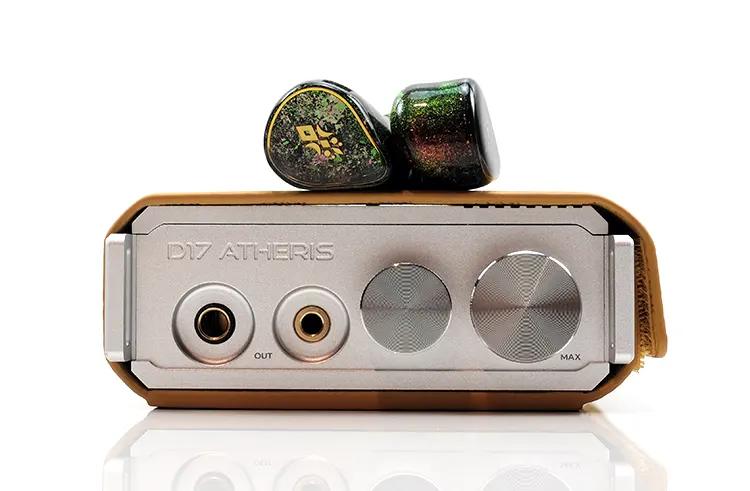
The Lua Synchronicity has an impedance of 14 Ω and an SPL of 112 dB/mW @ 1 kHz, so this is a very easy IEM to drive, though not too super-sensitive for amps with high noise floors. This one will pair easily enough with modern DAPs and dongles.
Design
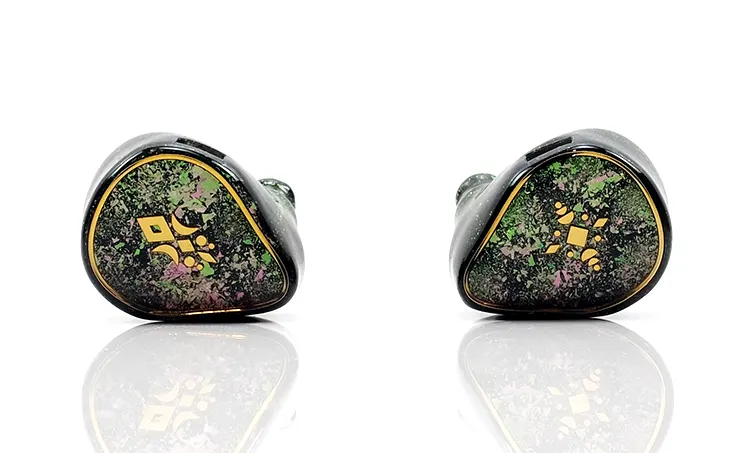
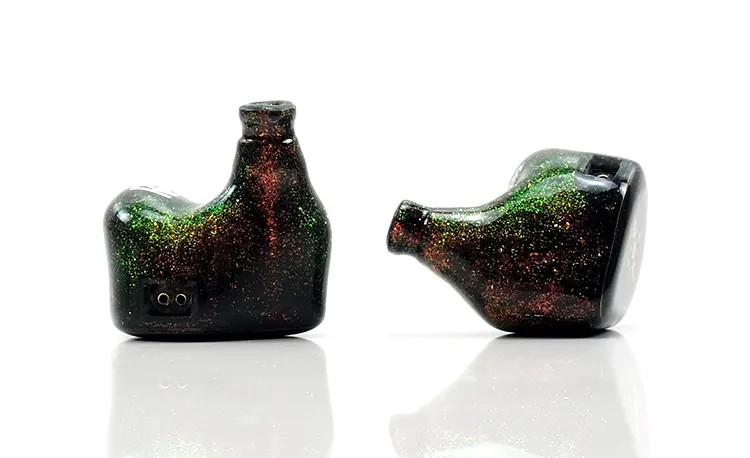
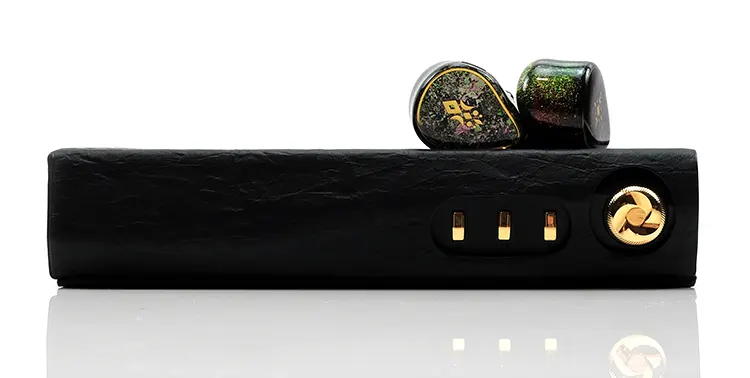
Much like Serendipity, the Lua Synchronicity has a beautiful artisanal aesthetic of an all-resin two-piece main shell and faceplate.
I would say the design language is almost a duplicate of the Serendipity save for the color scheme, which switches from purple-based to green, and a dash of orange with gold plate rims and logos on the plates as opposed to silver.
It’s a warmer, more organic visual tone compared to the cooler vibes of the Serendipity, but it is every bit as attractive looking to my eye. The ‘green theme’ is duplicated throughout the Lua Synchronicity’s packaging and not just the shells, so it’s quite a consistent approach from Rossi&Wing.
The Lua Synchronicity form factor is unchanged. The resin shells are fairly compact, lightweight, and are finished with decent contouring for a snug fit.
Arguably, the plate size is marginally bigger than the Serendipity version, but honestly, it’s a close call. The main shell dimensions and nozzle length look the same to my eyes.
Comfort & Isolation
Due to the reasonably long nozzle structure, the Lua Synchronicity gets a fairly deep penetration into the ear canal, which I always prefer over relaxed fits.
There is no horn design principle here, so the sound is delivered via a dual-bore exit (indicating two tubes), so getting it close to the second bend of the ear canal is more important.
The level of comfort from the Lua Synchronicity is excellent, with decent passive isolation for a hybrid port-vented shell.
The ear tips will determine the exact level of passive isolation (and sound signature), with the supplied single flange narrow bore tips providing a comfortable fit and not throwing up the same issues I had with the Serendipity’s performance.
There are no other alternatives to the silicone tips in S, M, and L in the Lua Synchronicity’s packaging, so it is perhaps just as well they are a decent fit for me and do not mess with the tuning this time around.
One critique I do have is that the stock tips tuning can sound a little soft and does not create the same staging depth as 3rd party tips, such as the PLUSSOUND Allegro II hybrid alternatives.
The PLUSSOUND tips can be bought directly from their website for $17.99, so something close and slightly cheaper would be the hybrid Symbio W alternatives.
Both sets of tips tighten up the note strikes considerably over the stock tips, with the PLUSSOUND hybrids creating a more intricate staging presentation and better vocal impact.
I would urge caution when putting wide-bore tips on the Lua Synchronicity. The ones I tried (AZLA tips) flattened the soundstage, creating too much distance from the performance to the ear.
Stock Cable
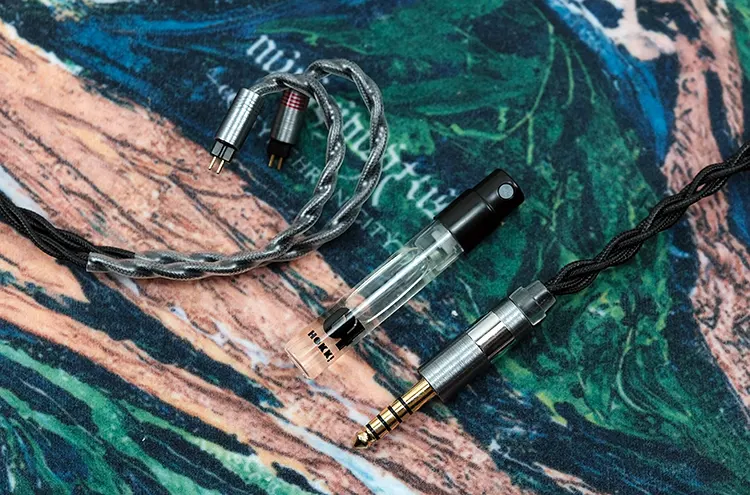
The Lua Synchronicity comes with the same stock cable as the entry-level Serendipity.
This is a 1.2m cloth-jacketed cable with a braided finish and terminated with a 4.4mm Pentaconn plug by default. Inside is a 6AWG 4N Silver-Plated 6N OFC copper wire in a 4-wire geometry.
The finishing has more than a hint of PWAudio’s grey/black cloth jacket styling, though the aluminum barrels for the plug, connectors, and splitter are markedly different and branded with the Rossi&Wing logos.
This is a soft, pliant, and easy-to-manage cable with a quality finish to a small chin cinch that helps keep everything under control during daily use. Microphonics are non-existent.
The only critique I have here is the same as the Serendipity cable feedback. The 4.4mm barrels have a nice finish but are relatively heavy, and the copious amounts of silicone for strain relief should ideally be internalized into the barrel for a more refined look.
Packaging & Accessories
As with the Serendipity, the Lua Synchronicity sample did not come with the full packaging, but I got pretty much everything save for the unboxing experience.
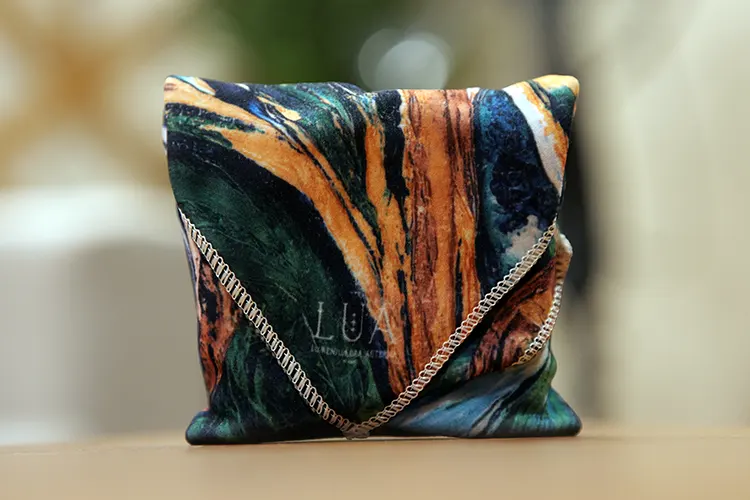
The set included a box of 3 silicone tips, the cable, and the IEM inside a neatly designed transparent plastic box. All of this is wrapped in a beautifully branded Furoshiki Japanese wrapping cloth with the same color tones as the main IEM shells.
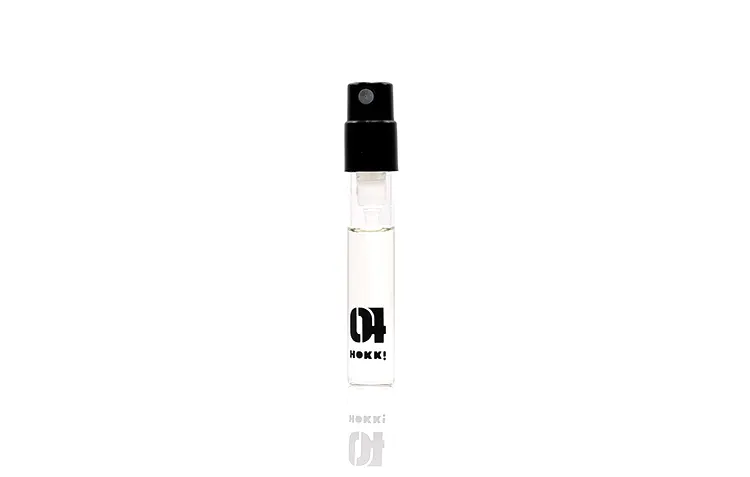
As before, when you open it up, you are going to get hit with some pleasant scents. And this is also where that collaboration with HOKKI comes into play, with a new decanted 2ml sample of perfume called No. 4.
This is quite a different fragrance from No. 3 that came with Serendipity. It has a darker, woodier tone to it, with notes of black tea, rice, blackcurrant, Geranium, and Jasmine, so it’s missing the brighter profile of the No. 3 and might be more suited as an evening spray.
And just to put my money where my mouth is, I ordered the No. 3 just last week and paid in full; it’s that good.
Sound Impressions
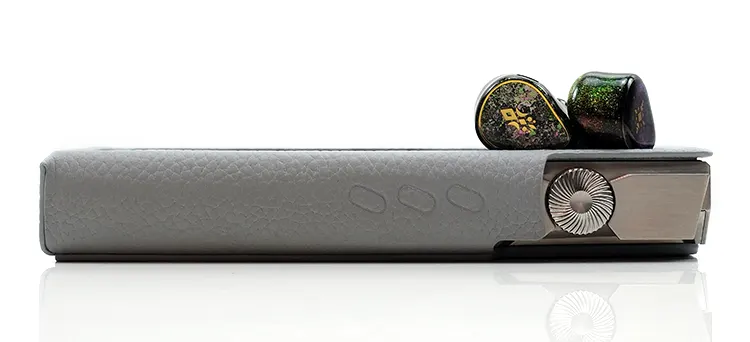
The following sound impressions of the Rossi&Wing Lua Synchronicity were completed using a mix of the iBasso DX340/AMP15 and the N6iii/R202 DAP and board combos in a low-gain balanced 4.4mm output mode.
Summary
The Lua Synchronicity has a nicely balanced, mildly W-shaped sound signature with excellent extension on the lows and a fairly forward-sounding midrange or pinna gain section.
The highs have some presence but deliver a pleasant sparkle rather than a grating harmonic dissonance on the midrange and lower-treble timbre.
The staging is deep and tall with some decent width, though the overall impression is vocal first, then instruments tucked in behind, courtesy of a north of neutral 1-3k range.
It does not have quite the separation and complexity of competing IEMs with a larger driver complement, such as the 64 Audio U4s or the Empire Ears ESR MKII.
The bass presence is more sub-bass biased than mid-bass fulsome. I find it’s largely ‘Harman correct’ up to around 200Hz, and like my PEQ-ed Serendipity response, it can hit hard with good control when required without too much bloat.
The Lua Synchronicity is nowhere near as dark or warm-sounding as the Serendipity stock tuning. In fact, it is tuned to be the polar opposite.
It has a lighter touch through the mids and highs courtesy of its BA driver (s) and a noticeable dip in the lower-mids around 500Hz, presumably to prevent bass bleed from a fairly elevated sub-200Hz region.
This is an IEM that works well with a wide range of genres, but particularly with vocal lovers. Leading edges or note attacks are relatively smooth, more so with the stock tips than firmer hybrid 3rd-party tips that introduce a little more contrast and clarity through the mids and highs.
Frequency Response
The Lua Synchronicity frequency response is at its most elevated from 20Hz to 60Hz, and again at 1-4k with a secondary bump around 8-10k.
The resulting sound emphasizes sub-bass presence and vocal impact with a little ethereal sheen on the upper-mids and highs. The 1-2k range is north of neutral, pushing the vocals and some instrumental presence front and center, so at times the Lua Synchronicity can sound intimate or vocal-focused.
There is a noticeable dip from 250Hz up to 1k, so lower-mids instrumental notes can lack a little body and presence, though the elevated 20-60Hz region does ensure that lower-register notes have a solid fundamental frequency.
I find this type of FR to be very suited to modern pop and R’n’B, where the lower-mids mix tends to be fairly sparse with a stronger emphasis on bass synth notes and female vocal layering on top.
It is not quite as immersive with acoustical recordings as the flatter ESR MKII, which pulls the pinna region back more to neutral and has more of a lower-mids lift, but if you enjoy singer performance, then the Lua Synchronicity will provide a solid harmonic balance with nothing overly edgy or sharp-sounding.
There is an 8-10k peak, but it is secondary to the midrange elevation, with the 5-7k region staying relatively neutral.
It can create a relatively airy, ethereal sparkle to some recordings, but on most occasions, it was not a strong factor in midrange timbre, more of a sheen than switching up the timbre to an upper-harmonic order bias.
In fact, for most pairings, I preferred a clean solid-state source like the DX340/AMP15, Mojo 2, or the DC-Elite. Softer, more analog sound-signatures can please but lose a little bit of contrast and sparkle in the process.
Staging & Dynamics
The Lua Synchronicity has some impressive depth and decent headroom and air. However, the forward pinna gain creates a lot of emphasis on the vocal and sub-bass region, leaving lower-mids instruments somewhat behind the singer.
I would not say it’s an intimate soundstage, just a vocal-emphasized presentation with a strong bass response when called upon.
This can leave the mids’ imaging and note separation a little muted in favor of one or two key areas compared to more immersive and deeper soundstages such as the U4s and ESR MKII, whose midrange imaging is pulled back a little.
Click on page 2 below for my recommended pairings and selected comparisons.
