

Sound Impressions
The following sound impressions of the Noble FoKus Rex5 were completed using a mix of the Samsung S23 Ultra (Android 14) and the Cayin N6iii (Android 12) with the stock single flange silicone tips.
Summary
Compared to the previous Mystique and FoKus Pro models, the Fokus Rex5 sounds like a TWS on steroids. It delivers a bigger and bolder set of lows, with a more resolving performance set of mids and sparkling highs than what I have previously heard from Noble’s wireless earbud lineup.
The coloration is warm to natural with an excellent fundamental frequency and a welcome level of contrast from a pleasingly elevated upper treble, just enough to create a light sheen on the midrange timbre without creating a harsh, edgy tone.
The midrange has some decent ear gain for vocal presence, but it’s not outlandish or shouty in its positioning. You can soften the coloration further with the foam tips, but the clarity levels seem better for me with the silicone tips, be it the single or dual flange variants.
Imaging is one of the most impressive I’ve heard to date from a TWS. I have been using the Huawei Freebuds Pro 2 for about 3 years now, primarily because of the depth and space it creates, and indeed it can match the Rex5 in terms of bass body.
However, the Rex5 bests it with a far more vivid and open-sounding set of mids and highs. The Freebuds Pro 2 sounds fuzzier and more relaxed through the mids and highs, whereas the Rex5 clarity midrange bloom is more evident, especially at the more extreme ends of its comparatively wide stereo field.
It’s a testimony to how accomplished the Rex5’s imaging and staging dimensions are that after doing the comparison work on the FoKus Mystique and Pro, I packed them away feeling I was missing out on a lot of dynamic range and ‘information’ from my listening experience when using the older models.
Frequency Response
The FoKus Rex5 frequency response is more to the contemporary side with a significant but not uncontrollable lift in the lows from 20- 80Hz that starts slowly dropping to its lowest elevation point around 1k before it gets an ear gain boost from there up to 5k.
The bias is more to the sub-bass than the mid-bass, so there is less of a punchy bias in its tuning and more of a juicy and dense thud at the very low-end of the spectrum, complete with a natural to slightly elongated level of decay.
The lack of mid-to-upper-bass elevation helps the Rex5 keep the bass bleed to a minimum, though the 500Hz to 1k lower-mids region will sink just slightly relative to the lows and presence region.
I tend to find this type of tuning excels with modern pop, R’n’B, and EDM, hence my opening ‘contemporary’ tuning statement. However, classic rock standards that ply their trade in this region can perceptually shrink in presence and crunch with the Rex5.
The 2-4k region is run neutral to slightly lifted with good separation and a slightly forward imaging experience. It’s not as front and center as the Mystique, but the depth and space from the Rex5 is superior, so vocals have plenty of space to shine.
There seems to be shift away from the lower treble with more 7-10k elevation from its planar driver and a bit of 5-7k suck out. That produces more of an ethereal ‘twinkle’ tone from its upper register note reproduction and a gentle treble overtone on the upper-mids timbre.
I think the planar driver performs quite well here. It’s a little light in physicality, but the speed and clarity from the Rex5 upper-treble is impressive, adding a nice perception of height and articulation from its treble performance.
Staging & Dynamics
I have heard some TWS reach as deep, such as the Freebuds Pro 2, some with decent height, such as the Samsung Galaxy Buds2, but nothing this spacious and holographic, and certainly nothing comes close to the perceived width from the Rex5.
The switch to the bigger dynamic driver is immediately apparent. Not just in the enhanced depth and power, but also in the textured detail and layering. Typical TWS bass bleed is kept to a minimum with excellent bass to mids separation, so low-end instruments do not end up in a blue or one-dimensional thuds.
Headroom is good, better if LDAC is activated, and optimal with ANC switched off. ANC just softens some of the instrumental detail and character compared to the non-ANC performance, but it’s subtle rather than overt.
Some might find the planar highs stand out a little with their lean and clean tone, and not quite in keeping with the otherwise very smooth bass-to-mids coloration. Thankfully, the bias to the upper over the lower-treble emphasis keeps any potential percussion harshness to a minimum.
Midrange imaging from its triple BA setup is slightly elevated but not as forceful as I anticipated. Coming from the Mystique, vocal imaging is just slightly more relaxed, with bass coming more to the fore.
However, the clarity and depth of the Rex5 presentation provide a lot more space for vocals to come through clearly without a hint of veil.
Noble FoKus App
Like many of Noble’s recent wireless offerings, the Rex5 is heavily integrated into their long-standing FoKus app.
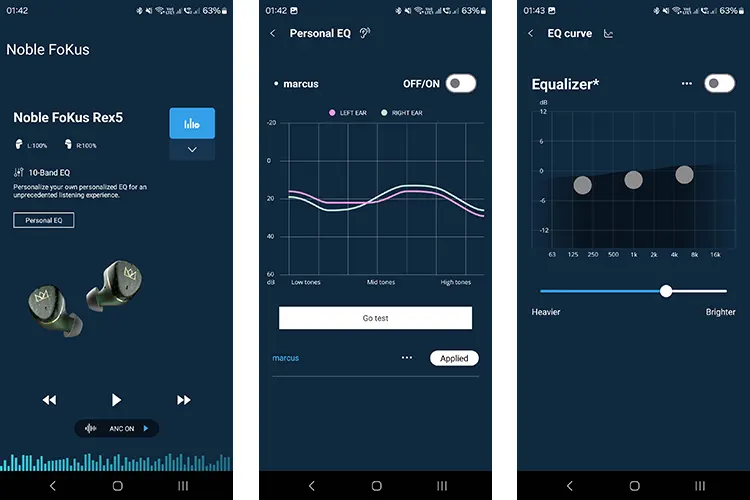
While the app is not as feature-rich as something like the Sony Sound Connect app, I value its stability and decent UI flow. Getting around is relatively easy with its drop-down menu system, graphical display of the TWS connected with its battery life, and quick access to ANC at the bottom of the home screen.
The launch of the Rex5 also heralds the introduction of Audiodo’s custom sound personalization, which involves signal testing the right and left ear to help it build what it thinks is an attractive FR profile to enhance your Rex5 listening experience.
My profile came out with a lifted sub-bass and decent ear gain up, so both aspects were quite emphasized once I activated the profile.
However, I felt the upper-mids were a bit stressed-sounding compared to the default profile, with too much tonal contrast on percussion timbre, making performances a little more fatiguing.
You can also opt for a more regular EQ adjuster, and this one I did enjoy with a slight tilt to brighter. It didn’t sound as aggressive as the personal profile, but it had the effect of lowering the bass shelf and giving the Rex5 a more neutral sound quality.
Wireless Performance
For the following tests, I used a mix of the Samsung S23 Ultra and the Cayin N6iii DAP for pairing and stability/range testing using the FoKus Rex5 in LDAC and aptX HD mode. For latency testing, I used the GitHub Sound latency checker, an open-source project that is free to use.
Pairing Ease
There are two stages to pairing and getting the most out of the FoKus Rex5. The first is your generic pairing via any Android or iOS device’s BT service.
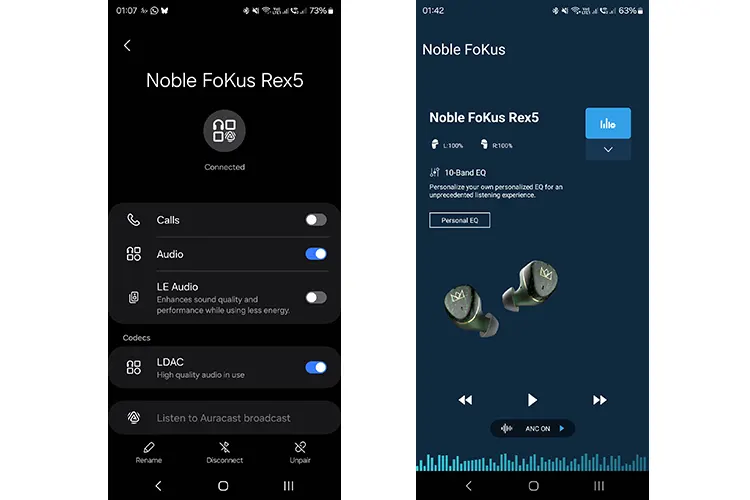
Both the Samsung S23 Ultra and N6iii had no issues finding and pairing with the Rex5. From there, dip into the menu and turn on LDAC if available, and you are good to go for general BT playback from your device.
The next stage is integrating into the FoKus App, and there is very little to do here. If the Rex5 is already paired with your phone, then it will show up on the FoKus app as soon as you open it.
Now this is where it gets interesting because the Rex5 is a multipoint TWS, meaning you can connect it to more than one device. Pairing requires one device at a time, but after that, you can play audio from 2 or more devices.
What I discovered was that if, for example, I started playing via the N6iii, I could control some of the playback via my smartphone FoKus app. If I stopped playback on the N6iii, I could initiate playback on the S23 and also control playback from the Fokus App.
That’s a pretty neat setup and gives me plenty of options, direct from what you could best describe as a quasi-remote control inside the FoKus app.
The only critique was that I could not stop playback via the FoKus app for the N6iii via the S23, just play, back, or forward track selection seemed available. However, one tap on the side of the TWS buds will stop the music pretty quickly.
Stability & Range
I found the FoKus Rex5 stability and range to be on par with the FoKus Mystique’s performance and slightly superior to the FoKus Pro using the Samsung S23 Ultra.
Your chosen BT source device will play a significant role in just how much stability you can achieve over long distances.
For example, my Cayin N6iii uses a Classic (BR/EDR) chipset, which I prefer over LE, and it provided a relatively impressive performance at long range. However, lingering out at 20m for a few minutes did inevitably lead to stutter and interference, which didn’t dissipate until I moved back to a much closer range.
With the S23 Ultra, the signal was rock solid over the same distance with no stutter or drop out over the same period. I always feel smartphones offer better BT performance over DAPs with TWS. BT modules are not as critical in a DAP’s performance criteria as a smartphone.
Latency
I ran the GitHub latency test about five times to get a set of usual parameters, i.e., lowest and highest numbers with the Rex5 scoring between 350ms and 380ms of latency on a 120BPM test track via my Samsung S23 Ultra.
Ranged against the Mystique and FoKus Pro, the latency benchmark parameters were quite similar, but against the cheaper Airoha 1562A-equipped H-ANC, the Rex5 was a good 100ms lower in latency performance, making it a superior choice for gamers and media playback.
