

Sound Impressions
The following impressions were had using my iPhone 16 Pro Max, MacBook Pro, FiiO JM21, HiBy R4, and Cayin’s N6ii DAP.
As noted above, the single-flange silicone tips were used for the majority of my listening time. The Encore was allowed to burn in for over 50 hours before critical listening occurred.
Summary
The Prestige Encore presents prodigious amounts of low-end that can give excellent grunt, especially with the ANC on. It can filter, not bleed, into the lower mids, helping to maintain very good note weight throughout the midrange.
The note weight never becomes cumbersome, overbearing, or slow. Instead, that note weight is what gives the Encore its excellent character, lending an organic naturalness to the sound qualities, without becoming slow, muddied, or clouded.
The treble reach helps add some height to the three-dimensionality of the soundstage, too, keeping the overall signature lively and vibrant.
That soundstage allows notes to stretch without thinning, and definition keeps the signature together. An organic naturalness represents the whole of the signature, with vocals coming across as sumptuous and complete, without being drippy, slow, or too melancholic.
Bass
The bass hits hard and fast, while staying under control, mostly. With ANC engaged, the bass gives very good guttural movement but can be a bit loose in character. Mind you, that bass is still very good, with details coming forth with speed in attack, but a bit longer in decay.
When in ANC off, that looser back end ceases, making for excellent control, which “filters” the sound into the midrange.
Even with ANC engaged, that propensity for thunderous bass does not hinder the next level, to me. I did run ANC on for the majority of the time and enjoyed what that low end brought to the signature across all genres.
The sub bass gives that low end an excellent foundation to build upon, and smoothly melds with the mid bass, making me almost forget this is a TWS earbud.
In fact, I have an IEM in for review, and going between the two makes me understand just how far TWS have come, closing the gap. The dynamism with which the Encore presents the bass should be commended.
Mids
The smoothness with which the midrange moves is something that Noble has done very well.
The sumptuousness of which I spoke above makes for an organic, engaging sound emanating from piano work, almost like you were sitting at the bar of an excellent jazz club.
Here, Noble has given equal emphasis to attack and decay, with that evenness coming across as smooth rather than truncated or disconnected.
This is the “filtering” of the lows I mentioned. The fact that this is done without pushing the midrange up and forward makes for an engaging, musical tonality that is organic, yet concise in response.
Moving towards the top, I do sense a small lack of energy in the upper midrange, but combined with the smoothness of the rest, I really do not miss it.
This clarity across the midrange makes for a thoroughly transparent signature that some may want to call a bit shouty. I would call it engaging and immersive instead.
Treble
The Encore promotes both energy and a certain vibrancy to the upper region, but keeps both in balance so one does not override the other.
There is a bit of roll off, too, but this lack of true reach simply means there is no screeching tendency or any strident behavior to the treble notes.
Note weight balances both reach and vibrant tonality to provide good extension without becoming harsh or gritty. That same note weight allows for a mix of the above into quite a pleasant ‘soup of sound’. Instruments that should be singular are, give an excellent definition of what is heard.
Where the low end goes deep without hindering the midrange, the treble exerts its energies to present and pull together the overall character using the top end. Note definition lends excellent clarity and detail retrieval to the quality of the whole as a result.
Staging
If one were to blindly put the Encore on and start the music, one would be hard-pressed to say definitively that this was a TWS earbud, and not a wired IEM. Such is the soundstage character that blurring the lines shrinks the individual differences markedly.
A reviewer found that the height of the soundstage might be its “downfall,” so to speak, but I would rather say the defining character of the treble keeps the height in control, lending to a more even character across the three dimensions.
The engaging sound signature defined across the three dimensions might also be how one can define this really is a TWS, for in keeping with that evenness of presentation across the 3D, there is a lack of true separation and layering.
Instead, the 3D works in concert to present the whole character, but with less definition of individual layers.
What the Encore does instead is present an engaging overall character to the listener that envelops you with the presentation. Top-notch resolution does come into the equation, making for that engaging quality while enticing the listener into the 3D sphere.
And, when you can insert your EQ settings, especially the personal one using the Audiodo test, this can be countered to make the signature as engaging and immersive as one would like.
In fact, on some songs I used the personalized EQ setting, while on others I did not. I rarely use E period, so the fact that I was willing to play with the app settings (when I could) makes user engagement a very enticing call.
Wireless Connectivity
Bluetooth
The BT5.4 connects easily (once I figured out how properly), and the multi-point connectivity was easy. Latency in YouTube videos, or music videos, was mostly non-existent.
While all devices were paired, I often had to clear one of the previous devices due to the automatic reconnection of the previous device. This, of course, was expected since the directions state you should disconnect or forget to pair a new device.
I found, much as Marcus did, that control of the FoKus app could be garnered from my smartphone while playing music on another source.
While I found that changing the EQ setting yielded no results as expected, forward, rewind, and play worked, giving me the ability to use my smartphone exclusively for the actions needed. As he found out, pause did not work in this manner.
Stability & Range
The stability varied by device, with my aging N6ii suffering at about a 10-12m range. Mind you, sitting right next to my router will sometimes yield less than full bars for the Cayin anymore. I find the age of the source is at fault here, not the Encore.
Using any other device ranged from 25-30m before any stuttering occurred, or loss of signal completely.
My iPhone reached an astounding 49m through one wall to the outside before stuttering occurred. That is the longest of any device I have ever used. I repeated the test two more times with the same results.
Latency
The Encore averaged 277.2ms on five online tests from the website wutools.com, which is lower than the Rex5 from Marcus’ tests listed here. Variability from the limited online test was quite small, too.
Marcus found the Rex5 scoring between 350ms and 380ms of latency on a 120BPM test track via my Samsung S23 Ultra, using GiHub, while the Mystique and FoKus Pro were quite similar.
Wireless Pairings
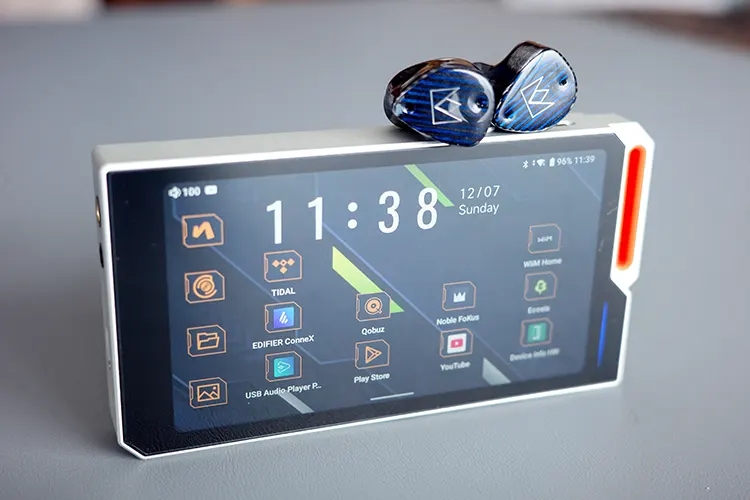
I used the Prestige Encore on three main units: my iPhone 16 Pro Max, my MBP, and the older Cayin N6ii.
My favorite was the Cayin, especially since it ran an Android OS, giving me more choices. Apple really needs to get with the program and unleash its sound wares.
I found the Cayin allowed the Encore to stretch its legs with a vibrant quality across multiple genres.
The top end extended with excellent verve, but no grittiness. The midrange simply sang with a sumptuous smoothness of quality that made me forget this was a TWS bud. And of course, the low end presented an excellent foundation.
My MacBook Pro played nicely with the Noble too, making for an excellent alternative and one that could play music, paired with my iPhone, should a call arise mid-work (it did, and functioned easily).
There was a bit less top-end character using the MBP compared to the Cayin, but the pairing was very tolerable to me, making for an excellent traveling pair.
The least favorite was my iPhone 16 Pro Max, but when combined with the MBP made all quite acceptable, knowing I could easily switch between the two without issue.
A lack of virility came from the iPhone, but using the app, I could quickly add that back in using my Audiodo test. For portability, the iPhone still rules in my pockets.
