

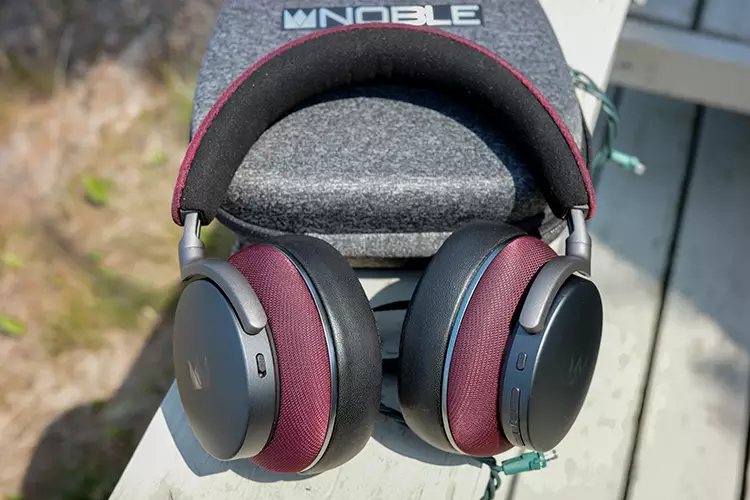
Voice/Call Quality
It seems that I restate this on wireless headphone reviews, regardless of maker, but call quality almost seems to be a moot point anymore.
On a blustery Lake Superior day (my standard testing protocol), even with the microphone attached, our son could hear me without much bother. Even the isolating qualities of the microphone worked its magic during the test.
I have little to no issue with the current crop of wireless headphones when it comes to call quality, and the Noble FoKus Apollo Pro fits right into the mix.
Wireless Connectivity
Bluetooth
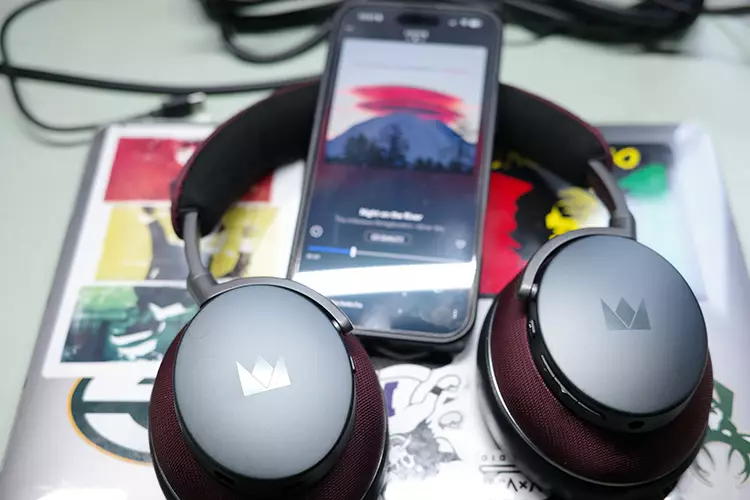
Multipoint Bluetooth 5.3 connectivity is quick and easy, as one would also expect from today’s wireless offerings. As with many, I was able to connect the Noble FoKus Apollo Pro to my MacBook Pro for music, and my iPhone for answering calls.
As part of the testing, I purposely did this and had our son call, which gives me the benefit of gauging this aspect, along with call quality mentioned above.
Answering was seamless as expected, and once the call ended, the music automatically started up again.
Wired Connectivity
USB-C to USB-C
This is again a highlight of sound quality, closing the gap between a fine wired headphone and wireless. While I still had to equalize the sound differences between USB-C wired and Bluetooth, the sound was still stellar, like the OG Apollo.
Turning the Noble FoKus Apollo Pro into a wired headphone can certainly pay dividends, and can make one think of having the Apollo Pro as a singular headphone across multiple platforms.
3.5mm to 3.5mm AUX
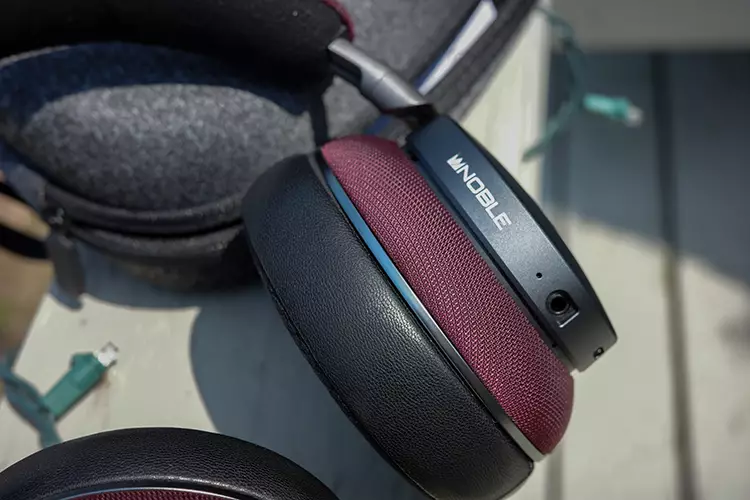
Much like the original, you can listen from the 3.5mm single-ended cable while charging simultaneously from the included USB-C.
This is especially convenient for users who may forget to charge by the end of the week and need that extra bit of juice for the commute home.
Anyway, I find the gap continuing to diminish between Bluetooth and 3.5mm audio quality, so for testing I listen almost exclusively in Bluetooth format.
The inclusion of the right-angled 4.4mm balanced adaptor only adds to the sound quality offerings, mimicking my comment above regarding the use in USB-C format.
Having the included choices is an excellent offering from Noble and can certainly justify the format of using the Apollo Pro singularly across all your choices of wired and wireless.
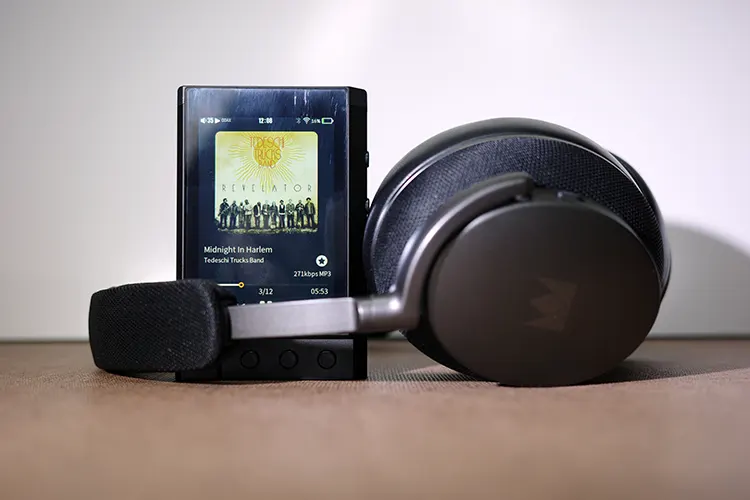
As luck would have it, I have a portable CD player in for review, and I connected the Apollo Pro across BT, 3.5mm single-ended, and 4.4mm balanced connections.
My preferred connectivity here was 4.4mm balanced, which presented the best soundstage and three-dimensionality of presence.
For portable use, the duo could quickly be considered a favorite if one can carry CDs with them. Any manner of old (or new) “Spacecase” will allow you the opportunity.
Select Comparisons
Noble Audio FoKus Apollo
Features
The FoKus Apollo (and Pro) is a set of supra-aural wireless hybrid driver headphones. Both feature a first-of-its-kind dual driver consisting of a 40mm dynamic driver coupled with a 14.5mm planar variant.
The dynamic driver handles the lows with the smaller 14.5mm planar driver, while mids and highs are handled by the planar driver, bringing the known strengths of dynamic natural decay, weight, and planar speed and clarity into one package.
The difference is in the tuning, with the Apollo Pro losing some of the guttural bass response.
With QCC3084 BT5.3 capability, the Apollo can handle a wide range of wireless codecs, including LDAC, AAC, aptX, aptX HD, and SBC. There is no change with the Apollo Pro.
The Apollo also has hybrid noise-canceling technology consisting of microphones on both the outside and inside of the headphones.
This setup combines the feedback and feedforward processes for ANC, allowing for more precise and quicker noise pickup. Both the OG and Pro provide excellent responses.
Full ANC provides up to -35dB in isolating outside noise, without diminishing audio quality. The Apollo and Apollo Pro can also be used with the included 3.5mm and USB-C cables for wired listening.
Design
The overall feel and design of the Apollo fit comfortably into that flagship role. The Apollo Pro raises the quality a bit.
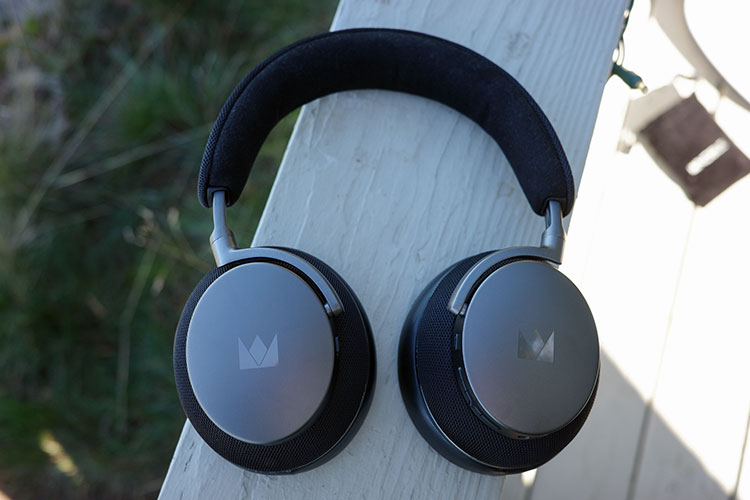
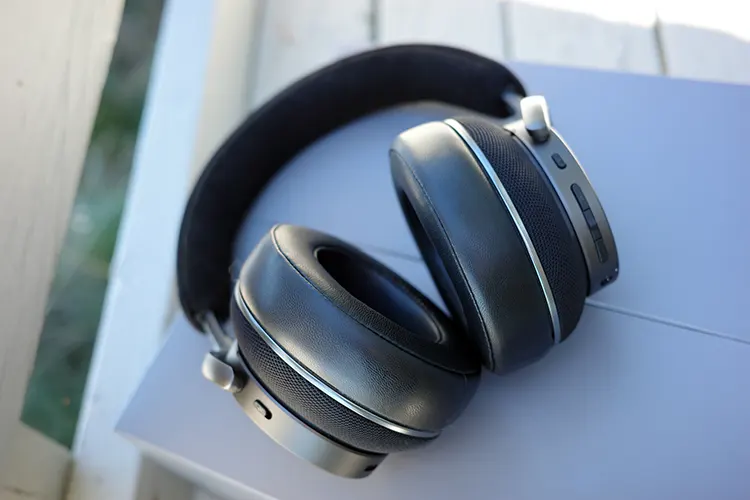
The frame is made of anodized aluminum with a tasteful silvery-gray finish, which combines nicely with the darker grays and black of the cups, pads, and headband. I do love the burgundy color of the Apollo Pro even more.
The soft, black, cushy ear pads are removable but required enough effort that I did not want to proceed any further. Combined with the black mesh pattern behind the cup, the fit and feel were very good, with excellent tactility.
The silvery-gray stanchions move into a single headband, which is wrapped in Alcantara, and has good tactility. The play in that headband was such that the Apollo formed easily to my head dimensions without too much or too little pressure.
I will note that for proper fit, I had the stanchions pulled out to within two notches of the maximum. This is the first wireless headphone that I have almost maximized for proper fit. The Apollo Pro followed the same adjusting scheme.
Control buttons lie on the right cup, and once acclimated to their proximity, are easily accessible. The ANC button, which moves between open, transparency (ambient mode), and full-on ANC, is separated enough so there isn’t confusion.
The three buttons below were equally easy to access, with the play/pause/BT connect/power on/off buttons raised for easy delineation. The left cup carried a single switch for activating the boom mic, which also attaches to that cup. No change in the Apollo Pro.
Performance
A preponderance of bass highlights a rich, full-noted signature from the FoKus Apollo. Herein lies the main difference between the two, with the low-end guttural response tamed in the Apollo Pro.
There is a bit of bleed into the lower midrange, but this can also be construed as a deft ability to add weight to the lower mids, masking what might be considered a bloated upper bass region.
That good heft down low translates into plenty of rumble when called upon. Gone is the bleed into the lower mids with the changed tuning of the Apollo Pro.
The upper midrange and treble notes deliver a distinct level of detail and clarity that is neither too thin in weight nor too elongated in either attack or decay.
A succinct character carries the top end, presenting a mostly open sound signature that can add spatiality to the character.
With a more vibrant character to it, slightly different from the “maturity” of the Apollo Pro, you immediately recognize the strengths of the Apollo across the board.
I can certainly appreciate both tunings and really cannot say I prefer one to the other.
Sennheiser MOMENTUM 5 Wireless
Features
The MOMENTUM 5 Wireless uses the same 42mm transducer driver as the MOMENTUM 4 Wireless, but with modified tuning.
That modification purportedly makes the 5 more natural sounding, with a slight increase in bass response. The Apollo Pro uses the dual drivers of a slightly smaller dynamic driver and the inclusion of the 14.5mm planar magnetic driver for the mids and highs.
The modified tuning and a reworking of the ANC technology inside lowers battery life by three hours, for a potential of up to 57 hours on a single charge. Losing three hours is no big deal to me when the flip side equates to better ANC performance.
The MOMENTUM 5 Wireless also comes with Qualcomm’s BT 5.4. Reportedly, BT 6.0 is in the works, bringing adaptive head movement technology. The Noble FoKus Apollo Pro falls back to BT5.3, but with many of the same codecs.
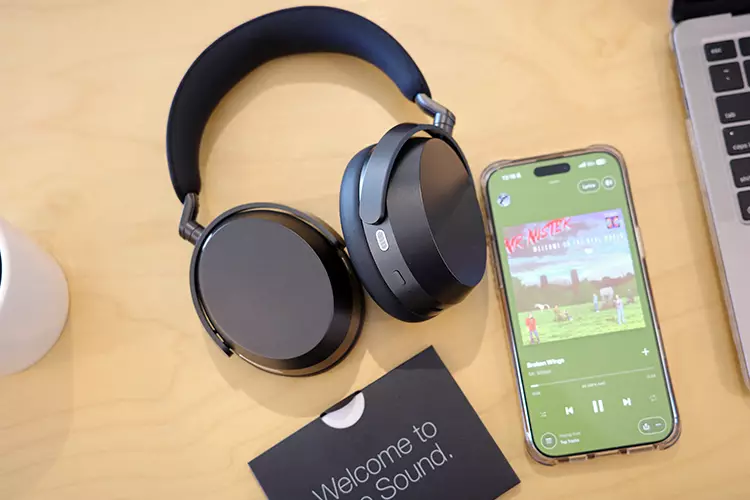
Customization through the app is quite good. Within the app, though, Sennheiser has opted to license Dolby® Atmos surround sound. The Noble app is much more rudimentary in nature.
Where other companies use in-house proprietary surround for a 3D effect, Sennheiser went straight to the source and licensed the Dolby version.
Smart thinking in my book. This does help to enhance the sound capabilities of the MOMENTUM 5 Wireless, while the Apollo Pro relies upon the headphones’ tuning.
As with most wireless headphones, a 3.5mm aux cable and a USB-C to USB-C cable are included for wired usage. You can charge and listen simultaneously. The Noble adds a 4.4mm right-angled balanced adaptor for good measure.
The right ear cup acts as the control center for functionality. I can say that the MOMENTUM 5 Wireless functions more smoothly than previous Sennheiser iterations. All controls are physical buttons on the Noble FoKus Apollo Pro.
Design
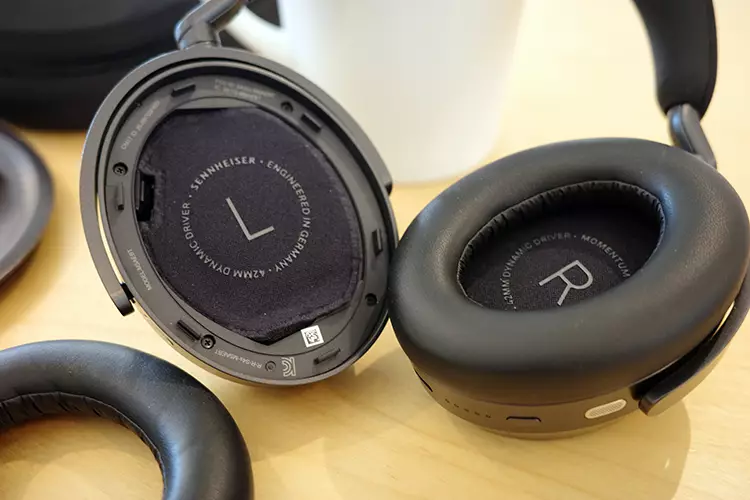
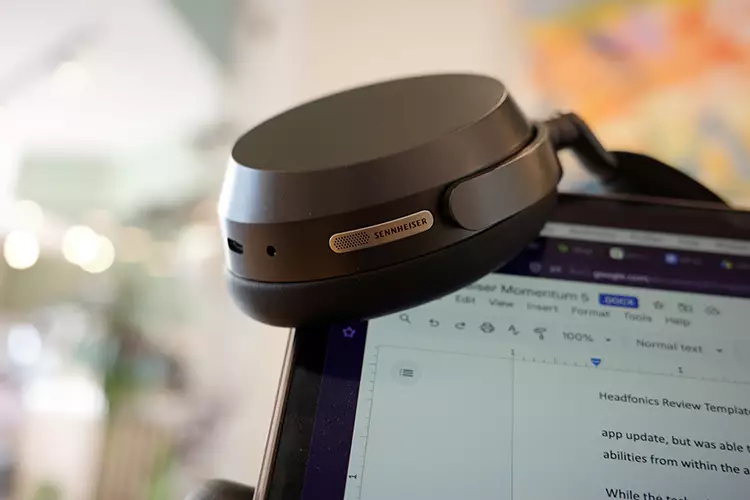
The MOMENTUM 5 Wireless looks and feels more upscale compared to the previous iteration. But it falls short of the luxurious look and feel of the Apollo Pro.
With slide-out stanchions on the headband, you do need to eyeball each side to ensure an even fit. The cups are a bit smaller, too, which makes for a snug fit on my average-sized ears. The Noble FoKus Apollo Pro has audible clicks for adjusting purposes.
Some who have larger ears may find the ear cup constricting as a result. The MOMENTUM 5 Wireless also incorporates four microphones for not only calls, but ANC performance as well. The Noble, on the other hand, fit more comfortably on my average-sized ears.
The dark gray and black look subtle and mainstream, which I do not mind. I prefer not to draw attention to my devices. That said, there is no denying the luxury-level look and feel of the Apollo Pro.
The underside of the headband is a hard rubberized coating, with padding only in the top half, like the HDB 630. This is where the main pressure points usually are, so it works. The Noble provides a solid but cushioned feel across the whole of the underside.
The quality of parts is very good, with no cheapness to any of the build. Sennheiser’s products have traditionally been of top-class build, so it’s nice to see this continued in the MOMENTUM 5 Wireless.
But the difference in price points can be discerned simply by looking and touching both.
Performance
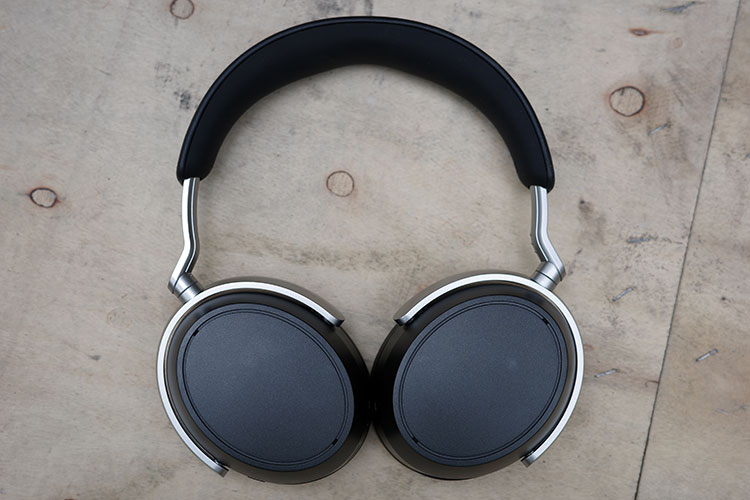
When in BT mode, the MOMENTUM 5 Wireless presents a neutral signature, with a slight push in the mid bass, and a nicely rounded, smooth upper end. The Noble FoKus Apollo Pro presents a smoother quality to the sound, with added maturity.
The lack of true extension did not make the MOMENTUM 5 Wireless suffer from a stuffy upper region.
Instead, the top end came across with alacrity and a smooth texture to it that pervaded a rich signature, albeit not one that exudes an overall warmth countering the neutrality.
While somewhat similar in nature, the Noble FoKus Apollo Pro presented better detail, even with the smooth signature.
In USB-C mode and Tidal, there was a preponderance of low-end, especially since Tidal pushes that region.
In those situations, the bass did become a bit bloated, but I blame Tidal for that, not the MOMENTUM 5 Wireless. The “bloated” low-end of the Noble has been smoothed to meld well with the lower midrange.
The midrange comes across as centered and central, with no push up or forward. To me, this was a refreshing take on the mids, since many headphones today push the mids to the front or up to help expand the soundstage.
The move forward of the Noble tuning sits slightly more frontal than the Sennheiser, but not to the point where it becomes shouty or demanding.
Speaking of which, the soundstage was pleasantly 3D, but not expansive. You certainly know this is a closed-back wireless headphone, and I do think it falls a bit short of the competition.
The Apollo Pro seemed a bit wider and certainly taller than the Sennheiser, with both having nearly equal amounts in depth.
Sennheiser HDB 630
Features
The Sennheiser HDB 630 wireless headphones use a 42mm dynamic driver (produced in the company’s Tullamore facility in Ireland), which is slightly larger than the Noble FoKus Apollo Pro’s 40mm dynamic driver.
But the inclusion of the 14.5mm planar magnetic driver runs the mids and treble for the Noble offering sets it apart from the Sennheiser offering.
Full support for aptX Adaptive, SBC, AAC, and mSBC is included courtesy of Qualcomm’s Bluetooth 5.2 chip, with up to 24-bit/96kHz resolution. The Noble FoKus Apollo Pro uses BT5.3 with similar codecs.
Both come across as easy to drive (when wired), reaching quite loud volume levels when the source could provide the energy.
With carefully tuned acoustic treatments, precision of reproduction is emphasized, mimicking wired performance. Wireless, the amplification of the Noble pulled slightly ahead.
Two microphones per side, “beamforming” for noise reduction, provide top-quality voice technology for use with your phone.
Our son was able to hear me quite well, with minimal wind noise on a blustery Lake Superior day, with the wind cutting right into me. The performance of the Noble in this same scenario never caused an issue.
Design
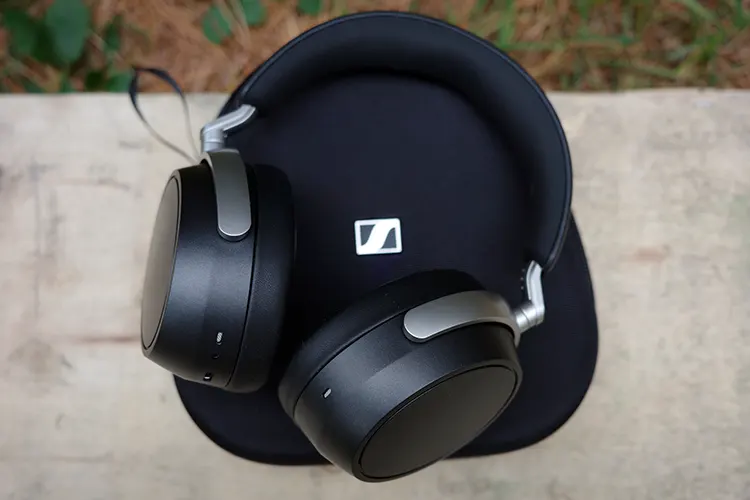
The immediate feeling of quality came to mind when I opened the HDB 630 box. And higher quality than the more plastic MOMENTUM and ACCENTUM variants, which, of course, have a designated price point to hit.
This is where the Sennheiser comes close to the Noble, and its upscale qualities show forth.
The luxurious feeling is reminiscent of a competitor, but with the Sennheiser flair for efficiency and good looks. There is definitely a Germanic flavor to the design and efficiency. The Noble FoKus Apollo Pro still resides a tier or two above, as one might expect.
The headband replaces the Kvadrat fabric with a pleather one (IdeaTex) and adds more padding on the underside.
I appreciated this additional material for comfort’s sake and the quality of the build. I do prefer the complete cushioning across the Noble.
A simple single-band approach is still used for the headband, but the additional padding, along with the material change, makes for a thoroughly positive response.
The “memory” feel of that extra padding helps to form fit to the user’s head, if you like. This is better than the MOMENTUM series, and shows the HDB630 sits a level or so higher.
Performance
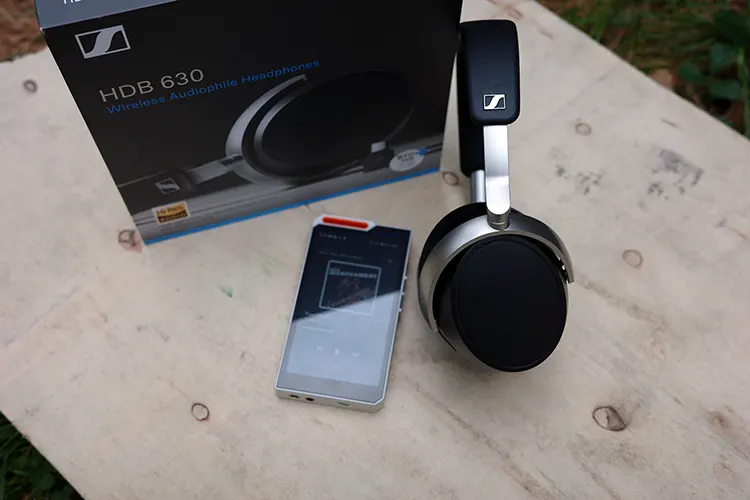
Bass comes on as controlled, but not reaching overly deep unless the song builds that into the mix. The midrange sits slightly forward, but not elevated, which is a nice change. Running stock, the Noble FoKus Apollo Pro’s low-end runs circles around the Sennheiser.
The treble extension is nothing to brag about, but it does not become piercing either, thankfully. I found that extension allowed the music to spread out, adding to the depth of layers, giving a note that benefited in weight.
The two are quite similar, with the Noble presenting slightly more of a smoothing effect, which may or may not be to your liking.
The HDB 630 soundstage comes across as a smaller venue-oriented, but with good height. That height makes sense, since the top-end extension allows for the spatial capabilities.
The Noble FoKus Apollo Pro comes across as more expansive, but not so much as to thin note quality.
That expansiveness pairs with the smooth nature of the sound signature to fill the potential voids such a large soundstage might present.
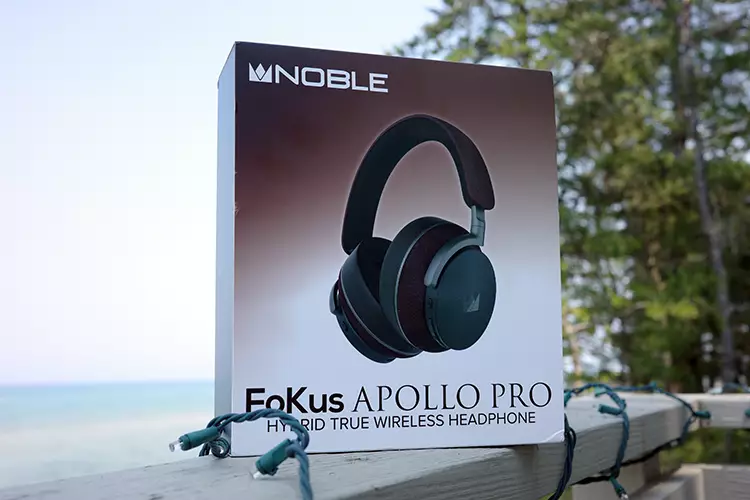
My Verdict
The Noble FoKus Apollo Pro isn’t necessarily a revolution from the original Apollo, but rather an evolution, or tweaking of the sound.
This is like car manufacturers offering various tunes to a certain model. Neither one may be better than the other, but for different tastes.
That said, the Noble FoKus Apollo Pro tames some of what may be called the “unruliness” of the Apollo. The bass has been dialed back, but it does not lose its character. There is plenty of grunt down low, but without intruding upon the midrange now.
The more mature tuning is also smooth and rich, but without losing its characteristic detailed qualities. Sometimes, when a sound signature is smoothed, it becomes boring or lacks energy.
Not so with the Apollo Pro, as the vibrant tendencies still shine, coexisting with the smoother signature to present a coherent signature that is pleasing for long periods of time.
If there are any downsides, it may be that the Noble FoKus Apollo Pro is a limited run and has already sold out. Another may be the “almost” lack of fit some may encounter with the stanchions completely pulled out.
But that does not dissuade me from liking the overall characteristics of the Pro, from build to sound. It is indeed an evolution of an already superb unit, and one that most certainly will stand upon its own merits.
Should you replace your current Apollo? Well, that is kind of a moot point since it is already sold out.
Noble Audio FoKus Apollo Pro Technical Specifications
- 40mm Dynamic Driver
- 5mm Planar Magnetic Driver
- Bluetooth Version: 5.3
- Chipset: Qualcomm QCC3084
- Bluetooth Profiles: A2DP / AVRCP / HFP / HSP / SPP
- Supported Codecs: SBC / AAC / aptX / aptX HD / LDAC
- Operating Range: 10m
- Multipoint Connectivity
- 1000mAh Li-ion Polymer Battery
- Up to 80 Hours Playback (ANC Off)
- Up to 60 Hours Playback (ANC On)
- Charging Time: Under 3 Hours
- Standby Time: Up to 1000 Hours
- Weight: 327g
- Dimensions: 19.5 x 17 x 8.5 cm
- Improved Leather Ear Pads with Premium Velvet Cushioning
- Smaller, More Compact Carry Case
- Detachable 3.5mm Cable
- Enhanced Boom Microphone
