

Synergy
Efficiency
I tested background noise using highly sensitive IEMs. With the sensitive HiBy ZETA, the X8 automatically selects low-gain. In a quiet room, some audible background hiss becomes noticeable if you listen carefully, though it may become negligible once music starts playing.
With ultra-sensitive IEMs such as the Andromeda or sensitive CIEMs with a better seal, this hiss can be more apparent. Overall, the X8’s design appears better optimized for headphones above 16Ω or those that benefit from higher output voltage swing.
That said, the X8 remains impressively quiet with sensitive portable headphones like the Meze Audio 105 SILVA, which helps preserve perceived dynamics.
With 32Ω or above designs and the corresponding gain levels, the background also remains dark, and dynamics feel stronger.
Power
The X8 is not the most powerful amplifier on the market, but it has sufficient swing and current for most vintage headphones and newer models to sound enjoyable. Especially after some EQ-ing that cancels out the potential for impedance mismatch.
The 3 stages of gain on the X8 are nicely set so it can cater for sensitive headphones, common 32Ω headphones, and some harder to tame beasts with its full power at the highest gain level.
To me, it works best with moderately sensitive gears to sound more engaging and detailed, and some stronger loads like HIFIMAN Isvarna may sound slightly soft in the punch, yet it is still relaxing and polished in the upper end.
The MOONDROP COSMO does not sound veiled, but it struggles slightly with layering and dynamics. This is especially apparent when compared to amplifiers like the Luxman P750u, which offers ample current output.
However, the equalizing feature significantly improves the experience, making the sound much more euphonic. It outlines the mids with superior clarity and provides a firmer kick in the lows compared to other gear in the same class.
Pairings
The X8 performs well with moderately power-hungry headphones. It delivers a wide, expansive soundstage, relaxed yet punchy bass, and good energy in the upper vocal range.
EQ makes demanding models like the HIFIMAN Susvara more euphonic and dynamic. Ample power tames and cleans up the bass-heavy tuning, and a modest upper range lift creates a less lean, airier, and more balanced presentation.
For current demanding headphones like the MOONDROP COSMO, manually switching to higher gain further boosts dynamics without sharpening treble.
High impedance models like the Sennheiser HD 800S also benefit significantly. DSP and EQ add dynamics, cleanliness, vividness, clarity, and spaciousness.
Compared to stock tuning, articulation becomes more natural. Bass resolves more cleanly, and the overall sense of detail improves.
Quick AI prompts to mimic the HD800, such as boosting the 6kHz range for extra air, deliver noticeably airier results without introducing distortion. While many devices offer parametric EQ, few match the X8 ease and precision.
With unregistered models like the Meze Audio Strada, default tuning can sound slightly flat. Manually applying the Harman target curve boosts clarity, definition, and vocal presence while keeping treble energetic yet controlled.
Prompting the AI to emphasize vocal frequencies, especially for darker voices, adds welcome weight and fullness. Similar tweaks can crisp up transients, add subtle bass, and tame spikes across various gear.
The X8’s rich, practical DSP features, including crossfeed, enable excellent synergy with diverse driver configurations and headphone types. Though further fine-tuning is preferred sometimes, in most cases, within 1-2 prompts, it makes different gear sound more balanced and enjoyable.
There is no steep learning curve. Also, switching between saved profiles is instant, making it highly practical for users with multiple active headphones.
Selected Comparisons
Luxsin X9
Technical
The Luxsin X9 features dual AKM AK4499EX and AK4191EQ flagship DAC chips with femto clocks, supporting decoding up to PCM 768 kHz/32‑bit and native DSD512.
It features a precise R-2R volume control with excellent channel matching, and the fully balanced amplification circuitry employs OPA1612 op‑amps and a TPA6120A2 for high‑current output.
While the output power for the X9 is lower than that of the X8, with 2,650 mW per channel into 16 Ω in balanced configuration, or 3,000 mW into 32 Ω, other measurement figures are superior, including an SNR greater than 128 dB.
The X9 also supports HDMI ARC connections, which are not available on the X8, but it does not support I²S connections or the AI‑EQ features that were added to the X8.
Design
The design language is consistent with the key differences being just color and size. Both devices are very compact, but the X9 clearly feels heftier.
With the same screen size but in a smaller body, the X8 retains the smooth operation experienced on the X9.
The AI EQ feature makes shaping the output straightforward and more enjoyable than using presets alone. It feels more practical than expected, allowing targeted tweaks without overly coloring or exaggerating specific frequencies. X9 users may as well enjoy the same feature.

Performance
Compared with the X9, the X8’s higher output and absence of an R2R volume stage shift its tonality. Sound is more vivid and full, with the mids colored warmer, and with added body to vocals, also smoother transients for a more relaxed presentation.
Direct A/B testing with balanced terminated gears reveals distinct personalities. The X8 feels more mellow and reveals in the upper registers, with a more rounded, more open presentation.
In contrast, the X9 delivers sharper definition, superior tonal accuracy, and greater authority overall. Bass performance further highlights the divide. The X9 offers denser, more weighted low-end with richer detail, deeper extension, and firmer, more impactful attacks.
With roughly 40% more output power on the single-ended output, the X8 proves more forgiving and friendly with older or harder-to-drive headphones.
On the classic AKG K701, for example, the X9 excels with faster transients and tighter bass control. Yet the X8 sounds lusher and more vocal-forward, adding emphasis on overtones and air in a way that injects extra energy and vividness, making it more engaging and fun.
Even when both units are dialed to an identical EQ curve, differences remain audible in note weight, overtone richness, and overall response speed, particularly in the bass.
The X9 consistently provides a darker, blacker background, better bass definition, and stronger dynamics across all gain settings, making it the clear choice for listeners who prioritize clinical clarity and precision.
With DSP features, tuning can be adjusted to very similar levels on both. You get what you pay for in decoding quality, but the X8’s stronger raw power and AI-EQ access give it a real edge when compared to others under the same price bracket.
D&A Alpha Pro
Technical
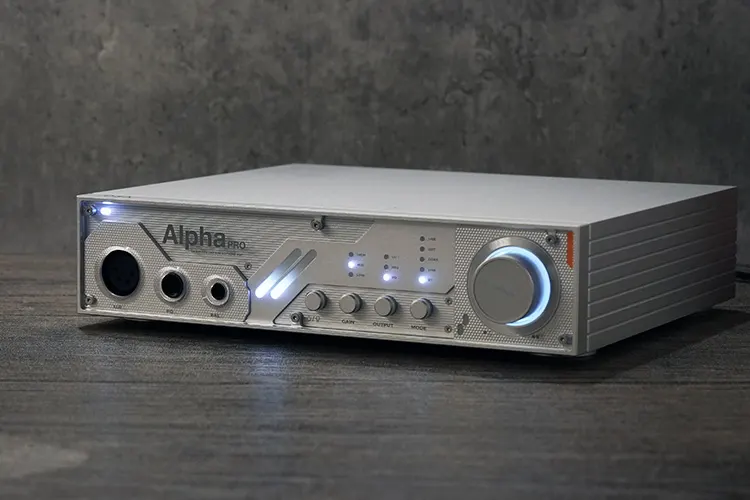
The D&A Alpha PRO flagship decoder and amplifier features the ESS Sabre ES9039MSPRO DAC chip configured in 8-channel differential summation, supporting PCM up to 768 kHz/32-bit, native DSD512 decoding.
The Alpha PRO can deliver 6000 mW per channel with 32 Ω balanced loads and has less than 0.1Ω output impedance and 0.0001% THD measured. The line output offers up to 133 dB dynamic range and -124 dB THD+N, which is decent.
Design
The Luxsin X8 and D&A Alpha PrRO embody two distinct philosophies in the modern desktop DAC/headphone amplifier space, each offering compelling performance while appealing to different listener priorities through their unique sonic signatures and hardware combinations.
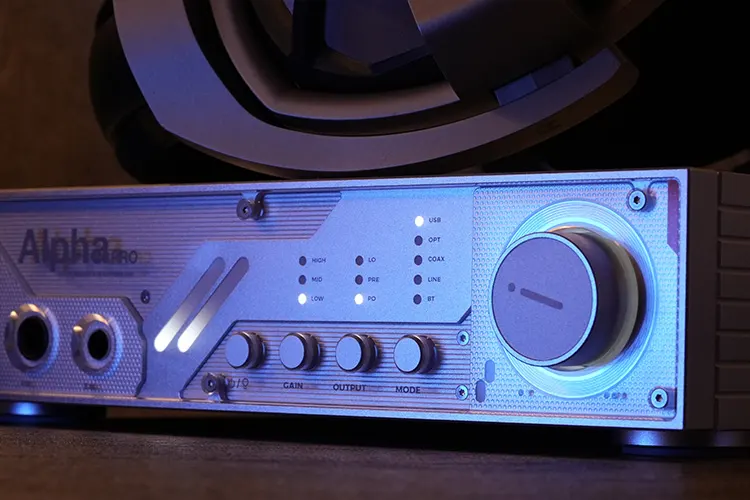
The X8 comes closer to the size of the Alpha PRO compared to the X9, and both designs feel very solid and cool in their own ways.
With a screen on top, the X8 offers a comprehensive set of software features, while the Alpha PRO focuses on a cool light and a future-proof design, with no tweakable tonal profiles.
The X8 also supports IIS and app control over Wi-Fi, though it doesn’t have an analog line-in like the Alpha PRO does, as well as a phono input that supports direct connection with turntables.
Therefore, it depends on whether you want to connect the DAC to your analog gear or focus on digital inputs/outputs.
Performance
The Luxsin X8 emphasizes flexible, musical tuning through its custom DSP and AI-assisted parametric EQ.
It delivers a smoother, more vocal-revealing presentation with an expansive soundstage, enhanced air, fuller mids compared to the D&A Alpha Pro, all without sacrificing dynamics.
The X8 feels smoother overall, though slightly less layered in the bass. It sounds livelier and more expansive, drawing greater attention to vocal details.
In many pairings, bass instruments emerge more pronounced with elaborative decay, while vocals appear less sharp and more naturally outlined than on the Alpha Pro.
By contrast, the D&A Alpha PRO leans toward a neutral, technically proficient signature with superior speed, precision, and transparency.
It offers tighter transients, denser bass, faster decays, more conservative overtones, and a cleaner, uncolored vocal range that maintains strong dynamics even with complex multi-instrument backings.
This controlled, resolving character works better with sensitive IEMs and small headphones, where it adds bass texture and delivers a more precise yet commanding presence with large ensembles.
However, details in vocals and instruments across the mids may feel more restrained than the expressive X8.
While the Alpha PRO maintains a technical edge in resolution, spatial positioning, distortion control, and transient performance, the X8 counters with its expansive soundstage, greater tuning flexibility, and powerful AI-EQ customization.
This combination often delivers a more relaxed, immersive, intimate, and engaging listening experience.
The Alpha PRO stands out as the stronger choice for raw technical quality, particularly with sensitive IEMs and headphones. On Bluetooth connection, it displays a stronger resolution in the output, and it also works great as a pure amplifier via RCA input.
However, if you seek an all-in-one solution for relaxed listening or prioritize tonal balance and musical presentation over technicalities, the X8 proves more convenient and versatile.
My Verdict
AI once felt like a gimmick, yet with Skynet-like fears looming on the horizon, we might as well enjoy chatting with AI assistants for better audio experiences right now.
Frankly, Luxsin has exceeded my expectations by pushing far beyond the standard PEQ and DSP found in most desktop or portable DACs.
The X8 marks the introduction of the world’s first truly commercial interactive AI-assisted EQ platform, letting you apply precise parametric filters in seconds for natural, coherent, and highly resolving improvements.
Pre-loaded profiles and over 2,500 headphone presets are handy, but the real magic is on-demand customization, which helps correct known issues without making the sound lean, veiled, or artificial.
Far from gimmicky, it’s more enjoyable and intuitive than anticipated, as it eliminates the frustration of manually tweaking multiple EQ bands.
Even without the AI or advanced DSP, the X8 remains a versatile performer thanks to its HP-EQ capabilities and vivid, expansive tuning.
The intelligent EQ pushes the bar to the genuinely exciting and user-friendly territory, making the X8 an ideal choice for anyone craving an expansive stock tuning, and curious about the customizable listening experience, but hesitant to dig deeper into the complex controls of PMEQ.
Luxsin X8 Technical Specifications
- Dimensions: 236 × 236.8 × 64 mm
- Weight: 2.75 kg
- DAC: 8 × Cirrus Logic CS43198
- Decoding: PCM 768 kHz/32-bit; DSD512 native
- Digital input: USB-B, USB-C (OTG), IIS, Coaxial (192 kHz/24-bit), Optical (192 kHz/24-bit),
- Bluetooth: 5.1
- Outputs:
- Line/Pre: Balanced XLR, RCA
- Headphone: 6.35 mm SE, 4.4 mm balanced, 4-pin XLR balanced
- Output Impedance: <1Ω for all PO
- Balanced (4.4 mm / XLR):
- High Gain: ≥4840 mW + 4840 mW @ 16 Ω; ≥4300 mW @ 32 Ω; ≥950 mW @ 300 Ω
- Single-Ended (6.35 mm): High Gain: ≥2900 mW + 2900 mW @ 16 Ω; ≥1750 mW @ 32 Ω; ≥230 mW @ 300 Ω
- SNR: ≥129.5 dB (XLR), ≥124.5 dB (RCA)
- THD+N: < -121.8 dB (XLR), < -120 dB (RCA)
- Noise Floor: <1.1 µVrms (XLR), <1.3 µVrms (RCA)
