


Synergy
On my days listening to the Halcyon, during a walking exercise, in a coffee shop, or at home, it never caused any noise in all the sources I paired it with; the cable never picked up any radio frequency interference and is not sensitive enough to allow the sources’ noise floor to be heard.
Halcyon is fairly sensitive and easy to drive. I haven’t heard any sources, including those not included in this review, struggle driving the Halcyon.

Pairings
That said, the Halcyon pairs very well with the iBasso DC-Elite, which has a modest 280 mW maximum power. It reveals the subtly U-shaped sound signature of the DC-Elite, as well as its highly detailed sound.
With the MUSE HIFI M6 Double in tube mode, the dynamics are effortless, and the sound can reach very high levels without distortion or compression. The Halcyon easily reveals the tubey yet controlled sound of the M6 Double, resulting in a musically fulfilling sound quality.
Finally, with the FiiO M15S, I hear a highly dynamic sound with punchy, tight, extended bass, a slightly forward midrange, and a slightly relaxed yet extended treble. This is what I have always expected M15S to sound like when paired with a highly revealing IEM.
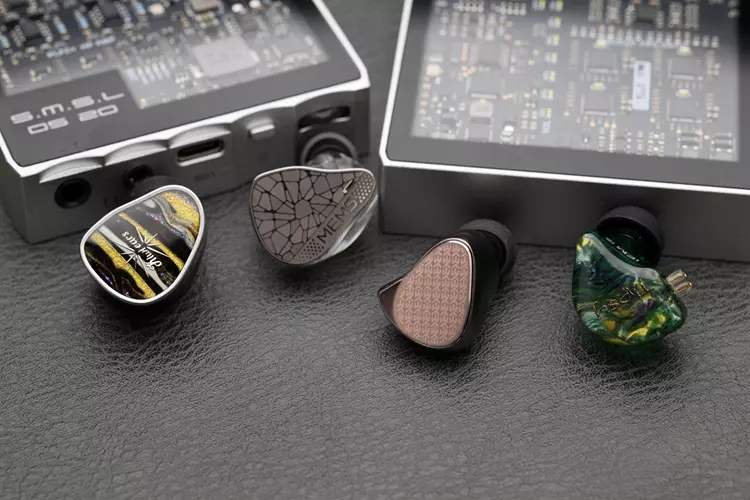
Selected Comparisons
I use my usual sources for this comparison: the iBasso DC-Elite, MUSE HiFi M6 Double, and FiiO M15S, and I often switch between them.
Still, I use the iBasso DC-Elite mostly for this comparison because I can discern differences more easily with its detailed, transparent sound, and it can drive all these IEMs easily.
Tipsy M3
Technical
The Tipsy M3 is a hybrid IEM with a single 9.2mm PET-titanium-coated dynamic driver and two customized composite balanced armature drivers.
An independent tri-band acoustic partitioning design ensures precise separation between lows, mids, and highs.
The M3 features a precision hand-finished faceplate that is sweat-resistant up to IPX4, but I would avoid getting the nozzle wet. Sensitivity is listed as 105 dB/mW, and its impedance rating is 17 Ω, which means it’s not hard to drive but not super-sensitive.
Design
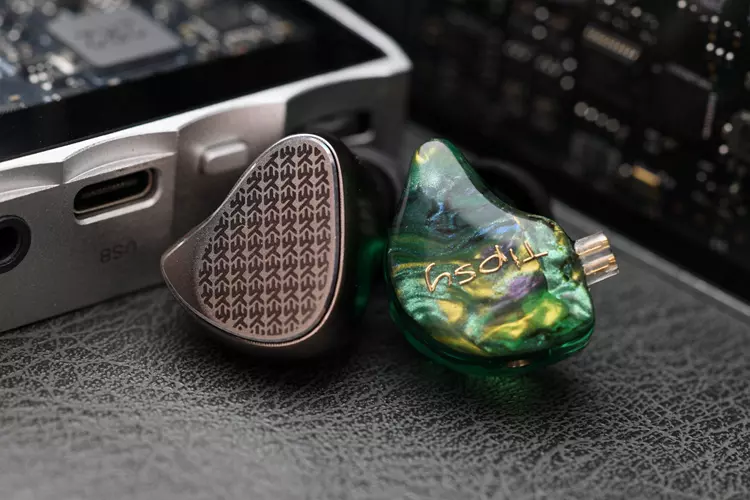
The M3’s shell is a 3D-printed resin, hand-painted with Light-reactive artistic designs crafted for uniqueness and visual depth.
The M3 uses metal nozzles with edge lips to prevent ear tip slippage, covered by a perforated metal grill. There is a small hole near the nozzle and a bigger vent with a horn-shaped gold orifice near the QDC type 2 pin connector.
Performance
The M3 has a classic V-shaped sound, with deliberately boosted sub-bass, mid-bass, treble, and upper treble, and a recessed midrange, resulting in a bassy, warm low end with forward-sounding highs.
In comparison, the Halcyon has an equally boosted sub-bass but a leaner upper bass, resulting in cleaner but less dense upper bass. Treble in the Halcyon is more relaxed, only in the upper treble, where it is boosted.
The Halcyon has a marginally larger soundstage in every direction; however, when it comes to imaging,
The M3 has more definition and holography, especially in the center vocals, which float in the middle front of the stage. In contrast, on the Halcyon, they are more blended with the background instruments. This gives the M3 a more realistic image.
Both are dynamic-sounding, but I find the M3’s fun V-shaped sound more energetic and lively. Both have no issues at high volume, as they can handle high power and remain loud without entering distortion or compression.

Kiwi Ears Étude
Technical
The Kiwi Ears Étude is a tribrid IEM that uses three types of transducer technology.
It features a 10mm Beryllium-plated diaphragm subwoofer that operates below 250Hz, a balanced-armature driver for the midrange, and two balanced-armature drivers for the treble.
Additionally, it has a vibration driver known as the Kiwi Vibration Transducer. Étude has a sensitivity of 104dB SPL/mW and an impedance of 5Ω.
Design
An attractive faceplate covers the backs of the shells, featuring a silver metallic edging, an artsy stripe pattern reminiscent of Jupiter’s surface, and the metallic Kiwi Ears logo at its center.
I like how Kiwi Ears spent resources in making the IEM look good, considering its entry-level price and innovative use of various driver technologies. Instead of making so much effort to make the packaging and accessories look expensive.
Performance
The Étude is near-neutral in tuning, with added bass thickness from the Kiwi Vibration Transducer (KVT). Étude has an even balance among the bass, midrange, and treble, and sounds clearer overall.
In comparison, the Halcyon has a recessed midrange, letting the sub-bass and upper treble somewhat dominate the music, or at least they sound more prominent.
Étude has a slightly bigger soundstage, and thanks to its flatter perceived frequency response, the imaging is better as well. Étude has a more defined image and is more holographic-sounding.
Both sound dynamic, but I find the Étude livelier, especially in the midrange. Both can take a lot of power and can go loud without distorting or compressing.
Binary Audio EP321 MEMS
Technical
There may be some debate as to why Kiwi Ears claims that the Halcyon is the “World-first Tribrid MEMS implementation” since the Binary Audio EP321 MEMS is a six-driver-per-channel MEMS tribrid setup.
It features a 10mm actively driven dynamic, a 6mm passive dynamic driver, three balanced armature drivers, and one Direct Drive MEMS Driver Unit.
Upon further searching, it turns out that the EP321 MEMS is the world’s first IEM to use Direct Drive MEMS drivers.
All these drivers are frequency-divided by a three-way electrical crossover. The EP321 MEMS has an impedance of 13Ω and a sensitivity of 122 dB/Vrms.
Design
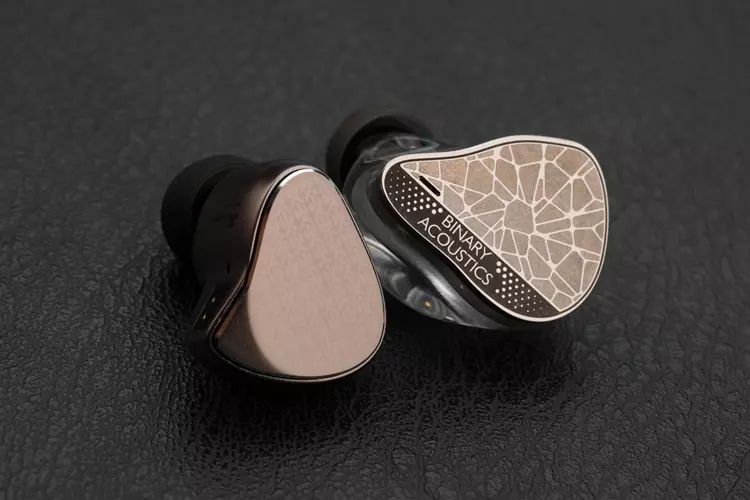
One of my favorite IEM designs is clear 3D-printed shells with a metal or opaque faceplate.
Especially when the IEM is a hybrid with many drivers, I like how I can look closely at the EP321 MEMS shells and see all those drivers and the sound tube that guides the sound to the ear canals.
I also like the way the CNC-machined stainless-steel faceplate is finished, where, depending on the angle of light, the iridescent colors change.
Performance
The MEMS driver requires a higher voltage and a step-up transformer to incorporate it into a tribrid setup. And the first to do that is the Binary Audio EP321 MEMS.
Perhaps Kiwi Ears means that it is the world’s first in its particular configuration, and the EP321 MEMS has an additional 6 mm passive radiator; otherwise, their driver configuration is very similar.
The EP321 MEMS has a more neutral sound signature, with mildly boosted bass, a neutral midrange with slight relaxation in the upper midrange, and a very extended, slightly elevated treble.
In comparison, the Halcyon sounds darker due to its recessed upper midrange and lower treble, while having more sub-bass presence.
The EP321 MEMS has a wider stage, but is about equal to the Halcyon in depth and height. However, due to the EP321 MEMS’s more neutral sound, I find its imaging slightly better.
EP321 MEMS has slightly better edge definition, more space between the instruments, and better front-to-back layering.
Both sound dynamic and energetic, but I find the EP321 MEMS more so, due to its more forward midrange and treble presentation. Both can take a lot of power and go loud without distorting and compressing.

My Verdict
The Kiwi Ears Halcyon is delightfully comfortable to wear due to its compact size and lightweight. The fully aluminum alloy shell makes it feel very premium.
I like the incorporation of the MEMS driver and how it adds detail to the sound. I love the clean, granular, and detailed sub-bass quality, which is not too common in IEMs.
Kiwi Ears should have included medium-bore ear tips, as I find the wide bore too bland and the narrow bore too energetic in the upper treble, with a recessed upper midrange and lower treble, resulting in a so-so imaging performance.
As discussed previously, medium bore ear tips somewhat improve the staging and imaging.
Overall, the Kiwi Ears Halcyon MEMS tribrid driver IEM offers good sound, especially in the bass and treble, thanks to the sub-bass boost and the MEMS driver.
I would suggest it to listeners who like good-quality sub-bass, a laid-back upper midrange and lower treble, with extended highs.
Kiwi Ears Halcyon Technical Specifications
- Driver Configuration: 1DD + 1 MEMS + 3 BA
- Rated Impedance: 29 ohms
- Maximum Power Handling: 10mW
- Sensitivity: 109dB (at 1kHz/mW)
- Frequency Response Range: 10-42kHz
- Distortion: <1% (at 1kHz)
- L/R Channel Imbalance: <1.5dB
- Connector: 0.78mm 2Pin detachable
- Nozzle Diameter: 6.1 mm
- Weight: 5.8 mm
