


Sound Impressions
Summary
Every aspect of the sonic spectrum is somewhat replicating the previous Arya, but it seems closer to a type of U-shaped, more so than any other HIFIMAN headphones I’ve tested.
There is a balancing act in that there is a forward bright character, but the midrange has just the right amount of forwardness so as not to be considered aggressively tuned.
The Arya WiFi produces a full-spectrum sound that is possibly the best I’ve heard from a wireless headphone when running off a WiFi transmission, and very similar to running them off the included USB cable.
On Bluetooth, it’s very competitive for the top position as well, but the high frequencies suffer a drop in detail, comparatively.
I especially like the tall, almost boundless soundstage that puts everything in an almost pinpoint position. This is a correction that is a welcome one over the smeared soundstage produced by some bygone wireless headphones in the past that run Bluetooth and simple codecs.
HIFIMAN has been tuning their headphones in a manner that will please a larger number of listeners.
It veers away from the ultra-bright presentation to one that’s more balanced with a full-bodied bass, in line with the high frequency quantity, and midrange that is soft and pleasant with no apparent harsh spots.

Bass
The HIFIMAN Arya WiFi produces the lowest bass notes with an audible rumble. It presents bass with a strong presence, lots of depth, and eminence. It’s not a very punchy or thumpy bass, and the presentation is more of an audible experience.
The bass tuning over at HIFIMAN has taken a steer in the positive direction lately, and improved over the earlier HIFIMAN tuning in that the lowest bass notes took a back seat. Not here.
Here, they’re in balance with the rest of the spectrum, but slightly above the mids. It gives the Arya WiFi an overall sonic signature that has warmth, compared to, let’s say, an Ananda BT, or a DEVA, which are some of HIFIMAN’s other full-sized wireless, but bright-sounding cans.
The upper bass response is also up in production, bolstering the warm characteristic mentioned above that can be experienced on this headphone.
It’s a bass response that is produced with more weight, but there’s a slight tonality that sounds like a loose string. It’s subtle, but it’s there. It’s probably a lack of power since I’m used to listening to my set of Arya Unveiled with a monster 11.5 wats per channel amp, the SMSL SH-X.
Overall, the Arya WiFi’s bass response veers from the classic HIFIMAN signature and takes more of the front stage, and also produces low notes more generously from their first-generation headphones. Note distinction and speed of delivery are very good.
Midrange
The Arya WiFi produces a full-bodied midrange that doesn’t sound overly thick and is produced with lots of body and a wholesomeness that invites the listener to stay for a while, and is one of the areas that make this headphone an interesting listen.
The Arya WiFi takes a smoother approach and distances vocals and instruments just a few inches back, adding an interesting aspect soundstage-wise, and giving the overall tuning a balanced tuning with an ever-so-slight presence that makes them fun to listen to.
The mids tend to sound natural and organic, which is something that has carried on within the Arya line since its inception and that has gotten better. They’re not intense and never become abrasive, as certain frequencies on the Arya line can become pronounced.
On most Arya models, the areas between 2k and 5k were usually a bit predominant. However, on the Arya WiFi, they seem to be below that SPL level compared to, let’s say, the Arya Stealth or the Unveiled variant, and on par with their two neighboring frequency sectors within this set, promoting overall balance.

Treble
HIFIMAN cans usually do treble well, but they tend to represent a bright signature genre of headphones.
The Arya WiFi takes a more subtle approach on this front. The treble is lush rather than analytical with an airy aspect, but it’s kept under the intense threshold.
The high frequencies are inclined to portray realistic amounts of high frequencies, instead of the usual presentation HIFIMAN produced in the past. The sharp treble has been tuned here to favor authenticity, free from grit.
You can also say there’s sparkle without sibilance. Once you use Bluetooth, however, the treble gets darker.
The good part about that tuning is that it eliminates fatigue; however, the Arya WiFi highs remain audible to the point of easy note distinction, with earthy-sounding highs that are coherent and decipherable.
Staging & Dynamics
One of the best characteristics of the HIFIMAN Arya lineup has been its wide and rather precise soundstage. The Arya WiFi follows suit and supplies most of what the wired brothers produce.
If you’re on WiFi or on a USB connection, the soundstage is indistinguishably large as the Organic variant, but there’s an increase in smear, and some elements lose some of their solidity and focus, but that’s on Bluetooth, not on the other mentioned connections.
On WiFi, or fed by the USB cable, the Arya WiFi soundstage is focused. Since the width has a reduction in size over the other Arya models, I would say that the width has been reduced in this set compared to the other Arya models. It gives rise to a smaller projected area that decreases positioning detection.
Vocals take a strong position center stage, but they tend to come from the center of your head, instead of from the front area directly, which would more closely mimic a real-life singer that’s front and center stage.
Actually, there’s a sense of space produced by the Arya WiFi that assimilates a good set of speakers, properly placed, with an ample phantom center channel, and invisible speakers.
It’s spacious presentation, which tends to center itself inside one’s head with side pockets of microstaging areas.

Wireless Performance
Some apps, like Spotify, require a premium account to work with the Arya WiFi, and certain players, like Hi-Fi Cast, let you play internal files with some advertisements.
My favorite app that paired well with the Arya WiFi was BubbleUPnP, but it’s also a premium player that requires purchasing.
The only aspect that has to be improved upon here is that, up to now, HIFIMAN has not come up with a solid way to connect the Arya WiFi to a PC through the WiFi streamer. This might even turn out to be a deal breaker.
I was only able to successfully connect to the Arya WiFi by using an Android mobile device and specific apps.
Although the Arya WiFi claims to be fully UPnP-capable, the major challenge it presents to the user is the research they have to do in order to find what works and what doesn’t.
However, if you’re at a desktop PC, why not use the supplied USB cable? The volume becomes useful, and that undesired lack of precision from the volume control smooths itself out somewhat.
Selected Comparison
HIFIMAN Arya Unveiled
Technical
Let’s be frank here, there are not many WiFi-capable headphones out there. So let’s compare it to the most similar headphone to the Arya WiFi and brother, the Arya Unveiled.
I fully understand the Unveiled concept in that the design implementation allows the diaphragm to breathe freely, and that’s what helps the driver achieve a higher level of performance. It’s a simple but effective solution.
Design
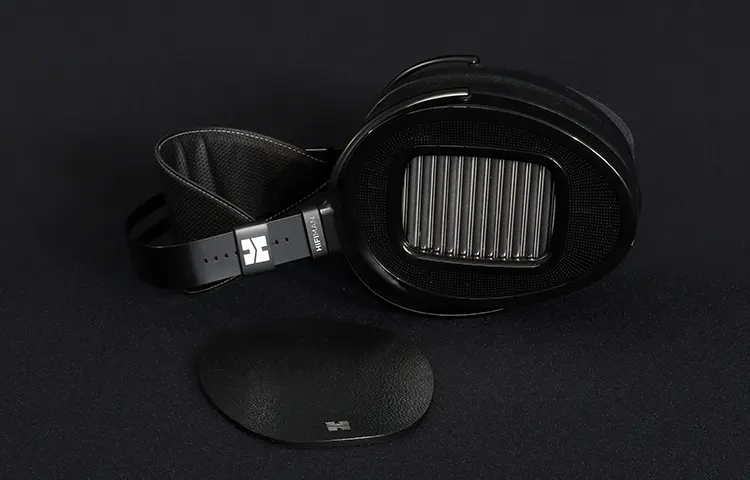
Both these headphones share the same headband assembly. The obvious change took place with the metal grill that was placed to protect the driver, whereas the Unveiled doesn’t have one.
The Arya WiFi cups did gain some girth, I’d say around 5mm, to accommodate all the electronics.
Although unnerving for some, the magnet assembly on the Unveiled is assembled as a tight array that prevents most items from being able to reach and perforate the thin diaphragm.
Of course, being a conventional headphone, the Arya Unveiled has 3.5mm connectivity at the cups, meaning you can get aftermarket cables and use any amplifier out there, raising scalability and versatility.
You could always get something like an iFi audio GO blu, a Questyle M18i, or a FiiO BTR17 to go Bluetooth wireless and feed the Arya Unveiled that way. There are no aftermarket additions that can turn them into a headphone capable of receiving a WiFi stream.

Performance
Of course, I prefer the Arya Unveiled sonically, but only by a small margin, and that’s because you can feed them with any full-sized DAC amplifier combo, like the SMSL SU-X and SH-X stack.
You can power them with a Topping A90 and a Centaurus DAC, or go portable with something simple like a Shanling UA7. The possibilities are endless.
Here, the Arya WiFi’s inherent functionality takes the user in different directions. The convenience of losing the umbilical cord and still obtaining an epic performance is worth a lot, and as you’re walking around the house, they become addictive.
The problem is that the fun factor of finding gear with excellent or interesting synergy is gone with the Arya WiFi. Although I do have to admit, the Mini Hymalaya DAC amplifier that’s inside the Arya WiFi does a very good job, sonically speaking.
The Arya Unveiled can produce a slightly wider and more precise soundstage, depending on what they’re fed with, and produces a larger amount of space. The Arya Unveiled also produces a bolder sound profile with more brilliance.
The bottom line question is, did HIFIMAN capture the essence of the Arya line in the sonic profile of the Arya WiFi? It’s about 95% there. But that small loss is a fair and acceptable tradeoff, I’d say.

My Verdict
The open-back planar HIFIMAN Arya WiFi could be one of the best-sounding wireless headphones to date because nothing on Bluetooth can match the sound quality of lossless audio via WiFi. Even on Bluetooth, it has a competitive edge over most others.
Yeah, there is that inheritance in that you can’t upscale by using high-end gear to feed them, and there’s a limited amount of support by paid apps, mostly.
But that’s the price you pay for the ability to lose the umbilical cord and still enjoy true lossless music with no boundaries.
Are we looking at the future of where headphone tech is heading?
Perhaps, but this is the closest a wireless format has come to being true lossless up to date, and as it stands, it takes the pole position in the wireless headphone segment, until something better comes along.
HIFIMAN Arya WiFi Technical Specifications
- Frequency response: 8Hz to 55kHz
- THD+N: DAC 0.00055% @9db, 1kHz
- DAC+AMP: 0.009% @32Ω 1kHz
- Channel separation: 105db @1kHz
- Net weight: 452g
- Operating modes: WiFi, Bluetooth, USB audio
- Battery life under WiFi: 6.5 to 7.5 hrs
- Battery life under Bluetooth: 23 hrs
- Charging time: 3 to 4 hrs
- Standby time: 30 days
- Audio formats: PCM 44.1k-768kHz 32/24/16 bit and DSD native 64-512
- Bluetooth codec: SBC/ AAC/ aptX HD/ LDAC
- Package contents: Headphones/w earpads, USB cable
