


Wireless Connectivity
FM Radio
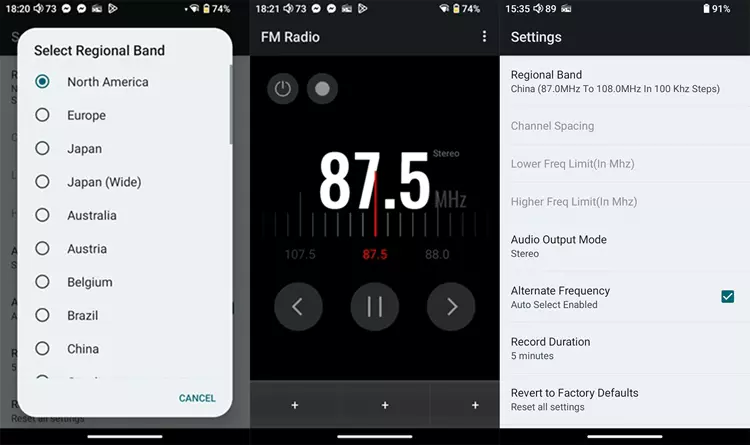
The M500 4G is equipped with an internal FM antenna, eliminating the need for an external antenna or an IEM plugged in to receive FM music.
However, of the 20 FM stations in my City, I can only receive a couple of stations in my room when no IEM is plugged in, using only the internal antenna in speaker mode.
I have to go outside to get a couple more stations with reasonable clarity, but I still can’t achieve a clean, stable reception. I would say the reception is not very good with the internal antenna.
When I plug an IEM into either the 3.5 mm or 4.4 mm output, reception improves a lot. Of the 20 stations, I can receive 11 with good clarity in my room at night.
The FM radio app allows you to record FM music for up to 5 minutes.
4G network
I transferred my SIM card to the M500 4G, originally thinking I could use it for calls and texts just like a phone. I can’t, as it turns out, there is no phone app installed.
Luckily, the M500 4G still rang when someone called me on that number, so I called back after transferring the SIM card back to my phone.
I put the SIM card back into the M500 4G after the call and used it as I would my phone.
I tried most of the apps I installed on the M500 4G using the 4G connection, including YouTube, Facebook, Messenger, Lazada, Shopee, etc. I experience very good signal reception, and the M500 4G works well, with no issues handling those apps.
In addition to this nice feature, M500 4G supports Wi-Fi Hotspot, which is very useful if you are travelling without Wi-Fi access. It allows other Wi-Fi devices to connect to the internet using the 4G network on the unit.
Bluetooth
The M500 4G features Bluetooth 5.0 transmission, which isn’t the latest but not very old either.
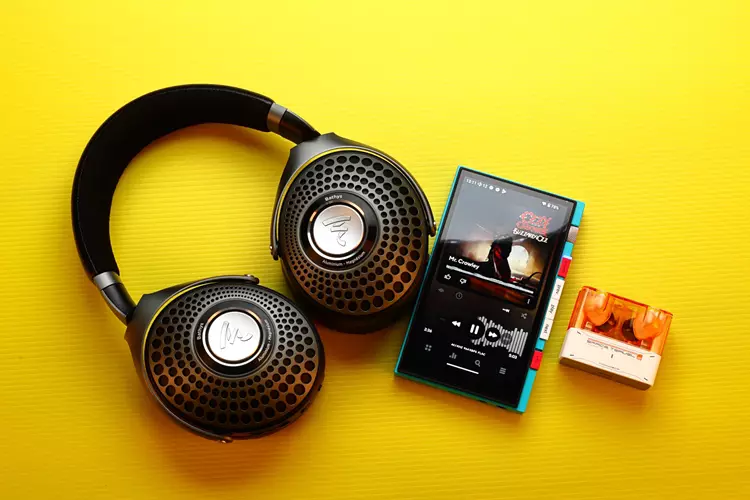
The subsequent connections after the initial pairing were fast with my Focal Bathys noise-cancelling wireless headphones and the MOONDROP Space Travel 2 noise-cancelling TWS, and latency was minimal when watching videos on the M500 4G.
The M500 4G supports various codecs, including LDAC, AptX HD, AAC, and SBC.
There is no need to select the highest-quality codecs, as the M500 4G automatically selects LDAC or AptX HD, depending on the connected device.
The connection has great signal strength, whether in my pocket or in the next room with a concrete wall; there were no signal interruptions. The signal would only cut off if I were far away, like 30 feet.
WiFi
The M500 4G supports both the 2.4 GHz and 5 GHz WiFi bands. I tested both connections on my WiFi router and found no issues.
The subsequent connection after the initial pairing is reasonably fast. There are no annoying delays with the WiFi speed when using music streaming Apps. As well as other apps, such as YouTube, Facebook, and Messenger.
Wired Connectivity
The M500 4G works as a transport or digital music source for some of my dongle DACs or battery-powered Bluetooth amps, but won’t work with others, including power-hungry dongle DACs like the iBasso DC-Elite and Cayin’s RU3.
This is not a deal-breaker, because honestly, why would I use a DAC dongle with my DAP? I don’t.
The M500 4G does not support DAC/amplifier mode, which is fine with me, as I never use any of my other DAPs this way.
Synergy
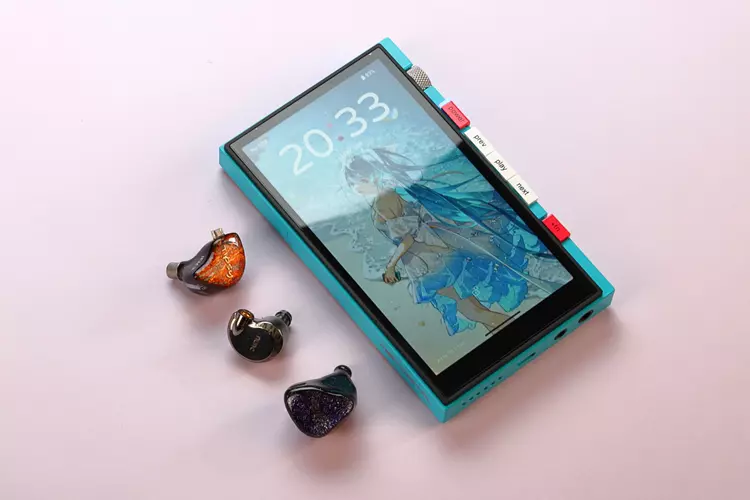
There is no noise with any of the Headphones and IEMs in this review; I couldn’t hear any hissing, clicking, or popping while operating the M500 4G. It is utterly clean and noise-free.
The M500 4G’s power output is more than enough to drive any headphones and IEMs to very high-volume levels, which exceed what my hearing can take.
Combined with its neutral, natural, and transparent sound signature, the M500 4G pairs nicely with just about any headphones and IEMs.
IEM Pairings
When paired with the M500 4G, the DUNU Falcon Ultra sounds the way it should: slightly warm and neutral, with good detail and imaging.
The bass is well-controlled, the resolution is high for a single dynamic driver IEM, and the dynamics are good.
With the Tipsy M5, the tonality is very neutral, with many micro details. The Tipsy M5 is a monitoring tuned IEM and is very revealing of the source’s sound signature.
Even with a bone-conduction driver, I hear a coloration-free, tight bass sound from the M500 4G when paired with the Tipsy M5, with good dynamics.
The QoA Martini employs a bone conduction driver that is more powerful than the Tipsy M5’s, but the M500 4G pairs very well with the QoA Martini; the bass is well-controlled and tight, and the sound and the background are very clean. The dynamics are very good.
Headphones Pairings
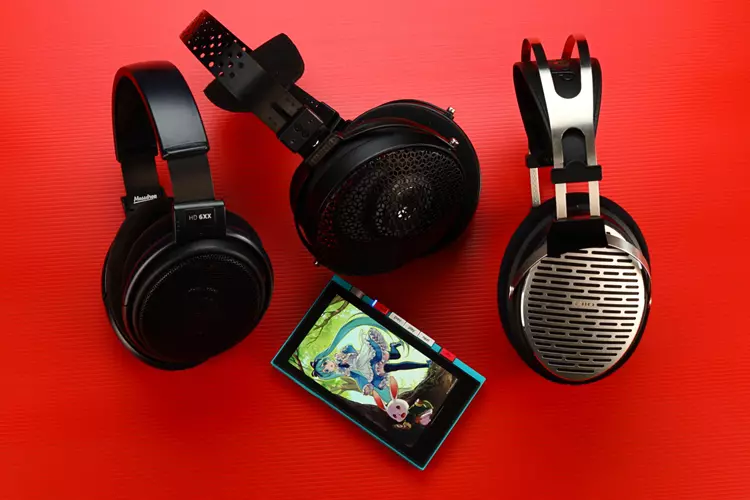
When paired with the FiiO JT3, the sound is very dynamic and lively, with a V-shaped signature. The bass and treble are joyfully boosted, adding life and musical engagement to the sound.
The M500 4G effortlessly drives the JT3, even with only the 3.5 mm connection, delivering excellent dynamics.
With the MOONDROP Horizon, the sound is warm and neutral, with a slight midrange emphasis and a polite yet extended treble. M500 4G can easily overload the Horizon even with its 3.5 mm connection.
Finally, with the difficult-to-drive Sennheiser HD 6XX, I set the gain to high and used the 4.4 mm balanced connection.
The sound is effortlessly dynamic; at 80 percent volume, the sound is very loud. The bass is tight and punchy, the midrange is clear, and the treble is lively and extended.
I must say, the M500 4G is one of the few portable audio devices I tested that pairs well with the HD 6XX, both in loudness and sound quality.
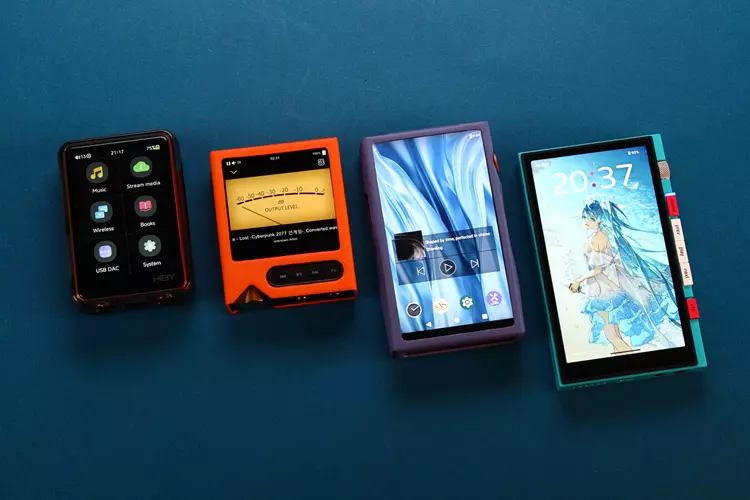
Selected Comparisons
For this comparison, I listened to all the headphones and IEMs. However, I decided to use mostly the Tipsy M5 for its near-neutral, monitoring-type tuning, which allows me to hear differences between sources easily.
Shanling M3 Plus
Technical & Design
The Shanling M3 Plus features the Snapdragon 665, 4 GB of memory, 64 GB of built-in storage, and Android 13.
It can transmit LDAC and aptX HD using Bluetooth 5.0. It uses a 4.7-inch touchscreen with a 1280 × 720 resolution that looks bright and clear.
4 x Cirrus Logic CS43198 digital-to-analog converter chips handle the signal conversion, followed by the dual SGM8262 amplifiers with output power of 800 mW into 32Ω balanced and 200 mW single-ended.
The M3 Plus has faceted curved sides, a knurled volume knob, and the mocha color shown in my review unit. The back is covered with a body-colored tempered glass panel.
The front has a SHARP-branded 4.7-inch touch screen. The M3 Plus measures 115 x 70 x 18mm and weighs 205g.
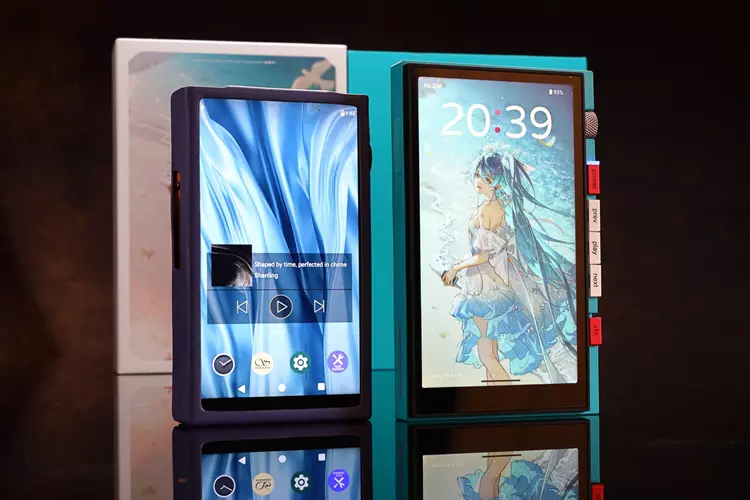
Performance
Both the M500 4G and the M3 Plus have a very similar, neutral, flat perceived frequency response.
The difference is that the M3 Plus leans toward a more analytical sound with tighter, leaner bass, while the M500 4G has looser bass and a less analytical sound.
In terms of soundstage, the M3 Plus has a wider stage, while the M500 4G has a deeper soundstage.
This gives the M3 Plus wider imaging panning, while the M500 4G has more front-to-back layering. Both are highly resolved.
Both the M500 4G and the M3 Plus are very dynamic-sounding and can easily drive all the headphones and IEMs in this review. Both are good pairings for the Sennheiser HD 6XX.
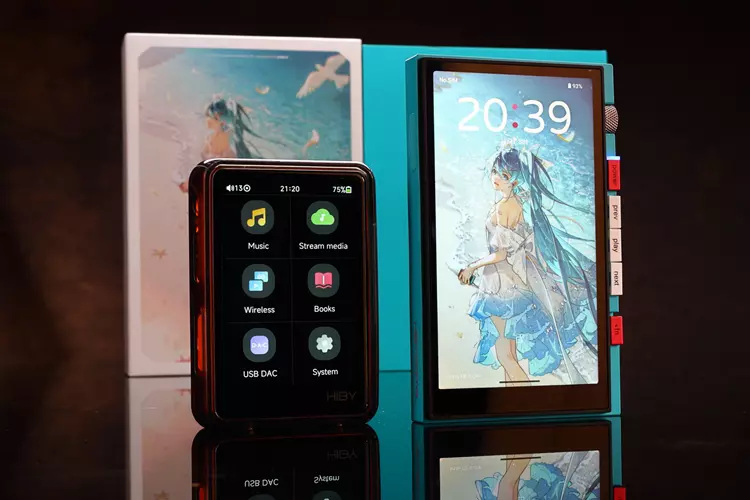
HiBy R3Pro II
Technical & Design
The HiBy R3Pro II uses a dual CS43198 DAC chipset and 4x OPA1622 headphone amplifier chips.
It features a switchable NOS (non-oversampling) mode. HiByOS features an equalizer and the well-loved sound-enhancing interface, MSEB.
There is support for Bluetooth 5.1 with LDAC, APTX, UAT, AAC, and SBC, and WiFi via AirPlay, DLNA, and HiByLink.
Output power is 480 mW per channel for the 4.4mm balanced output and 121 mW per channel for the 3.5mm single-ended output, both at a 32 Ω load.
The R3Pro II has a cute and youthful appearance. It looks short and slightly fat, with some thickness. The curved edges, corners, and suede back make it easy to hold.
It features a fully metal body sandwiched between the front touchscreen and the suede backing, offering a solid feel and refinement in the hand.
My review sample is orange, but it is also available in black, silver, and blue.
Performance
The R3Pro II has a warmer sound signature compared to the neutral M500 4G. R3Pro II’s treble sounds less extended and has fewer microdetails than the M500 4G. This gives the R3Pro II an analog sound style.
The M500 4G has a more spacious stage than the R3Pro II’s more intimate one. I also find that the M500 4G has higher perceived resolution and a more forward sound presentation.
Regarding dynamics, I find both to be very dynamic and capable of driving all the headphones and IEMs in this review with good energy.
However, I find the M500 4G pairs better with the Sennheiser HD 6XX than the R3Pro II would, in terms of sound quality.
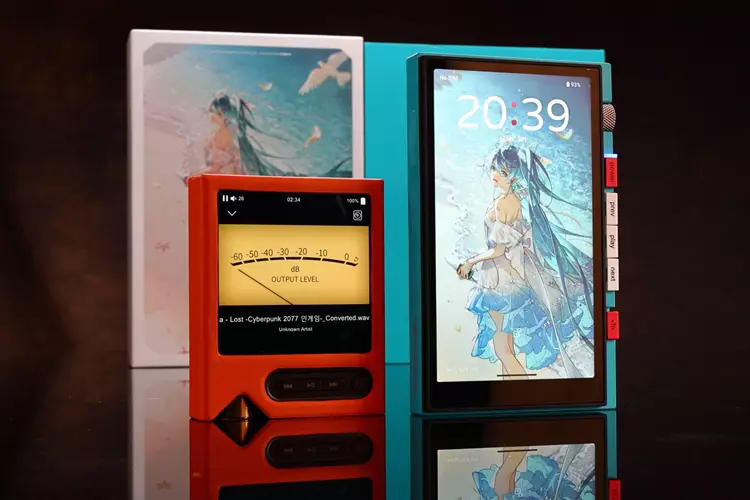
ONIX Tocata XM2
Technical & Design
The Onix XM2 is a compact, non-Android DAP that uses an Ingenic X2000 system platform and an in-house-developed operating system.
The XM2 has the latest flagship DAC decoder chip, CS4308P, which can decode Hi-Res Audio up to PCM 768kHz & DSD512.
After the DAC chips, the signal is converted to voltage using ONIX’s “Brighton” I/V conversion architecture, which is based on two OPA2211s. In the final stage, the signal is routed to two SGM8262-2 op-amps.
The maximum output power is 204 mW in the 3.5 mm output and 800 mW in the 4.4 mm output, both with a 32Ω load.
The XM2 is a delightfully compact DAP that fits in my hand well. I like the black, squarish, rectangular, one-piece, full-CNC-machined aluminum alloy body with slightly radiused sides to prevent them from digging into my palm.
It has a glass-metal-glass sandwich design, with a glass back cover and a 3-inch OLED Touch Screen on the front.
Performance
Both the XM2 and the M500 4G have a similarly neutral sound presentation. The difference is that XM2 has a slightly darker, more polite treble, giving it a more analog sound.
I find the M500 4G has a wider soundstage, while the XM2 has a deeper soundstage.
Both are spacious sounding, but I find the M500 4G has a more expansive soundscape. I also find that the M500 4G presents the details more prominently, while the XM2 is more relaxed.
Both sound powerful, but I find the XM2 has a more dynamic bass presentation. Both are energetic and never boring.
However, even though the XM2 is more powerful than the M500 4G, I find the M500 4G sounds better when paired with the Sennheiser HD 6XX. I find the treble on the XM2 too polite compared to the already polite HD 6XX.

My Verdict
The HiBy Digital M500 X Hatsune Miku 4G is a good-sounding DAP, characterized by its neutral, transparent, and coloration-free sound.
Unlike some DAPs I’ve heard, which have very good technical performance but sound boring, dry, and flat to my ears, the HiBy Digital M500 X Hatsune Miku 4G sounds musically engaging and three-dimensional with plenty of both macro and micro details.
Aside from the design and the well-integrated Hatsune Miku theme and animation in the operating system, I also like that the M500 4G has extra features over most Android DAPs.
It includes a 4G network connection, Wi-Fi hotspot functionality, a camera, an FM radio with a built-in antenna, stereo speakers, and two built-in microphones.
However, I feel disappointed by its camera performance and image quality, which produce soft images and videos with poor dynamic range and so many blown highlights.
Also, the FM radio’s reception performance and sound quality have low sensitivity, unstable reception, and noisy sound.
I hope HiBy will address these two areas in their future DAPs by improving these features, as it would truly make their DAPs more versatile and increase their appeal and usability to everyday people.
Nonetheless, I find the HiBy Digital M500 X Hatsune Miku 4G to have a very good balance of size, weight, power output, features, design, price, and, most importantly, sound quality.
Being a limited-edition product packaged with a collector-worthy box and accessories, plus the in-depth Hatsune Miku integration in the operating system, it would be a waste not to get one if you have the means.
HiBy M500 X Hatsune Miku 4G Technical Specifications
- Processor: Qualcomm Snapdragon 680 octa-core (6nm process).
- Operating System: Android 14 with HiByOS.
- DAC: Dual CS43198.
- Memory & Storage: 4GB RAM + 64GB ROM.
- Expansion: MicroSD card slot (supports up to 2TB).
- Display: 5-inch, 1280×720 resolution.
- Audio Outputs: 3.5mm Single-ended, 4.4mm Balanced.
- Maximum power: 124 mW, 3.5 mm/ 449 mW, 4.4 mm
- Connectivity: 4G LTE and Wi-Fi.
- Camera: 13MP
- Battery Capacity: 3100 mAh 3.8V
- Battery: 26-hour battery life.
- Body material: Glass and ABS
- Dimensions: 128 x 76 x 15 mm
- Weight: 208g.
- Additional Features: External speaker, dual microphones, FM radio, Hatsune Miku custom theme.
