

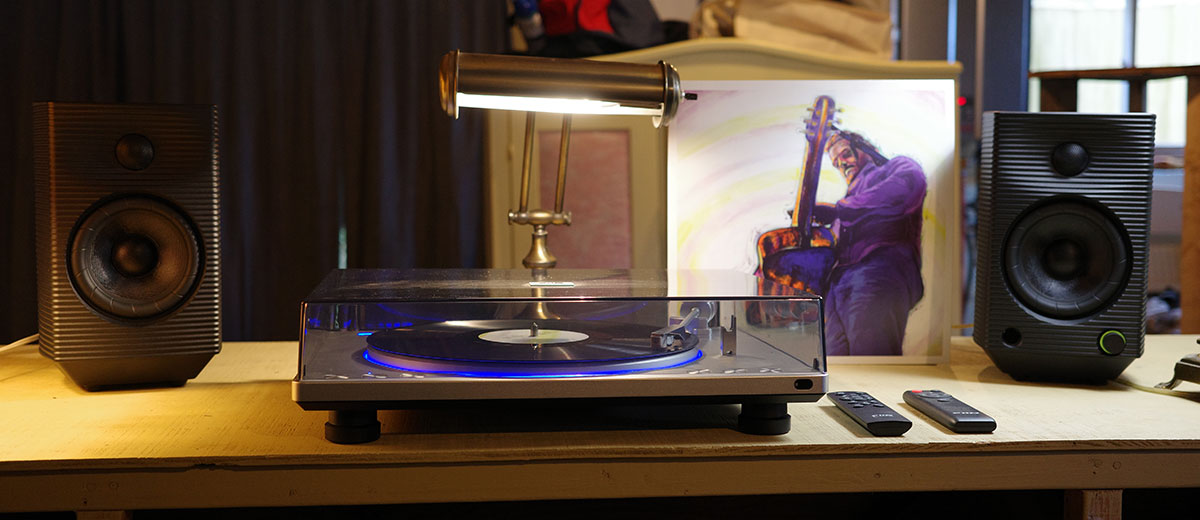
Lynn reviews the FiiO SP5, a new set of wireless-capable 2-way desktop speakers with up to 60W+20W x 2 of Active Class D output power. They are currently priced at $749.00.
Disclaimer: I received this sample in exchange for my honest opinion. Headfonics is an independent website with no affiliate links or services. I thank FiiO for their support.
You can click here to learn more about the FiiO audio products previously reviewed on Headfonics.
This post follows our current scoring guidelines, which you can read in more detail here.
FiiO rolls along nearly two-thirds of the way through 2025 with more new products, such as the much-anticipated SP5 speakers, reviewed here.
The SP5 is FiiO’s new flagship speaker, moving upscale considerably from the SA1 I previously reviewed and the SP3, which shares “similar” design looks and technology.
Larger than either, the SP5 can still be marketed as a nearfield desktop speaker, but functions equally well as a bookshelf speaker, under the right circumstances.
Once I finished the SA1 review, Marcus let me know that I would be among the first to receive the SP5. I was looking forward to it based on my impressions of the SA1. Some of the technology is new for FiiO, while some is tried and true, carried over from previous models.
I do miss the internal phono stage of the SA1, but since the SP5s are Bluetooth, the ability to connect a Bluetooth turntable is still well within reach. Plus, the addition of XLR inputs makes for some interesting options, such as using a desktop amplifier.
The SP5s were put through their paces after the standard 75 hours of burn-in period.
Features
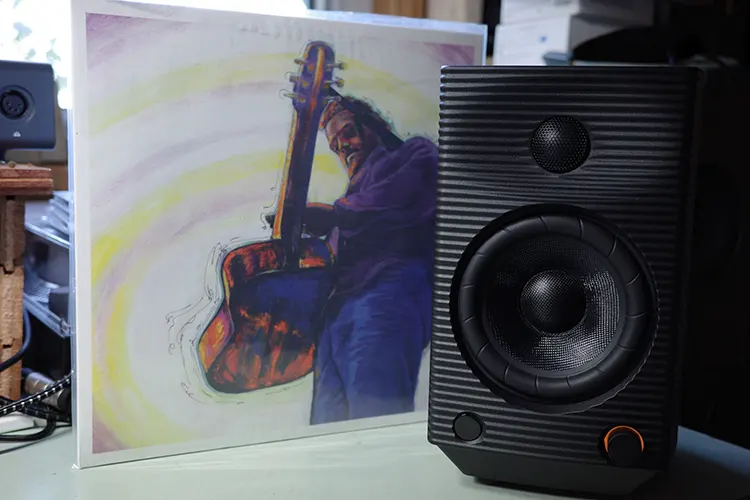
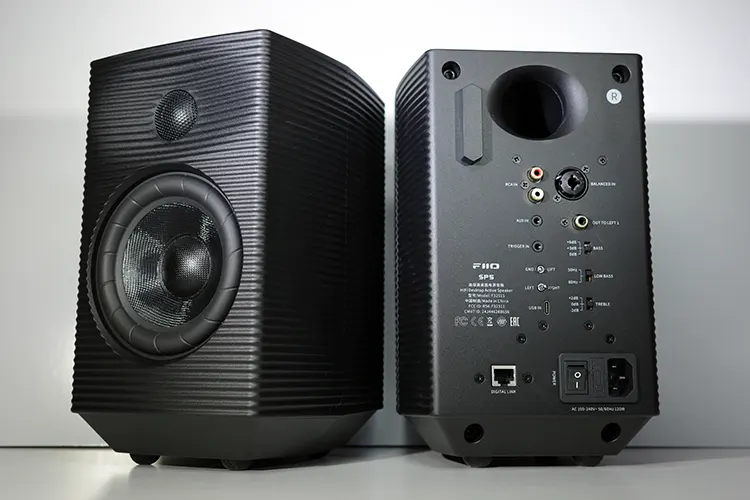
The SP5 follows the same exterior design as the SP3 and features an aluminum die-cast cabinet from Genelec.
Equipped with an independent 4-channel amplifier delivering 60W to the 5.25-inch Rohacell-cone bass driver and 20W to the 1-inch composite silk dome tweeter, this represents an increase over the SA1 and SP3 models.
The SP5 is suitable not only for near-field desktop music listening but also as bookshelf speakers for medium-sized rooms or dedicated listening rooms.
Users can control the speakers with the FiiO Control App, which is available for both iOS and Android devices. The app features 10-band PEQ tuning and complete speaker configuration, all from a phone, tablet, or laptop.
Upon first use, I was greeted with a message to kindly update to V1.0.0, which took about four minutes before use.
The speakers have built-in trigger input support so they can be powered up in sync with other audio gear, making the SP5 suitable for integrating with home or studio setups. When turned on, it will automatically remember the previous source and volume.
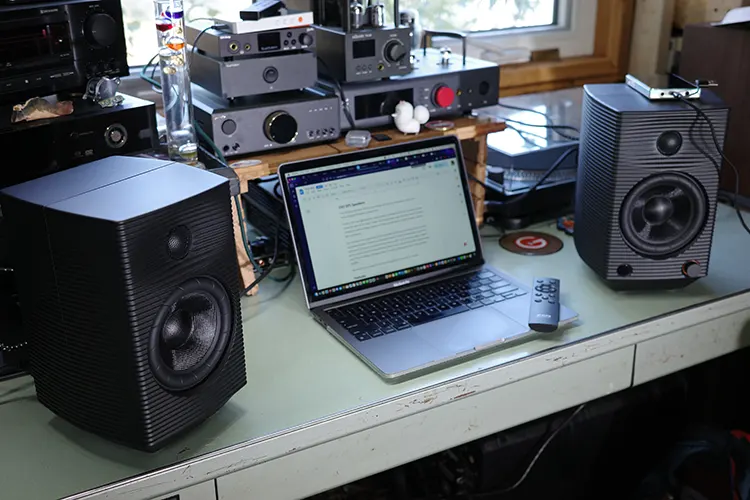
A custom IR remote is included (labeled for the SP5), and the volume knob comes complete with RGB LED indicators denoting input. Tactility of the knob is very good.
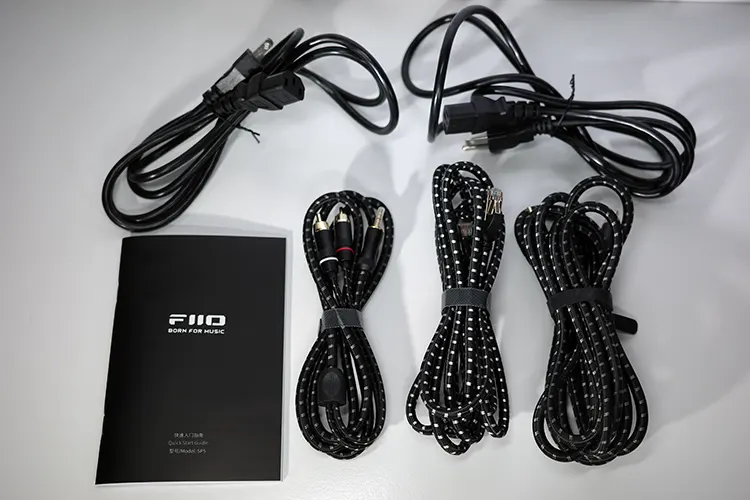
The SP5 speakers come with two Furukawa oxygen-free copper power cables for clean power delivery with maximum electrical conductivity, as well as robust connecting cables between each speaker and the connectivity options. They are heavy-duty.
I will, of course, test the SP5 using FiiO’s TT13 and my Audio-Technica AT-LP120XBT-USB, among other options. Utilizing independent volume memory allows each source to return to the preset volume level when going between sources.
Design
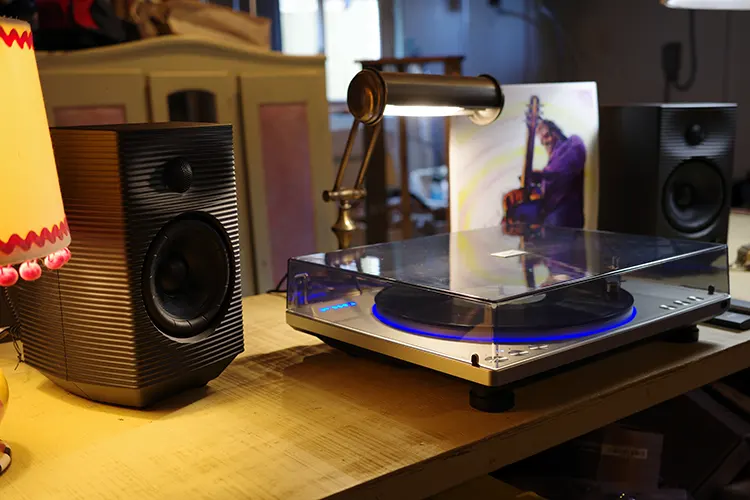
The FiiO SP5 comes in either black or white. I received the black version and immediately noted that it collects smudges and prints somewhat readily.
Once connected, though, you should have minimal contact with the speaker. I could see the white staying cleaner, plus to me it looks quite regal. Not that I mind the subdued black color, which allows the speaker to fade into the background.
Made of two-piece die-cast aluminum, the ridged texture has a rough feel for better grip when you need to move the speaker. Fit and finish are top-notch, though I did note a small mismatch with the melding of the two edges on both speakers.
At 11” high, 6.75” wide, and 7.25” deep (280x170x185mm), the SP5 will fit into most spaces with ease.
The cables included, while wonderful in build, are quite stiff (but somewhat tactile) and will require some break-in to accommodate some spaces. The speakers are robust, coming in at roughly 3.85lbs each (About 1750g)
The rubber woofer surrounds have an articulated pattern to them, reminiscent of a mechanical blower fan, like you might find in a pellet stove.
Both the woofer and tweeter are recessed a bit, with the tweeter mounted slightly behind the front face as a result. The woofer sits flush; once the curved area surrounding it moves back on the left and right sides.
The carbon fiber of the woofer accents the ridge and furrow design quite nicely, lending a more modern look to the mid-century design of the cabinet.
The robust nature of the SP5 means it should be placed with care, and the owner’s manual provides good instructions for proper listening positions and placement.
I/O
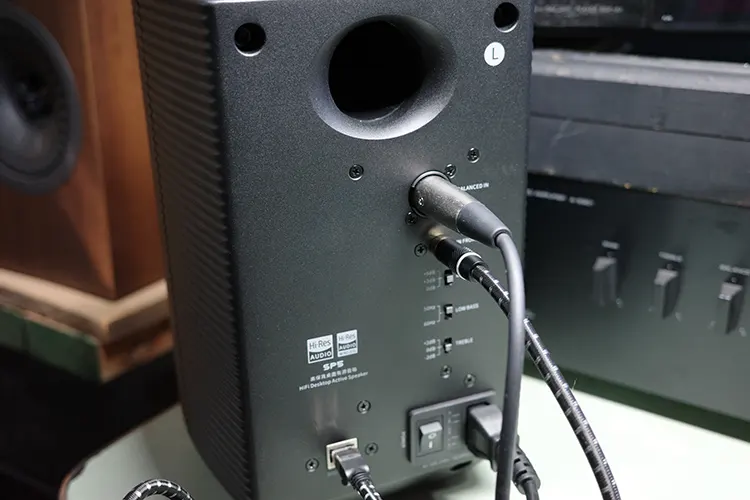
Like the SP3, the SP5 offers a wide range of inputs, supporting Bluetooth 5.1 (QCC5125), USB-C, XLR (one for each speaker), analog 3.5mm AUX-IN, and an infrared remote control.
Missing, though, is a dedicated RCA-phono input and subwoofer output. But since it utilizes BT technology, Bluetooth turntables such as FiiO’s TT13 can be used. LDAC, SBC, and aptX Adaptive audio codecs for lossless wireless streaming with minimal latency are used in BT mode.
The inclusion of an “Ethernet” digital cable between each speaker allows the user to hook up both the RCA and digital cables for multiple options.
Each speaker has a dedicated XLR input, too, which is usually reserved for studio monitors. Knowing the price, I appreciate this option and will test some recent desktop amplifiers capable of XLR out.
There is no option for headphone hookup or dedicated speaker wires, but that isn’t really the point of these speakers. Short of the two omissions mentioned above, the SP5 comes fully loaded, with pretty much any option for source input one may want or need.
Controls
The full-function remote allows the speakers to be kept on. Entered into standby, the speakers will automatically reconnect to the last source and at the same volume as shutdown.
FiiO has a reputation for making remote use easy, with the labeling in large enough letters to see. The only thing lacking is a backlight to see the desired function. A small omission that doesn’t really bother me.
App
The FiiO Control app allows you to connect through your smart device or computer, giving you access to a 10-band parametric EQ, among other things. Firmware updates are run through the app and are automatically prompted.
You can preset BT CODEC in a menu, as well as choose source input, much like the remote. Control of the speakers can run through your device if desired, taking the place of the remote.
While it may be a fairly rudimentary app, all you need from the PEQ option(s) to firmware updates and choice of CODEC are included.
Packaging & Accessories
The SP5s came protected in a double box, as expected. The package was rather large and heavy, denoting extra care and the sheer weight of the speakers.
The main box shows life-size line drawings of each speaker’s back, giving you a good look at the connections. Inside, on top of the protective foam tray, you will find a couple of cables and the remote (no batteries).
The speakers are wrapped individually and set into a bottom foam protective insert. Tucked into the “holes” of each bottom space are other cables, including the digital cable and RCA cable.
The SP5 comes ready to be used across most sources, with the included 3.5mm to dual RCA cable as a bonus. Plus, since we all have extra USB-C to USB-C cables lying around, we can use the length we desire of our own choosing.
Connectivity
Bluetooth
Connecting to multiple devices via Bluetooth 5.1 was seamless, and with the aid of the remote, quite easy. A simple push of the “pair” button on the remote and a click on the source device you are using, and you are done.
Using the FiiO Control App can be done on a DAP, your smartphone, or a computer as needed. Plus, if you have an account, you can take your personalized EQ settings across devices.
USB-C
Using the FiiO M21 & JM21, and the HiBy R4 in USB-C to USB-C, allowed me to stream Tidal and Qobuz without issue, as well as use my native SD card music.
Connectivity through this method showed better grab down low, with a better reach and control than BT. Detail retrieval has a positive effect, too, with more clarity through the midrange and an extension in treble notes with good weight and a succinctness that could not be had using BT.
This is to be expected, but it shows the capabilities of the SP5 in user situations.
XLR
Connecting from the Oppo BDP-83 using coax, into the xDuoo TA-32, and then XLR into the SP5s provided an option that was a good source for listening to CDs.
The level of detail retrieval was quite good, with a midrange that was slightly forward, but not lifted. The treble extension provided good height and extension, filling in the space to make very good levels of clarity.
If you use long enough XLR cables, the SP5s can be mounted just like a “regular” pair might be, giving you more options for placement.
RCA
Connecting a DAP through the included RCA cable allowed me to stream or play native SD card music similar to BT. I found little difference between the RCA and BT, other than the ability to have another source hooked up for convenience.
This does not mean it shouldn’t be considered, because having the ability to hook multiple devices up is really the point.
Aux-in
Running a 3.5mm single-ended out from a DAP or desktop amplifier into the Aux-in on the SP5 is yet another option. You can run an external amplifier into the SP5 in such a manner, having only to connect the source to the external amplifier, much like the XLR and TA32 above.
Click on page 2 below for my sound impressions and recommended pairings.
