

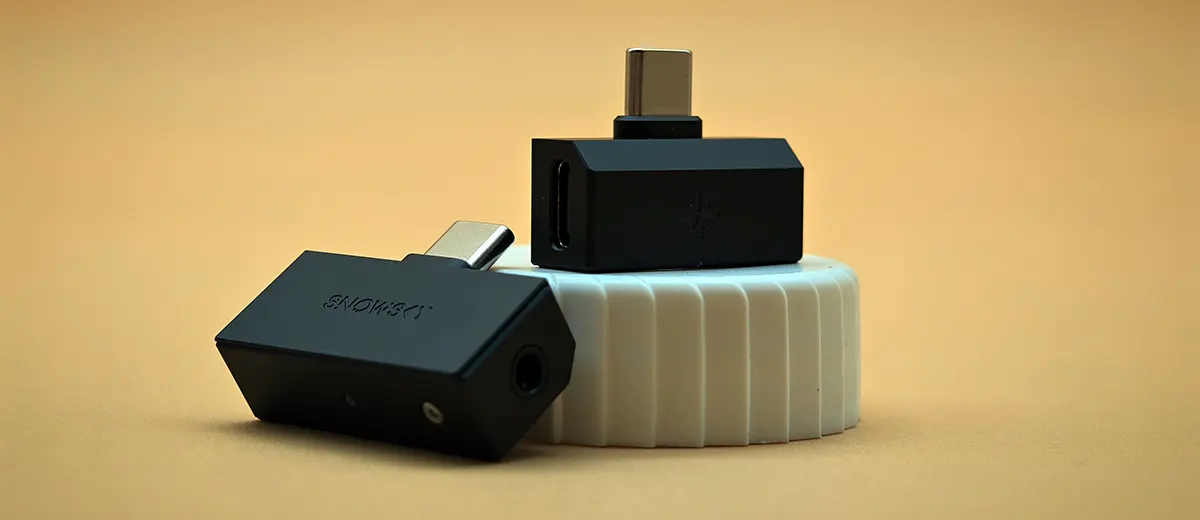
Synergy
I tested the FiiO SNOWSKY Tiny with single dynamic drivers, hybrids, full BA sets, and planar IEMs. All of them were powered with ease, showing that the dongle has sufficient output for various IEM types.
Even heavy, power-hungry planars and complex multi-driver IEMs were handled with ease. The Tiny B’s 4.4mm output provided plenty of clean power.
I paired the ZiiGaat Luna with the Tiny B’s 4.4mm output, and it retained the IEM’s great sound. This pairing also slightly elevated the existing clarity while noticeably boosting the controlled midrange.
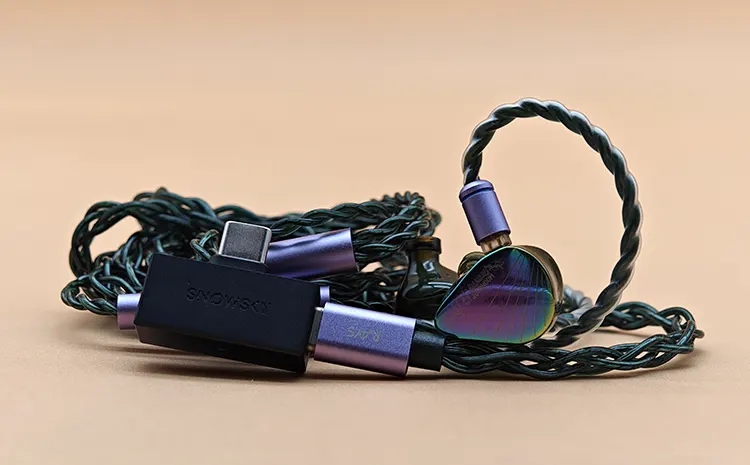
With the MOONDROP RAYS on the Tiny A, I liked how the dongle’s bright coloration pushed the vocals forward and surprisingly cleaned up the bass. The unit and cable did get slightly warm, but it was not uncomfortable.
The Softears Studio 2 is a dark-tuned IEM, so testing it with the 3.5mm jack on both Tiny models was a great match. The added brightness, clarity, and midrange forwardness helped it stray from being just a mixing IEM.
Usage with the in-line microphone was good. I experienced no delays, hissing, or static while using it for calls or in-game chat.
Pairing the FiiO SNOWSKY Tiny with a phone is a great experience due to its T-shape. It attaches directly to the bottom, almost making it look like a part of the phone rather than a dangling extension.
Select Comparisons
FiiO JA11
Technical
The FiiO JA11 supports DSD128 and 32-bit/384kHz output, though its specific chipset is not disclosed. Its power output is rated at a modest 30mW, which is not particularly noteworthy.
It features support for microphone input, making it useful for calls. The dongle also integrates with the FiiO Control app to provide access to a 10-band PEQ.
Design
The JA11 is extremely small and lightweight, weighing only 5 grams. Its main body is made of an aluminum-magnesium alloy, and it uses a short, non-detachable double-layer braided cable.
This design is highly portable and does not get hot during use. It has no physical volume controls and relies on a simple plug-and-play operation.
The FiiO SNOWSKY Tiny and FiiO JA11 are aimed at different user scenarios, which is clear in their design. The JA11 is built for maximum portability and does not get hot, but the Tiny’s “T” shape is more secure and less tangly.
Performance
The FiiO SNOWSKY Tiny has a clear, bright coloration that makes the midrange more immediate in its impact. The JA11 showcases better purity, as it is completely neutral and adds no coloration to the sound.
The Tiny has a slight buzz when plugged in that the JA11 does not, but the JA11 requires some firmware updates to fix some of its noise oddities.
With power, the Tiny provides impressive loudness and can drive most IEMs with ease, while the JA11’s low power is only serviceable for most IEMs.
The Tiny also feels more feature-rich, especially the B version with its 4.4mm port and the A version with its charging passthrough. Both dongle DACs have PEQ as one of their main features.
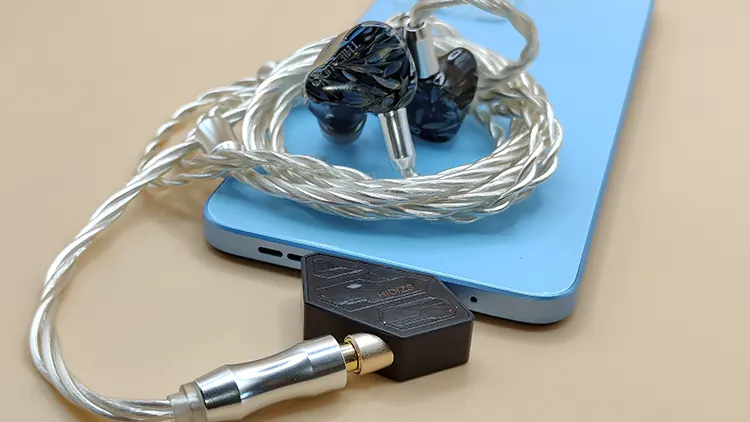
Hidizs SD2
Technical
The Hidizs SD2 uses an ESS ES9270 DAC chip. This allows it to support decoding for PCM up to 32-bit/384kHz and DSD128.
It features a single 3.5mm unbalanced output, which is rated to deliver 70mW of power at 32Ω. The SD2 also supports the use of in-line microphones for calls and gaming.
Design
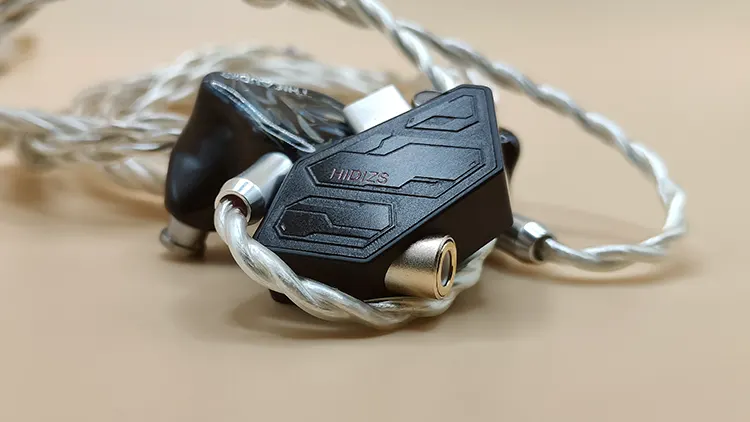
The SD2 has a unique “mecha-style” boxy design, and its chassis is constructed from aluminum alloy and resin. It is extremely compact and lightweight, weighing only 6 grams.
It operates as a simple plug-and-play device with no physical buttons. An LED indicator light displays the sampling rate, showing red for PCM 44.1-48kHz and blue for higher-resolution PCM and DSD.
The SD2 is extremely lightweight and wins in heat management as it runs cool, while the Tiny’s metal body can get warm during use.
Their main design difference is port placement, as the SD2’s 3.5mm jack is on the bottom while the Tiny’s ports are on the left and right.
Performance
Both dongles have a clear, bright coloration that makes the midrange more forward-sounding. The FiiO SNOWSKY Tiny’s brightness is energetic and adds a lively bite that fits my preference, while the SD2’s bright coloration can be more aggressive and highlights sharpness.
The Tiny has a slight buzz when plugged in that the SD2 does not, but this is a minor oddity. With power, it provides impressive loudness, especially from the Tiny B’s 4.4mm output, and can drive most audio gear with ease.
The Tiny also feels more feature-rich. Its main feature is the 10-band PEQ, which the SD2 completely lacks. The charging passthrough and the alternative B’s 4.4mm port make it a more versatile dongle overall.
My Verdict
The FiiO SNOWSKY Tiny successfully delivers a feature-rich and powerful experience in an impressively small “T-shape” design.
The bright, vocal-forward sound coloration is a great fit for my preferences, and the inclusion of a 10-band PEQ adds valuable customization.
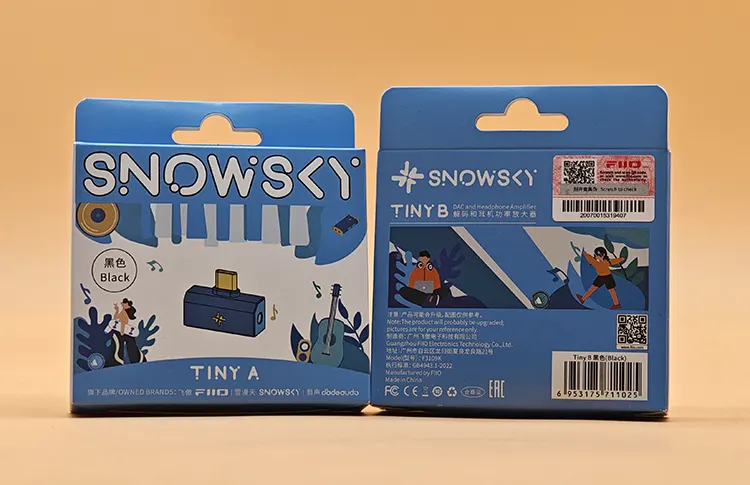
Although the unboxing is a simple, no-frills affair with no accessories, the Tiny series still carries itself well as a complete package.
It proves itself as a versatile and powerful dongle that excels in portability, especially with the Tiny A’s charging and the Tiny B’s 4.4mm output.
FiiO SNOWSKY Tiny A Technical Specifications
- Dimensions: ~29mm x 22mm x 10mm
- Weight: ~7 grams
- Decoding Formats: PCM 32-bit/384kHz, DSD256
- Headphone Jack: 3.5mm (single-ended), USB-C (passthrough charging)
- Output Level (3.5mm): 45mW@16Ω, 34mW@32Ω
FiiO SNOWSKY Tiny B Technical Specifications
- Dimensions: ~35mm x 24mm x 10.8mm
- Weight: ~10 grams
- Decoding Formats: PCM 32-bit/384kHz, DSD256
- Headphone Jack: 3.5mm (single-ended), 4.4mm (balanced)
- Output Level (3.5mm): 68mW@16Ω, 34mW@32Ω
- Output Level (4.4mm): 45mW@16Ω, 34mW@32Ω
