


Marcelo reviews the FiiO SNOWSKY Melody, an affordable wood-designed dongle DAC with a dual CS43131 DAC and a 250mW balanced amplifier. It is currently priced at $39.99.
Disclaimer: I received this sample in exchange for my honest opinion. Headfonics is an independent website with no affiliate links or services. I thank FiiO and SNOWSKY for their support.
You can click here to learn more about the FiiO SNOWSKY audio products previously reviewed on Headfonics.
This post follows our current scoring guidelines, which you can read in more detail here.
Although the SNOWSKY product line has only recently debuted, Melody is not the first product under this name that I have tested. That honor goes to the cool-looking mini DAP, the ECHO MINI.
So far, products under the SNOWSKY name are priced to serve the budget and entry-level market. As the owner of a FiiO M15S DAP and the KA11 dongle DAC, I’m curious about the SNOWSKY Melody, which currently sells for $39.99 as of the time of this review.
Melody faces tough competition in the under $100 price bracket, which makes me wonder how it compares to the Hidizs S9 Pro Plus and MOONDROP Dawn Pro. Find out in my review below.
Features
The Melody features a specially selected aged premium wood from North America. Through dozens of processes, including CNC precision carving, polishing, eco-friendly oiling, and air drying, the wood achieves stabilized treatment.
It utilizes a high-performance USB chip, which receives both UAC1 mode for gaming consoles and UAC2 mode for HiFi audio.
The Melody features an onboard Audiophile-grade DSP, which includes a programmable parametric EQ and presets that can be controlled via the FiiO Control App.
It utilizes dual Cirrus Logic 43131 DAC chips, which support PCM 384kHz/32-bit DSD 256 audio decoding and feature fully balanced left and right outputs.
A dual-mode amplifier that can switch between the conventional Class AB and the unusual but more efficient Class H. There is a difference in sound, which I will discuss later in this review.
The output power of the Melody is 100mW into 32Ω with the single-ended 3.5mm connector and 250mW into 32Ω with the balanced 4.4mm connector.
Design
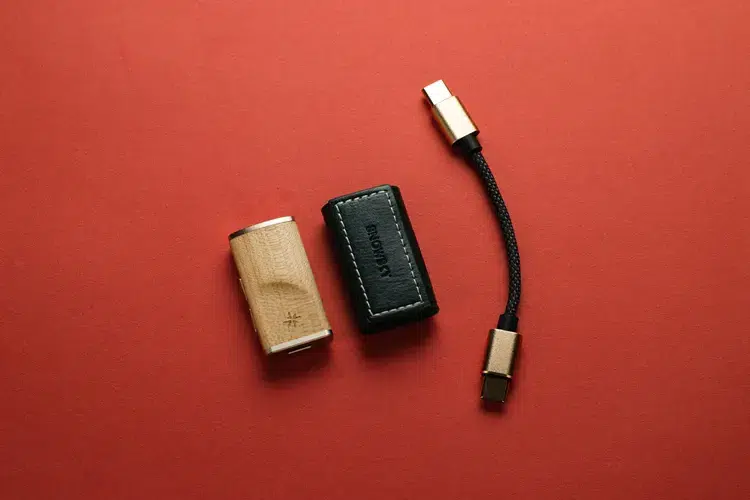
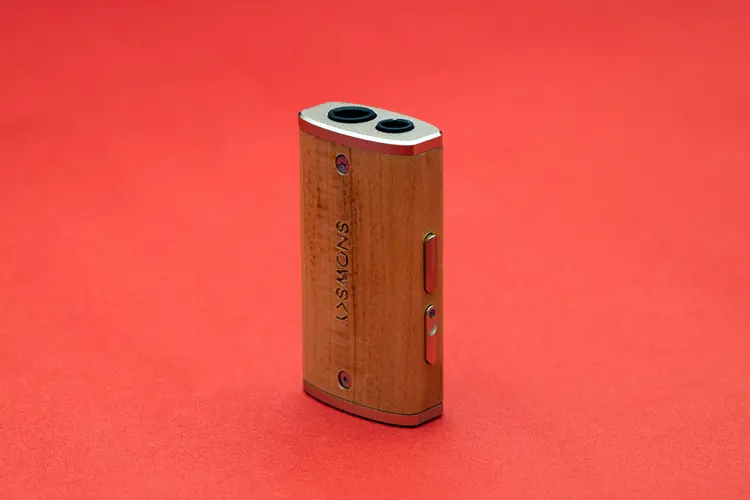
The Melody is available in maple and walnut wood finishes. My Maple review sample looks lovely, especially with the matching USB-C cable, which has a matte gold finish; together, they appear aesthetically cohesive.
I like the compact size of 22.5mm x 42.5mm x 11.5mm and the lightweight design of 10g, which makes the Melody very portable and able to fit in tight IEM cases.
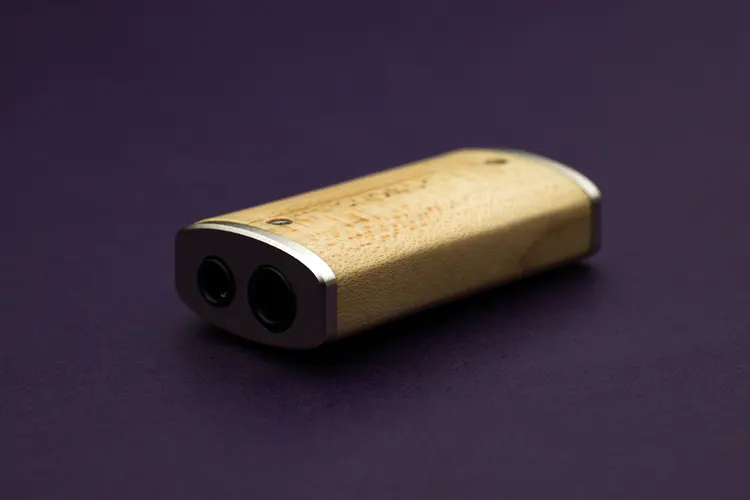
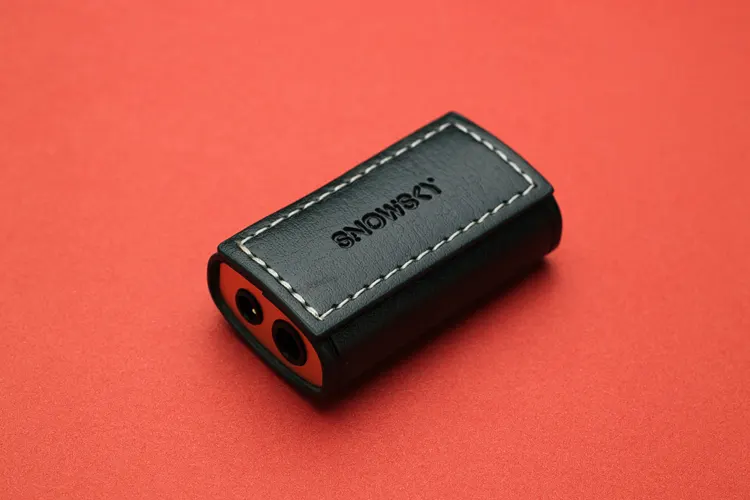
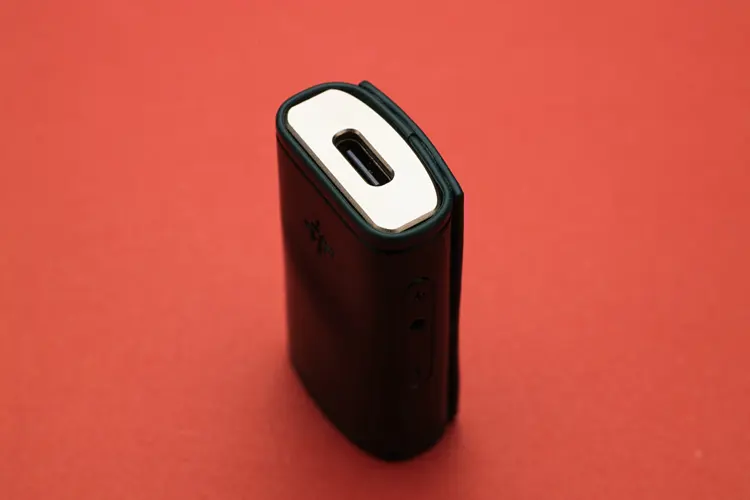
USB-C input is located at the top silver colored metal end cap, while the 3.5 and 4.4mm outputs are located at the bottom silver colored metal end cap.
The front has a carved-out portion with a snow logo carving. The back is blank, with a tiny Torx screw located near the top and bottom.
There is a small RGB LED indicator between the two volume control buttons on the right side, while the left side remains blank.
I/O
The Melody is a simple dongle DAC with a single USB-C input, serving as both a data port for the FiiO Control App’s programming data and an input port for the digital audio signal.
It has UAC1 mode for gaming consoles and UAC2 mode for maximum audio transmission, which can be controlled via the FiiO Control App.
Opposite to the USB-C input are the two outputs, including the 4.4mm jack for a genuine balanced output connection with significantly improved power, signal-to-noise ratio, and inter-channel crosstalk.
The 3.5mm jack is not balanced and has significantly less power, signal-to-noise ratio, and inter-channel crosstalk; however, it supports in-line controls and a microphone that can do calls, karaoke, recording, and in-game chats, making it a versatile solution as a dongle DAC.
With an adapter cable, which isn’t included in the package, the Melody’s 3.5mm jack can be used to output an SPDIF digital signal.
Heat
The Melody became only mildly warm, even in my warm country, and during the burn-in period, which lasted for a couple of days.
I noticed negligible power consumption; the power consumption of the Melody must be modest enough that it didn’t significantly shorten the battery life of my phone or DAP.
However, I didn’t notice the difference in battery life or consumption when switching between the Class AB and Class H amplifier modes in my casual, non-scientific use.
Software
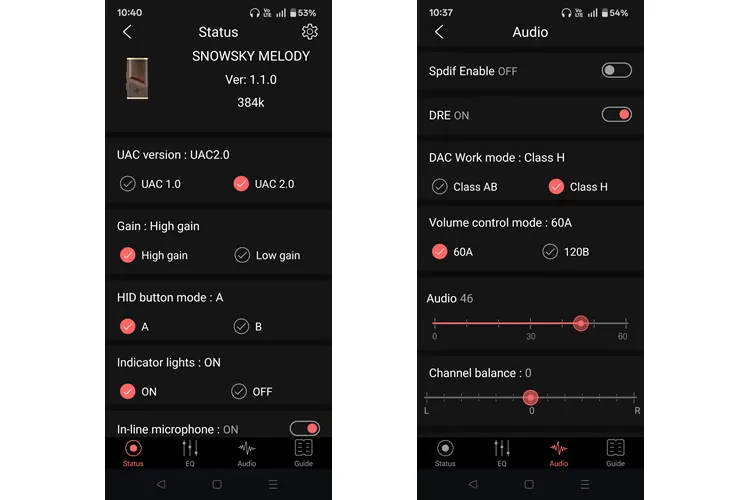
My Melody review sample came with the latest firmware version as of this writing, 1.1.0, which can be viewed and updated via the FiiO Control App, available for both Android and iOS operating systems.
The FiiO Control App includes controls for switching between UAC 1 and 2 USB modes, in-line microphone on/off, Gain, 10-band Equalizer, channel balance control, Class AB and H amplifier modes, and access to the user manual.
10-Band Parametric EQ
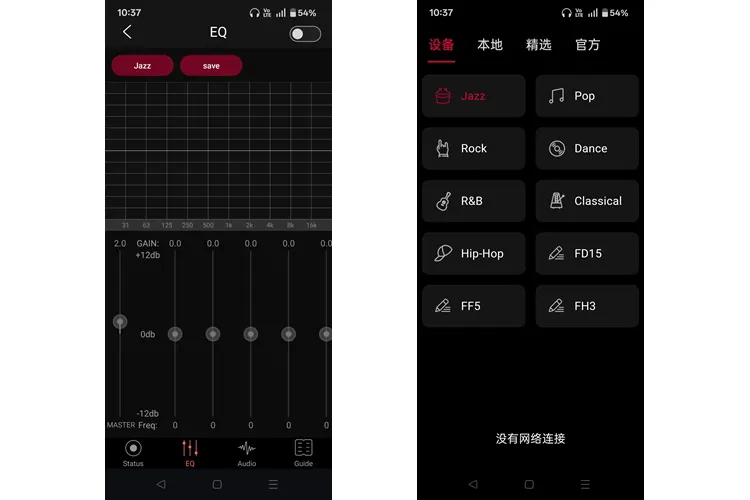
The Melody’s 10-Band EQ is a fully adjustable parametric EQ, featuring gain controls of up to +/- 12 dB, customizable center frequencies, and Q ranging from broad (0.25) to peaky (8), which I find very useful for taming the peaks on some headphones and IEMs.
There are seven preset and fixed EQ settings, including Jazz, Rock, R&B, Hip-Hop, Pop, Dance, and Classical. And three customizable EQ settings, named FD15, FH5, and FH3, which I presume are used for their IEMs with the corresponding names.
Memory
Everything that was set in the FiiO Control App stays in the Melody even after a long time of no use, and even when used with other devices, it stays that way until you change the settings again in the FiiO Control App, making the Melody an excellent dongle DAC for a permanent pairing with a specific IEM.
Wired Connectivity
As a USB-DAC
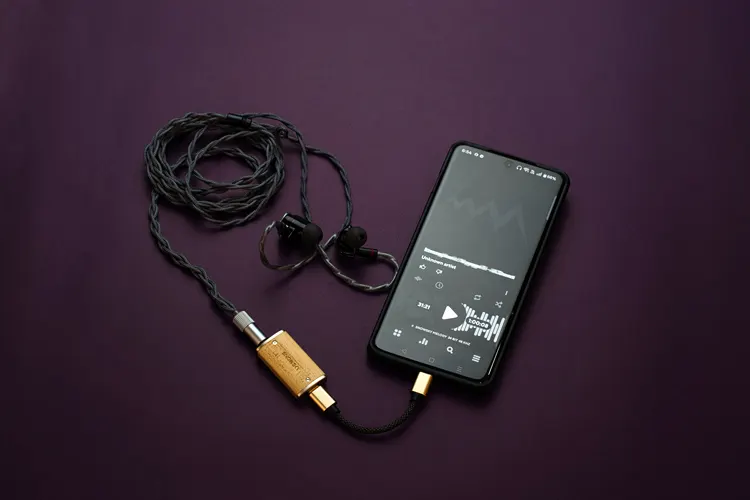
Thanks to Melody’s up-to-date firmware and internal components, it is highly compatible with various USB sources. Melody connects instantly with all the sources I tried: PC, Laptop, phones, and DAPs, with no hiccups.
Melody doesn’t require a driver to function as a basic dongle DAC on all the devices mentioned above, but it does require the FiiO Control APP to change the USB input mode and switch between UAC 1 and 2 for use with gaming consoles.
Packaging & Accessories
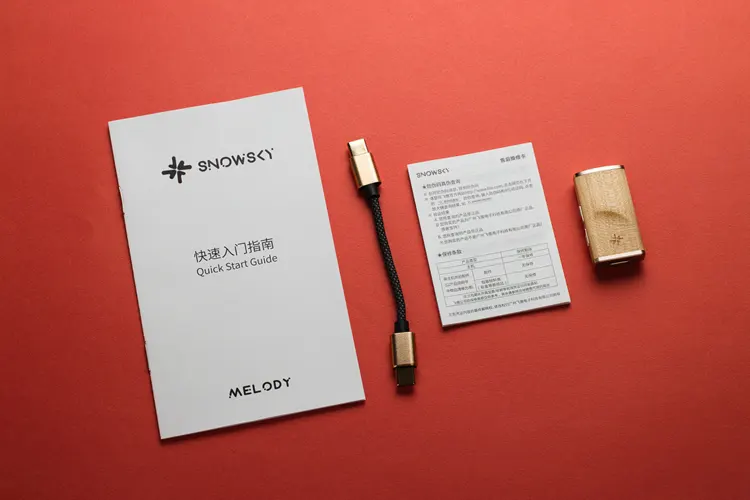
As an entry-level product, Melody’s packaging is simple, consisting of a 100mm x 150mm x 26mm box with graphics.
Inside, it includes the Melody dongle DAC, a short USB-C to USB-C cable, and two user manuals. The leather protector comes in a separate package and is sold separately.
Sound Impressions
Before seriously listening to the Melody, approximately 24 hours of burn-in were completed by playing it with a spare DAP and IEM for 8 hours a day over three days. There was no noticeable change in sound after the burn-in.
However, I did notice a significant difference in sound when switching between Class AB and Class H amplifier modes using the FiiO Control App. Class H is the default setting, which produces a boomy bass and a slightly hazy treble. Class AB has tighter bass and cleaner treble.
I didn’t use any EQ or sound enhancement programs, and the filter is set to linear phase with a fast roll-off, which is the least colored among its five available filter styles. I use my Android phone, OnePlus 13, with UAPP and PowerAmp music players.
For IEM listening, I use my Kinera NOTT Phantom, MOONDROP Harmon, and the Hidizs MK12 Turris. For headphone listening, I use my MOONDROP Horizon, all of which are paired with their stock cables using the 4.4mm balanced connection.
Summary
The Melody’s Class H mode is too boomy and colored for my taste, so I exclusively use the more conventional Class AB amplifier operating mode. Class AB mode has a noticeably tighter bass and more transparent treble.
Like other FiiO DAC/amps in the entry-level price range, there is a noticeable thickening in the bass. The sound signature is slightly V-shaped, with a slight boost in energy in the bass and treble.
Midrange is slightly warmer than neutral, but the difference is almost imperceptible. The upper midrange is very neutral, if not somewhat relaxed, which prevents any fatiguing or shouty sound in this range, a trait that some people are susceptible to.
The Melody’s treble is slightly above neutral in energy with moderate details, resolution, and air. It’s not the most detailed, resolved, or airy treble available; the treble is in line with most entry-level DAC amps that use CS43131 chips.
It is extended, but there seems to be a slight haze in its sound, and the decays are not as clean as they could be.
The overall sound focuses mainly on providing a pleasing tonality to the listener, rather than emphasizing technical aspects that can sometimes make the sound cold and clinical. Melody has the positive traits that the CS43131 chip is famous for.
Coloration
The Melody sounds clean and clear enough for casual listening. Still, for critical listening, it isn’t the most transparent-sounding DAC/AMP, due to the slight thickening in bass and the less-than-stellar transparency in the treble.
That said, the colorations are not obvious, primarily when used with less resolving entry-level IEMs, for which the Melody was designed; these colorations only become apparent when paired with highly resolving IEMs and headphones, revealing the haziness in the treble.
Soundstage
The Melody’s soundstage has a reasonable height, width, and depth; neither the biggest nor the smallest, just average, just like any other DACs with the CS43131 DAC chips, which is not bad at all.
The soundstage shape is deeper than wide; it’s as if you are sitting slightly further back than the middle of a mid-sized movie theater when the sounds are coming from the front.
I can’t help but think that the Melody’s staging could have been bigger and grander if the background decay were cleaner and the treble were more transparent.
Imaging
Imaging performance varies based on the pairing of IEMs and headphones. Still, on average, Melody’s performance is ok, with nice lateral panning but average front-to-back layering due to the laid-back presentation of the images.
Images are all grouped laterally far in front, and there are not many images emanating near the listener, making the imaging performance not as holographic as it could be, even when paired with an IEM that usually has a holographic imaging performance.
Dynamics
Thanks to Melody’s slightly V-shaped sound signature, the music feels more energetic and dynamic than most dongle DAC/amplifiers with a neutral sound signature.
Dynamics are good as long as I don’t go too loud, as I hear a slight compression in sound at 75 percent volume and higher with the IEMs in this review. However, that volume is already deafening and not advisable for long listening sessions.
Click on page 2 below for my recommended pairings and selected comparisons.
