

Selected Comparisons
The following comparisons to the FiiO M27 were completed using a mix of the PMG Audio Apx, Volk Audio’s ÉTOILE, and the Audeze LCD-4z.
Note that since the M17 has already been compared to the M27 throughout the review, there will be no additional comparison work done in this section.
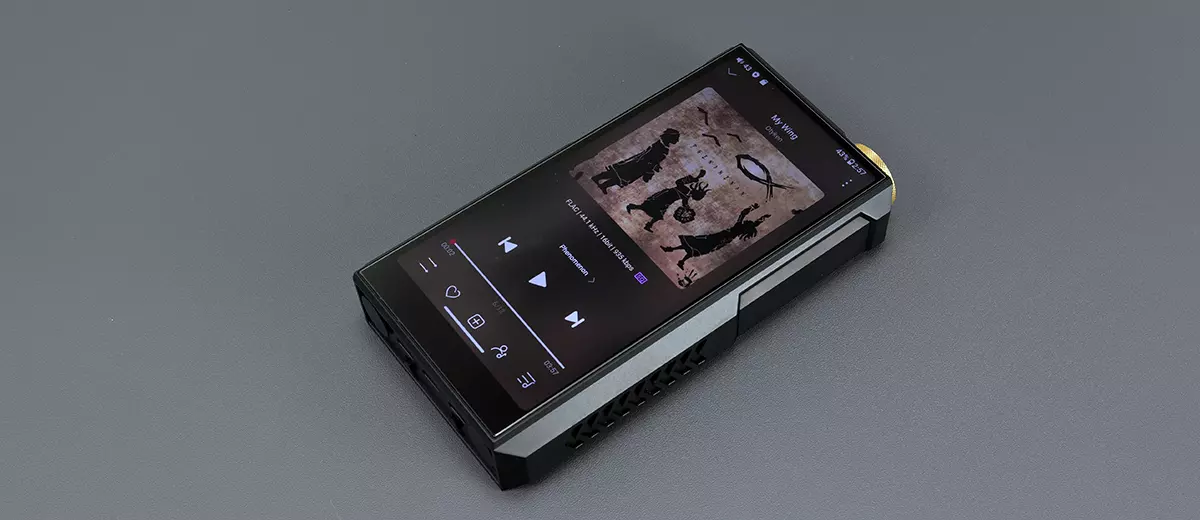
iBasso DX340 (AMP17)
The iBasso DX340 was launched in early 2025 along with the stock AMP15 card and won our Top Gear Award for Best DAP. For this comparison, I will be using the DAP with AMP17.
Technical
Inside the DX340 is an in-house discrete-engineered PWM DAC as opposed to the M27’s dual delta-sigma ES9039SPRO.
The DX340’s digital signal management is handled by a lower-tier Snapdragon 665 CPU, but it has similar RAM levels to the M27 at 8GB with a proprietary FPGA-Master 3.0 algorithm.
Both devices use the open Android 13 platform with their own music apps and Google Play activated out of the box. However, the M27 adds a few more FiiO-centric apps such as the Equalizer, Tape Mode, and Applications Center, though of the 3, it’s the Equalizer that adds the most value.
Performance-wise, the DX340 has good speed, but its aging chip vastly underperforms compared to the newer Qualcomm QCS6490 inside the M27, which is almost 4 times as fast.
The DX340 is capable of decoding at similar levels to the M27 with up to 32-bit/768kHz PCM and native DSD512 via USB.
Both have SPDIF output, but the DX340 is more limited to coaxial output, whereas the M27 can offer both in and out on full-sized coaxial and optical connections, albeit at lower rates.
The DX340 Bluetooth 5.0 chipset is not as modern, so whilst it can decode up to LDAC in transmission, it drops back to SBC for receiving and does not offer aptX Lossless support.
For amplification, the M27 surpasses in raw numbers at up to 5W on a 32Ω load via its USB-C powered connection and the highest gain level compared to the AMP17’s 1900 mW into the same load via its additional 12V DC input.
However, the design of AMP17 is very different from M27’s amplification, using fast-switching gallium nitride (GaN) semiconductor material. This card has low internal and output resistance, resulting in high current capacity with balanced output only.
Design
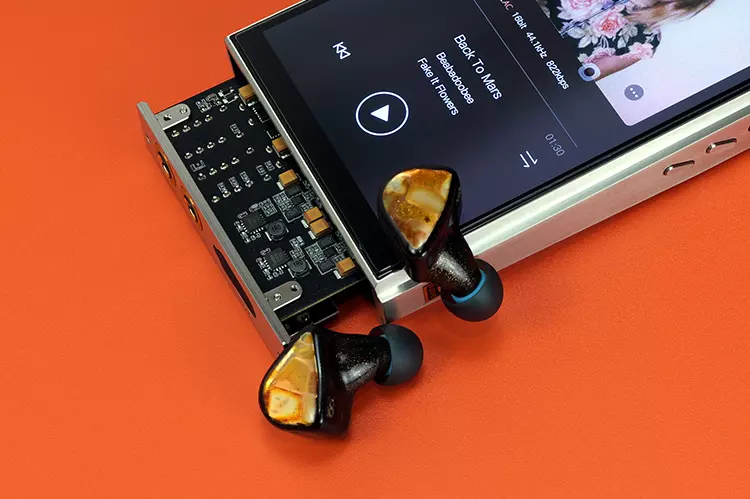
If you want portable, pick the DX340; if you want transportable and a potential desktop replacement device, then pick the M27. I doubt either company would be uncomfortable with that classification, despite both devices being battery-powered.
Not that the DX340 is small, its 6.5″ AMOLED screen is bigger than the M27’s 5.99″ FHD+ screen, though both are equally resolving at 1080×2160 pixels and the M27 screen has a slightly better pixel density count.
Still, the DX340’s minimal bezel design and slimmer 316 Stainless steel give it a sleeker look, but watch out, the weight difference is not huge, with the Aluminum M27 weighing around 90g more, making the DX340 deceptively heavy for its size.
Analog outputs will depend somewhat on the amp card you insert into the DX340. AMP15 has balanced and unbalanced SE/LO, and AMP16 also offers balanced and unbalanced, but for headphones only, no lineout. AMP17 offers balanced LO/PO only.
The M27’s analog output matches AMP15 with balanced and single-ended PO/LO and an additional 6.35mm port for headphone users.
For digital I/O, there are differences. Where they are similar is their USB-DAC/OTG capabilities. Where they differ includes a sole 3.5mm coaxial output on the DX340 as opposed to full-sized coaxial and optical input/outputs on the M27.
iBasso are sticking with the DC power supply, which bumps performance and enhances battery life. FiiO has gone for a more flexible USB-C power solution to the same effect, but without the external brick. Heat from the M27 is more of an issue than the DX340, though, hence the fan stand.
Performance
Both DAPs have tonal profiles that are neutral to natural, more so when you opt for their more even-harmonic filters or selector level.
The immediate difference is in the sub-bass extension. I hear the DX340/AMP17 reaching deeper and offering more body, whereas the M27 has a slightly wider and taller soundstage.
The DX340/AMP17 bass advantage translates into a stronger fundamental and slightly fuller note quality through the lower-mids and vocal presence regions.
The M27 stays more neutral and linear throughout. It has excellent punch in the lows, clean mids that stretch quite wide, and a bit more sparkle and air on top.
Vocals on the m27 are not quite as forward or well-separated as the DX340/AMP17, and generally, its imaging is a shade further away from the listener, enhancing the sense of space.
With the DX340/AMP17, I felt the delivery was more aggressive or ‘musical’ with the additional bass body and weight. It enhances the general perception of a slightly more natural tone.
The M27 stays resolutely neutral in note weight and very coherent with no real emphasis anywhere, but does have slightly shorter note decay.
You could argue that it has perhaps a slight bump in odd-harmonic influence in the upper-mids and highs, but that is more in context with the reduced sub-bass bloom compared to the DX340/AMP17 pairings.
One final note. I found the M27 medium-gain setting had the right amount of voltage swing to match the dynamic delivery of the DX340/AMP17 with DAC gain turned on.
Low gain on the M27 sounded a little duller in comparison, but background noise (mild hiss) with sensitive IEMs on the DX340/AMP17 might be more noticeable.
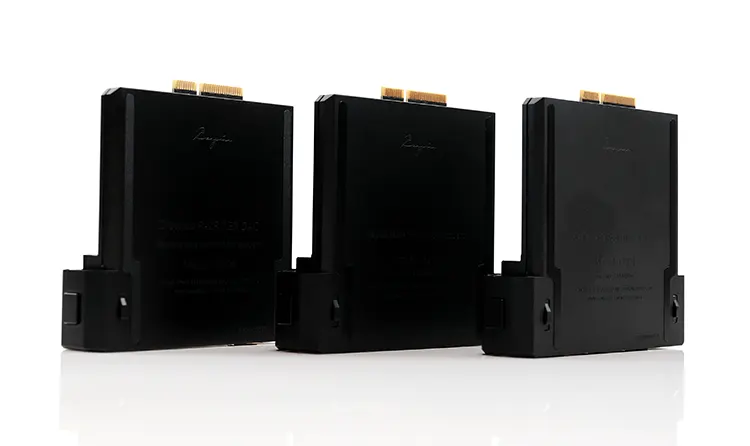
Cayin N6iii (R202)
The Cayin N6iii was officially launched in late 2024, with our review out in early 2025.
It came with the C201 as its primary motherboard card, but for this review, I will be comparing the N6iii with the R202 motherboard, which has a combo price similar to the M27.
You have to bear in mind that the Cayin N6ii is a digital signal management device only. The DAC and amplification components are all housed on swappable DAC/amp cards, meaning you have options depending on your preference and budget.
The R202 stands out as the best card for sound quality, in my opinion; however, it has no line-out capability. So, if you are deciding between it and the M27 and lineout is important to you, then I suggest you buy the N6iii with the stock C201 motherboard.
Technical
The N6iii/R202 uses an older Android 12 platform, though, like the M27’s Android 13 version, it’s quite open with Google Play services and dedicated music apps installed out of the box.
Its Snapdragon 665 CPU and 6GB of RAM setup means it is considerably slower with reduced multitasking capability compared to the M27’s Qualcomm QCS6490 and 8GB of RAM.
The R202 DAC is a user switchable discrete dual 1-bit/R-2R resistor array, as opposed to the fixed dual delta-sigma ES9039SPRO inside the M27.
The R2R DAC handles digital PCM streams and supports native PCM decoding up to 384kHz. The discrete 1-bit DSD DACs support up to native DSD256 decoding.
The DAC inside the M27 will decode at a higher level, 32-bit/768kHz and DSD512, and will handle both signal formats via PCM-to-DSD conversion. It also offers a user-selectable All-To-DSD option to control sample rates.
Upsampling and conversion will occur in the R202 if you opt for one audio format using a DAC that excels in the other format. For example, if you select 1-bit mode, it will convert the PCM stream into DSD and then decode it using the 1-bit architecture.
There is a massive difference in amplification. This is where the R202 card specifically feels more like it is geared towards IEMs than efficient headphones, with a maximum balanced output of 550 mW into 32Ω balanced, dropping to 250 mW single-ended.
The M27 is the power choice at up to 5W when connected to a USB-C power source. Even without, at 32Ω it will deliver up to 2.25W balanced, which is far beyond the R202. Though they are more powerful, the Cayin E203 and C201 motherboards are weaker than the M27, with a maximum of 700 mW and 900 mW balanced.
Design
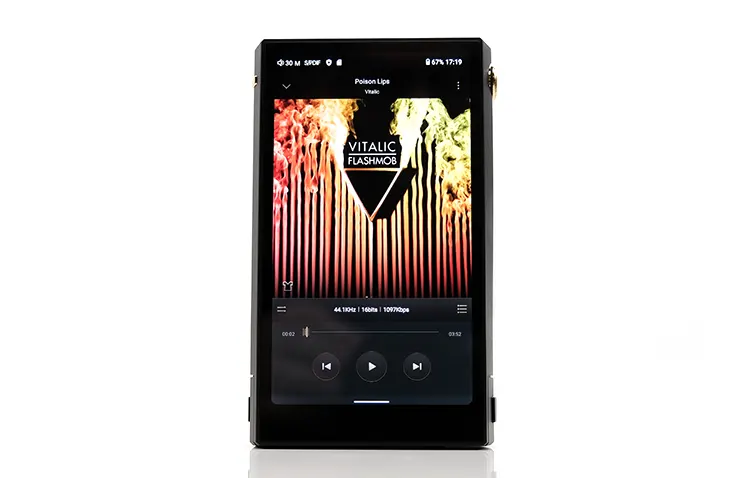
Of all of the comparable devices in this review, the N6iii is the most portable. It looks tiny when placed beside the M27 and weighs a lot less at 350g compared to 556g.
The reduction in size means it is far more pocketable, with easier access to controls in one hand. Power and volume are split, much like the older M17, but given the compact size, you can still reach for both in one hand.
The smaller size of the N6iii also means a smaller 5″ Sharp FHD+ 1080P display compared to the M27’s bigger 5.9″ version and fewer inputs and outputs, especially with the R202, which is headphone only.
With the N6iii/C201, you get balanced, SE, and lineout for analog output, but it is missing the M27’s 6.35mm output. With the E203 and R202, there is no line output at all.
If you want coaxial output, you will have to get a USB-C to coaxial adapter from Cayin (custom pin configuration). Aside from that, you get USB-DAC and USB OTG capabilities on the N6iii, but not full-sized optical output or coaxial output/input.
The M27 has a distinct advantage in storage options with 2 memory card slots and 256GB of onboard memory as opposed to just 128GB and 1 card slot on the N6iii.
The Cayin N6iii has an advantage for battery life, but how much will depend on the card being used. You can get up to 16 hours with the R202 card, which is significantly more than the M27’s maximum 9-hour rating.
However, the N6iii cannot bypass the battery when in use, unlike the M27, whose USB-C power mode can bypass the battery completely, preserving battery health for potentially longer periods.
Performance
There are two sound signatures from the N6iii/R202 to compare: the lusher, sweeter sound of the R2R timbre and the more neutral, spacious 1-bit sound.
Of the two, the 1-bit mode hits closer to the neutral quality of the M27; however, you can still pick up on some key differences between resistor DACs and delta-sigma DACs, as well as their two amplifiers.
For a start, the M27 has stronger voltage swings, providing more energy and drive in its performance, especially once you start comparing the gain levels above low.
Second, both the 1-Bit and R2R modes provide a more natural sound, with R2R amplifying vocal presence, creating a lush note quality, rich in etched texture.
The M27 sounds comparatively pristine, articulate, and more detailed, but the note quality is more polished with a bit more contrast coming through. It’s more typical of delta-sigma, better in resolution and spatial detail, but perhaps slightly less ’emotional’.
Of the two modes, the N6iii/R202’s 1-bit mode is more in line with how I think an M27 owner would appreciate the Cayin DAP. It’s more neutral in its imaging than the R2R mode, quite linear throughout, but also quite spacious and detailed.
It’s less about emotion and more about the detail and accuracy, though its tone is still more on the analog side with slightly more natural note decay than the M27.
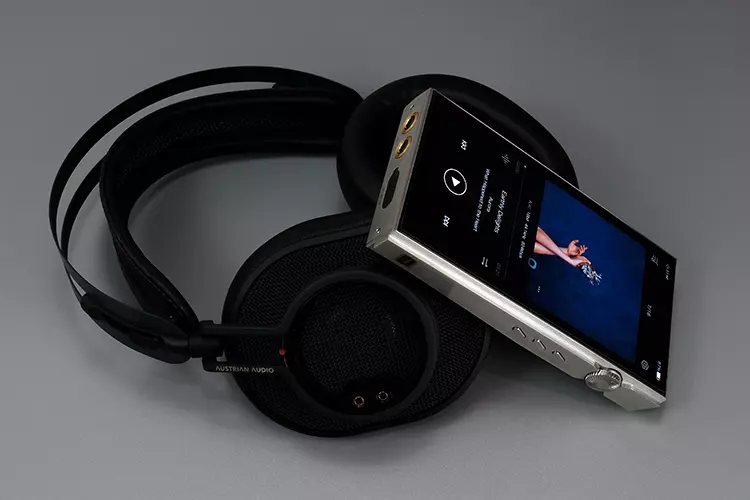
Another major differentiator is power. The N6iii/R202 is decent enough and will drive the Austrian Audio Composer quite well and put a lid on its edgy upper-mids and treble, more so than the M27.
But beyond, no chance with weaker dynamics and reduced staging size than the M27 when paired with the HIFIMAN Susvara Unveiled, or alternatives such as the DCA EXPANSE.
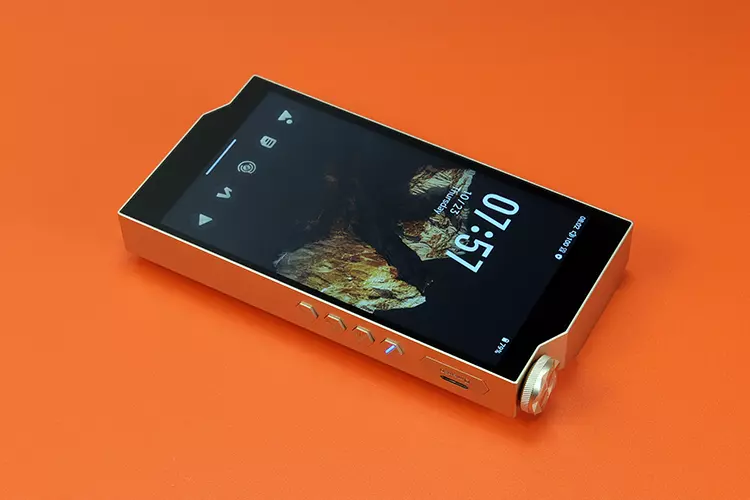
HiBy RS8 II
The HiBy RS8 II is the company’s flagship DAP, and one that was reviewed by me last month. Whilst it is significantly more expensive than the M27, I felt the comparison was worthy, given that both are high-profile recent releases.
Technical
The two DAPs have very different pitches. For me, the RS8 II has excellent hardware, but it exists to put a spotlight on the software, whereas the M27’s software feels like a gateway to the hardware.
The RS8 II is ‘governed’ by its Darwin III architecture, which is a discrete R2R network array as opposed to dual delta-sigma inside the M27, combined with an AI-powered FPGA, providing digital signal processing for its oversampling harmonic controls.
The new CPU and FPGA setup is also the foundation for the RS8 II’s new Sankofa AI platform, which provides the user with an ever-expanding set of tone controls based on vintage hardware.
Compared to the M27, its decoding capability is higher at an impressive DSD1024 and PCM 32-bit/1536kHz, compared to the M27’s DSD512 and 32-bit/768kHz.
The RS8 II BT5.3 capability is a step below the M27’s BT5.4, though both can handle up to LDAC and aptX Lossless.
Both DAPs have heavily invested in superior CPUs, with the M27 running a Qualcomm QCS6490 CPU with 8GB of RAM and the RS8 II on a higher-tier QCS8550 with 16GB of RAM.
This is one clear area where HiBy can justify that higher price tag, though surprisingly, they stay on Android 13 with the RS8 II, similar to the M27.
No question, the M27 has the more powerful amplifier. Its 5W USB-C-powered balanced output is way above the RS8 II’s peak of 812 mW into the same 32Ω load. Even without DC power, the M27 has more than twice the output power of the RS8 II.
HiBy takes a more studied approach to amplification, mixing Class A and Class AB in a computation-driven Adaptive model that switches between each Class depending on what is happening in the recording.
Design
Although slightly larger than the N6iii, the RS8 II is still very much a portable player that you can hold in one hand compared to the bulkier M27.
And again, I doubt FiiO is too worried about that size difference, given the pitch is for the M27 to be both portable and a desktop crossover.
The aesthetics are also quite different. The RS8 II cutaway curvature, combined with the gold finish, has a more classical HiFi or elegant look. It feels like it’s pitched to wizened audiophiles or business class ticket holders.
The M27 ‘Mecha’ design language still gives off a more aggressive, futuristic vibe, strongly suggesting there is a lot of power under the hood. It feels more youthful in its approach.
The black aluminum only adds to that “Dark Overlord” experience, and though the Titanium version has a somewhat softer welcome, the pointed grills and RGB lights might soon change your mind.
Speed is the name of the game here. On that note, the RS8 II is technically faster and doubles the AnTuTu score of the M27.
However, the additional 8GB is needed for the computational work required by adaptive amplification, the Sankofa AI module, and a wide range of DSP options within HiBy Music.
The M27 does not have the same in-depth sound-shaping experience, though the FiiO Equalizer app is a solid PEQ tool with a lot of value.
Where the M27 shows off its expertise is in the I/O. It has more memory expansion and ports, and combined with the desktop bypass mode, it is better suited for connecting to desktop components. It is, however, missing the RS8 II I²S port, which I love to use with compatible DACs.
Performance
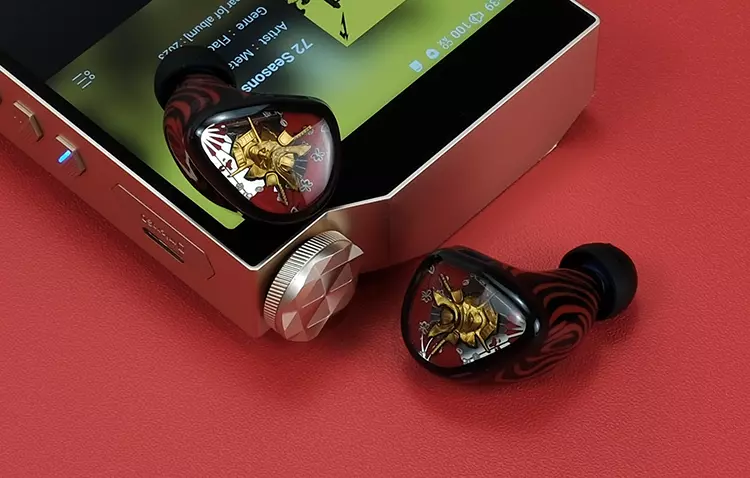
For this comparison, I kept the RS8 II in adaptive mode with Turbo Mode turned on for amplification. I also kept the DSP features turned off for the stock sound.
Some clear tonal differences between these two DAPs, with the RS8 II sounding more natural with an analog coloration and enhanced sub-bass depth and power, something that is evident even with Turbo Mode turned off.
The M27 is more reference-like and less colored in its delivery. It’s flatter in the sub-bass volume but more forward and aggressive in the mids, with stronger treble presence.
It creates an impression of the RS8 II tuning tapering the presence gradually through the mids and highs to create a more pleasing, sweeter-sounding, even-harmonic balance.
And it is again, delta-sigma versus R2R. You can hear that in the precision, polish, and speed of the M27 performance delivery versus the smoother, elongated note decay, heavier bass bloom, and richer vocal performance of the RS8 II.
How best you perceive the value of those two performances depends on your preference. Reference, energetic, slightly dry, and cleaner-sounding from the M27, or a coherent and natural analog tone with a stronger bass response from the RS8 II.
Power is where I think the M27 comes into its own, with the superior dynamic range and staging size for demanding headphones such as the Susvara in Ultra High Gain Mode.
However, for more efficient headphones, the depth of the tuning tools from the RS8 II can make it a more flexible pairing partner.
My Verdict
The FiiO M27 would well be a bit of a bargain, considering the depth of features, power, and improved performance over the M17, and reasonable pricing compared to competing flagship DAPs.
It’s far more resolving and spacious-sounding than the M17, offers more power to drive some of the most demanding headphones out there, and is packed with a vastly improved processor and a decent level of RAM. There are very few faster high-end Android DAPs in the market right now to compete with it.
Yes, the M27 is huge, one of the caveats of buying into FiiO’s vision of a desktop crossover solution. It is not a pocketable device. And yes, for those wanting more of a “retro-vibe” or a very organic sound, it’s not going to be ideal for your tastes
However, if you are a big headphone user, a reference-sound lover, and need a wide range of traditional HiFi connectivity options, I can’t think of too many DAPs in 2026 that come close to delivering the same convincing crossover desktop/portable device experience as the FiiO M27.
FiiO M27 Technical Specifications
- Processor: Qualcomm QCS6490
- RAM: 8GB
- Storage: 256GB internal
- OS: Android 13
- Bluetooth chipset: Qualcomm QCC5181
- Bluetooth codec support: aptX Lossless, LDAC, aptX Adaptive, aptX HD
- DACs: Dual ESS ES9039SPRO
- Power regulators: Dual ES9312
- Volume control: NJU72315 digital volume chips
- Op-amps: OPA2211
- Balanced output power: up to 5000mW+5000mW
- Headphone outputs: 3.5mm, 4.4mm, 6.35mm
- Digital I/O: Optical out, coaxial in/out
- Clocking: Dual RIVER femtosecond oscillators + FPGA
- Battery capacity: 9200mAh
- microSD support: up to 2TB per slot (2 slots total)
