

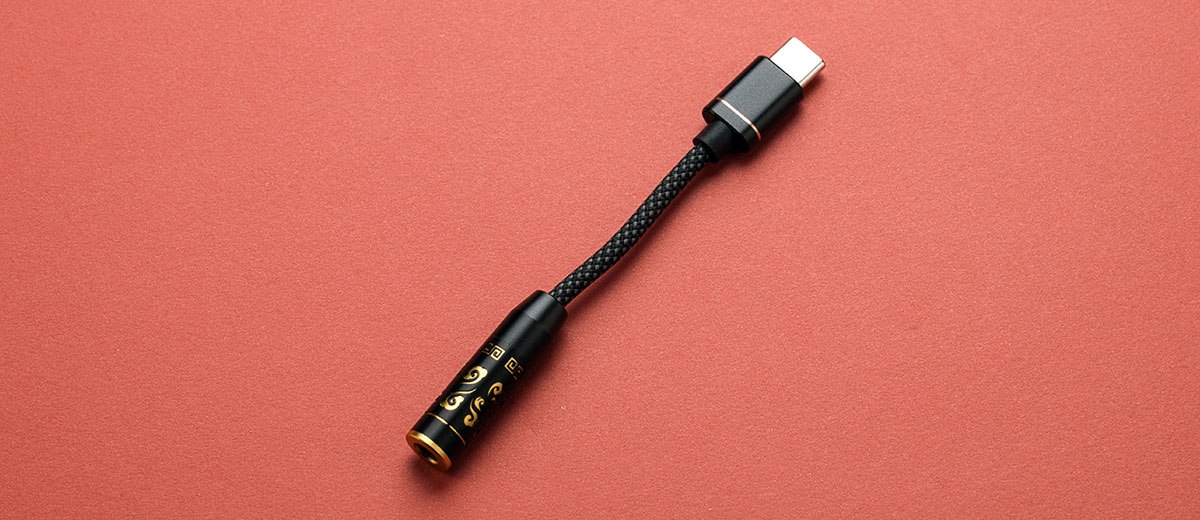
Marcelo reviews the FiiO JIEZI B, an affordable 4.4mm dongle DAC that supports 10-Band PEQ with up to PCM 32-bit/384kHz and DSD256 decoding. It is currently priced as low as $11.99
Disclaimer: I received this sample in exchange for my honest opinion. Headfonics is an independent website with no affiliate links or services. I want to thank FiiO and JadeAudio for their support.
You can click here to learn more about the FiiO audio products previously reviewed on Headfonics.
This post follows our current scoring guidelines, which you can read in more detail here.
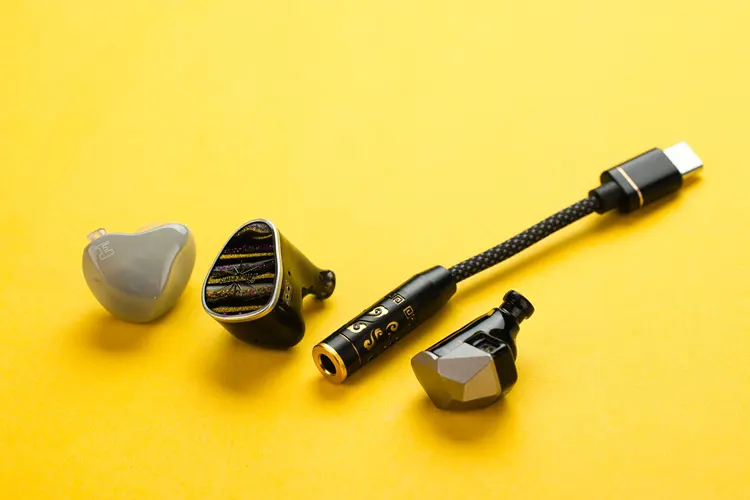
As an owner of a FiiO M15s DAP and KA11 dongle DAC, I’m always curious about FiiO’s JadeAudio sub-brand. And finally, I got to hear my first JadeAudio product when they sent me the JIEZI B 4.4 DAC AMP for review, which currently costs under $20.
Although I’m new to the JadeAudio branding, it has been around for many years now, and some products under the JadeAudio brand have been reviewed here at Headfonics, including the FiiO JD7, JD1, and JH5, among others.
Will the JIEZI B be able to drive the modern IEMs and headphones? And how will it compare in sound quality to the FiiO KA11 and the MOONDROP Dawn Pro? Find out in my review below.
Features
The JIEZI B features a lightweight aluminum-magnesium alloy construction with unbalanced 4.4 output. It supports high-resolution PCM 32-bit/384 kHz and DSD256 decoding.
It has an output power rating of 49mW into 16Ω and 34mW into 32Ω, with an SNR of 104dB and a THD+N of0.0034%,. The output Impedance is less than 0.5Ω, so I have no concerns with potential impedance skew.
Another feature that has gained popularity in recent years is the inclusion of a customizable equalizer.
The JIEZI B features a 10-band parametric equalizer that works in conjunction with the FiiO Control App for Android and iOS devices. The EQ setting is stored in the JIEZI B and will not be changed unless modified in the App again.
Design
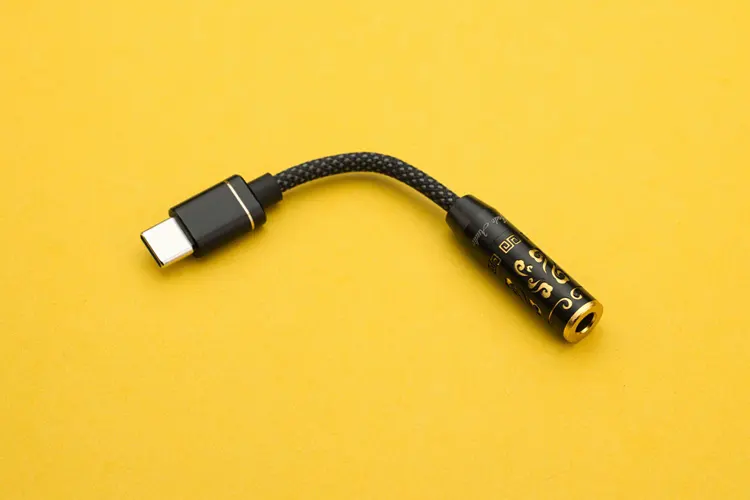
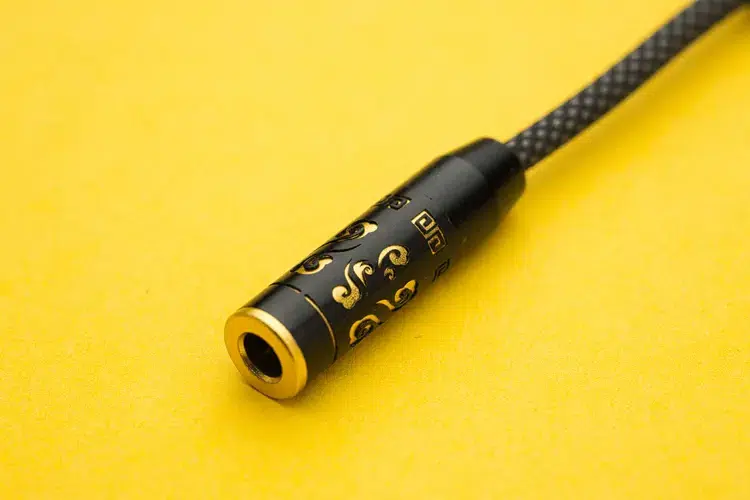
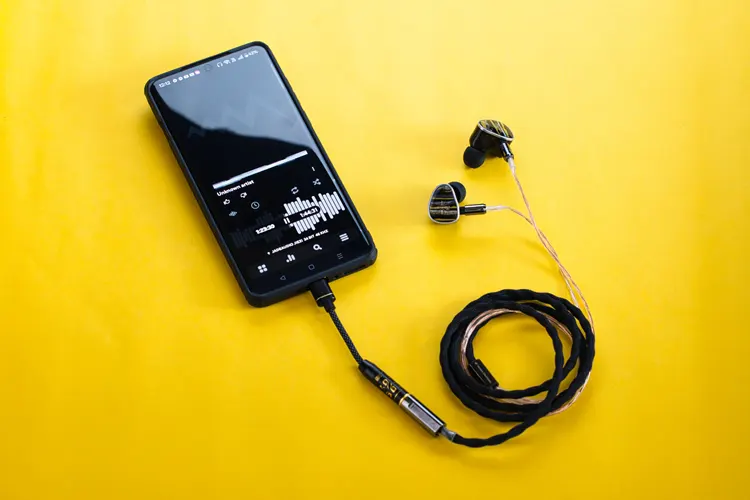
The JIEZI B is a small tail-styled dongle DAC with a total length of only 99.1mm and a width of 8.9mm on the 4.4 barrel and 10.9mm on the USB-C plug. Which easily fits even in a cramped IEM pouch or case.
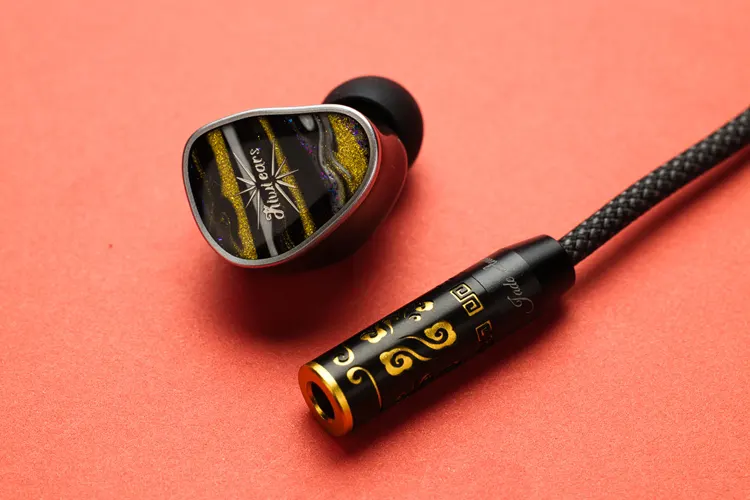
I like the golden hoop-like design with eastern-style carving on the barrel of the 4.4mm plug. The black and gold color scheme is visually appealing, although it remains understated on the USB-C end.
I also like the fabric braided cable, which complements the golden hoop-like design well and feels strong and durable.
I/O
As a tail-styled dongle DAC, nothing could be simpler. The JIEZI B has only a USB-C plug on one end, which serves as both an input for music and a data port for the FiiO control App, and a 4.4mm output plug on the other end.
The JIEZI is also available with a 3.5mm output (JIEZI A) and includes support for in-line controls, allowing for voice calls, karaoke, recording, and in-game chats, making it a versatile solution as a dongle DAC.
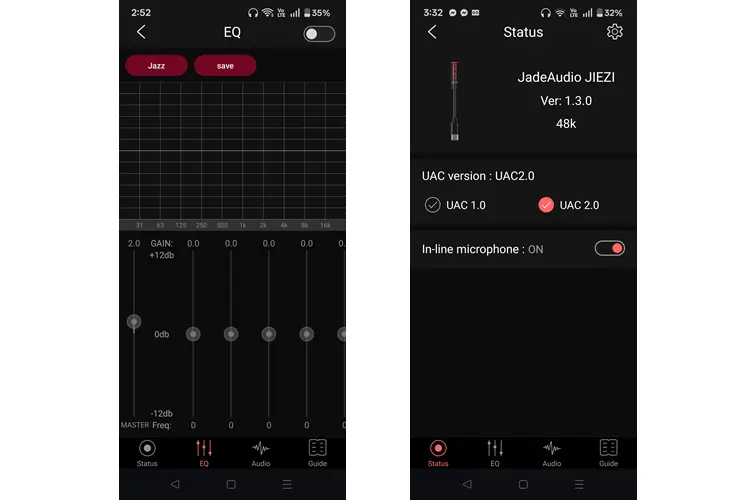
The JIEZI’s USB-C input can be set in the FiiO Control App to either UAC 1 or UAC 2.
UAC 1 is used for gaming consoles, which limits the audio bandwidth in exchange for broader compatibility and increased processing speed. UAC 2 is used for audio, maximizing the digital transmission bandwidth for optimal sound quality.
Thanks to JIEZI B’s up-to-date firmware and internal components, it is highly compatible with various USB sources. JIEZI B connects instantly with all the sources I tried: PC, Laptop, phones, and DAPs, with no hiccups.
JIEZI B didn’t require any driver to be used as a basic dongle DAC on all the devices mentioned above, but it requires the FiiO Control APP to change the USB input mode to switch between UAC 1 and 2 for use with gaming consoles.
The JIEZI B exhibits mild warmth in the USB-C portion during the burn-in period, which lasted for a couple of days.
I also noticed negligible power consumption; the power consumption of the JIEZI B must be so modest that I didn’t feel it shortened the battery life of my phone or DAP, which I used it with.
Software
When I received the JIEZI B, it came with firmware version 1.2, which had weak subjective sound output. However, I updated the firmware to 1.3 using the FiiO Control App, which has stronger and cleaner sound output.
Since there are no controls in the body of the JIEZI B, all the controls are accomplished via the use of the FiiO Control App, which is available for both Android and iOS systems.
The FiiO Control App includes controls for switching between UAC 1 and 2 USB modes, in-line microphone on/off, Gain, 10-band Equalizer, channel balance control, and, as a bonus, the user manual for the JIEZI B.
10-Band EQ
The JIEZI B’s 10-Band EQ is a fully adjustable parametric EQ, featuring gain controls of up to +/- 12 dB, customizable center frequencies, and Q ranging from broad (0.25) to peaky (8), which I find very useful for taming the peaks on some headphones and IEMs.
There are seven preset and fixed EQ settings, including Jazz, Rock, R&B, Hip-Hop, Pop, Dance, and Classical. And three customizable EQ settings, named FD15, FH5, and FH3, are used for their IEMs with the corresponding names.
Memory
Everything that was set in the FiiO Control App stays in the JIEZI B even after a long time of no use.
When used with other devices, it stays that way until you change the settings again in the FiiO Control App, making the JIEZI an excellent dongle DAC for a permanent pairing with a specific IEM.
Packaging & Accessories
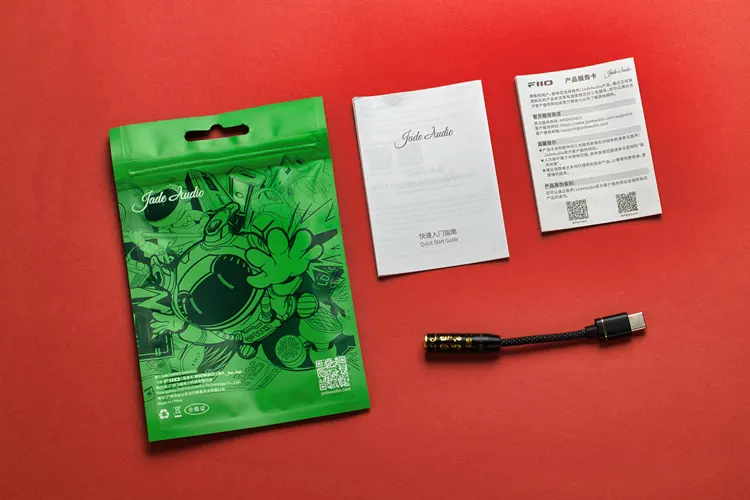
JIEZI B’s packaging is simple, made only of a 100mm by 150mm green flat resealable plastic with some graphics and stickers on the back. Inside includes the dongle DAC and two user manuals. This is acceptable for the price, in my opinion.
Sound Impressions
Before seriously listening to the JIEZI B, approximately 24 hours of burn-in were completed by playing it with a spare DAP and IEM for 8 hours a day over three days.
There was no noticeable change in sound after the burn-in, as the sound signature of JIEZI does not lend itself to extensive sound analysis.
However, when I updated the firmware from version 1.2 to 1.3, I noticed a change in sound. Previously, it sounded subjectively weak and too warm, but now it sounds punchy and more forward after the firmware update.
For this review, I used my Dita Audio Project M, Kiwi Ears Etude, and MOONDROP’s Harmon and Horizon. They were chosen for their distinct sound and varying load difficulty.
I used my OnePlus 13 phone as the primary sound source, but also tried the JIEZI with my Laptop, DAPs, and PC I used PowerAmp and UAPP music player Apps, without any sound enhancement such as EQ and soundfield expansion.
Summary
The JIEZI B is not the most neutral-sounding DAC/AMP around; it has a noticeable, slightly V-shaped sound signature, with perceived extra energy in the mid-bass and a lower treble.
There is a perceived roll-off or limitation in the sub-bass, as there is little subjective response in the frequencies below 40Hz.
Sub-bass rumble and slam are muted; however, there is extra energy in the mid-bass to compensate for the lack of sub-bass, resulting in a fuller sound than expected.
Upper midrange has a laid-back and relaxed characteristic, with smooth and warm tonality, as there is a perceived recession centered around 1.2 kHz. This prevents vocals and instruments from sounding thin, glaring, and fatiguing, at the expense of midrange presence.
Treble frequencies around 5 kHz are boosted. It has a slightly rough characteristic, making the JIEZI B not the most refined-sounding. Additionally, there is a perceived roll-off or limitation in the upper treble extension, resulting in an average rendition of micro-detail.
I don’t mind the boost in the treble and the slight upper treble roll-off, but what I don’t like is the lack of perceived resolution and micro-detail rendition. JIEZI B’s treble sounds slightly hazy and congested at times. The macro details are acceptable, though.
Coloration
The JIEZI B isn’t the most transparent-sounding DAC/AMP, due to its mid-bass-centered bass and boosted treble, as well as slightly limited upper treble extension.
That said, the colorations are not as apparent as stated; mainly, when used with less resolving IEMs and headphones, the colorations are subtle.
However, for me, the most obvious coloration of all is the slight congestion in the treble; still, it is also subtle. Nonetheless, I wish it were cleaner-sounding.
Staging & Dynamics
The JIEZI B’s soundstage is average in size, with reasonable height, width, and depth.
There is a good sense that you are listening in an actual musical performance space, albeit slightly miniaturized. Instruments and vocals give an illusion that they are coming from outside the head, just like any other dongle DACs, with average staging performance.
I can’t help but think that the JIEZI B’s staging could be improved if only the treble response were smoother and cleaner, which would significantly enhance the staging. However, it’s not too bad either, or again, it’s just average for a small, tail-style dongle DAC.
Depending on the IEM or the headphone used, there is reasonable image holography, and the image sizes are relatively accurate. However, the images themselves are not as defined or stable as they could be, especially in the center vocals, where I don’t feel as palpable as they should be.
The JIEZI B is energetic in its sound presentation, with good contrast between the average and loud passages in the song, as long as I don’t put the volume at or near maximum, where the limitation of its modest power output rating is audible.
Despite the JIEZI B’s modest power output rating, I was surprised by how loud the music could go without maxing the volume. To be able to clip or compress the music, one has to go dangerously loud or use a very difficult-to-drive and insensitive IEM or headphones.
Click on page 2 below for my recommended pairings and selected comparisons.
