

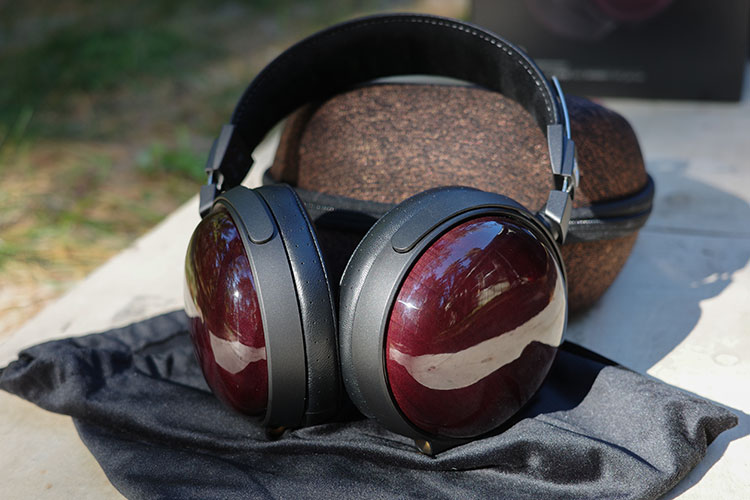
Synergy
The easy-to-drive 32Ω FT13 has a sensitivity of 98dB/1mW @ 1 kHz, making it easy to drive from pretty much any source. I was never left wanting for more power, no matter what was used. So, reaching a palatable listening level should be easy.
Pairings
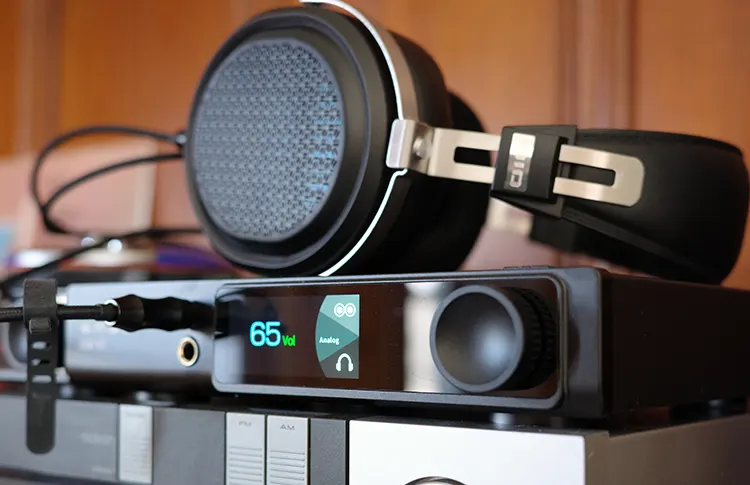
The Aquila III is known to be a somewhat brighter-sounding headphone amplifier, and that is still the case when paired with the FT13.
However, I never felt there was too much energy, especially up top. While I could not reach louder levels than I can with other sources, the pairing was a very pleasant offering.
The Aquila III is known for its excellent detail retrieval, and it showed here, while allowing the top end the proper expansion without becoming harsh or grating.
Switching to the EarMen CH-AMP Signature provided more midrange energy, with slightly more bass, too.
Where the Aquila III could expand but tame the top end, the EarMen held no grudge against the treble region, providing an energetic sound that might turn some off. I pushed the volume as a gauge to note the sound, but quickly found I had to lower it for my listening desires.
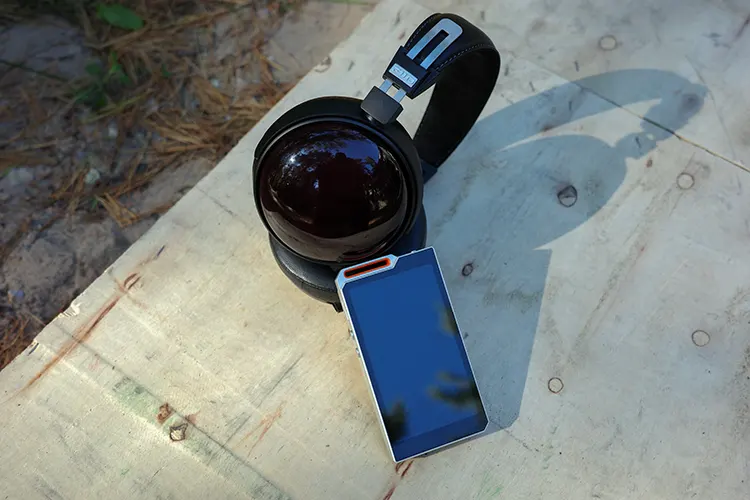
One of my favorite pairings was using the iPhone 16 Pro Max tethered to the EarMen L-Amp. The tube warmth helped quell the overexuberance of the top end.
Reining in the treble region to make a palpable sound quality that provided good richness to the FT13 and showed the duo could pair favorably. I was also able to raise the volume beyond what the two desktop amplifiers allowed for pleasant listening.
Pairing the FT13 with the FiiO JM21 provided a vitality to the sound that topped the HiBy R4. The top end extended with decent control, but when raising the volume became a bit unkempt; tempering the volume was the course of order.
I appreciated the additional detail of the JM21 over the richer signature of the R4, but it may be a bit hot for some.
Selected Comparisons
The following selected comparisons to the FiiO FT13 were completed with the YULONG Aquila III, the EarMen CH-AMP Signature edition, and the FiiO JM21
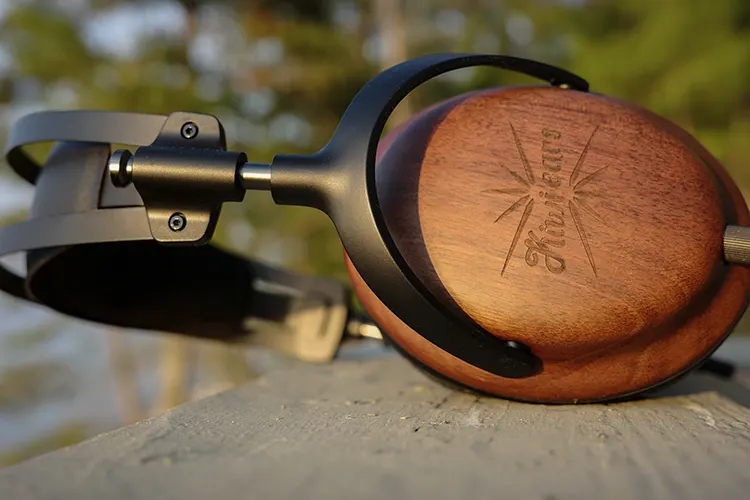
Kiwi Ears Atheia
Features
The Atheia has a 50mm dynamic driver and a 14.5mm planar magnetic driver, paired together. We continue to see companies move towards multiple drivers, but the FT13 stays true to its course with a single dynamic driver.
The dynamic driver helps to push the low-end to the forefront, despite the company stating that the Atheia has a “neutral sound profile.” It doesn’t.
Expect good reach down low to set the tone. The larger 60mm dynamic driver can be felt in the FT13, with a bit more low-end extension, especially with the suede pads.
The walnut cups help to disperse sound qualities equally through the hardwood, making for a more accurate sound signature, purportedly. Both models look quite good.
The 3.5mm single-ended cable has a braided business end up to the Y-splitter, then a plastic sheathed, wrapped copper cable.
Microphonics are kept to a minimum this way, but can still be heard, unlike the FT13, when physically touching the cable. Left to its own, the cable lies nicely, though that braided part tends to wrap around itself a bit.
A sensitivity of 102 ±3 dB @1KHz 1mW and impedance of 32Ω ±10% @1KHz (98dB & 32Ω for the FT13) make the Atheia not only easy to drive, but also compatible with a variety of source inputs.
Similar to the FT13, a multitude of DAPs were used, with similar (as in variable) results.
Design
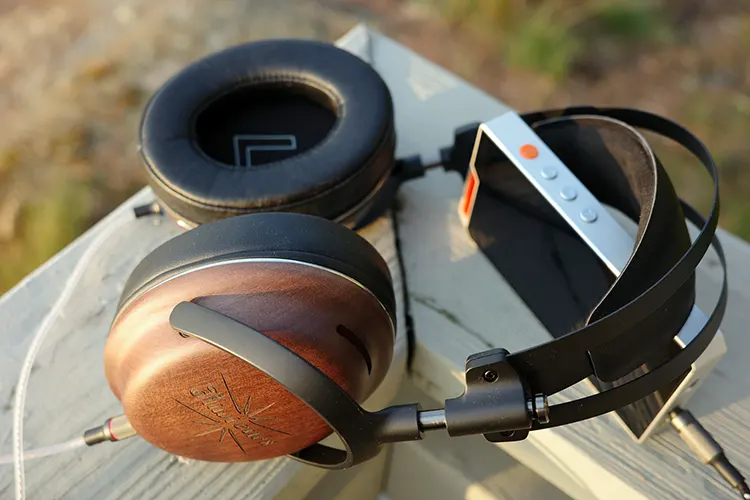
There is no denying that the walnut cups make for a stunning, understated look to the Atheia. From the opening of the box to first listen, I was impressed with the craftsmanship and fit/feel. On looks alone, the FT13 may have one-upped the Atheia, with the stunning purpleheart wood look.
The vegan leather cups are plush without being gushy. Structured without being flabby. A nice combination. The FT13 comes with true lambskin and suede pads.
Handcrafted, the cups show nary a flaw but do give off that handmade flair. The darker aluminum alloy stanchions, gimbals, and yoke add to the appeal, along with giving presence to the headphone without the weight penalty (349g).
Lighter, solid-looking, and excellent fit come about as a result. There is a bit more of an upscale look to the FT13 if you only look at the cup.
The cable insertion into the headphone also has a notched mounting “system,” with a plug-and-twist approach that prevents the cable from being pulled out while in use.
The downside is that if you want to add a balanced cable to the mix, it must be able to handle that notch on the headphone end or fit inside without disturbing the notch. Something to consider when looking for an upgraded cable. There is no such issue with the excellent FiiO cable.
The Atheia has a fairly loose slider on the side to adjust fitting, along with the double headband straps on top. The fit and feel were very comfortable, with slightly more shifting while moving my head than on the FT13.
The Atheia’s quality build and fit make it to the top of this segment, easily. I do wish for a slightly tighter fit, though, unlike the near-perfect fit of the FT13.
Performance
There is no denying that Atheia is not neutral. The preponderance of bass exudes a thumping low-end, overshadowing the rest.
Bleed into the midrange couples with a recessed midrange, making for a polite instead of exuberant midrange. There is more bass in the Atheia, and with less control, but this makes for a more fun sound, comparatively.
Where the over-the-top treble of the FT13 might become tiresome, there is no such response from the Atheia. Utilizing a warmer, richer source helped tame that tendency in the FT13, where there was no need in the Atheia.
Vocals are slightly lifted to counter this, making for good height and a presence that belies the guttural low-end.
The warm-sounding signature extends north into the treble region, without too much sizzle, which is something I appreciate. The Atheia presents a warmer signature than the FT13 and is more cohesive overall.
Instrumental passages carry better clarity and detail retrieval than mixed passages, making for a decent amount of vibrancy going along with that deep-reaching bass note. The FT13 falls behind here, but different genres can even this out a bit.
This is a more musical headphone than an accurate one, and should be taken as such, without thinking too deeply into the details. The FT13 tries to be musical, but the top-end extension makes for a headphone that almost tries too hard.
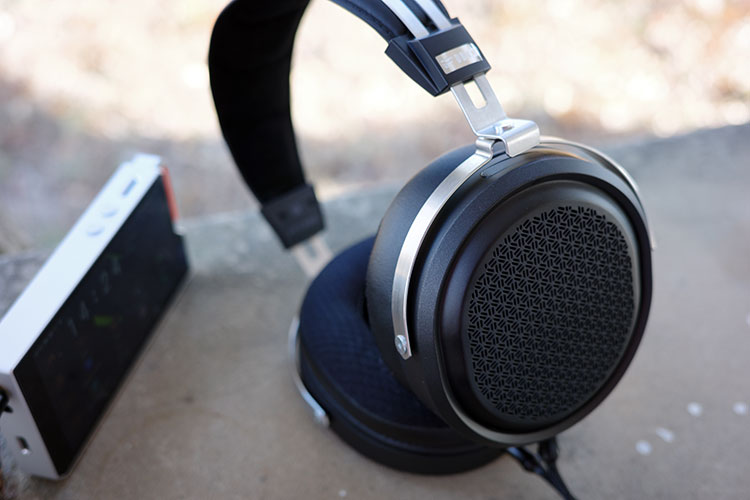
FiiO FT1 Pro
Features
The FiiO FT1 Pro is a set of open-back planar driver headphones equipped with a 95mm x 86mm in-house developed planar magnetic driver and a rounded corner dual magnet array to create a more evenly distributed magnet field for this size of the driver. The FT13’s dynamic driver is 60mm, which is a bit larger than “normal.”
Sapphire and aluminum coat both sides of the driver for an excellent sonic response, while the 1µm thin diaphragm results in a fast musical response. The W-shaped diaphragm of the FT13 provides a bit of the same musical response.
The 20Ω lower impedance means the FT1 Pro isn’t that inefficient, though its 95 dB/mW | 112 dB/Vrms rating might mean pushing the volume a bit more on weaker sources than you are used to.
The 98dB & 32Ω for the FT13 make them a bit easier to drive, or rather, more forgiving. Otherwise, I would consider the FT1 Pro headphone not that difficult to drive from a decent DAP or modest desktop setup.
Design
There is no mistaking the open-back look, with an ornate aluminum faceplate built into the cup shell.
Aluminum helps to keep the headphone light, continuing into the stanchions and yoke with what looks to be pressed shapes. On looks alone, the FT13 presents itself as much more upscale, including build quality.
The all-black cups and pads are countered by the steel yoke, stanchions, and connecting hardware, giving the FT1 Pro a smooth, upscale look.
The FiiO logo on an aluminum inlay is above the yoke, while small lines on the inside of the stanchions let the user know if each side is pulled out evenly. The solid black and purpleheart wood of the FT13 combine into a cleaner package for me.
The single headband of the FT1 Pro has six separate “pillows” underneath for padding cut in a suede-like material, with a soft black pleather top.
Usually, a single headband does not work well for me since I prefer a suspension system, but the FT1 Pro fits well and stays put. The similar fit and function of the FT13 make this a superfluous point, to me.
The thick pleather and suede ear pads are very comfortable, and the whole unit fits with the right amount of pressure. Only those with very large heads may feel it to be too much.
The rear of the pads is slightly thicker, canting the cup forward a bit, but not noticeably so. I also found them to be stiffer than the FT13. Going back and forth, the sheer comfort of the FT13 provided relief to my head comparatively.
I found I could wear the FT1 Pro for long listening sessions, going over 5 hours at one point, without issue. I could go even longer with the FT13. Both are quite adequate.
Performance
The FiiO FT1 Pro promotes an exuberant signature, with enough verve to satisfy those who like a speedy signature. It also carries a melodic, natural tonality to it, exemplifying the planar driver within.
The unevenness of the FT13 comes across as more disjointed, but still with some fun characteristics to it. But not like the FT1 Pro.
Bass reach, while not too deep, is taut with control and matching attack and decay. The midrange sits behind both ends but comes across as organic and natural.
Succinct transient responses also highlight the midrange, giving it excellent weight characteristics. The overall control of the FT1 Pro sound qualities is to be commended comparatively.
The treble note extends further than many planar driver units I have tried lately, but not like the FT13. The sapphire coating shows its mettle here with very good extension and tight control over the high end. There is also better control on the FT1 Pro up top.
Never lacking in note weight, the signature also does not become saturated with thickness, either.
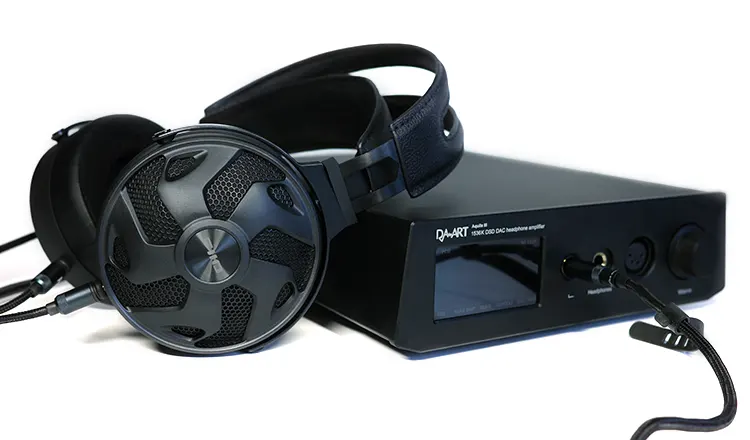
FiiO FT3 32 Ohm
Features
The FT3 32 Ohm uses the same 60mm dynamic driver as the 350Ω model but switches to an LCP Aluminum metal-plated gasket, which also has an aluminum metal diaphragm compared to the Beryllium-plated gasket of the 350Ω edition. The FT13 also uses a 60mm dynamic driver but with a W-shaped diaphragm and a large voice coil.
The rated sensitivity rises to 110dB @1kHz, which is higher than the FT13’s 98dB @1 kHz.
The combination makes the FT3 32 Ohm easier to drive for those who do not have an amplifier capable of handling the higher-impedance headphones.
The drivers are still angled slightly forward for better placement in the sound signature within the sphere of your ear. On sheer drivability, both come across as on the easier side.
The stock cable is also changed to a 392-wire High-purity silver-plated monocrystalline copper, instead of the earlier Furukawa Monocrystalline Copper cable. There is more microphonics associated with this cable comparatively, but both lay quite nicely while in use.
Design
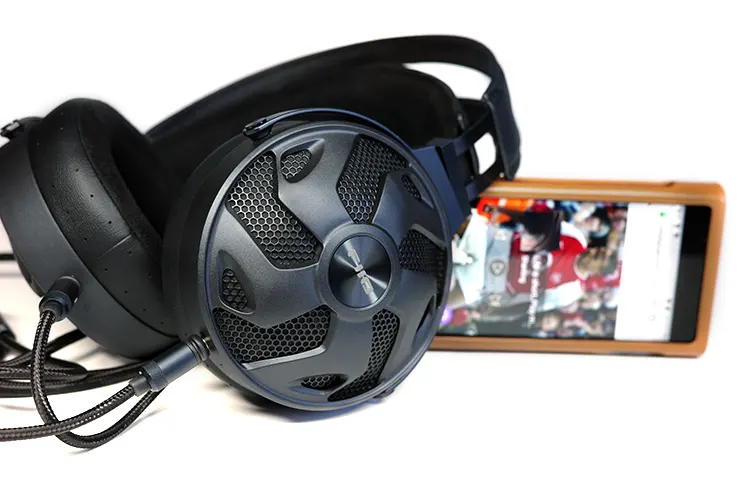
A stark contrast in design separates the two, with the “spider-like” look of the FT3s making for a futuristic look as opposed to refined and more traditional. The FiiO FT3 32 Ohm all-aluminum open design still has the airflow potential of the older model and the 60mm driver.
The spoked spider-like wheel design on the back takes a bit of getting used to (as mentioned), but with its unique design, I have come to appreciate it.
Neither too garish, nor flashy; it fits the model, showing that differences in design are all right. When side-by-side, though, one cannot deny that the look of the FT13 is quite enticing.
The suspension system has a strap extending through both sides of the sub-suspension, instead of the single headband of the FT13. There is a kind of trampoline suspension to the FT3, but one that does not bounce once the headphones are in place.
The extension can touch the outer headband, but I never encountered this, not even while wearing a hat. I do like this sub-suspension design, due to the tension provided, which was neither too much nor too little. The fit is a bit tighter than the FT13 and somewhat less comfortable.
The gray coloring of the cup and spokes makes a nice, subdued look, and those spokes look like a raven running if you look closely.
The darker gray of the headband and sub-suspension add to the subdued look, while the honeycomb protective layer gives a 3D look to the cup. The smooth, good looks of the FT13 counter the modernistic look of the FT3 nicely in FiiO’s lineup.
Performance
The FT3 32 Ohm is easy to drive, and with the ability to change pads quickly (I prefer the suede, just like on the FT13), you can tailor the sound with two distinct signatures.
The FT3 embodies a certain amount of warmth and richness at the expense of some clarity, but not like the FT13. The FT3 comes across with better detail retrieval and cohesiveness comparatively, even with the warmer overall tonality to it.
The suede exclusive pads exude a warmer signature, while the combination pleather/suede pads give more detail with a bit deeper reach down low. This matches the FT13’s combination pattern, too.
The soundstage on the FT3 32 Ohm is quite wide and deep, giving the notes room to spread out, but not become too thin. With good height too, it almost reaches the FT13’s broad expansiveness, but I have to give the nod to the FT13.
The FT3 is an excellent alternative to the FT13, and if one has the former, one may not want to move to the newer model.
My Verdict
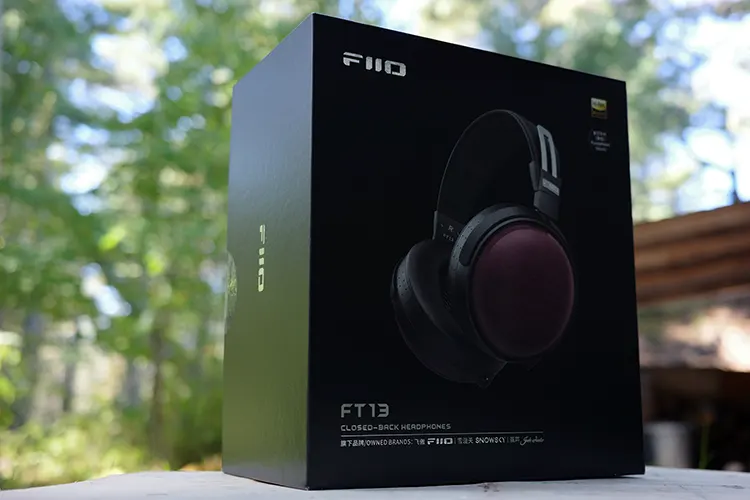
The stunning good looks of the FiiO FT13 lay the foundation for what should be a full-on package of good sonic qualities and excellent fit-and-finish. What I found was that the FT13 might be more of a niche product that may or may not appeal to users.
Changing to the suede pads will give a fatter bottom (a positive), but at the cost of control. The suede will also help to quell the overexuberant top-end, too. But you will lose control of the sound overall, which might appeal to those who prefer a sound that lies on the fun side more.
The lambskin pads fit luxuriously, giving a more detailed response, but only somewhat bring out the darker signature of the midrange. Plus, the extension up top becomes specific genre-wise.
I will say that using the lambskin pads was indeed a treat of comfort, but one where I could not raise the volume to levels where I could appreciate the music like on some of the other FiiO headphones.
There is the fun side of the FiiO FT13 sound signature that will appeal to those who prefer a more upbeat tuning, but the listeners should be prepared to EQ for their satisfaction to even things out.
As it stands, the FiiO FT13 may be more of a lateral shift than a move forward, albeit a stunningly good-looking one. For those who already own the FT3 (in either iteration), this might be a good complementary product, but you might not want to consider replacing them.
The FT13 has the looks but will need some solid user EQ to appreciate all of its benefits.
FiiO FT13 Technical Specifications
- Headphone type: Closed-back dynamic driver
- Frequency response: 7Hz-40kHz
- Driver size: 60mm
- Impedance: 32 Ω
- Sensitivity: 98dB/mW@1kHz, 113dB/Vms@1kHz
- Weight: About 356g (w/o cable)
- Earcup pressure: 4.2N+/-0.3N
- Cable material: Secondary refined Furukawa monocrystalline + silver-plated oxygen-free copper
- Cable length: About 1.5m
- Cable headphone connector: Dual 3.5mm (TS)
- Audio plugs: 4.4mm bal, 3.5mm se, 4-pin XLR bal, 6.35mm se
- Earcup material: Purpleheart wood
- Earcup colors: Natural wood/black
