

Synergy
Power
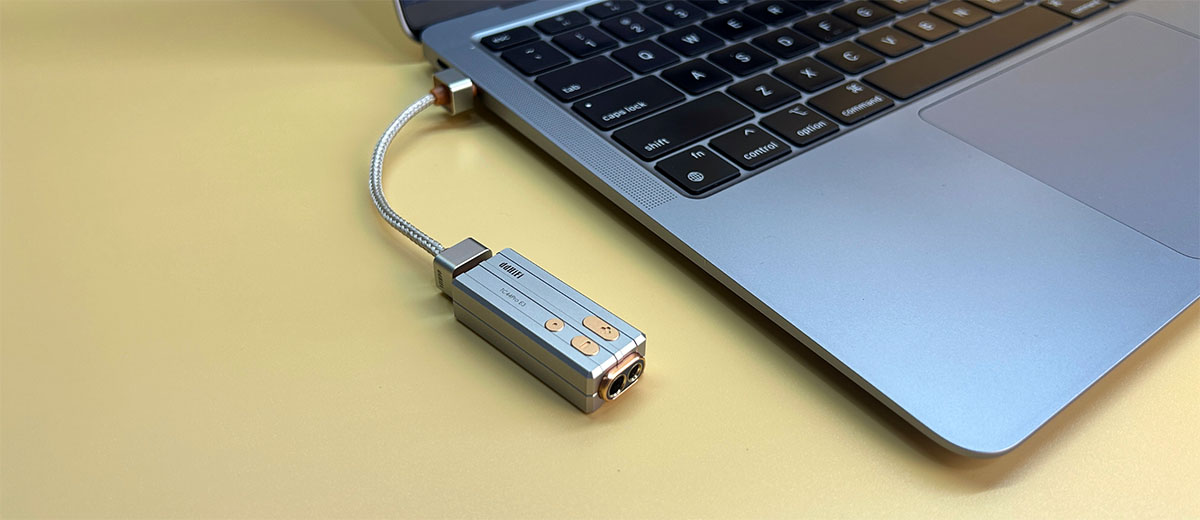
The TC44Pro E3 delivers impressive output power, rated at 510mW into 32Ω from its 4.4mm balanced output and 175mW into 32Ω from the 3.5mm single-ended jack.
In practice, even the single-ended output had no trouble handling more demanding IEMs such as the Yanyin Canon II and MOONDROP Blessing 3. There was always enough headroom to push them to comfortable listening levels without distortion or strain.
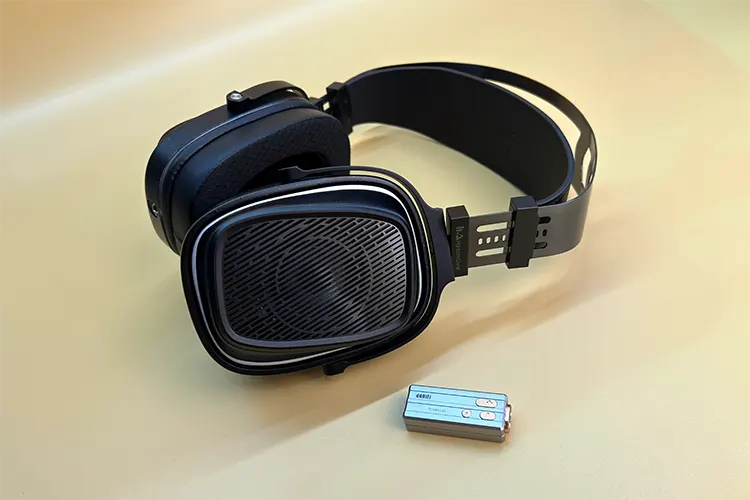
Switching over to the balanced output, the E3 proves capable of driving full-sized headphones like the Sennheiser HD 600 and HarmonicDyne BAROQUE with authority.
Among the dongles I’ve tested, the E3 performs particularly well with the HD 600. While other units can get close, offering decent extension at listenable volumes, the E3 went a step further.
I felt no immediate need to switch back to my desktop amps for casual listening. For a dongle of this size, that’s a remarkable achievement.
Pairings
In my testing, the TC44Pro E3 really shone when paired with warmer-leaning IEMs and headphones that complemented its slightly cooler tuning.
Among all the IEMs I tried, the Kiwi Ears KE4 stood out as the best match. This didn’t surprise me, since I’ve always preferred the KE4 with more neutral sources since they balance out the KE4’s slightly tame treble.
The E3’s leaner mid-bass didn’t make the KE4 sound flat or thin; instead, it added texture and brought out more detail in the presentation.
What did surprise me was how well the E3 worked with the Harmonicdyne BARQOUE. Thanks to its efficient drivers, the E3 powered them easily while keeping dynamics intact. Since the Baroque already has a warm tilt, the pairing felt like a perfect fit for portable listening.
The Blessing 3 and Sennheiser HD 600 also played nicely with the E3. Both have a more neutral tuning, and with the E3, I still got satisfying dynamics and extension at both ends of the spectrum.
That said, for my own taste, I usually prefer these headphones with warmer sources to add back a little mid-bass weight, which makes them more relaxing for long listening sessions.
Select Comparisons
ddHiFi TC44Pro E2
Technical
The ddHiFi TC44Pro E3 steps up in its DAC and amp architecture. It uses dual Cirrus Logic CS43198 DAC chips, paired with dual SGM8262-2 amplifier chips, supporting PCM decoding up to 32-bit/384 kHz and native DSD256.
Its outputs include both a 4.4 mm balanced jack and a 3.5 mm single-ended jack, and it offers higher output power: approximately 510 mW into 32Ω via the balanced output, and around 175 mW via the single-ended output.
By contrast, the TC44Pro E2 uses dual CS43131 DAC chips and dual ES9603Q op-amp stages. Its power output is lower: rated at 250 mW into 32Ω via its balanced 4.4 mm output.
The E2 only offers the 4.4 mm balanced out (no separate 3.5 mm SE output), which slightly limits flexibility compared to the E3.
Design
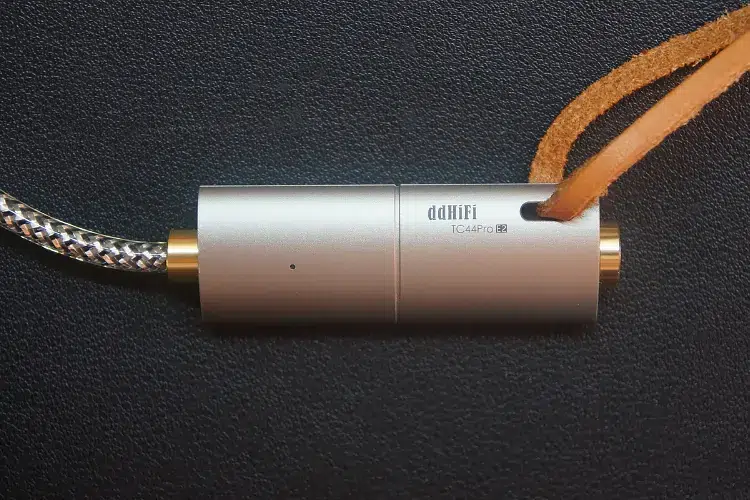
The TC44Pro E2 and TC44Pro E3 both follow ddHiFi’s minimalist industrial aesthetic with aluminum alloy housings and gold-accented outputs.
However, their physical formats differ. The TC44Pro E2 uses a fixed 9 cm cable attached to its main body, while the TC44Pro E3 adopts a detachable TC03SS USB-C cable.
The TC44Pro E3 is noticeably smaller than the TC44Pro E2. In practice, this makes the E3 far easier to slip into a pocket when connected to a phone, something the E2 struggled with due to its bulk and fixed cable.
Both units feel solid, but they emphasize different design details. The TC44Pro E2 has an elongated “eye” shape with smooth contours and comes with a leather strap.
The TC44Pro E3 instead rectangular shape with decorative lines machined into each, providing subtle flair.
Control layouts also differ. The TC44Pro E2 has a simpler form with fewer external elements, while the TC44Pro E3 integrates three tactile side buttons for volume and gain, along with discreet rear LEDs to indicate gain and playback format.
Performance
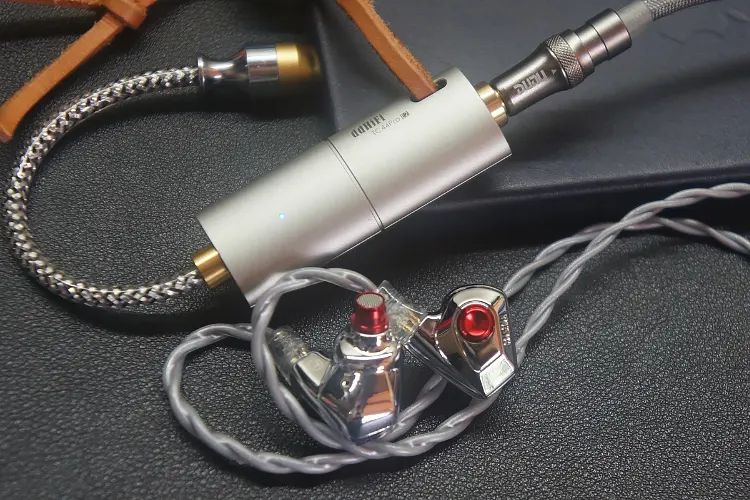
The TC44Pro E2 and TC44Pro E3 both lean toward a clean, analytical sound, but the E3 puts more emphasis on sub-bass extension and power.
This gives it a stronger rumble in genres like hip hop, though its leaner mid-bass can leave funk or disco tracks sounding less full and groovy compared to the E2.
In the mids, the E2 brings both male and female vocals forward, which works well in ballads and acoustic recordings.
The E3 shifts slightly thinner in the lower mids and brighter in the upper mids. This improves separation and clarity for strings and female vocals but makes deeper male voices sound less authoritative.
Treble is where the two diverge most. The E2 adds resolution and sparkle without straying into harshness, while the E3 pushes for more energy and presence. Cymbals, horns, and synths stand out vividly on the E3, but the added bite can verge on sibilant on colder pairings.
iFi Audio GO Link Max
Technical
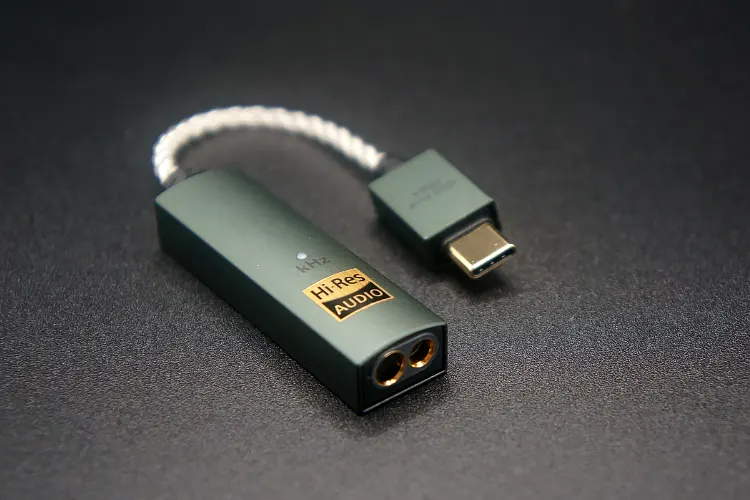
The iFi Audio GO Link Max and ddHiFi TC44Pro E3 differ in power and tuning focus. The GO Link Max, with dual ESS9219 DACs, outputs up to 241mW balanced and 100mW single-ended, making it well-suited for efficient IEMs.
The TC44Pro E3, using dual Cirrus Logic CS43198 DACs, is more powerful, reaching 510mW balanced and 175mW single-ended at 32Ω, giving it the edge with harder-to-drive headphones.
Both support PCM 32-bit/384kHz and native DSD256. In practice, I also found the TC44Pro E3 to be significantly more powerful than the iFi
Design
The TC44Pro E3 embraces ddHiFi’s industrial aesthetic with an all-aluminum chassis, raw anodized finish, and gold-copper accents for subtle flair. It slips easily into pockets while retaining front-facing tactile buttons for volume and gain, plus rear LEDs for status.
The switch to a cable-on-dongle format avoids USB-C port crowding and improves flexibility, though the shell can heat up during long, high-gain use.
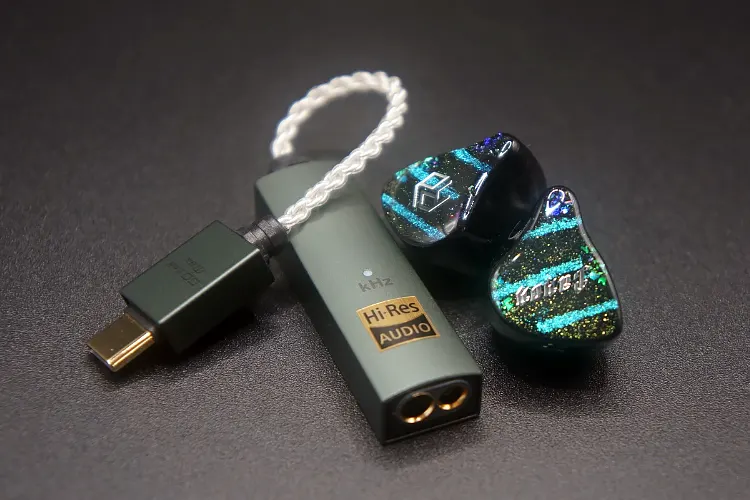
The GO Link Max, by contrast, prioritizes ultra-compact convenience. At 150mm x 15mm x 10mm, it’s longer but noticeably narrower than the E3, making it sleeker and easier to store in most IEM cases.
Its two-piece design connects via a flexible anti-tangle cable, and the lightweight alloy body with a dark green matte finish keeps it understated.
Performance
The iFi audio GO Link Max and ddHiFi TC44Pro E3 differ noticeably in sound presentation. The E3 delivers a much stronger sub-bass impact, giving tracks more physical weight, while the GO Link Max offers slightly better sub-bass texture but less overall punch.
In the midrange, the E3 takes the lead with better separation, richer tonality, and more dynamic note weight, especially in string instruments, which sound fuller and more engaging compared to the GO Link Max’s leaner presentation.
Both devices offer a similar sense of warmth, but their staging differs, with the GO Link Max creating a wider, more open soundstage, though at the expense of resolution and precision in instrument placement.
The E3, on the other hand, sounds a bit more intimate but compensates with stronger clarity and separation, allowing instruments to remain distinct even in complex tracks.
7Hz Artemis39
Technical
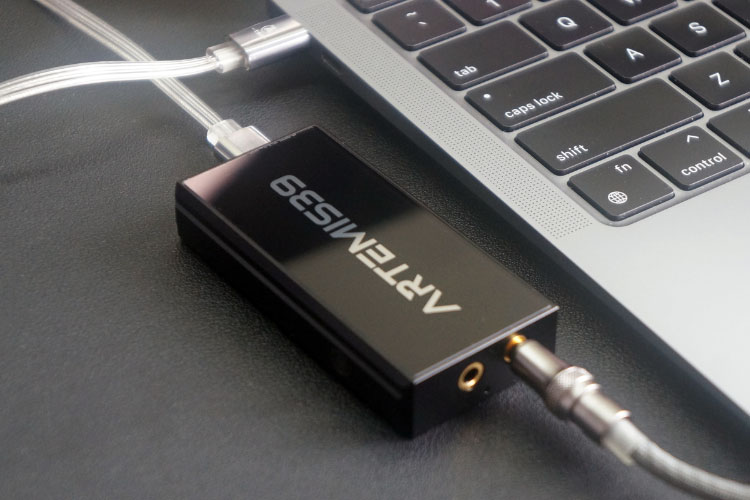
The Artemis39 is built around an ES9039Q2M DAC with an ESS9603Q amp, supporting PCM 32-bit/384kHz and DSD256. It outputs up to 405 mW into 32Ω via its 4.4mm jack and around 320 mW from its 3.5mm, making it particularly strong for single-ended use.
It also integrates a Qualcomm Bluetooth chip, a large 1100 mAh battery, and wireless playback options, effectively bridging the gap between a dongle and a portable DAC/AMP.
The TC44Pro E3, meanwhile, uses dual Cirrus Logic CS43198 DACs paired with dual SGM8262-2 amp chips. It also supports PCM 32-bit/384kHz and DSD256, but with higher balanced output power up to 510 mW into 32Ω.
Though its single-ended output is lower at around 175 mW. Unlike the Artemis39, it is a pure wired dongle with a swappable USB-C cable and an ultra-compact form factor
Design
The ddHiFi TC44Pro E3 and 7Hz Artemis39 take very different approaches in design. The TC44Pro E3 continues ddHiFi’s industrial aesthetic with a precision-machined aluminum chassis finished in raw anodization.
At around 20% smaller than the previous E2, the E3 is genuinely pocketable and comfortable to carry. The switch to a cable-on-dongle format with a swappable USB-C cable improves ergonomics, avoids port-blocking issues, and adds flexibility.
Tactile volume and gain buttons, paired with discreet rear LEDs, keep the E3 highly functional and easy to use.
The Artemis39, on the other hand, emphasizes sleek modern styling with an anodized frame sandwiched between glass panels.
While it feels premium, the glass quickly picks up fingerprints and micro-scratches. Its much larger body makes it harder to slip into a pocket compared to the E3.
Performance
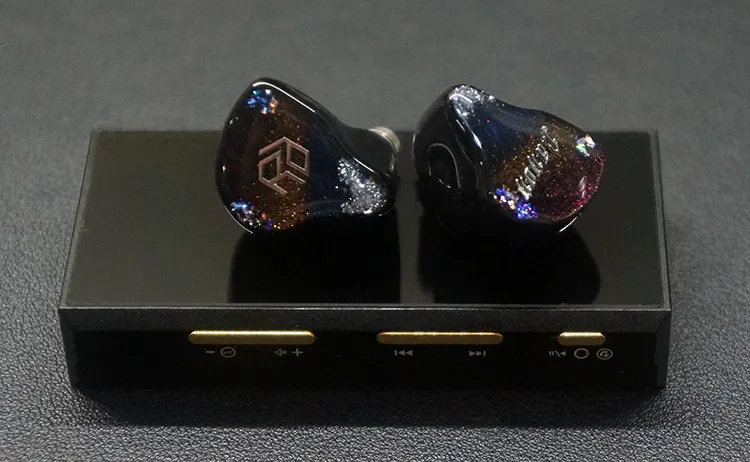
The Artemis39 leans noticeably warmer, with a stronger low-mid presence that gives body and weight to lower-pitched string instruments.
This warmth contributes to an impression of a wider soundstage, presenting music with a more spacious, atmospheric character. Its tuning makes it particularly enjoyable for genres that benefit from thicker mids and a more laid-back presentation.
In contrast, the TC44Pro E3 emphasizes clarity and resolution. Sub-bass is more pronounced, adding power and extension to the low end, though its treble can veer toward sibilance depending on pairing.
The midrange, however, is cleaner and more precise, giving vocals greater emphasis.
My Verdict
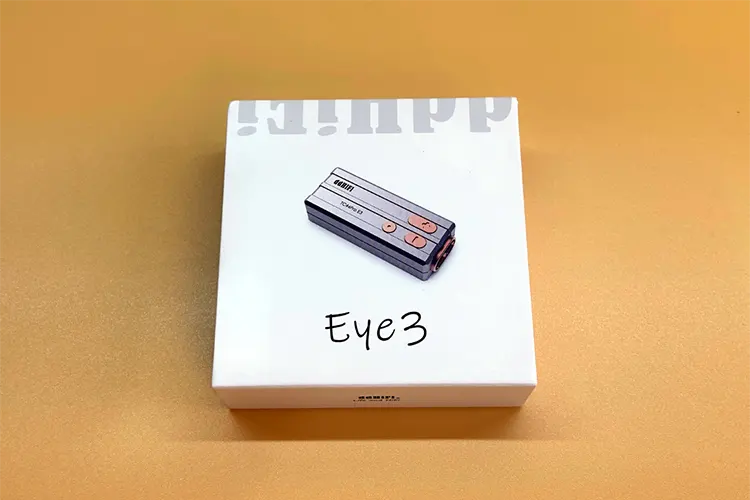
The ddHiFi TC44Pro E3 is a return to form for the brand, with its extremely compact form factor, shockingly high-power output, and inclusion of both 3.5mm and 4.4mm outputs.
It’s by no means perfect; its clinical and neutral sound signature can make it pairing-dependent, but its high-power output makes a wider range of full-sized headphones accessible for portable use.
For listeners with IEMs, headphones, or both that are tuned more towards the warmer end, the TC44Pro E3 is a dongle that is worth giving a listen.
While it still pairs well with less warm-sounding headphones and IEMs, it may come off as sibilant to more treble-sensitive listeners
ddHiFi TC44Pro E3 Technical Specifications
- DAC Chips: Dual CS 43198 DACs
- Amp Chips: Dual SGM8262-2
- Output(s): 3.5mm Single-Ended and 4.4mm Balanced
- Output Power: 175mW @32 Ohms (SE) and 510mW@32 Ohms (BAL)
