

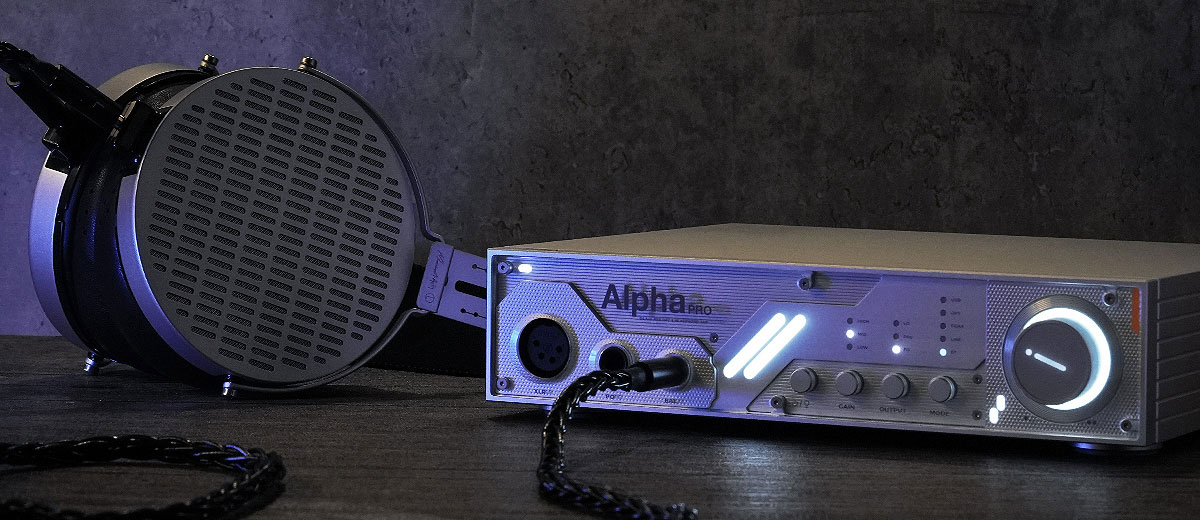
James reviews the D&A Alpha PRO, a desktop integrated ES9039MSPRO DAC and 6W-capable, discreet-engineered balanced headphone amplifier. It is currently priced at $699.
Disclaimer: This sample was sent to me in exchange for my honest opinion. Headfonics is an independent website with no affiliate links or status. I thank DIGI & AESTH and Shenzhen Audio for their support.
Click here to read more about Shenzhen Audio products we have previously reviewed on Headfonics.
This article follows our current scoring guidelines, which you can read here in more detail.
Digi & Aesth (D&A) is a new brand that just emerged from Shenzhen’s renowned high-tech R&D district, Nanshan, with their debut desktop integrated DAC and headphone amplifier, the Alpha Pro.
Interestingly, the design showcases a sci-fi aesthetic with LED visualization effects and appears to target lower impedance designs, particularly for planar headphones, thanks to its low output impedance architecture.
In this review, I will look into the synergy with less sensitive headphones and compare it with some of the competition, including the FiiO K17 and HIFIMAN EF500. If you crave both captivating aesthetics and impressive sound performance for your planars, then you definitely shouldn’t miss this!
Features
Decoding
The D&A Alpha PRO utilizes ESS’s SABRE ES9039MSPPRO decoding chipsets, which are also used in the HiBy R6Pro MAX.
The DAC has an 8-channel configuration and is assembled into a 4-channel, fully balanced design with their Sigma DAC Topology. This allows the Alpha PRO to support decoding up to DSD512 natively and PCM 768kHz/32-bit.
The multi-channel DAC enhances the SNR, helps achieve lower output impedance, and boosts dynamic range.
There are also three VCXO Femto-clocks for enhanced jitter control. According to D&A, they have also adopted a second PLL clock in the design, along with shielding over major components and a 4-ply PCB implemented for separated digital and analog sections.
In short, the Alpha PRO achieves a dynamic range of 133dB and -124dB THD+N performance, which is commendable.
Amplification
The Alpha PRO utilizes a fully balanced discrete amping (FBDA) architecture and consists of a total of 32 matched transistors across its four amping channels.
The design team had specific goals in mind when creating this amplifier, which is to accommodate certain hard-to-tame, less sensitive, current-hungry gears. The output impedance is impressively low, at below 0.1Ω, while delivering 6000mW per channel on a 32Ω load.
In addition to this, there is notable attention to detail. For example, the Nisshinbo Micro Device NJU72315 volume control chipset is spotted for low dynamic compression performance.
With RCA input, you can bypass the DAC function and connect the Alpha PRO with another decoder. This offers good flexibility, allowing it to function as a preamp and pair with other DACs that have different characteristics.
I will outline some observations in the sound section below. However, if you already have strong decoders but lack matching amplifiers for sensitive planars, you might want to consider the Alpha PRO.
Design
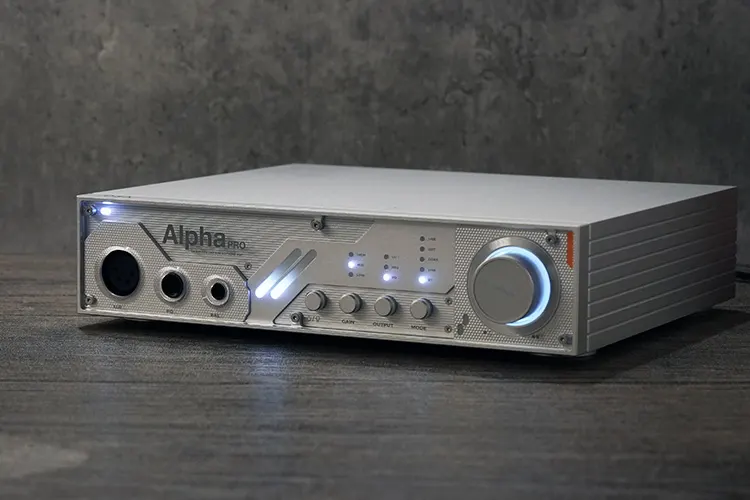
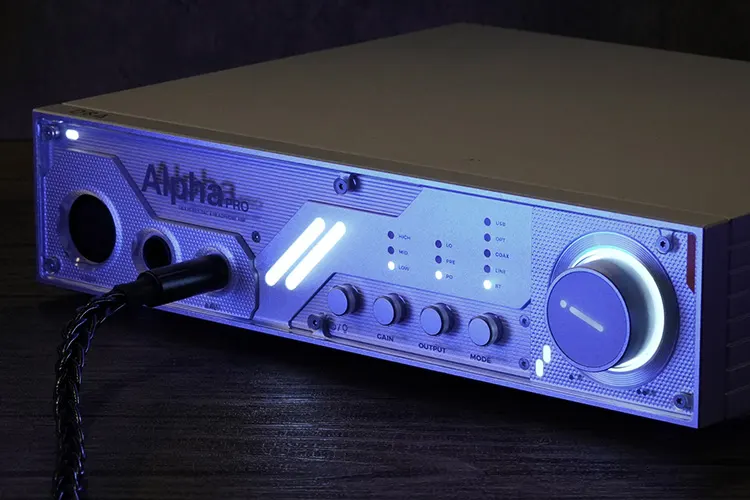
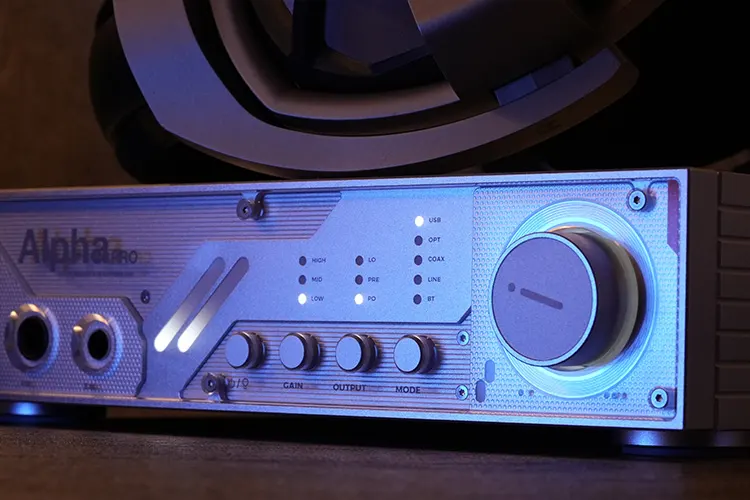
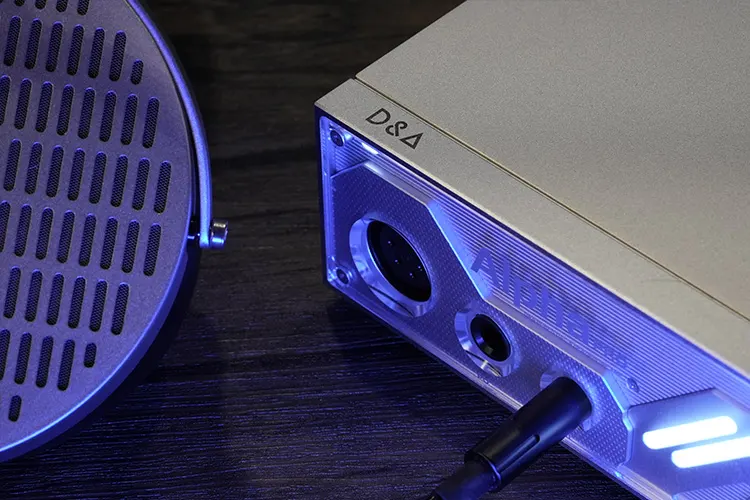
With a screwed-on acrylic front panel and a light show reminiscent of the Nothing Phone, the D&A Alpha PRO looks very future-proof and feels incredibly cool when you dim the room lighting.
You can cycle through different lighting modes with just a click, and the default mode features a bar-shaped area that dances with the output intensity, resembling a futuristic VU meter.
In addition to the two bars mentioned, the volume knob is also illuminated, along with indicators for source, gain, and input device. The gain button is thoughtfully programmed to cycle through low-mid-high and high-mid-low gain settings.
The CNC-machined aluminum casing has a smooth finish and decorative lines, with legs underneath that enhance shock-proof performance.
The overall build is robust, and this is easily one of the coolest designs I have seen in the desktop audiophile realm, aside from those with extra-territorial-like lighting such as the Hugo M Scaler from Chord Electronics.
I/O
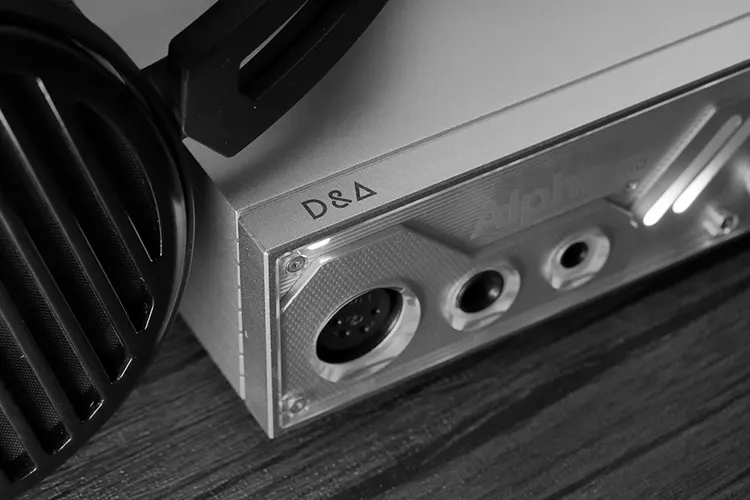
The Alpha PRO has a clean design featuring XLR, 6.3mm, and 4.4mm balanced outputs. As mentioned, you can cycle between input gears by pressing the button on the front panel.
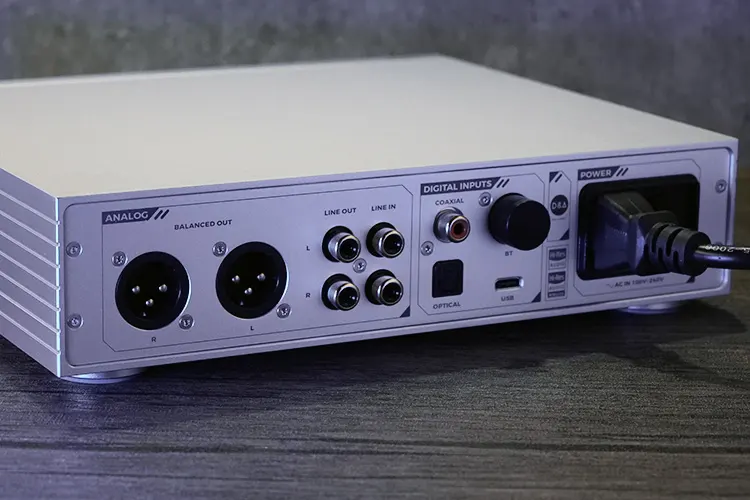
At the back, you will find XLR analogue output, RCA Line In/Out, Digital Coaxial/Optical input, USB-C input, and it also doubles as a BT receiver, with a protruding Bluetooth antenna at the back.
Packaging & Accessories
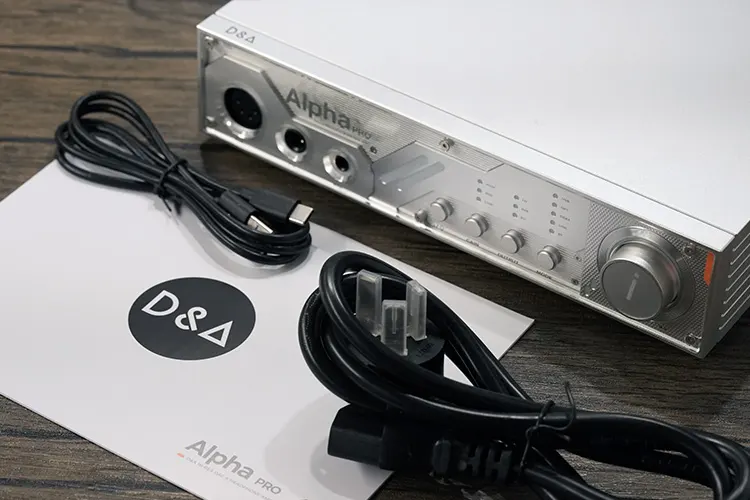
The packaging has the same design language as the body unit and has sufficient padding when shipped in. Inside, you will also see a power cord and user manuals, and everything supplied looks pretty well made.
Wireless Connectivity
The Alpha Pro is powered by the QCC5125 chipsets, Hi-Res Audio Wireless certified. It can decode up to 24-bit/96kHz on LDAC mode, and supports aptX HD, AAC, and SBC. Connection is swift within 5-8m, and it auto reconnects to my phone without issues.
The output quality is quite decent with good dynamics and enjoyable, but you will hear some slight loss in dynamic range and detail retrieval over playing back from digital sources.
Considering the quality of the wireless connection, I may as well not bother to switch to a wired connection if I am watching videos or playing back lower-resolution files.
Wired Connectivity
USB-DAC
With the 16-core XU-316 XMOS USB receiver inside, the Alpha PRO supports USB decoding up to DSD512 and PCM 768kHz, also full MQA decoding.
Compared to Bluetooth connection, USB decoding delivers higher quality, sounding more defined, effortlessly extended, and gives clearer, tighter transient responses.
While the Bluetooth performance is also delightful, I would recommend using USB decoding or Coaxial for its best performance.
Sound Impressions
I have given it more than a week of burn-in, and the impressions below are based on pairings with the HD800s and various planars, including the MOONDROP COSMO, VENUS, FiiO FT7, Fosi i5, and more.
Summary
The D&A Alpha PRO takes an organic, neutral-to-natural tuning approach and sounds fast and refined across various gears tested. There is a welcome hue of warmth and ample power in the bass, which also exhibits plenty of agility and decent control.
The tuning is subtly M-shaped yet engaging. It may not wow you in the first few seconds of listening, but you will quickly realize it is well polished, defined, and layered.
Synergy with the various planar headphones I tested is excellent, especially in terms of transient response and dynamics, which can sometimes be lacking with mismatched amplification.
It seems that the Alpha PRO can handle the current drain from less sensitive planars very well without compromising dynamics.
Timbre
Testing with different gear and using the Alpha PRO as a USB decoder, the output demonstrates decent organic richness, with sufficient power and air, especially in the lower register, and adequate treble extension.
There is a marginal tilt to the bass, which is tight, firm, and moderately deep. It doesn’t go too far into the subs, maintaining clarity and speed, and sufficient air in the decay, keeping the overall presentation controlled and not clinical. The bass articulates swiftly into the mids without overstressing either side.
The vocals have adequate body and weight to stand out slightly more than the backing. The ambience and backing are rendered vividly, with a good sense of control and harmony between these elements.
Specifically, bass guitars and synths sustain with good density, tight imaging, and power in the lows, layering well on the Alpha PRO. When the vocal line emerges, it overlays the backing without sounding veiled in the mids, maintaining a good level of dynamics.
For larger drums, the Alpha PRO captures good punchiness, sharpness, and plenty of air without peaking, recovering quickly while avoiding dryness. However, deeper and slightly more intensive bass could make it more immersive.
Guitars sound quite wet with brittleness that is well suppressed, so it is enjoyable listening to the overtones. A slight boost at both extremes could improve contrast, but the stock tuning works well with electronic and classical music, sounding swift and well-articulated.
Overall, the Alpha PRO feels defined and controlled in the sibilance zone, capturing transients while maintaining naturalness in tuning.
It offers stability across genres and responds well to fast current draw, sounding impactful while holding a tight, defined 3D image. The gain setting is also effective in authorizing the vocals with more penetration power, especially with less sensitive headphones.
Staging & Dynamics
The Alpha PRO sounds fairly extended, with the vocals not being overly pushed, maintaining good balance and a rather linear energy distribution across its output, as if listening in an acoustically treated, lecture hall-sized room.
Nothing is exaggerated, which is great for a longer listening session, as there is a good sense of calmness and control. There is sufficient dynamics and separation for quartets and multiple vocal lines to present themselves clearly alongside a rich bass line.
That said, there is decent transient response and resolution, even when matched with planars that often sound less dynamic, hollow, or more compressed in depth when output power is lacking or impedance is mismatched.
With streaming content, which boosts the two ends more, the Alpha PRO gets even more engaging while maintaining decent dynamics.
Click on page 2 below for my recommended pairings and selected comparisons.
