

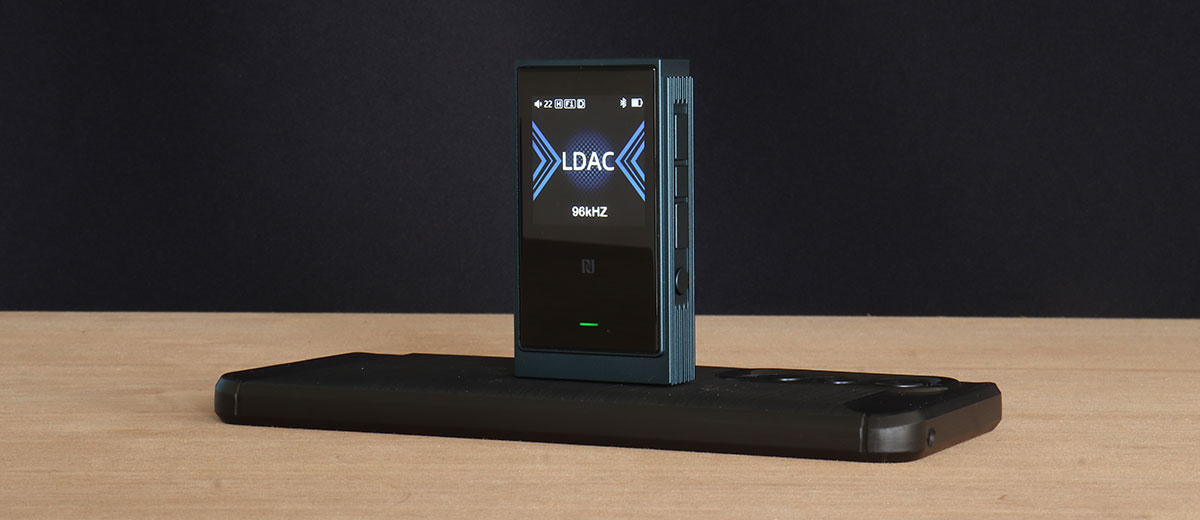
Today, Louis reviews the Shanling UP6, a new dual ES9069Q DAC and balanced headphone amplifier with BT LDAC and aptX Adaptive support. It is currently priced at $199.
Disclaimer: This sample was sent to me in exchange for my honest opinion. Headfonics is an independent website with no affiliate links or status. I thank Shanling for their support.
Click here to learn more about Shanling products previously reviewed on Headfonics.
This article follows our current scoring guidelines, which you can read in more detail here.
Almost six years ago, Shanling entered the portable Bluetooth DAC amplifier market with the UP2. Since then, they’ve been improving their UP line, and their work has culminated in today’s subject, which is the UP6.
Shanling was one of the first companies to enter this recent segment; however, nowadays there’s stiff competition coming from the likes of FiiO with their BTR17, iFi audio with their GO blu, and Questyle with their M18i, just to name a few.
The question then is, what does the Shanling UP6 have to offer over the others? At first glance, it appears that Shanling took a sensible and safe approach in designing the UP6, as it seems to utilize a handful of well-known modern components.
The UP6 has one key specification: it is Shanling’s most powerful Bluetooth Dongle/DAC and amplifier to date. Perhaps that is the selling point of the UP6. Or is it?
Features
Decoding
The center components inside the Shanling UP6 are a set of ESS ES9069Q DACs with a feature that lets you select between active single or dual DAC operations in case you need to go easy on power consumption. There are also eight digital PCM filters to choose from.
The DAC section is a PCM and DSD-only DAC and does not cover any MQA playback. The UP6 can play files and formats at up to 768kHz/32-bit and DSD512 natively.
Dual KDS oscillators and an XMOS XU316 handle the USB digital input section. One aspect I like about the UP6 is that there’s only one USB input to handle charging and audio needs. The Bluetooth is handled by a QCC5125.
The UP6 also has 2.0 and 1.0 USB DAC modes, built-in user tweakable equalizer presets, and a list of other selectable features within the system menu. All the features are also operable by using the Eddict app.
One unique feature is the UP6’s NFC sensor upfront and below the screen for easy pairing when you’re in Bluetooth pairing mode. I don’t remember seeing this kind of implementation on any of the others in my Bluetooth dongle collection.
Amplification
Shanling went with a pair of SGMICRO SGM8262-2 headphone amplifiers, which are high-speed, low-noise chips capable of driving some heavy loads according to the manufacturer. These chips are voltage feedback Opamp variants.
The pair forms part of a four-channel implementation that uses two channels for the single-ended output and then four channels to produce higher output levels at the cost of a higher output impedance.
In the four-channel configuration or balanced mode, the dynamic range and SNR specs all improve. The UP6 has better background noise numbers from the 4.4mm output: usually, the opposite occurs when chips are combined to create a multi-channel circuit.
Shanling was able to squeeze out a formidable 626mW at 32Ω balanced, making it Shanling’s most powerful dongle device to date on paper and rivaling some of the highest numbers in this segment.
There’s a feature within the menu that lets you set the maximum volume on the first bootup, and trust me, it is a very useful feature that will save your ears or your IEMs.
It auto-defaults to 20, and there’s a total of 64 volume adjustment steps, which is a drop from some that have 100 steps of volume control, but that’s okay.

Design
The overall design of the Shanling UP6 looks familiar to me, with its ribbed sidelines and sharply defined corners and edges. Cough, cough, UA6, it’s the Shanling homespun rectangular case made from CNC-shaped aluminum solid blocks.
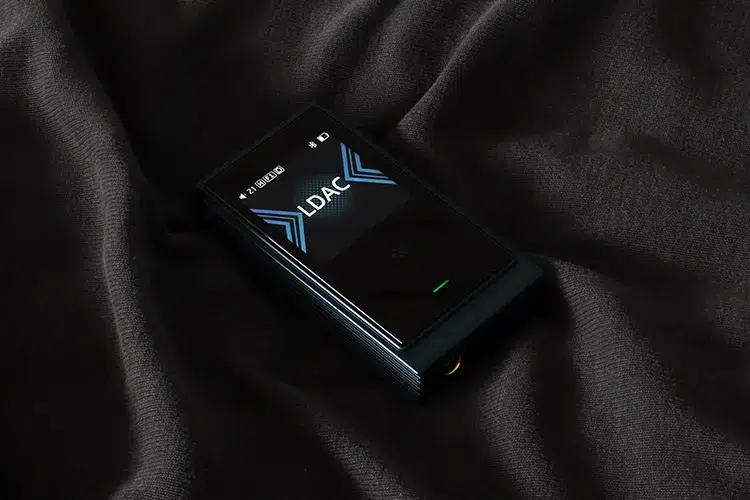
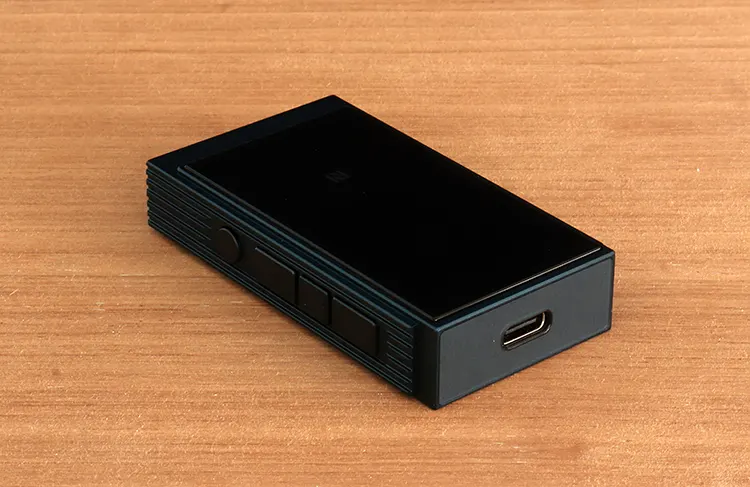
One side holds all the buttons, and there are a total of four push buttons. The top and bottom panels house the ports, with the 1.54-inch color screen on the front, sitting under a raised glass, and goes into blackout mode when off. There’s also a format indicator right below the screen, close to the NGFC sensor.
The UP6 is not a heavy dongle. It weighs 51.2 grams. The only aspect I didn’t like was the corners, which are rather pointy and tend to poke my hands, which is a weird sensation.
By the way, the UP6 comes in two colors. One is black, and the other is the one I received, which is called Midnight Blue. Shanling also offers a custom case as a separate purchase.
Aesthetics
I would change the backside, and I would have glassed up both sides since Shanling installed glass on every side except for that one backside on the UP6. They even went to the extent of installing glass on both sides of the device, which is a nice touch.
It must have been a heck of an endeavor to cut that one glass that sits on the headphone plug plate. Particularly since its small measurements sport three perfect orifices, and the one for the mic is a pinhole. It shows skill, effort, and patience.
Since all the buttons are on one panel, it makes the UP6 a one-handed operational device for portable use, and for my tastes, it is perfect. The ribs also help obtain a good grip on the UP6.
In the looks department, there’s not much to talk about. It’s a well-made device, hefty in construction, but it doesn’t treat my eyes artistically, except when the color screen is on, which is a nice contrast from the common monochromatic screen.

I/O
I’m not pointing fingers at anyone here, but I felt that double and separate USB ports for extra power were an unnecessary commodity, since USB cables can carry power and signal.
Especially if you have a switch that you now have to be conscious of, because if left in the wrong position, you’re left with a no-charge state.
The Shanling UP6 uses one USB-C port for extracting digital audio and for charging the internal battery. That simplifies things, but if you run into the need to turn off the charging capability, you can shut it off within the menu. That’s a comprehensive feature.
The opposite side of the UP6 USB-C port is where you’ll find the single-ended 3.5mm plug alongside the 4.4mm balanced connector.
The balanced port is decorated with a gold ring, and to be honest, I would have preferred them to be black or gold so they match each other in appearance.
Controls
There’s a lot you can do within the UP6 menu. There’s a two-stage gain, single or dual DAC modes, plus four PCM filters. There are also EQ presets, and you can make your own and recall them later on.
The screen orientation can be changed, the brightness adjusted, and the fonts can also be changed, along with a screensaver timeout time adjustment.
There’s a charge mode that turns the charging circuitry on or off. Another power-related feature is the car mode, whereby the UP6 turns on when a USB signal is present. The unit turns off automatically when there’s no USB signal. This also works very well in a desktop scenario.
The other options are the factory reset, a switch mode that puts the device in either USB 1 or 2 mode, plus a firmware updater with an about section that lets you verify what firmware the device has installed. I mean, it doesn’t have a sandwich-making mode, but that’s okay.
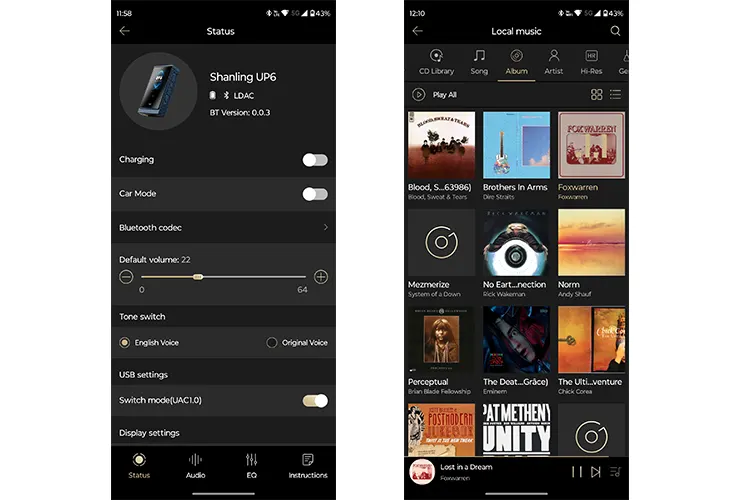
Eddict app
The way I linked the Shanling UP6 to the Eddict app was through SyncLink under the options that drop down by touching the top left menu selector. There are too many features to cover within the app, so I’ll just cover the basics.
The one thing I liked about it is that it’s an all-in-one app that covers OTA streaming like NAS access, cloud sharing, Wi-Fi transfers, and cloud service access.
Playback and file browsing are also featured. I also like that you can customize the EQ presets, load them up to the UP6, and then take them on the go.
The Eddict player itself is a good choice and seems to have sonically improved. I remember at one point the player sounded too soft-mannered for my taste. Now, it provides neutrality, but it also provides a full-bodied audio experience.
I do have to mention again that this app has a small issue in that it stays open until you kill the app from within the Android system.
This was happening on my Android 14 mobile device. That’s a small inconvenience that can be remedied if the side swipe is enabled on the top slide-down menu on Android.
Battery life
The internal battery is a 950mAh battery that takes approximately 2 hours to fully charge, according to Shanling, but it took me more on one occasion with a 2 amp charger. It’s not a fast-charging battery, but it won’t take half of your day to charge either.
I got a solid 6 hours of playback on the UP6, but that was on the ACC codec and with IEMs on the 3.5mm port. Once I kicked into the LDAC codec, the available time went down to 5 hours. The 4.4mm port takes it down to 4 hours.
One aspect I did like about the UP6 is that the standby time was excellent. In other words, off-time drainage of the battery was minimal. You could leave it around for a week and only notice a small amount of discharge.
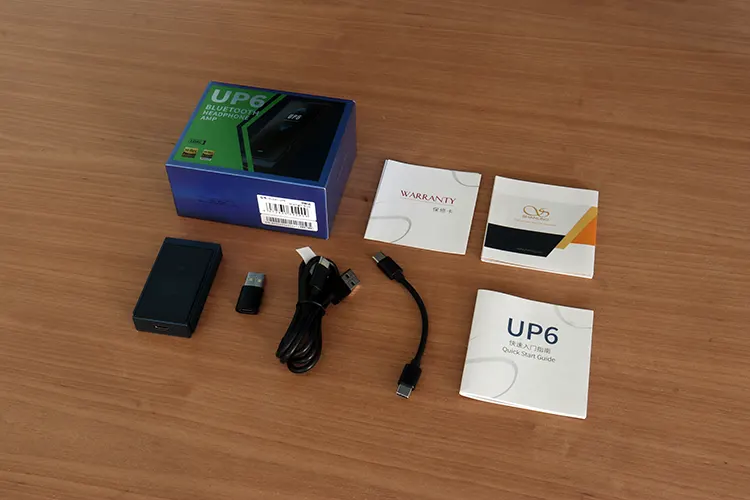
Packaging & Accessories
A quick-start guide, a Shanling catalog, and a warranty information foldable pamphlet are included in the box. The manual is downloadable from their website along with a driver that is exclusively for Windows users.
Some of the hardware that comes with the UP6 is a 40″ USB A to USB C cable, a USB C to A type adapter, and a short 4-inch USB C cable, and that’s it.
The box is fine, and the packaging is fine, but the box has a sheen that makes it hard to read off the box, and the letters have no contrast.
Sound Impressions
I used the Shanling UP6 with my daily mobile device, which is a Motorola Edge, running Android 14, mostly through the Bluetooth set to LDAC. The USB DAC was fed by my custom Windows PC.
I used my Meze Audio 99 Classics, my well-broken-in HIFIMAN Sundara with Dekoni Fenestrated pads, and fed them with Meze Audio’s MONO silver-plated upgrade cable terminated with a 4.4mm balanced connector. I also used two IEMs, the FiiO FX17 and the HIFIMAN Svanar.
Summary
The Shanling UP6 serves up a clean, articulate, and well-balanced sonic profile with a hint of warmth. It presents the listener with a neutral presentation that is the absence of color, except if you engage one of the EQ presets.
Music is reproduced with clarity and precision, but the presentation is almost too clean. The bass is tight and controlled and has an absence of boominess, offering up a nice amount of depth and low-frequency presence.
The mids, vocals, and instruments all come through with a natural tone and a sense of space that makes them feel present but not in your face.
The treble is crisp and detailed, but warm, with enough sparkle to bring out texture in cymbals and strings, but at the same time, it avoids poignancy. The high-frequency presence matches that of the midrange, promoting a balanced signature.
The UP6 gives you a clean window into the music. It’s the kind of device that rewards careful listening but doesn’t punish casual enjoyment. It’s an effortless-sounding device that keeps you engaged with a minimum amount of fatigue.
Staging & Dynamics
The Shanling UP6 produces a similar stage as the UA6, which sounds very spacious., There’s depth and width, but somehow height has been reduced from the UA6.
However, placement precision was increased. The UP6 produces what I call a well-rounded soundstage in that it envelopes the listener.
There’s some precision, but you can’t expect a dongle of this caliber to produce a perfect stage. It does, at times, condense certain elements within recordings. Most times, however, elements are placed distinctly where they belong, with little to no aura smear.
Click on page 2 below for my recommended pairings and selected comparisons.
