

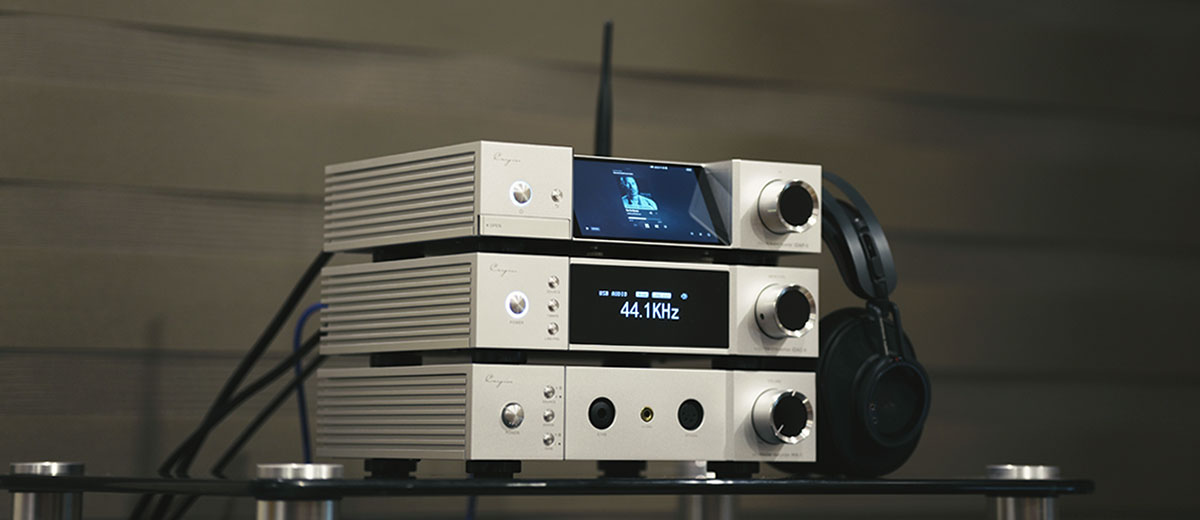
Today, Marcus reviews the Cayin iDAP-8, a desktop Android network media streamer with up to 4 TB of hard drive storage and Google Play access. It is currently priced at $1399.
Disclaimer: This sample was sent to me for my honest opinion. Headfonics is an independent website with no affiliate links. I thank Cayin for their support.
You can click here to learn more about Cayin products I have previously reviewed on Headfonics.
This article follows our current scoring guidelines, which you can read in more detail here.

Streaming technology is evolving faster than DAC and amplification technology. I reviewed the iDAP-6 desktop streamer in 2017, and out of the 3 original iSeries components, it is the iDAP-6 that has aged the most.
Not that it is unusable, it is still a perfectly functional device. Rather, the user’s needs and familiarity with streaming are driven by rapidly maturing software and competition. This creates a more complex target market, but one that the new iDAP-8 is aimed squarely at.
Gone is the simpler non-touch HiByOS software, the walled-garden interface to the outside world, and the fixed manner in which you can acquire and process audio.
The iDAP-8 introduces an upgraded processor, enhanced storage, an open touch-capable Android interface, and provides access to Google Play to download almost any compatible app to use with the iDAP-8.
Sounds like a recipe for success? Possibly, app-based platforms can be a very personal thing, and on that basis, there are some pros and cons with the new iDAP-8.
Unfortunately, I do not have the likes of Eversolo or the new FiiO S15 to compare, both of which are being reviewed by James.
What I can give you is my opinion on how much better it might be than the older iDAP-6 and how it competes against the likes of the Cyrus Audio One Cast and Chord Electronics’ flexible compact streamer, 2Go.
Features
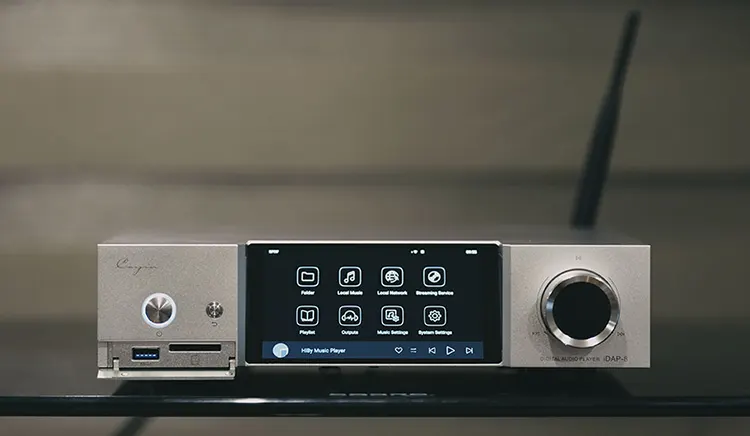
For those new to the Series, the Cayin iDAP-8 could be crudely seen as a ‘DAP in a box’.
It takes an existing portable multi-format streaming platform and builds a HiFi-friendly chassis around it to allow maximum connectivity from your network and local storage to your audio component setup.
It does not offer video or general media output capability, so those looking for HDMI ARC functionality will have to look elsewhere; this is purely an audio playback device.
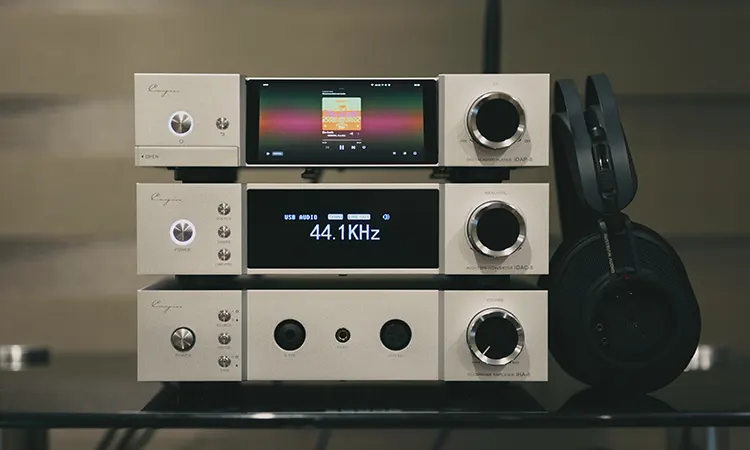
You can pair it with the iDAC-8 and iHA-8 as part of the complete iSeries triple stack for headphone users or buy it as a standalone streamer to connect to the iDAC-8 or a third-party decoder as part of your HiFi system setup.
It can source audio wirelessly via Bluetooth or WiFi, or you can run traditional wired connections, including USB and RJ45, with Gigabit LAN capability.
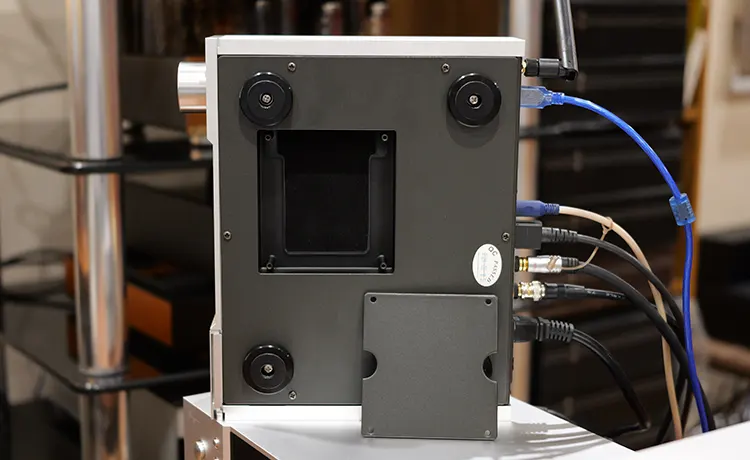
The iDAP-8 also has a wide choice of onboard file storage options, including 128GB of onboard memory plus an additional drive slot on its base panel for SATA3.0 2.5″ drives up to 2.5 TB.
It also retains the iDAC-6’s USB-A and SD card slots for flash memory and a USB-OTG connection on the rear panel for plugging in and accessing external hard drives.
At the heart of the iDAP-8 is a 2.2GHz Snapdragon 660 SoC with 6GB of RAM powering a heavily skinned and touch-capable open Android 9 OS layer with several preloaded apps and the option to use Google Play to load it up with plenty of 3rd party alternatives.
Design
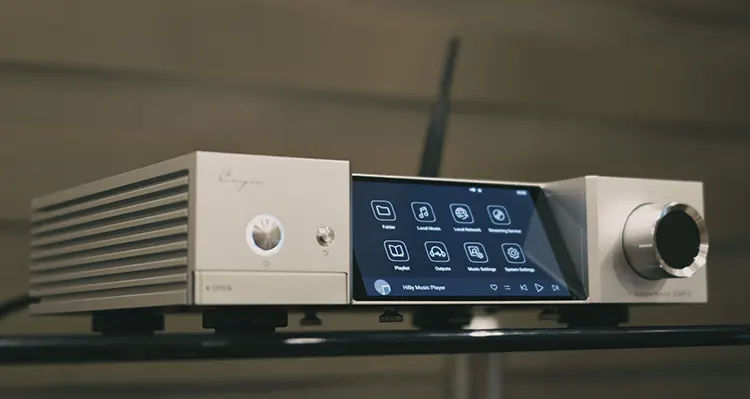
Of the three 888 Series units, the iDAP-8 is probably the most eye-catching courtesy of its large 5″ slanted 1080p touch-capable FHD screen and large wireless antenna screwed into the rear panel.
The surrounding sandblasted aluminum chassis, aggressive heatsinking side panels, and dimensions are identical to the iDAC-8 and iHA-8, meaning it has a fairly robust build quality and will stack neatly on top of the other two units to create one streamlined desktop system.
And on top is where it needs to go, as it is a bit lighter than the DAC and amplifier, generating slightly less heat. The pillored rubbery feet have a decent but not great grip on the aluminum housing and can be prone to sliding if pushed hard enough from the sides.
There is enough weight inside courtesy of its internal 45W toroidal transformer to ensure heavy cables do not tip the unit, something that frequently occurs with my Chord Qutest when connected to heavy-duty Wave High Fidelity Storm BNC cables.
All the control labels are either etched into the metal chassis (front plate) or clear white decals printed on the black backplates. The only exception is the lowing LED ring around the boot button on the left side of the front panel.
Label legibility is a bit fuzzy from certain angles in strong light. You almost have to be head-on before they suddenly appear clean and clear. Casting a shadow over them sometimes does help.
I/O
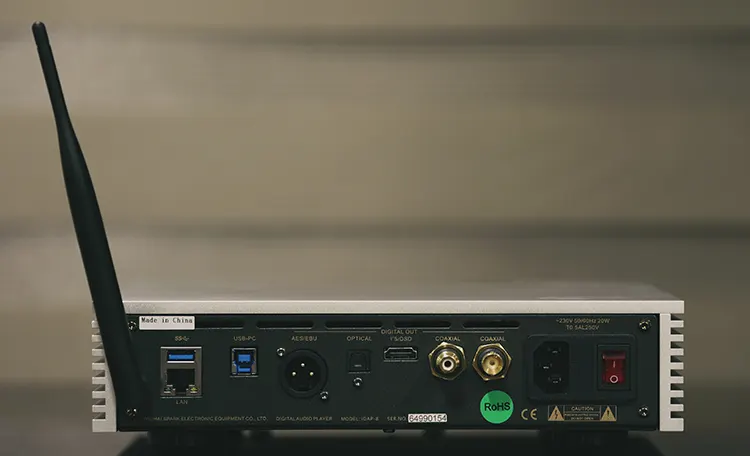
The iDAP-8 has no internal DAC, so there is no decoding to analog, meaning it operates purely in the digital domain. Therefore, all rear panel outputs and inputs are for receiving a digital signal wired or wirelessly and then processing that digital signal to a DAC via a wired connection for decoding.
To that extent, the rear panel is the iDAP-8’s biggest strength, with provision for a hefty screw-in wireless BT5.0/WiFi 2.4/5GHz compatible antenna, digital outputs including I²S, USB, and more traditional optical and coaxial (BNC and RCA) alternatives.
Digital inputs are covered via USB for PC/MAC connections (including OTG) and a single RJ45 with a SuperSpeed USB 3.0 slot above it. Just to note, the older iDAC-6 has two 2 USB-A slots, whereas the iDAC-8 has converted these to USB-A (3.0) and Type B
Granted, the iDAP-8 is pitched as an audio streamer, but I would have liked to have seen an HDMI ARC or HDMI output to allow the iDAP-8 to expand beyond pure audio and into Home Entertainment.
Since it has an open Android platform, you can install general media apps, including video, which will run fairly well on the iDAP-8. However, the lack of HDMI (not to be confused with I²S) means you can only watch them on the small 5″ FHD 1080p panel.
Controls
The iDAP-8 control system is a massive upgrade over the iDAC-6 version. We now have a touch-sensitive and very familiar Android framework with a skinned and easy-to-read home screen.
Before, there was no touch control, meaning the multifunctional rotary dial to the right combined with the return button on the left was the only way you could operate the HiByOS-equipped iDAC-6.
Now it works pretty much like a DAP in a box, except the system is in landscape mode as opposed to portrait. It’s not a perfect system, especially for ease of navigation with apps, but give me touch screens any day of the week over physical control only.
Not that the iDAP-8 has dumped physical controls completely, though. You still have playback options via the rotary dial and can exit out of menu systems via the return button.
However, I can count the number of times on one hand that I have used them on the iDAP-8, given that touch is so embedded into my way of thinking for using Android.
What is missing is a remote control, which really should be in the iDAP-8 accessory lineup. If Android TV boxes, FiiO, and Eversolo can do it, so should Cayin.
I can only presume this was a BoM decision, with any sort of remote control functionality being left to HiByCast and HiByLink software.
These apps do work, but are a little clunky and slow in their response time. Also, since the iDAP-8 screen is in landscape mode, your phone or DAP connection using HiBy Cast will switch to landscape, which some users might find unappealing.
Storage
The iDAP-8 storage has been massively improved over the iDAC-6. Now it comes with 128GB of onboard local storage built into the unit as standard, compared to nothing at all for the iDAP-6.
While both units can connect to external hard drives via USB, the iDAP-8 enhances this with a faster SS USB 3.0 socket on the rear panel and adds a storage bay on the base for SATA3.0 compatible 2.5″ drives up to 4.5 TB.
Hard drive bays are relevant in today’s streaming market, and most of the competition has them, including the S15 and Eversolo variants. So, whilst very much welcome, it’s not groundbreaking.
The open Android system also provides Cloud connectivity. You can connect to almost any Android-compatible online storage system, including Google Drive and MS One, with the correct app.
The front panel provides a similar expandable memory system to the iDAC-6 with provision for a USB-A and SD card slot for flash memory. I believe both are compatible up to 1TB, though I rarely use drives higher than 64 GB capacity.
Packaging & Accessories
The brown box and internal white foam packaging are more or less the same as the iHA-8 and iDAC-8, save for the small iDAP-8 label on one side to identify it.
You should have no issues with shipping and transportation as the foam and a small cloth wrap well protect the unit.
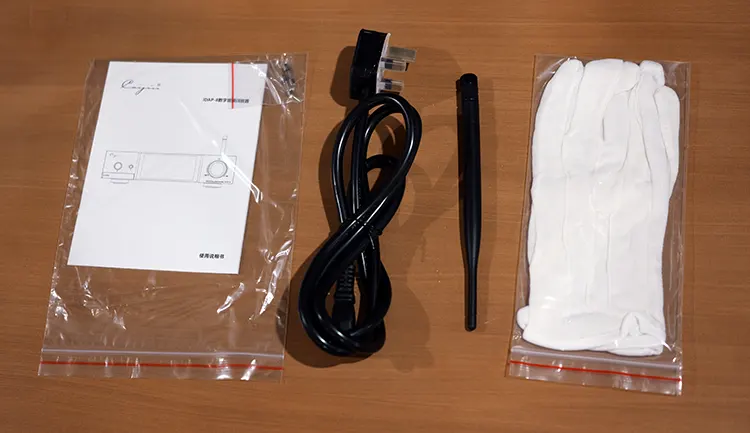
The accessory kit is fairly spartan with Cayin’s white gloves, the wireless antenna, spare fuses, a user manual, and a region-specific power cable.
As mentioned, I would have liked to have seen a remote control and possibly an I²S cable thrown at this price point, as I consider it the best sounding digital output from the iDAP-8.
Click on page 2 below to read my software and wireless performance impressions.
Click on page 3 below to read my audio performance impressions and comparisons.
