

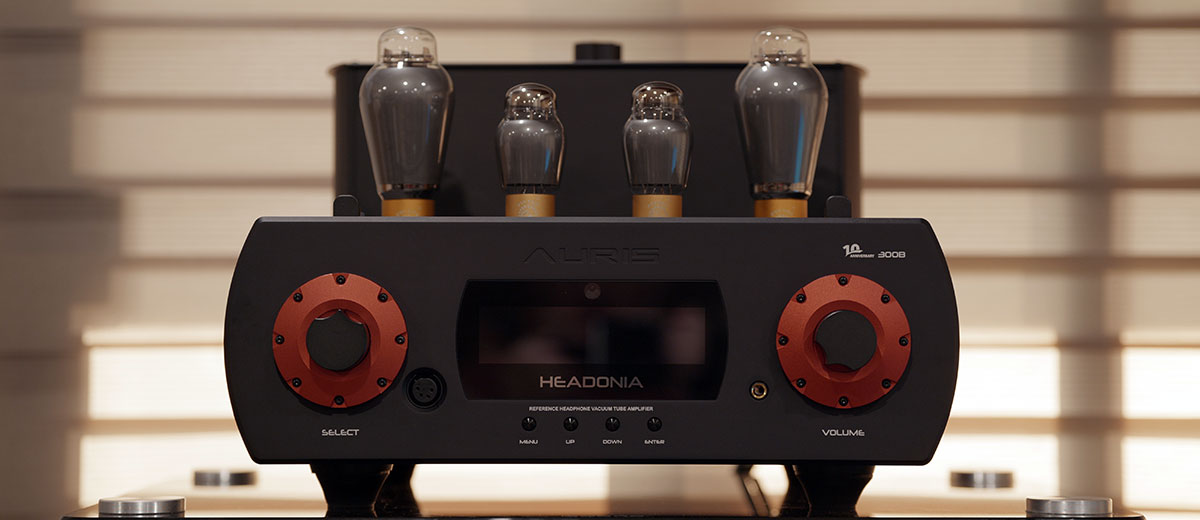
Select Comparisons
The following comparisons were completed using the dCS Bartok APEX and the Holo Audio Spring 2 Wildism Edition as my DACs, with the HIFIMAN Susvara Unveiled and the ZMF Headphones Atrium as my choice of headphones. All components were connected in ‘balanced mode.
Feliks Audio Envy
The Feliks Audio Envy was launched in 2022 and is the company’s flagship headphone amplifier. It was also our Top Gear 2022 Co-Award Winner for Best Desktop Tube Amplifier.
Technical
To some extent, these two amplifiers have some shared features or common design traits.
Both are desktop single-ended SETA headphone tube amplifiers with pre-amp output, and both use solid-state rectifiers with Lundahl transformers for their ‘balanced’ connections.
The two amplifiers also have impedance management as a key component with ALPS potentiometers for volume control.
And yes, the two amplifiers use a matched 300B power and 6SN7 driver tube configuration for the pre-amp and output stages. In fact, both use the same set of driver tubes, a matched pair of PSVANE double triode CV-181-T MKIIs.
The most notable difference is the choice of 300B tubes, with Feliks opting for a matched set of ‘gold-grid’ Fullmusic 300B triode power tubes for the Envy ‘Performance Edition’ and Electro Harmonix Gold 300B power tubes for the cheaper ‘base unit’ version.
The Headonia 300B is set up with pricier PSVANE 300B-TII power tubes (Arts Series), roughly about $200-300 more expensive for a matched pair, depending on where you shop for your tubes.
The Envy is floated as 8W capable, but unlike the Headonia 300B, that rating is not a consistent maximum across all the impedance values, with 6W for 32Ω dropping down to 500mW for 600Ω.
It would be a more accurate gauge of power if you studied the rating Vrms output at each impedance level. The Envy offers a maximum of 16Vrms on its high-impedance setting, whereas the Headonia 300B can deliver a stronger 46Vrms (300Ω) to 65Vrms (600Ω) output.
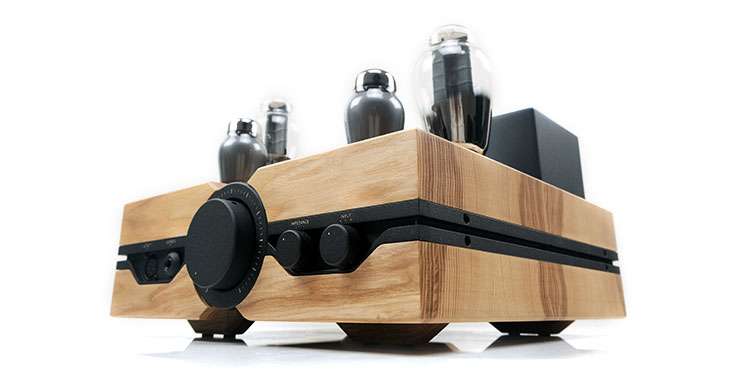
Design
The design language between the Envy and the Headonia 300B is completely different. Ironically, I think the Envy has jumped into the wood space that Auris has vacated, and the Headonia 300B has taken over the ‘metal mantle’ from Feliks’ older flagships.
The more compact and relatively lighter Envy (15.1kg) is all about wood with 2 heavily-grained, distinct sets of oiled woodblocks wrapped around a black chassis that ties the blocks together. My unit is the Oak edition, but for €200 more, you can buy a darker American walnut version.
The Headonia 300B is a more modern, urban design in all-black with subtle leather finishes on its curvier sides. The chamfering is good on the Envy wood, but the milling on the Headonia 300B aluminum panels feels a little more refined.
Granted, organic materials are a little harder to work with, but the payoff is that the raw grain aesthetic on the Envy sets each amplifier out as a unique design that cannot be replicated.
Where the Headonia 300B has an advantage is its LCD, complete with VU meters, and the USB-C chargeable remote control. I find the Headonia 300B a little more intuitive with its labeling and control system.
The Envy labeling is quite small, and for impedance management, the use of high/medium/low can seem vague. I love the center potentiometer dial design of the Envy, however. The Headonia 300B pot finish is clean and very workable, but not as eye-catching as the classic black dial on the Envy.
Both units have a standard 4-pin XLR and 6.35mm connection for PO on the front and 3 line-in and 2 pre-amp outputs with an XLR option for both modes on the rear panel. The larger size of the Headonia 300B means spacing for the cables is superior.
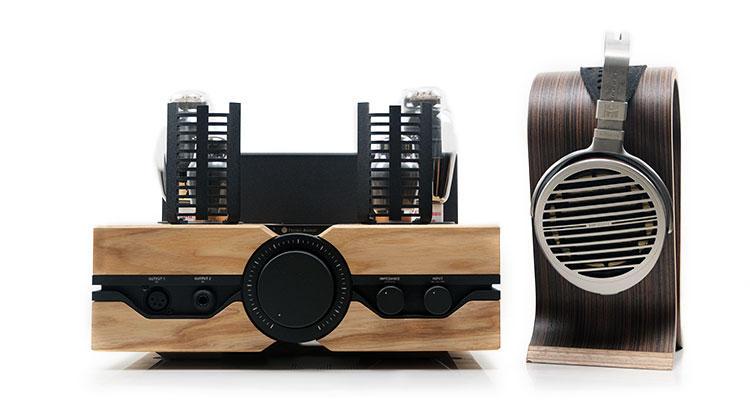
Performance
The two top headphone tube amplifiers in the office deserved to be paired with my top headphone, the Susvara Unveiled.
Both amps can easily drive the Unveiled, but the level of immersion and dynamic range from the Headonia 300B took this headphone’s performance to a level I have rarely heard before.
I should mention before I go into the differences that both of these amps’ solid-state rectification delivers a taut, modern tube sound with next to no ‘bass sag’ and excellent speed; something which the Susvara Unveiled really needs to sound optimal.
However, it’s the sheer scale of the Unveiled’s presentation, coupled with the level of dynamic range and midrange openness, that differentiates the Headonia 300B from the Envy.
The Envy’s mids are probably its comparative weak spot in terms of openness and staging width, something which the Headonia 300B ruthlessly exploits by pushing every note out front and wide.
You could argue that the Headonia 300B is more forward-sounding, and in part that is correct, but even in quieter passages, the Unveiled imaging around the vocal performances has a more holographic feel, enhancing the listening immersion.
Both have a nice snappy bass response; however, the contrast and layering are that bit sharper and more in focus on the Headonia 300B/Unveiled combo.
It creates the perception of a little bit of softness in the Envy’s low-end delivery, which took me by surprise, as the Envy has always been my go-to for bass from a tube amplifier.
Cayin HA-300MK2
The Cayin HA-300MK2 was also launched in 2022 and sits just below their statement Pure 170HA amplifier for headphone tube amps. Like the Envy, the HA-300MK2 was also a Top Gear 2022 Co-Award Winner for Best Desktop Tube Amplifier.
Technical
Like the Headonia 300B, the HA-300MK2 is a SETA Class-A headphone tube amplifier. The Cayin design also provides for a single-ended triode direct amplification for speakers, which the Headonia 300B does not offer. Conversely, there is no pre-amp output on the HA-300MK2.
Unlike the Headonia 300B, the HA-300MK2 uses a vacuum tube rectifier rather than a solid-state one. Solid-state is typically punchier and slightly more neutral-sounding, whereas tube rectifiers have a more classical, romantic tone but can suffer from bass ‘sag’.
Both amplifiers use a 300B/6NS7 tube configuration, though the choice of tubes differs. The HA-300MK2 uses matched Gold Lion Genelex PX300B power and Tung-Sol 6NS7GTB dual-triode driver tubes.
These were picked to best match the ideal Cayin house sound, though the low-end is a little softer and not as punchy as some of the PSVANE variants. It has its charm in other areas.
The HA-300MK2’s PSU is driven by a quad set of NOS RCA 22DE4 rectifier tubes, a feature not directly comparable to the Headonia 300B’s solid-state rectification.
For PO, the HA-300Mk2 delivers a variable power in combination with its impedance management system. It peaks at 6W on the high-impedance settings for loads up to 600Ω from its XLR output, dropping to 1500mW up to 250Ω, and on the low impedance selector, it’s 2W up to 64Ω.
The HA-300MK2 also offers a 4.4mm output, but its output is slightly reduced at a maximum of 5.4W for 4.4mm and 5W for SE 6.35mm on high impedance.
The Headonia 300B is more powerful at 7W, consistent across its 5 impedance values, with a higher Vrms output at its 600Ω setting compared to the Cayin. What it lacks is the 4.4mm option, which I would have found an interesting addition for high-end IEMs.
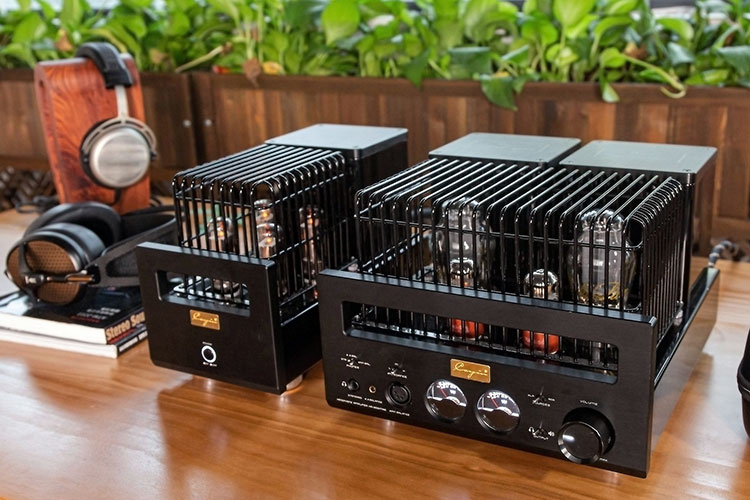
Design
Both amplifiers use metal as their main chassis material, though the HA-300MK2 comes in black and silver, whereas the Headonia 300B is available only in black.
Over time, I have come to appreciate the intricacy of the HA-300MK2 design. It feels almost overengineered with just about everything on display on the front of its narrow panel.
The Headonia 300B is technically the bigger of the two amplifiers, but once you include the HA-300MK2’s rectifier, it is actually slightly more compact width-wise and a little lighter, also by a few kg. Both need space and good support in short.
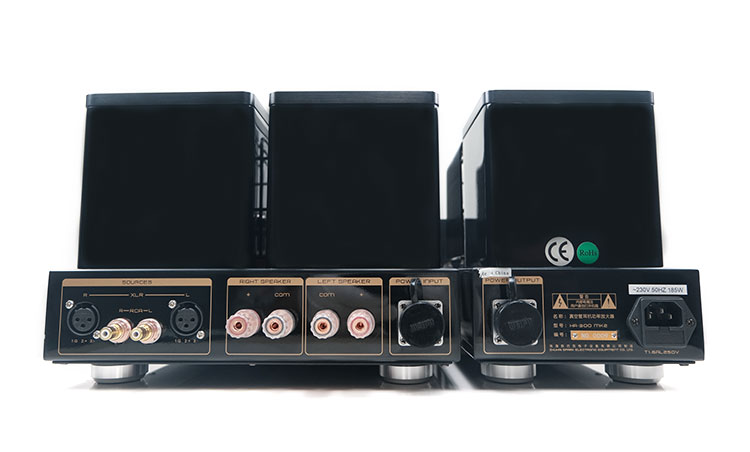
Aesthetically, the HA-300MK2 is more of a classic tube amplifier design. It’s busier looking from the front, with the cage adding to the frenzy somewhat if you usually have them inserted.
The Headonia 300B, despite its size, has a more discreet front facia with the LCD panel housing a lot of the controls that are more mechanical in nature on the HA-300MK2, such as the VU meters and the control switches.
Given that you can dim the lights on the Headonia 300B’s panel, you can kill a lot of distracting lights that are not possible on the HA-300MK2, making it more suitable for Hi-Fi setups.
The fact that the HA-300MK2 has no remote control also doesn’t really endear it to Hi-Fi system users, despite its ability to directly drive speakers.
The I/O on the HA-300MK2 has the 4.4mm PO advantage on the front facia but lacks the pre-amp connectivity on the rear panel. It does have binding posts for speakers and an 8W output rating, but there is no ability to link it to power amps similar to the Headonia 300B.
Performance
The HA-300MK2 is my most cherished tube headphone amplifier, particularly as a vocal and soundstage enthusiast, especially when paired with ZMF Headphones’ Atrium.
So, forgive me for saying I hate having to write this comparison, because I believe the Headonia 300B sounds more holographic of the two amplifiers and delivers vocal performances that sound much more accurate and lifelike. Ouch!
That said, with the Atrium, the performance gap is closer than, say, the Susvara Unveiled. Why? The Atrium is not as exacting, not as fast, and not as detailed, and these are some of the key strengths the Headonia 300B plays on.
Take those strengths away, then it becomes about emotion and connecting to the coloration these two combos have to offer.
Honestly, if I am going purely on vocal tone, then the HA-300MK2 puts up a stiff fight with its more mid-centric, vocal-forward, sweet, and emotive performance.
The Headonia 300 B’s more modern tube sound does a nice job killing some lingering decay that masks detail on the Atrium tonally. However, it does not gel quite as well with my tonal preferences.
Switch to the more revealing Susvara Unveiled or the DCA EXPANSE, then the Headonia 300B has a noticeable edge.
Again, the HA-300MK2 puts in a lovely vocal tone, one of the best, but it lacks the depth and realism of the Headonia 300B timbre. The Cayin delivers a more languid pace with more note decay and a bit more bass ‘sag’.
That has always been a weak spot with the Cayin tube selection; they lack extension and tautness on the low end. Whilst it’s airy and open, it’s not as deep or as powerful as the Auris setup, and with a bit more mid-bass bloat. Headphones such as the Susvara will quickly reveal that difference.
ZMF Headphones Aegis
The ZMF Headphones Aegis was launched last year and is technically a collaboration with ‘L0rdGwyn’ (Keenan McKnight) of Head-fi fame, with a refined version of his open-source 2022 DIY tube amplifier called the Aegis. It was also our Top Gear 2024 Award winner for Best Desktop Tube Amplifier.
Technical
The Aegis follows a different path from the Headonia 300B. This is a medium-sized desktop vacuum tube amplifier with a transformer-coupled topology combined with a “cathode follower” design.
The key difference is that instead of the gain levels residing in the voltage domain, the tubes are used to provide current gain.
That means a low output impedance level with good current drive, suitable for plenty of modern planar headphones as well as an array of voltage-demanding headphones.
It also uses a tube rectifier as opposed to a solid-state one and has no power or pre-amp capability. This is a pure headphone amplifier.
The Aegis does not have a lovely set of high-end 300B tubes. The strength is flexibility with a very wide range of options plucked from the 6SL7 high mu triode vacuum tube series.
The Aegis I have here comes with two JJ 6SL7 input tubes, 2 JJ EL34 driver tubes, and a Sovtek 5AR4 tube rectifier, known for its good build and durability.
Like the Headonia 300B, the Aegis has impedance management with a tri-stage impedance output selector going from its lowest at 5Ω output impedance to 85Ω at its highest.
That value range is further tweaked depending on the PO socket, with the 6.35 mm output starting at 5Ω and finishing at 31Ω, and the XLR going a bit higher, starting at 11Ω and finishing at a maximum of 85Ω.
The Aegis 4.4mm PO also has a voltage divider to reduce any potential noise for sensitive gear such as IEMs, and will sound a fair bit quieter than its full-size PO equivalent.
The Aegis is not as powerful as the Headonia 300B’s 7W consistent output, with 2.5W maximum output power. This amp is more about flexibility with headphones that traditionally are not seen as tube amplifier-friendly.
Design
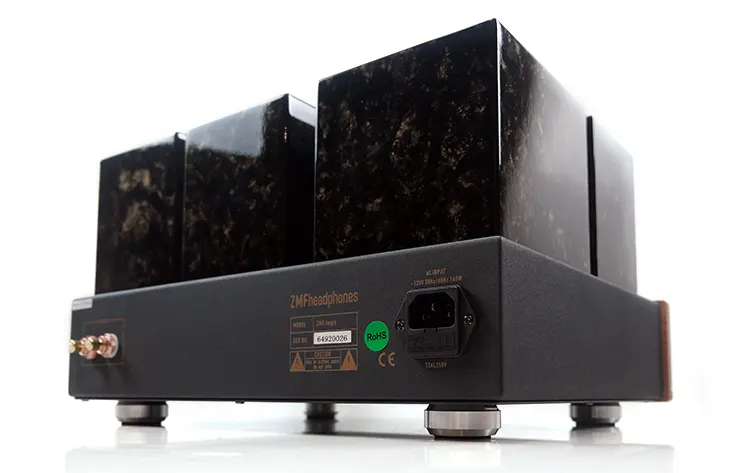
The Aegis is a smaller and lighter tube amplifier compared to the Headonia 300B.
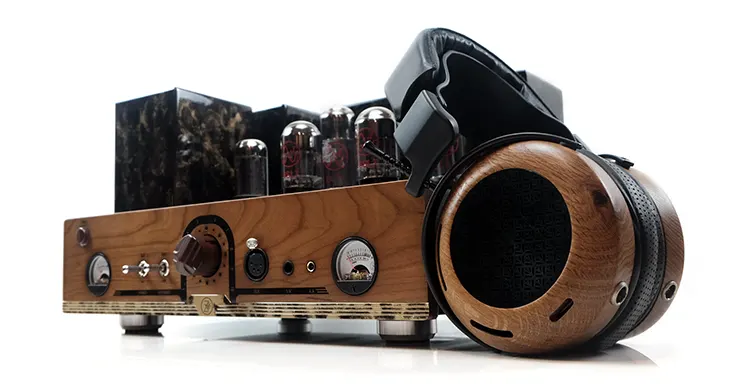
Its aesthetics are a mix of DIY and retro charm, but most definitely a ZMF Headphones interpretation, with its premium kiln-dried hardwood front panel and topped off with a beautifully CNC-cut walnut knob in the middle, a similarly finished power button, and a grooved brass fastener at the base.
The Headonia 300B has a more modern, urban design. It is clearly more refined with the superior materials and machining. Still, for traditionalists, many might point to the Aegis as putting out more retro charm, but I doubt anyone would disagree that the Headonia 300B looks more premium.
The Aegis also has a more classical mechanical switch and VU meter approach, similar to the HA-300MK2. Whereas the Headonia 300B introduces more digitization in its display, along with a bit more control and insight into the performance, and that excellent little remote control
I will say, however, the VU meter on the Aegis has a bit more energy about it. Its dials are livelier than the Headonia 300B’s version. It’s more of a stylistic thing, but if you are going to use them, give them some life.
Since the Aegis has no pre-amp, it lacks output on the rear panel. It also only provides for a single dual RCA SE input, whereas the Headonia 300B has 3, including a 3-pin XLR, and some high-end Lundahl transformers connected to it.
The Headonia 300B is clearly the more flexible system component, but for our purposes, it is more about the headphone performance, which you can read in more detail below.
Performance
The Headonia 300B is a little more neutral and precise-sounding compared to the richer, more elastic tone of the Aegis. With its solid-state rectifier at play, the Headonia 300B has a tighter grip on note decay, bass layering, and definition.
It also reaches deeper with a more observant sub-bass response when required, though it’s not as full or bloomy-sounding through the mid-to-upper bass response of my tested headphones.
The Headonia 300B also sounds the taller of the two amps staging-wise, with the blacker background and more headroom. Clarity is throughout the spectrum, with individual notes refusing to stomp all over each other regardless of complexity or pace.
The timbre of the Aegis vocal performance is a competing factor between the two based on perceived preferences. On the EXPANSE and the Atrium, the vocals were a little fuller-bodied, lusher in tone, and further forward than the Headonia 300B.
If you are a vocal-first audiophile, it does a wonderful job creating that traditional creamy vocal performance you would desire from a tube amplifier. However, it can come at the cost of staging expanse and imaging clarity, which is where the Headonia 300B pulls well ahead.
On numerous performances, the Aegis came a distant second to the Headonia 300B for staging width, especially for layered backing vocals that aim to expand the stereo field. This became very obvious when paired with headphones that excel in resolution and staging expanse, such as the Susvara Unveiled.
Those layered vocals on the Aegis sounded comparatively walled-off and lacking in height and air compared to the holographic performance of the Headonia 300B. For sheer resolution and dynamic range, the Headonia 300B was more convincing.
My Verdict
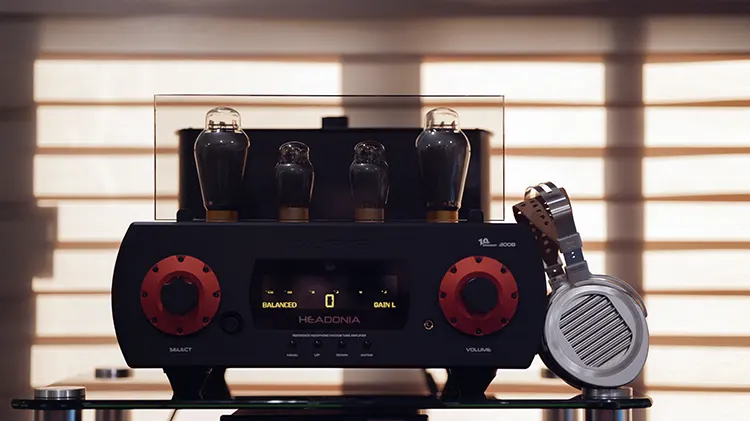
The Auris Audio Headonia 300B is a high-end modern tube headphone amplifier capable of world-class performance levels. It delivers a neutral-to-natural tuning with excellent speed and incredible levels of dynamic range within a spacious and immersive soundstage.
It has the power and flexibility to handle any headphones I paired with, as well as some IEMs, though I do not think this should be considered an ideal IEM amplifier in general, as microphonics are a thing at such sensitive levels.
This is also a huge amplifier with excellent build quality and an eye-catching, racy, urban-like design language.
You will need to give it plenty of space, whether it’s just for headphones or slipping it into a Hi-Fi setup. Once integrated, I have no doubt this amplifier will be a huge, positive talking point for anyone who casts their gaze on it.
Auris Audio Headonia 300B Technical Specifications
- Analog Inputs 2 x RCA, 1 x XLR
- Headphone Outputs 1 x 6.3mm, 1 x XLR
- Pre Out Outputs 1 x RCA, 1 x XLR
- Tubes 2 x 300B, 2 x CV181/6SN7
- Max Power Output 7W
- Output Impedance 32/80/150/300/600 Ω
- Dimensions L x W x H 460 x 440 x 310 mm, 18.11″ x 17.32″ x 12.20″
Headphones Output
- Max Power 7W
- 32 Ω = 15V
- 80 Ω = 23.5V
- 150 Ω = 32.5V
- 300 Ω = 46V
- 600 Ω = 65V
- THD+N 0.45% dB at 1W
- Frequency response ±0.45 dB at 1W ±0.9 dB at Max Power
- SNR 100 dB
- Input Sensitivity (for max power/voltage at output)
- SE input 0.8V
- BAL input 1.6V
Pre Out
- Max Output voltage 17V
- THD+N 0.06% for VOL<20 [Vout=7V]
- Frequency response ±0.2 dB for VOL<20 [Vout=7V]
- SNR 100 dB
