

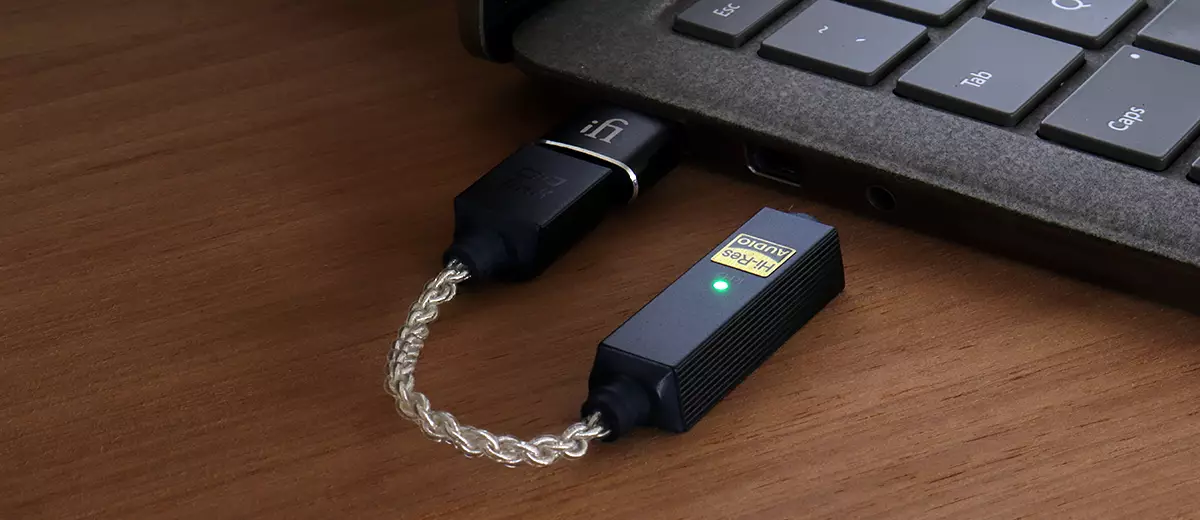
Louis reviews the iFi audio GO link 2, an affordable dual ESS dongle DAC with up to 244mW of output power for smartphone and iPhone users. It is currently priced at $59.00.
Disclaimer: I received this sample in exchange for my honest opinion. Headfonics is an independent website with no affiliate links or services. I thank iFi Audio for their support.
Click here to read up on other iFi Audio products we have previously reviewed on Headfonics.
This post adheres to our current scoring guidelines, which you can find here.
iFi audio recently launched the GO link 2, a smaller version of the original GO link dongle DAC, priced at $59.00 USD or £59.00 in the UK.
I will attempt to cover all the bases and talk about the GO link 2, referencing the original model to see if there were any improvements. Then, as usual, the competitive comparison begins.
The dongle DAC amplifier market competition is fierce at the budget level, and there are lots of heavy hitters on the roster.
The iFi audio GO link 2 has to stand out with something unique if it wants to be competitive against the likes of the Shanling UA1 Plus and SMSL’s D10. Going into this review, that’s what I was hoping to identify.
Features
Let’s take a look at the internals. IFi Audio doesn’t specify what ESS Sabre chip they use, or how many chips. But I am still wondering why they’re not using their tried-and-true Burr-Brown DAC as much. Not on their bottom tier, at least.
In the digital realm, the GO link 2 lost the MQA capability from its predecessor, but DXD is retained. It decodes bit-perfect DSD up to DSD256 and PCM 384kHz.
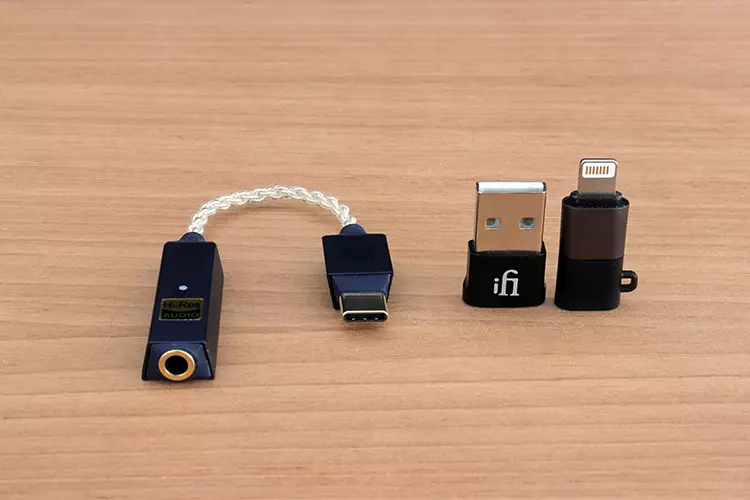
I do like the fact that it comes with a Lightning adapter plus a full-size USB adapter. It means that almost any piece of hardware out there will work with the GO link 2 out of the box, giving the device a high level of versatility, and that adds value.
Power output has got to be one of the lowest numbers iFi audio has posted for any of their devices. In fact, it only beats the original GO link by a small margin.
According to iFi, the GO link 2 produces 79mW at Ω32, while the original was capable of producing 70mW at the same impedance load. Both models equally post up 14mW at 300Ω. I don’t think that 9mW would make a real-world difference.
Design
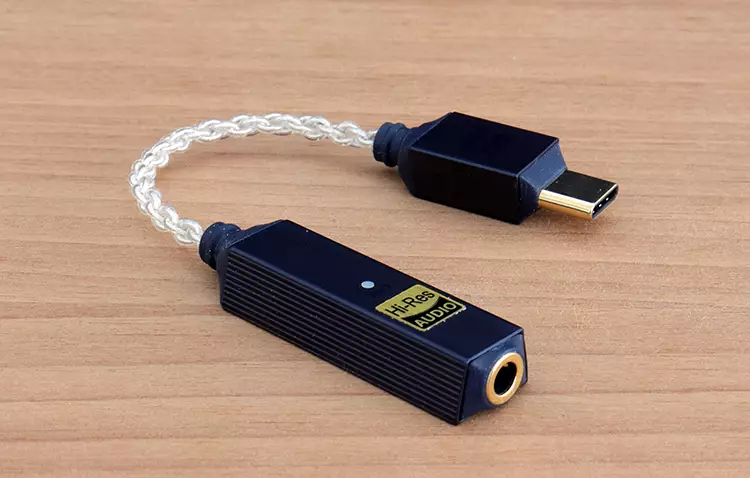
The GO link 2 is made of a very lightweight precision-milled aluminum alloy, with small rubber strain reliefs, and a braided, transparent, non-removable cable that looks to be built with silver-plated strands.
My opinion is that the strain reliefs are too tiny to protect the cable in any way, and that spot appears to be a weak link in its construction, plus it’s a non-removable cable. I just hope it holds up.
The main housing holds a single 3.5mm tap that uses iFi audio’s S-Balanced topology, which improves crosstalk.
But I just can’t remember the last time I received an IEM with a 3.5mm TRRS balanced type of connector, and it is an uncommon type of connectivity to run into nowadays.
Although S-Balanced works with regular TRS headphones and reduces crosstalk by 50% even with standard single-ended (TRS) 3.5mm headphones, I would have liked to have seen a single 4.4mm instead of the S-Balanced feature.
Or even better, I would have used the fourth pin to enable a TRRS with a microphone instead. Either solution would have been more useful.
The housing holds an LED which works as a multi-format indicator, changing color according to the format and bitrates it’s receiving, as some other dongles have implemented.
The USB-C connector wears iFi branding, and on the other side, it wears the GO link badge.
It’s a chunky connector; similar to some of ddHiFi’s recently released cables, particularly the TC03, and the cable that comes with the MOONRIVER 3 dongle. The connector itself has light gold plating, and it looks to be a custom connector.
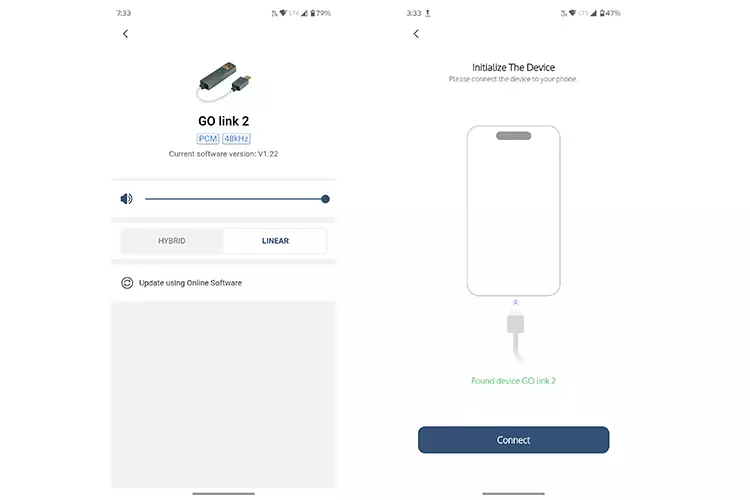
iFi Nexis app
The Nexis app does detect the GO link 2, but it doesn’t do much for the device. The only useful function it lets you use is a couple of filters and a firmware update feature.
I did register the app, thinking that it might open up some extra features, but it did nothing else. No changes took place.
The app does enable a linear plus a hybrid filter, but the quick start guide shows an additional bypass mode, which I have not been able to access. I tried taping on the two available filters, and they just switch over from one to another.
There’s apparently no way of switching them off, and I cannot find the way to activate that bypass filter. There are no firmware updates available either. Perhaps it’s an implementation that’s on the table. The current running version is version 1.22.
There is a volume control within the app, and it does work, but it would have been nice to be able to adjust and set the max volume there. But the app resets every time you disconnect the GO link 2 from the mobile device.
Meaning, it doesn’t hold an adjustment, so you must treat the GO link 2 as if the volume defaults to 100% every time. It defaults to a default state that’s an accident waiting to happen. Always rely on the source’s volume control just to be safe.
Packaging & Accessories
I’m sorry to be a complainer here, but the GO link 2 packaging is subpar. It’s made from a very thin cardboard that will not protect the contents. It’s well laminated, I can say that much.
To prove the point, the full-sized USB adapter, for example, that came with my unit was crushed because the box was crushed in transit, and I had to grab a flat tool to straighten it a bit.
Thank goodness nothing else was damaged. The cardboard actually has a pressure imprint of the dongle itself upfront.
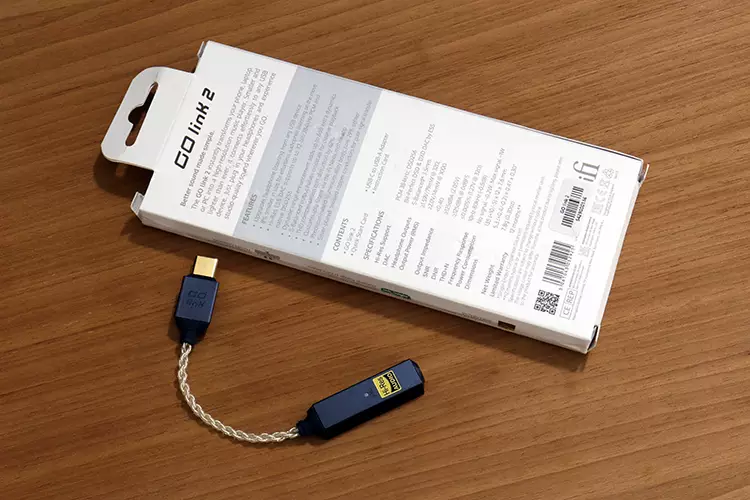
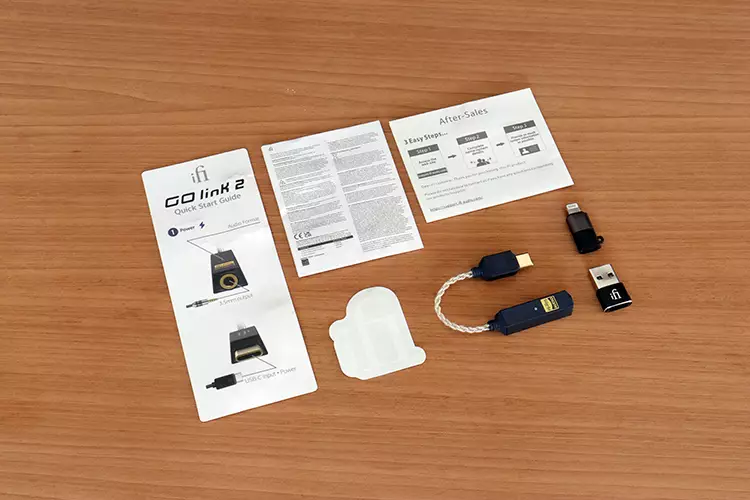
The thin cardboard is shaped with cutouts that hold the contents in place, which are the dongle, two adapters, one full-sized and one terminated with a lightning connector. It’s generous on connectivity and ensures that whoever buys one will be able to use it out of the box.
The rest of the content is paperwork. There’s a quick-start guide, another pamphlet with some legal mumbo jumbo, the customary iFi sticker, and an after-sales and MQA setup instruction pamphlet. But the GO link 2 is not MQA capable, oh well.
Sound Impressions
Summary
The GO link 2 is a low-distortion, low-noise device that caters to neutrality and soundstage, which was surprisingly good and a highlight of its overall sonic character. It sports a lean dynamic signature with low distortion.
From the bass to the treble, there’s an overall sense of balance that doesn’t emphasize any area over another. The midrange is smooth, but it has an edge and tends to sound too abstracted. Or perhaps I’m experiencing some sort of ESS hump?
The bass frequencies have good note distinction and ability to reproduce bass notes, but the power output is not enough in some cases, and is unable to produce any noticeable weight and punch.
The bass seems capped off at 20Hz since I tested a few IEMs that I’m sure are capable of performing as low as 12Hz, and once they reached 20Hz, they suddenly stopped producing bass with this dongle.
I would have incorporated a subsonic filter in this device myself, since it helps in conserving output power reserves, and is something beneficial for this device.
The midrange is expansive but focused, and forward, but not too vigorous. They sound assertive with a boundless character that can paint a bold midrange sound.
The high frequencies have a privation for sharpness in that they sound a touch strained. There are times when the high-frequency notes are produced sharply and well defined. Then there are times that they sound overwhelmed.
The bass and treble show the consequence of running out of driving power, which is this device’s weak point. If you keep the volume at a moderate level and use an efficient IEM, then no issues.
Nonetheless, the GO link 2 sounds better than any built-in mobile device output I’ve heard. It raises the bar on dynamics, frequency response, balance, and especially soundstage.
Staging and Dynamics
The soundstage capabilities here, along with the low noise floor, are the highlight of the GO link 2. The staging capabilities maintain focus and position, with very little smear or congestion, unless it runs out of steam driving your IEMs.
It presents the listener with enough technical ability to present music in layers. The GO link 2 can position voices dead center or anywhere within its given soundstage size, which is generous but not abnormally large.
The dark background it paints sound on helps one distinguish what’s in the foreground. That lets you pick out background nuances with the right IEMs and a better sense of pinpoint positioning within the soundstage.
Click on page 2 below for my recommended pairings and selected comparisons.
