

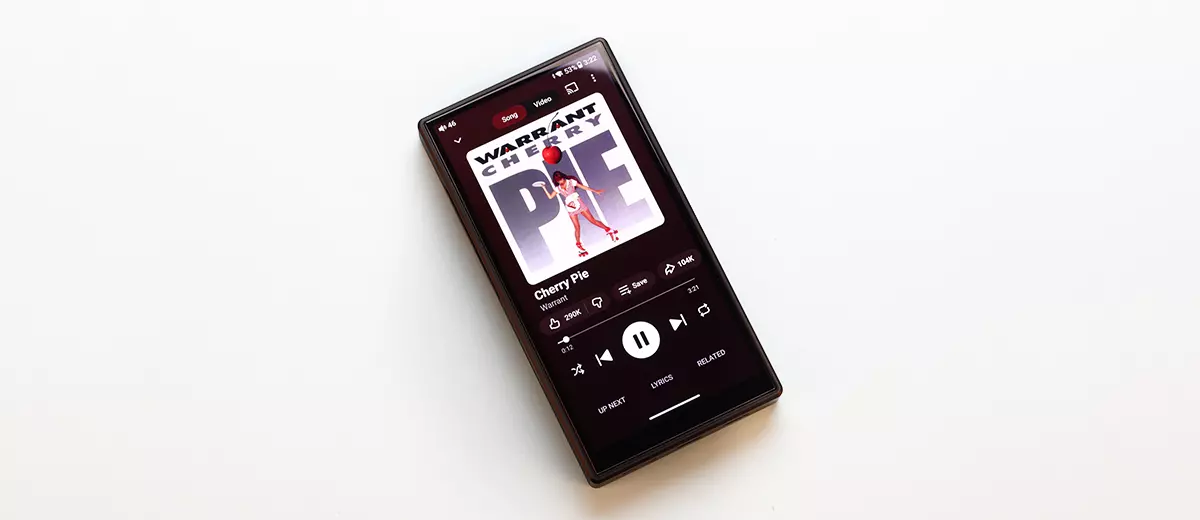
Marcelo reviews the FiiO M33 R2R, a new Android 13 DAP featuring a 24-bit R2R DAC, 8GB of RAM, and up to 1.1W of balanced output power. It is currently priced at $649.99.
Disclaimer: I received this sample in exchange for my honest opinion. Headfonics is an independent website with no affiliate links or services. I want to thank FiiO for their support.
You can click here to learn more about the FiiO audio products previously reviewed on Headfonics.
This post follows our current scoring guidelines, which you can read in more detail here.

FiiO is one of the most popular and oldest brands still operating today, and I have owned, heard, and reviewed a few of their products, including the FiiO SNOWSKY Melody, FiiO JT3, and JT7 headphones.
Today, I get to review the new FiiO M33 R2R DAP, which sells for $649.99 and is FiiO’s first R2R-based DAP.
The M33 R2R uses a discrete resistor array for R2R conversion, rather than delta-sigma chipsets, which are used by more than 99% of DAPs today.
Although R2R digital audio converters are rare in DAPs, more brands have begun using them, and they have become increasingly popular and sought after in recent years.
At first, DAPs with R2R digital audio converters were very few, including the HiBy RS8 DAP, which was loaned to me and reviewed two years ago. Thanks to technological advances, DAPs with R2R converters are finally becoming more affordable.
I was impressed by the huge soundstage and presentation scale of the HiBy RS8. Will the new FiiO M33 R2R give me a similar soundstage size and presentation scale?
Or more importantly, how will it compare to other price-relative DAPs, including the Shanling M3 Plus and the ONIX XM2? Find out in the review below.
Features
The M33 R2R features a Snapdragon 680 processor and runs Android 13. The Snapdragon 680 processor should have enough processing headroom for additional music and streaming apps, as well as the FiiO music player app.
I’m so delighted that the M33 R2R features a large 128 GB of internal storage and 8 GB of memory. This means you can store plenty of music on the M33 R2R even without a Micro SD card. This is a big plus in my opinion.
Another notable feature is the use of a flagship-level proprietary digital audio purification system with high-capacity FPGA and dual femtosecond crystal oscillators.
These are the same ones used in their flagship DAP, the M27, as FiiO stated. This is a massive upgrade compared to M33 R2R’s predecessor, the M23.
FiiO also miniaturized the M33 R2R’s design and used a 5.5-inch screen with a 1920 × 1080 resolution. This makes the M33 R2R smaller and lighter than the older-generation DAP, the M21, despite having more capabilities and features.
To prevent frustration caused by audio delays when using an external DAC, FiiO uses tan independent XMOS XU316 USB interface chip. XU316 is a popular, high-performance USB chip used primarily in high-end audio devices.
It supports DSD512 and PCM 768kHz/32-bit, making it a standard in high-end USB DACs and audio interfaces.
The M33 R2R features a bidirectional Bluetooth audio connection that supports SBC and LDAC codecs for transmission and SBC, aptX, aptX HD, LDAC, and LHDC codecs for reception.
A feature worth mentioning is the 10-band parametric EQ, which supports auto EQ. M33 R2R’s Auto EQ automatically matches curves for FiiO IEMs and headphones.
DAC
The M33 R2R is FiiO’s first R2R-based DAP, featuring a ladder DAC architecture in a compact, Android-based device.
This allows one to enjoy the lush, warm sound of R2R DACs not only with the native music player but also with third-party music players, video streamers, and games.
Unlike delta-sigma DACs, which are integrated into IC chips and used in more than 97 percent (I estimate) of DAPs available as of this writing, the M33 R2R DAC uses a fully differential 24-bit discrete-precision resistor array in conjunction with control chips.
This makes the M33 R2R’s DAC section more expensive to manufacture than that of other DAPs with delta-sigma DAC chips.
Amplification
The M33 R2R’s internal amplification borrows from FiiO’s higher-end designs, using Texas Instruments OPAMPs in a multi-stage layout.
FiiO’s goal is consistency across gain stages and lower noise under load, which translates into stable output for both sensitive in-ear monitors and harder-to-drive full-size headphones, whether you are listening on the go or at a desk.
To my understanding, they use multistage amplification to lower the output impedance, increase the damping factor, and improve the amplifier’s grip on the drivers.
This would result in a tighter, cleaner, more authoritative bass, lowering the chance of impedance skew, and making the perceived frequency response flatter and more consistent.
After the DAC section, the signal is received by Texas Instruments OPA1637 OP-AMPs for current-to-voltage conversion, then routed to the Texas Instruments OPA1662 for filtering.
At this point, the signal is almost ready for amplification and passes through the NJW1195, a 4-channel electronic volume controller manufactured by Nisshinbo Micro Devices (formerly New Japan Radio/NJR).
The headphone amplifier section is handled by four dual-channel units, each using two op-amp circuits in parallel for the four channels required for balanced stereo amplification. The signal is fully balanced from the R2R DAC to the amplifier outputs.
A slide switch on the right side of the M33 R2R toggles between charging and desktop modes; the latter allows the M33 R2R to increase power and gain by drawing more power from a USB-C source while plugged in.
The M33 R2R has three gain settings by default: low, medium, and high. A super-high-gain mode is enabled when you switch to desktop mode.
The M33 R2R’s maximum power output is 1100mW + 1100mW into 32Ω on its 4.4 mm balanced output jack, and 470mW + 470mW into 32Ω into its 3.5 mm single-ended output jack.
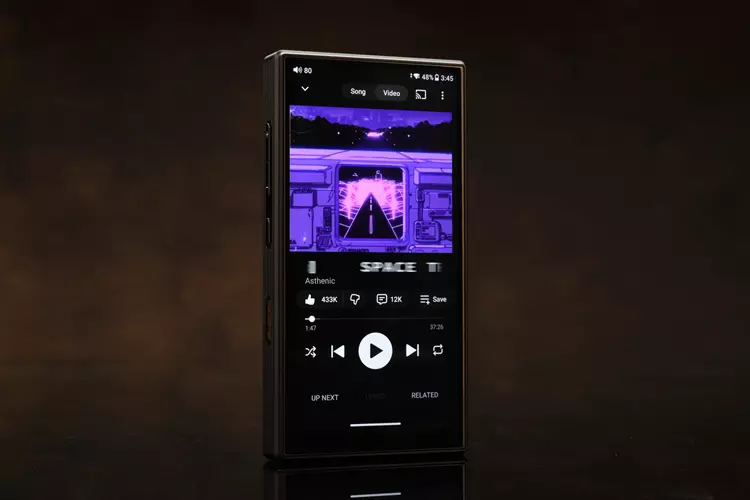
Design
The M33 R2R is pretty compact and light for its level of performance and features, especially compared to older FiiO DAPs with lower performance and fewer features.
I hope other brands follow this and make DAPs smaller and lighter while incorporating newer innovations and more features.
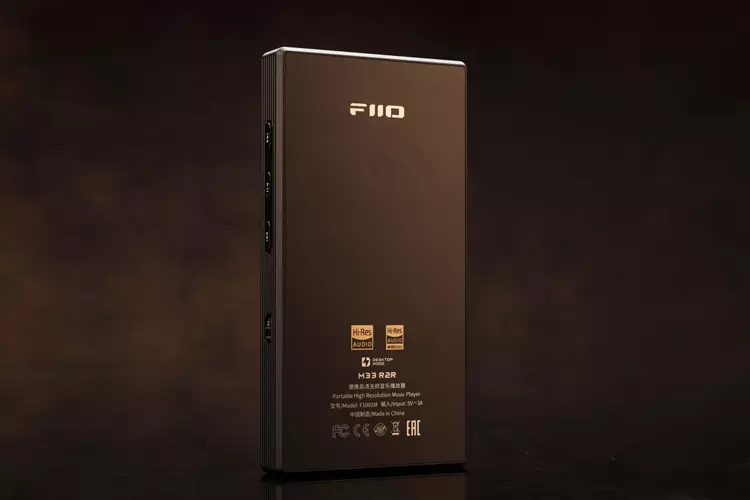
The chassis is made of solid aluminum alloy, sandwiched between a 5.5-inch full-HD touchscreen and a tempered glass back, printed with logos and text. I like the lines on both the left and the right side. The corners and edges are subtly chamfered, making for a refined feel.
My review sample came in black, but the M33 R2R is also available in blue and titanium gold. The finish appears to be anodized.
The M33 R2R is a mid-sized DAP with dimensions of approximately. 138.2 x 71.5 x 17 mm, and moderate in weight, approximately 258g.
In my opinion, it hits the sweet spot for Android-based DAPs: neither too small, too big, nor too heavy to bring along on long trips. The size allows for a screen that makes controlling the Android operating system easy.
The M33 R2R 5.5-inch touch screen has excellent brightness, color, contrast, and viewing angles. The color accuracy and refresh rate are good.
I estimate the screen refresh rate is 60 Hz, but I would love a 120 Hz refresh rate like on my phones; however, 60 Hz is acceptable and the current norm for Android DAPs.
I/O
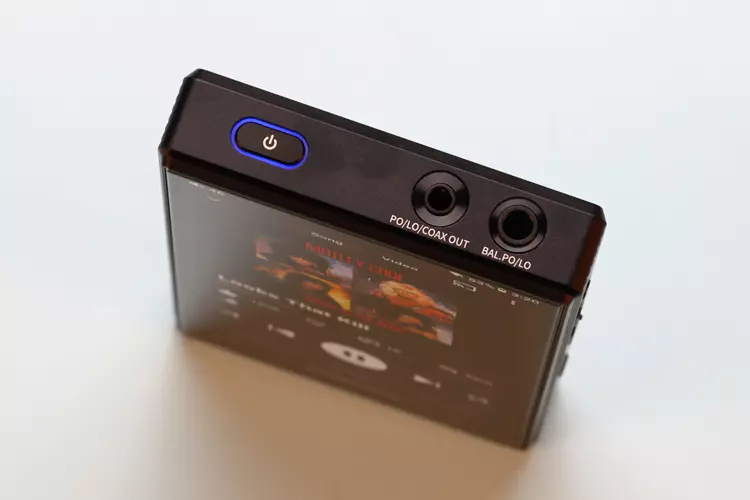
Both the M33 R2R 3.5 mm and 4.4 mm output jacks are located on top, which is my favorite location for them.
This lets me put the player on my tummy while lying in bed or sitting on a sofa, without the cable getting in the way. Both output jacks can be used as either a line-out for an external music system or the usual headphones output, separately.
According to FiiO, the line outs are dedicated circuits and are not shared with the headphone out amplifier, for purer R2R sound when connected to external amplification or a system.
The 3.5 mm jack also serves as a digital SPDIF output for connecting to a desktop or full-sized DAC with a dedicated cable available separately.
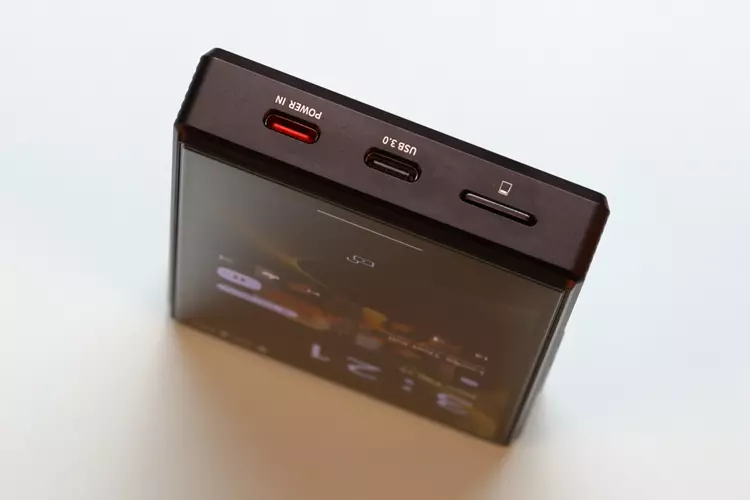
At the bottom are the memory card slot, which accepts MicroSD cards, a USB-C port at the center for audio and file transfer, and another USB-C port on the right side labeled power in for charging and power input in desktop mode.
Controls
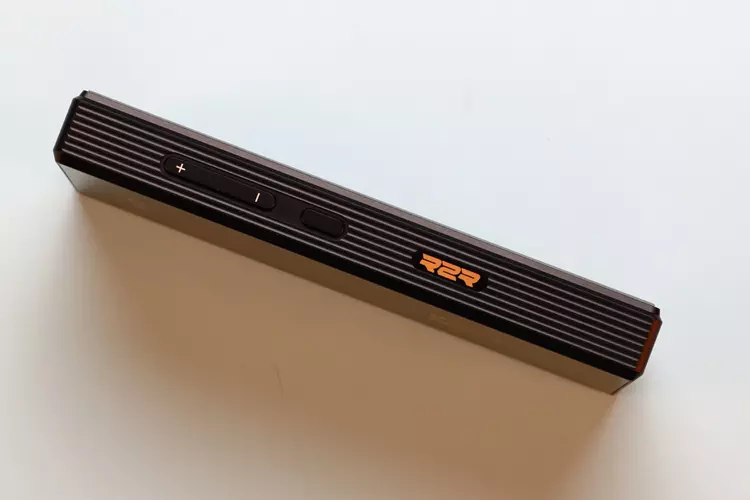
At first, I found it awkward that the M33 R2R power and screen on/off buttons are located on top, as I must change hand position to reach them to turn the screen on or off while listening to music.
I discovered that the button on the left, under the volume control, can be programmed to turn the screen on and off, and perform many other functions.
There are three buttons on the right: the play/pause button and the skip-forward and skip-backward buttons.
There is a slide switch below those buttons that lets the USB-C port act as either a charging port or a power-in port for desktop mode. The down position is the charging mode, and the up position is the desktop mode.
Battery Life
The M33 R2R features a 4400mAh battery that delivers up to 13.5 hours of playback at balanced output and 15.5 hours at single-ended output according to their product page.
However, the M33 R2R spec sheet states the battery life is 12.5 hours. I mentioned both battery life ratings, since I don’t know which is more accurate, so that you know.
When charging, the M33 R2R features a 25W low-temperature charge pump technology that prioritizes speed while keeping heat under control, helping preserve long-term battery health. It takes about 1.5 hours to fully charge, according to FiiO.
During the burn-in period, I also observed the battery life and charging time to make better use of the time.
I got from 90 percent to 80 percent battery with 1 hour of use with an IEM on a 4.4 mm balanced connection, Wi-Fi and Bluetooth off. I used PowerAmp music player at my normal listening volume, which is moderately loud.
That said, I estimate that I would get 10 hours or less of battery life. I speculate that if I use the FiiO music app at a lower volume, I can achieve the battery life stated in the spec sheet.
While charging with my 65W PD charger, I went from 23 percent to 93 percent in 1 hour, which means it takes less than 1.5 hours to charge from 0 to 100 percent. This also means the M33 R2R charges faster, or at least meets the claimed charging time by FiiO.
Packaging & Accessories
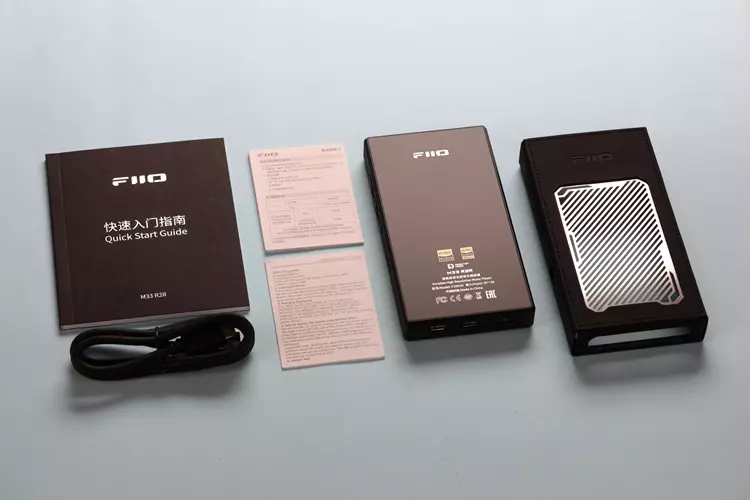
The M33 R2R came in a medium-sized white box measuring 190 x 120 x 65 mm, with a simple, clean design featuring only the M33 R2R photo on the front and text around the edges.
The box opens easily, and I had a pleasant unboxing experience. The box opens with a magnetically held door.
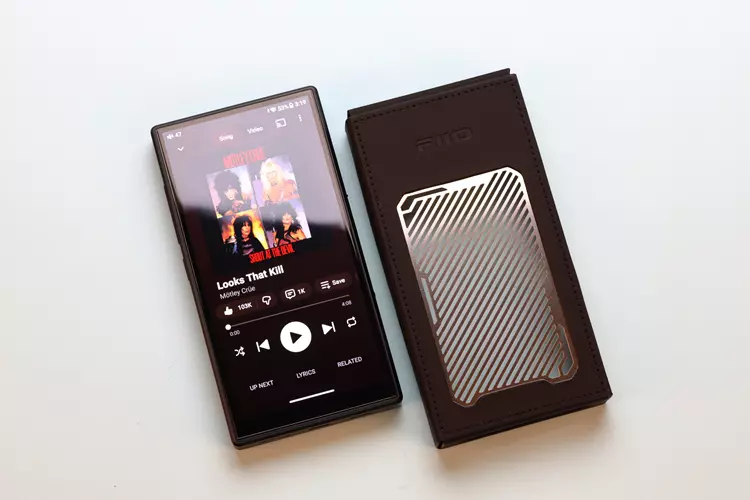
The items inside the packaging are divided and protected by EVA foam and cardboard. It comes with the leather case and the tempered glass screen protector already installed on the M33 R2R.
The package also included the manuals and a USB-A-to-USB-C cable.
Protective Case
The protective leather-like case is included with the M33 R2R, as it is already installed when I unboxed it, so it is not a separate purchase. The cases match the color of the M33 R2R unit: black, blue, or titanium gold.
Click on page 2 below for my software impressions.
Click on page 3 below for my sound impressions and recommended pairings.
