

Selected Comparisons
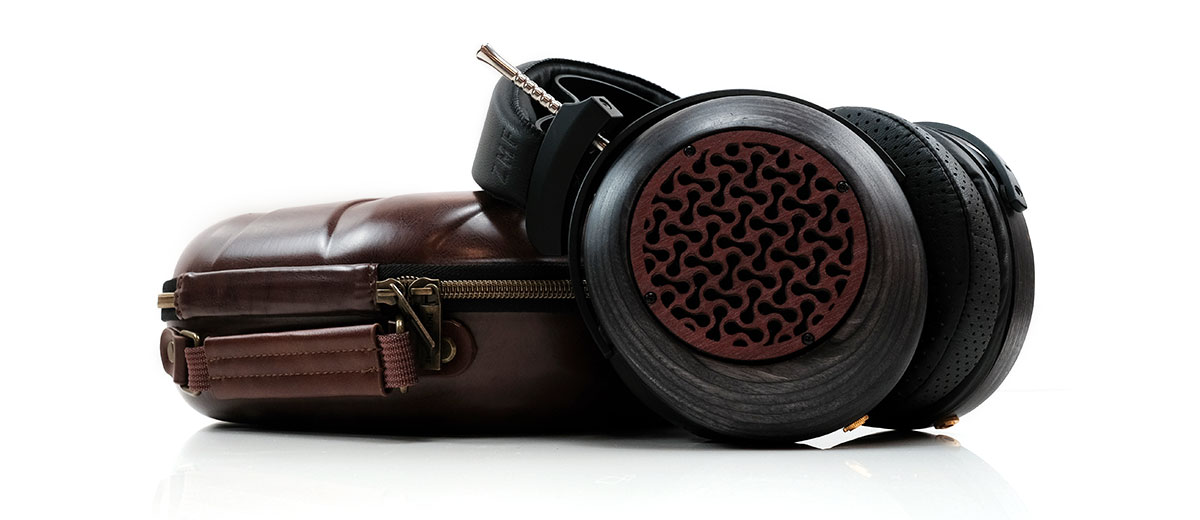
The following comparisons to the ZMF Headphones BOKEH Open were completed using a mix of the Cayin C9ii (with the iBasso DX340/AMP15 line-out) and the Chord Electronics Alto/Ferrum WANDLA GSE combo.
All connections were with the 4.4mm-terminated stock cable, and the Caldera Hybrid Ultra Perf pads fitted.
ZMF Headphones BOKEH (Closed)
The ZMF Headphones BOKEH Closed were launched in 2024, with our review coming out in October of that year. For comparison purposes, I will be using the ‘BOKEH tuned’ version of the Caldera (thin) hybrid pad that came stock with the Closed version.
Technical
The overlap is on the driver and the Atrium Damping system, and the differences are in the acoustic environment, one being open and the other closed.
Both BOKEH use the new 80Ω-rated LCP (Liquid Crystal Polymer) dynamic driver, a significantly lighter load than their usual 300Ω alternatives used on ZMF’s flagship headphones.
It is no surprise then that the BOKEH Open and Closed have matching sensitivity ratings on paper at 103 dB/mW @1kHz, though subjectively the closed cup acoustics and heavier bass tuning on the Closed version might create a perception of a more sensitive headphone.
I also have to assume the precise configuration of the Atrium Damping system for the open-back is not the same as it is for the closed cup version, due to it having a back wall creating more of a challenge for closed cup resonance and standing waves.
Both headphones are flexible for tuning; one set of pads fits another, and both have similarly sized interchangeable mesh options.
Though the tuning is quite different, the effect of the pads is broadly similar for both, with Ultra Suede creating a softer, lighter tuning, the hybrid protein leather more balanced with air in the highs, and the Caldera thins delivering the most robust sound.
Design
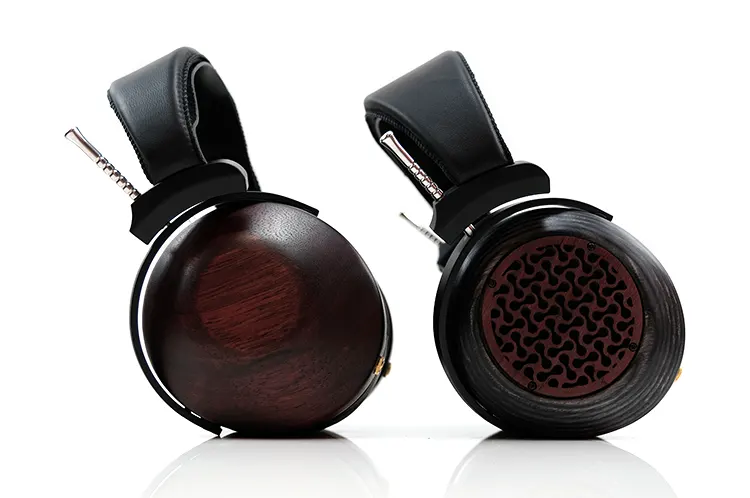
This shouldn’t be a competition, and thankfully, the purpleheart hue of the BOKEH Open’s Nocturna SpectraPly perfectly complements the Claret African Black Limba hardwood of the closed.
Yes, there are other color variants out there which you can mix and match in, but nothing quite as harmonious as these two IMHO.
You could argue the wood is more exotic on the closed back, but then you are paying a bit more for it over the BOKEH Open, which perhaps justifies it.
Most everything else is the same, save for the slight change in BOKEH Open headband width and thickness compared to the closed version. It could well be that this is a running change, and current Closed variants have the same ‘upgraded’ headband.
Now, subjectively, I see the BOKEH Open as a slightly more compact headphone when placed beside the closed.
The official weight is the same as 480g, but they feel a little different on my head, courtesy of the perceived stronger lateral clamp and stronger isolation from the closed version. The BOKEH Open feels ‘breezier’ on my head and perhaps a little more comfortable due to the open design.
Aside from that, both headphones come with the same pad, mesh, and stock cable options, and are interchangeable, so you do not have to buy one for each headphone if you own both.
Performance
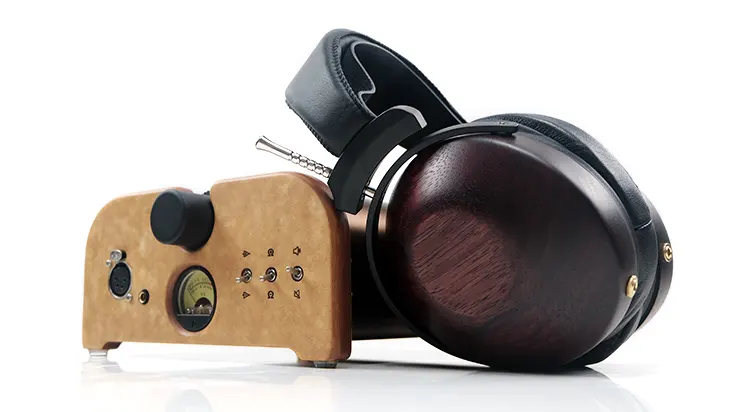
This is an easy comparison and yet a tough one at the same time. It’s the same driver with different acoustics and damping, so the presentations will sound quite different, with strengths and weaknesses in different areas. It just depends on your preferences.
If you are an open-back fan, you will pick the BOKEH Open in most side-by-sides for its more open and airier soundstage quality.
You might also pick it for its stronger midrange focus or more controlled bass response. I dare say the more noticeable contrast in the note timbre and enhanced micro-detail in the highs will also catch your attention.
Whereas Closed-back lovers might be looking for power, and yes, the BOKEH Closed offers more sub-bass presence sub-50Hz, along with a healthy level of bloom from 100Hz to 500Hz.
Of the two, and especially with the Caldera Thins, the BOKEH closed-back delivers the necessary energy and drive in the lows for rhythmic recordings to sound authoritative.
Arguably, the BOKEH closed is the smoother-sounding of the two. The vocal timbre is a little softer with reduced upper-harmonic influence and a stronger fundamental frequency.
However, depending on the voicing register, they are also imaging a little further back than the more forceful BOKEH Open equivalent. This will contribute to a perception of the BOKEH Closed sounding darker than the BOKEH Open.
Save for a small 6-8k drop, the BOKEH Open shows more energy and elevation from 2k upwards, fleshing out percussion strikes with more zest and accuracy.
Combined with the open-back acoustic design, it creates a slightly lighter tonal coloration but with better treble extension and height in its soundstage.
Dan Clark Audio NOIRE XO
The Dan Clark Audio NOIRE XO was launched earlier this year, and like the BOKEH Open, it follows hot on the heels of a closed-back variant, the NOIRE X.
Technical
The NOIRE XO is an open-back planar headphone, as opposed to a dynamic one, featuring a 62mm x 34mm single-ended planar magnetic driver and the latest iteration of DCA’s V-Planar Technology.
The contrast in timbre and technical performance will be stark, but what you will notice is that both utilize patented acoustical systems to fine-tune the performance of their respective drivers.
For the BOKEH Open, it is the Atrium Damping System, and for the NOIRE XO, a further augmentation of DCA’s AMTS or Acoustic Metamaterial Tuning System technology.
You could argue that the NOIRE XO AMTS and the BOKEH Open’s ADS have the same soundwave management objective and the same customizable ability, though both approaches are quite different in architecture.
The NOIRE XO is rated at 16Ω impedance with an SPL of 94 dB/mW, making it far less voltage sensitive than the 80Ω-rated LCP dynamic driver inside the BOKEH Open, but it is nowhere near as sensitive, requiring around 1W and more gain to sound optimal.
Design
Both ZMF and DCA started in the same modding niche many years ago, and it is fascinating to see where each company has gone through the years.
DCA has continually refined its headphones with weight and articulation as a primary focus, whereas ZMF has gone deep into the wood rabbit hole to create some beautiful aesthetics.
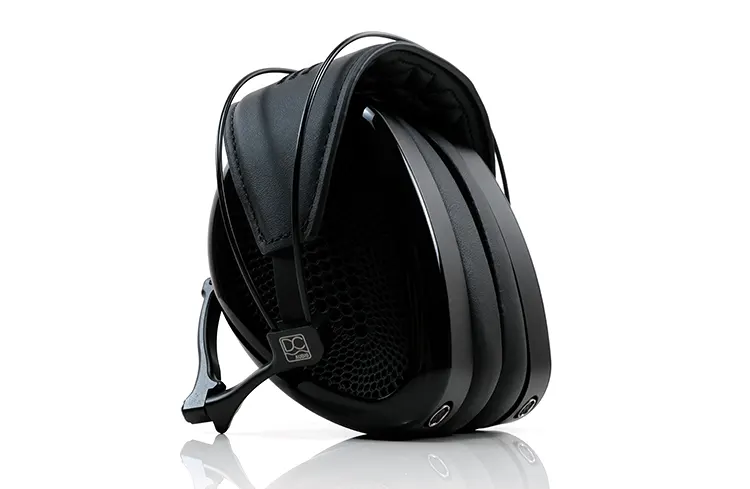
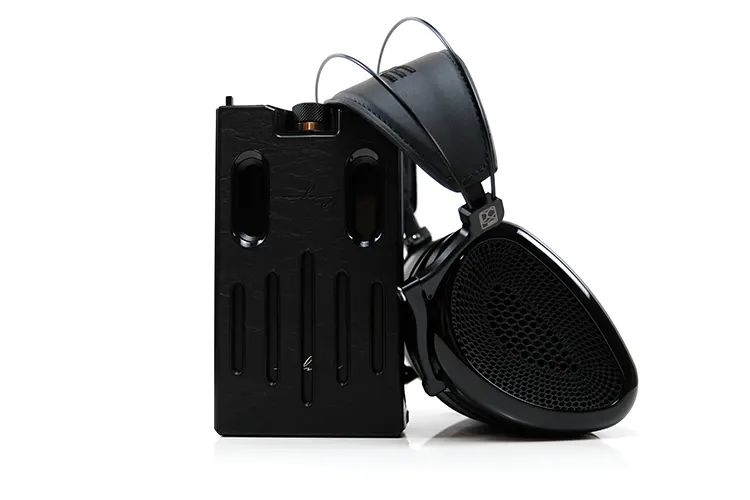
The beauty in the NOIRE XO is just how streamlined and nuanced the engineering is with those folding cups, lightweight nitinol bands, and long ovoid or teardrop form factor.
The NOIRE XO visual pop is low-key, but it works beautifully and will appeal to those who like a professional look.
The BOKEH Open is heavier, bulkier in some ways, but the artisanal aesthetic has more pop and visual appeal. No two ZMF headphones ever look alike due to the use of wood, where every cut has a unique grain structure.
The comfort levels are close, though for different reasons. The BOKEH Open feels more open with a lot more air and noise leakage. That’s a good thing; you want that in an open back.
The NOIRE XO’s ovoid cup structure, closer fit to the ear, and AMTS on the front of the driver create a slightly more closed feel to the acoustical environment with some background noise passive isolation, or more so than the BOKEH Open.
That sensation or perception plays out in their respective performances, which you can read in more detail below.
Both dissipate pressure really well. The NOIRE XO is light on my head, whereas the BOKEH Open pads feel further away from my ears. I just wish the NOIRE XO pads were more easily swappable and had a little more variety in the materials.
Performance
A lot of the different traits boil down to the driver chosen. Yes, there is a different FR for both, but the underlying characteristics, combined with very different staging properties, make more of an immediate impression on me.
The BOKEH Open delivers a much wider and deeper soundstage. I wouldn’t necessarily say it is as precise or as detailed-sounding as the articulate and fast transient response of the NOIRE XO.
That focus on detail and precise imaging from the NOIRE XO is delivered in part by a feistier top-end with more energy from 5- 10k.
So, whilst both headphones have a north-of-neutral 2-4k ear gain region that places a lot of focus on vocal and percussion presence, the NOIRE XO will sound cleaner, brighter, with shorter levels of decay and more attack emphasis.
The comparatively attenuated upper-treble of the BOKEH Open means the same midrange region is smoother sounding, more agreeable, but less attack-driven, slightly softer sounding, and with a longer decay.
And it’s more of the same on the lows. The NOIRE XO is tighter and faster-sounding, with the BOKEH Open sounding fuller and warmer. The LCD Dynamic driver is slower, with more decay and a bit more roll-off sub-50Hz compared to the NOIRE XO.
If you are into rhythmic music, the NOIRE XO’s chiseled sound signature will suit high BPM recordings that need to keep the notes tight and fast. If you prefer a “phat’ R’n’B or Motown bass quality with less speed, then the BOKEH Open sounds more natural.
Sennheiser HD 660S2
The Sennheiser HD 660S2 was launched in 2023, and though it’s cheaper than the BOKEH Open, I thought it would be an interesting comparison from an upgrade potential, and given that it has blue-chip branding
Technical
Both the HD 660S2 and BOKEH Open are open-back dynamic driver headphones.
The driver inside the HD 660S2 is smaller; it’s 42mm with a 38mm ultra-light aluminum voice coil as opposed to the 50mm LCP version inside the BOKEH Open.
Both companies have paid attention to the acoustics of their respective headphones. The BOKEH Open benefits from the Atrium Damping System, and the HD 660S2 uses an improved airflow system over the original.
Sennheiser also reduced the weight and increased the magnetic force around the driver to improve the impulse response.
However, as a result of the above, the drivers are heading in opposite directions for load with the 50mm LCP driver inside the BOKEH dropping down to 80Ω, and the HD 660S2 increasing from the original 150Ω impedance rating to 300Ω.
Ideally, the HD 660S2 will feel most at home with OTL amplifiers, but that is not to say the BOKEH Open will not be either. 80Ω is still above the norm for impedance for modern headphones, though nowhere near the Sennheiser’s 300Ω level.
Design
It is not even close in terms of materials and aesthetics, but then it shouldn’t be, given the price difference between these two headphones.
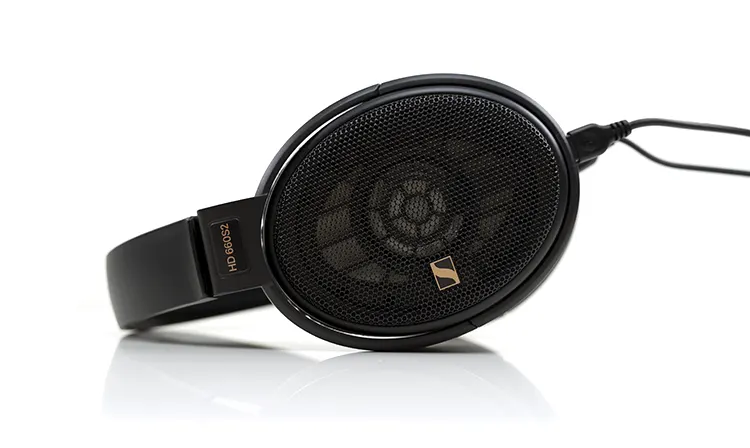
In one corner, you have plastics, spring steel, velour, and memory foam with minimalist branding on a matte black finish.
On the other side, you have a burst of wood grains, a purplewood hue, and a mix of aluminum, protein leather (or suede), and pressure straps. The BOKEH Open design is far more ambitious, unique, and eye-catching. The HD 600S2 is basically efficient mass production in a classic shell.
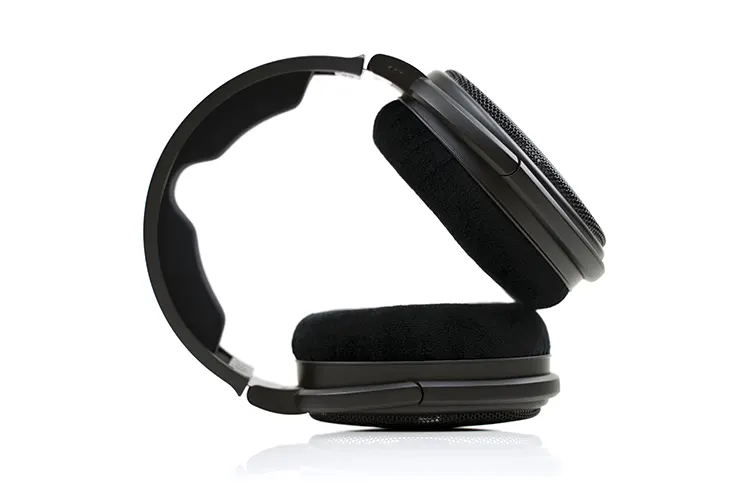
The HD 660S2 is by far the smaller and lighter of the two, so if weight is a concern, then it has a distinct advantage. It also has that classic Sennheiser aesthetic with the streamlined ovoid cups and utilitarian finish.
Despite the plastics, the HD 600S2 is quite durable. In fact, I would say a drop of these would be less damaging than dropping the BOKEH Open. They are built to last in many ways.
The comfort, however, well, that’s anecdotal in nature, but for me, the HD 600S2 is a tight lateral clamp with partial on-ear pressure and nowhere near as comfortable as the more relaxed and open fitting of the BOKEH Open.
Yes, there is more weight from the BOKEH Open; the HD 660S does feel quite light, at least for vertical pressure, but the clamp needs working out over time to get the desired comfort levels.
One advantage for Sennheiser is the cable options out of the box. You get two cables with 6.35mm and 4.4mm terminations and a 3.5mm terminated short extension for the 6.35mm plug. If you want all 3 for the BOKEH Open, you have to buy them separately.
Performance
Whilst I think the HD 660S2 is the best of Sennheiser’s recent HD offerings, you are really entering a whole new immersive world when switching to the BOKEH Open.
And it is the soundstage where you will notice the most immediate difference. The HD 600S2 sounds more restricted, more mid-centric, with less staging depth compared to the BOKEH Open.
It has this left-right stereo field feel effect to its soundstage, not terribly expansive, at least in comparison to the BOKEH Open.
The ZMF acoustical design lifts the BOKEH Open to a far more immersive level with a richer and deeper sub-bass presence, an area that the HD600S2 starts rolling off at around 100Hz.
The HD 600S2 is a little more elevated over the BOKEH Open through the upper bass and lower mids, and both have fairly strong 2-4k frequency responses.
Arguably, the BOKEH Open is more accented from 4-6k, allowing percussion to sound more impactful and clearer in the presentation.
However, while the BOKEH will have some vocal and percussion emphasis in the staging mix, it’s the HD 660S2 that falls back into that “mid-centric’ category for me due to the flatter bass and slightly more relaxed 8-10k region.
It just doesn’t have enough power and space to really open up the sound and compete with the huge presentation of the BOKEH Open.
My Verdict
The wood-finished ZMF Headphones BOKEH Open is a beautiful-looking and spacious-sounding dynamic driver set of headphones.
Not for the reference heads or micro-detail fans, the focus here is on delivering a balanced and natural tonal quality, making it a very flexible headphone for a wide range of musical preferences.
And along with a wide range of genres, it can pair with a wide range of amplifiers, with deeper or holographic sound signatures such as the Alto or HA-300MK2, standing out the most for what they bring to the BOKEH Open tuning.
Flexibility is further enhanced by ZMF’s range of pads and mesh options. It’s still not the quickest for pad changing, and one wonders if pads and meshes are central to the listening experience, then perhaps moving to a magnet system might enhance this feature even more.
Other than that, the BOKEH Open might prove itself to be a bit of a bargain, coming in $200 cheaper than the closed version. The closed-back will have its hardcore fans, but the open-back will appeal to a much wider audience.
ZMF Headphones BOKEH Open Technical Specifications
- Impedance: 80Ω
- Driver: LCP (Liquid Crystal Polymer)
- Weight: 480g ±30g
- Sensitivity: ~103 dB/mW
