

Synergy
Efficiency
The XENNS Mangird Top Pro has an impedance of 16Ω and a sensitivity of 103 dB ± 1dB, making it easy to drive to high volumes with most sources.
No extra power is needed, as even smartphones, laptops, and portable DAC-amps can drive it comfortably.
Using the Top Pro with a 4.4mm balanced connection is recommended for the best control and flexibility in volume adjustments.
The 3.5mm single-ended option remains convenient for on-the-go use, but it doesn’t deliver the same efficiency or headroom as the balanced output.
At lower volumes, the Top Pro’s bass becomes more subdued, with the midbass in particular losing some of its usual impact. The mids and treble, however, remain strong and consistent, keeping their presence and clarity intact.
Increasing the volume brings the low-end back to life, restoring energy and impact to the bass region.
Higher listening levels also add clarity to the Top Pro’s mids and treble, giving a noticeable boost to the bite of vocals and instruments.
Pairings
Using a smartphone required pushing the volume up to around 80% to get the Top Pro’s bass to the level I prefer. The overall tuning remained the same, with no changes in clarity or staging.
Pairing with the FiiO JA11 resulted in a slightly brighter tone from the Top Pro, making higher frequencies more forward and present.
This increased brightness gives vocals and the treble a touch more edge, making them sound more energetic but also slightly thinner.
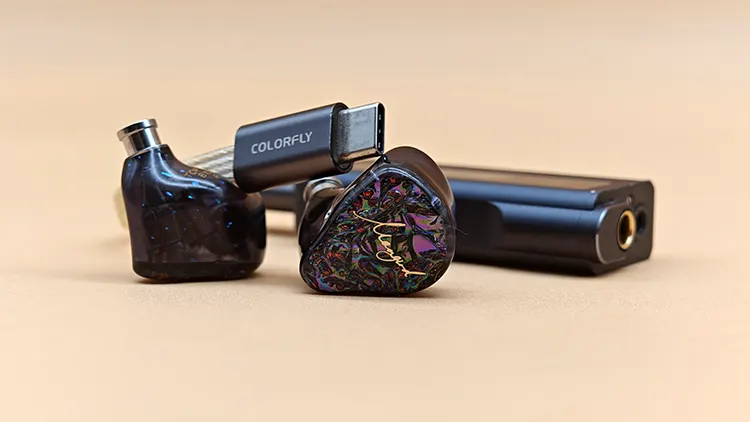
The Colorfly CDA-M2 allowed use of the 4.4mm balanced output, which noticeably boosted the Top Pro’s vocal clarity and presence. Vocals sounded more organic and real in my listening, with a more lifelike sense of detail and texture.
Switching to the Heartfield R1 added a clear bump to the Top Pro’s midbass, making drums hit harder and adding weight to the low end.
It also brought in some warmth to the overall tuning, which was less to my liking as it softened the treble and shifted the balance slightly away from being neutral.

Select Comparisons
MOONDROP METEOR
Technical
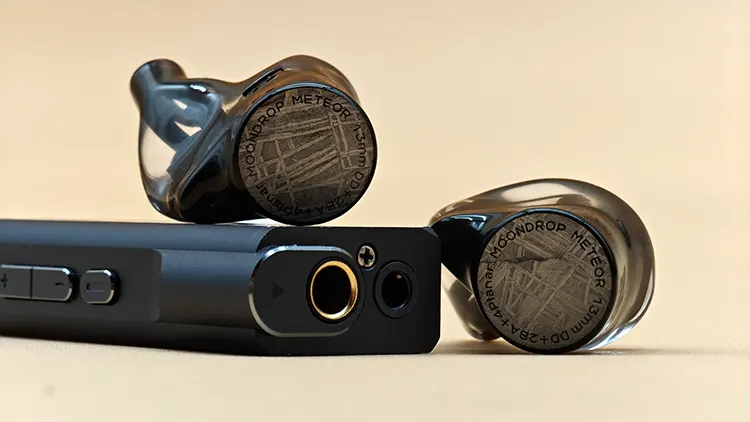
The MOONDROP METEOR brings a new approach to tribrid IEMs, using a combination of one dynamic driver, two balanced armatures, and four micro-planar drivers, all managed by an advanced crossover system.
At the core is XTM Complex Technology, which integrates the seven drivers and uses a passive notch filter to target unwanted treble peaks.
A 13mm dynamic driver with a large N52 magnet is responsible for the bass, while the custom balanced armatures handle the midrange with precision.
The four micro-planar drivers focus on treble, aiming to match EST-level extension while maximizing efficiency and control.
Design
The visually striking faceplate of the MOONDROP METEOR features a real Aletai meteorite embedded as a vibration damper, which is also the reason for its large size.
Despite the IEM’s imposing size, the fit is closer to the MOONDROP Blessing 3, and comfort is less of an issue than it first appears.
The shell is made from black semi-opaque resin, revealing internal drivers and the crossover when viewed under light.
Its nozzle has three sound openings but lacks a nozzle lip, which can cause ear tips to slip off, while vents near the connector and faceplate help manage pressure.
Performance
The XENNS Mangird Top Pro holds the clear edge in bass, delivering stronger, more detailed, and impactful lows from subbass to midbass.
The MOONDROP METEOR finds it hard to keep up here, sounding noticeably bass-shy and lacking the weight and authority that the Top Pro brings.
In the midrange, the METEOR goes for a more forward sound, putting vocals and instruments up front, while the Top Pro remains more neutral and laid back.
The METEOR’s vocals and instruments come with extra bite, sitting at the edge of sharpness, while the Top Pro sounds smoother in comparison, though both excel in vocal detail.
Treble on the METEOR has the upper hand in pure detail retrieval, but that comes with a risk of sibilance that can feel uncontrolled at times.
The Top Pro focuses on refinement, handling sibilance better, and still delivering plenty of resolution and microdetail.
Both have wide soundstages with good vertical and depth cues, creating an immersive field for the listener.
Imaging is tight on each, but the METEOR stands out when tracks get busy, keeping everything clearer and more organized as the mix fills up.
Softears Studio 4
Technical
The Softears Studio 4 uses a four-balanced-armature driver setup built around a 3-way crossover. Its wide frequency response and nearly flat impedance curve make it well-suited for studio recording, mixing, and stage monitoring.
This configuration aims for a flat frequency response, focusing on accuracy and neutrality across the spectrum. Studio 4 is designed for professionals who need a reliable reference for critical listening.
Design
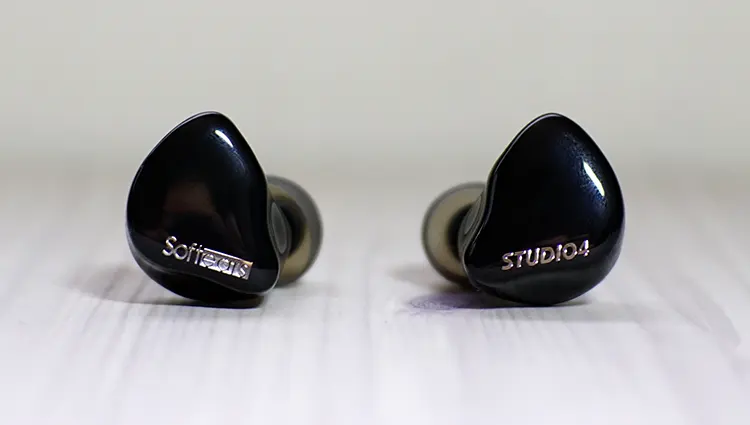
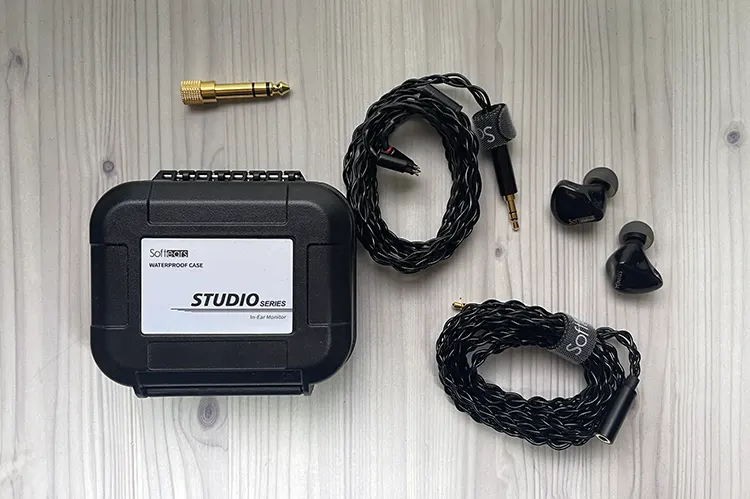
The Studio 4 keeps things simple with a clean and understated monitor look that’s all business. Finished in solid black, it avoids flashy accents in favor of a more discreet and practical appearance.
While there’s nothing particularly unique or eye-catching about its exterior, the build feels premium and well-finished in hand.
The overall design gives off a professional vibe that matches its intended use for monitoring and studio work.
Performance
Bass is where the XENNS Mangird Top Pro immediately steps ahead, with much greater depth, slam, and fullness than the Softears Studio 4.
The Studio 4 keeps its bass quick and controlled, but it simply can’t deliver the same physical impact or rumble as the Top Pro, coming across leaner and more reserved by comparison.
In the midrange, the Studio 4 leans into clarity and separation, putting vocals and instruments right in the center with its slightly more forward upper mids.
The Top Pro takes a smoother and more natural approach, sounding richer and warmer, but doesn’t push the mids quite as forward, making it more relaxed overall.
The Top Pro is simply more capable in resolution, sparkle, extension, and detail retrieval compared to the Studio 4.
Treble on the Top Pro stands out for its openness and clarity, while the Studio 4 is more reserved and lacks the same sense of air and finesse.
Soundstage and imaging are both superior on the Top Pro, which offers a more immersive experience with proper vertical staging, depth, and a sense of space that feels larger in all directions.
Sounds move around the field with greater ease and realism, while the Studio 4 only provides some vertical staging and feels more restricted and less dynamic by comparison.
My Verdict
The XENNS Mangird Top Pro stands out for its superb refinement, natural tonality, and impressive technical ability from top to bottom.
Its tuning delivers a combination of clarity, balance, and musical engagement that makes every detail easy to appreciate without sounding clinical or dull.
It manages to be both revealing and enjoyable, offering a sense of spaciousness and layering that puts it ahead of many in its class.
It’s a complete package that’s hard to fault, with strengths that make it an easy recommendation that some could say is endgame worthy for what it gives.
XENNS Mangird Top Pro Technical Specifications
- Driver Type: Two (2x) custom neodymium iron boron dynamic drivers, two (2x) Sonion E50D BA, two (2x) custom Knowles BA, and one (1x) Knowles Super Tweeter
- Plug: 0.78mm 2-pin modular with 3.5mm, 4.4mm, and 3.5mm to 6.35mm termination
- Frequency Response: 20Hz – 33kHz
- Impedance: 16-ohms
- Sensitivity: 103 dB @ 1dB
