

Selected Comparisons
The following comparisons to the Unique Melody Mest Jet Black were completed using the DX340/AMP15, the Cayin N6iii/R202, and the Chord Electronics Mojo 2.
Unfortunately, I cannot compare the Mest Jet Black with the Mest MKIII CF at this time, as my unit is with UM for some repair work.
Unique Melody Maven II Crescent
The Maven II Crescent is a recent release and comes from a different IEM series lineup (Maven), one that UM classifies as a Pro or studio IEM. As with the other comparisons, this is the custom version and is priced significantly higher than the universal variant.
Technical
The Maven II Crescent is a hybrid dynamic, BA, and EST driver monitor that comes in custom and universal formats.
Unlike the Mest Jet Black, it does not use bone-conduction drivers and a passive 5-way crossover for air conduction. Its differentiators also include a dual dynamic driver setup for the lows and a quad-EST array for the highs instead of the Mest Jet Black’s dual EST configuration.
The dual dynamic is split between a 9.8mm ‘core bass’ dynamic driver and a smaller 6.8mm variant that covers the ultra-low and bass frequencies.
The rest of the Maven II Crescent’s driver configuration consists of a similar 4 BA driver array for the mids and highs, and the higher 4 Sonion electrostatic driver count for ultra-highs.
The Maven II is rated at 10.7Ω for impedance with an SPL of 106 dB/Vrms @1kHz, which is very close to the Mest Jet Black’s 12.6Ω impedance and 106 dB @1kHz SPL rating.
I found my real-world testing has the Maven II slightly more sensitive at the same volume level on the DX340/AMP15 in a low-gain balanced output setting.

Design
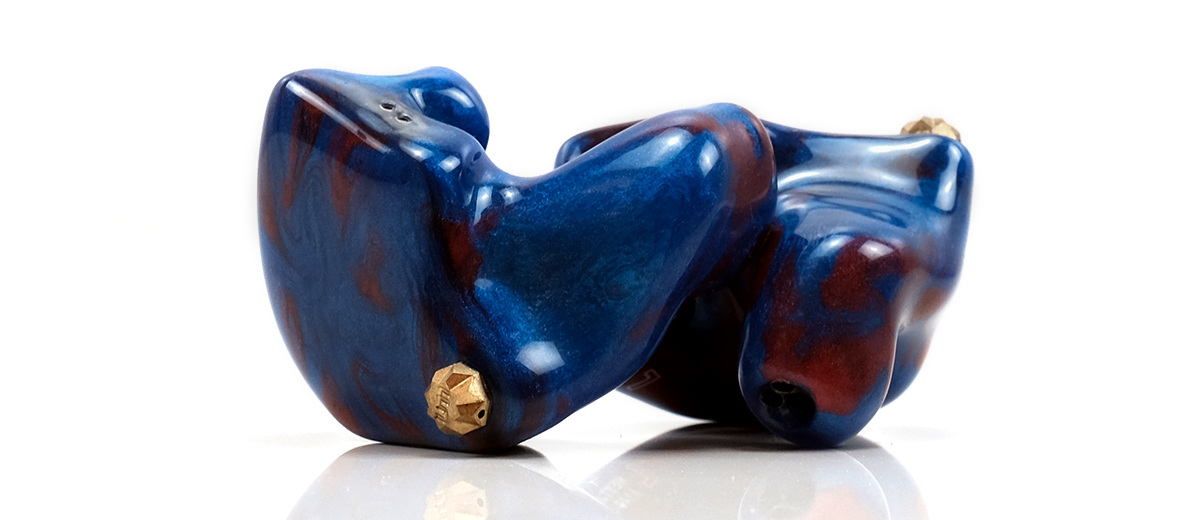
These two customs have extremely different aesthetics and materials, and if I had to decide which one, I would pick the Maven II Crescent’s beautiful and unique titanium alloy shell.
Not that the Mest Jet Black shell is in any way less striking aesthetically. I would argue that some would rather have the more striking colors of the Mest Jet Blacks resin shells.
Rather, it’s the fact that a titanium alloy custom shell is very difficult to achieve, so to have one that perfectly fits your ear is an incredible achievement. It makes UM custom designs stand out from the custom crowd in a way the Mest Jet Black shells do not.
Aesthetics is personal, but beside each other, the tactile or handling difference is very obvious. The Maven II Crescent is robust, solid, and dense-feeling. It is also larger and heavier, and with that metallic surface, they can feel quite chilly in your ear on a cold winter’s morning.
The resin shells of the Mest Jet Black are much lighter, perhaps more fragile, but if there is one benefit from resin, then it is the comfortable fit and superior passive isolation performance.
The Maven II Crescent is very good for passive isolation, but the Mest Jet Black edges it so long as the petal vent does not pick up too much wind.
Stock cables are a Mest Jet Black thing. You only get one with the Maven II Crescent, the UM Copper M2 RE cable.
Technically, it uses a similar 24AWG-rated wire as the UM Dreamy, though it does not use a Sevenfold pipe geometry. It is also built with similar barrels but is finished in silver and has a slightly firmer and glossier PVC jacket.

Performance
The Maven II Crescent is a beefier, more natural-sounding monitor with an almost analog overtone and a slightly rounded note quality through the mids and highs.
The Mest Jet Black is leaner, not so weighty on the lows, but more precise and revealing through the mids and highs.
It delivers more tonal contrast and sparkle in the highs, which helps accentuate peripheral imaging presence, giving a stronger perception of size and complexity in the presentation.
The Maven II FR shelf has more bass emphasis from 20-60Hz, which injects a stronger fundamental frequency into almost every note up to around 2k. Combine that with a bit more attenuation from 7k onwards, and you get a firmer, but perhaps slightly darker tone.
I also found Maven II Crescent vocal imaging to be a bit closer than the Mest Jet Black experience. Perhaps just edging ahead of the bass presence in everything bar the strongest EDM or dance tracks.
The note decay is a shade longer, which tends to create a slightly more congested feel to the Maven II Crescent presentation when compared to the wider and airier Mest Jet Black sound.
Not that the Maven II is fuzzy, but rather it’s just not quite as wide and open in the mids and highs as the Mest Jet Black. The cleaner-sounding Jet Link cable doubles down on this comparative perception by enhancing the sparkle and contrast from the Mest Jet Black highs.
I would pick the Maven II Crescent if you need a meaty sound, especially on the lows, and go for the Mest Jet Black if you prefer an airier, cleaner sound with more staging ability.
Unique Melody Mest MKII
The Mest MKIII was launched in 2021 and became one of the models that gained almost legendary status in UM’s IEM lineup, a testament to its popularity. The unit we have here for comparison is also the custom version.
Technical
The Mest MKII is also a hybrid dynamic, BA, electrostatic, and bone conduction driver IEM in universal and custom formats.
The precise configuration for the ‘air drivers’ is the same as the Mest Jet Black with a single 10mm dynamic driver for the lows, a dual BA driver unit for the mids, dual BA for the highs, and dual Sonion electrostatic drivers for the ultra-highs.
What has changed is the bone conduction configuration. The Mest MKII’s dBC-s dual-sided Bone Conduction System only covers the upper bass to the upper treble, rather than the Mest Jet Black’s dual composite BA and piezoelectric setup covering a much wider FR range.
The Mest MKII is rated at 12.3Ω impedance with an SPL rating of 112 dB SPL, which, on paper, is more sensitive than the Mest Jet Black’s 12.6Ω impedance and 106 dB @ 1kHz SPL rating.
In truth, the difference is negligible when tested out of the DX340/AMP15 setup in a low-gain balanced out mode. Both monitors sounded properly driven with matching loudness levels on set volume points.
Design
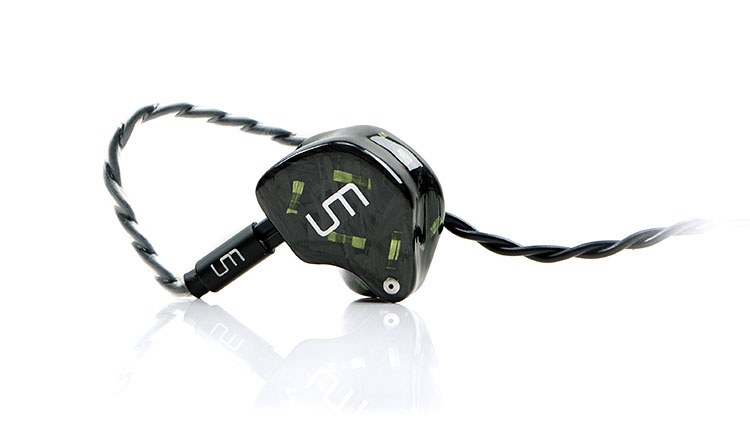
As always with custom designs, you are free to choose your own, but technically, the design I chose for the Mest MKII is the monitor’s signature design for the universal variant.
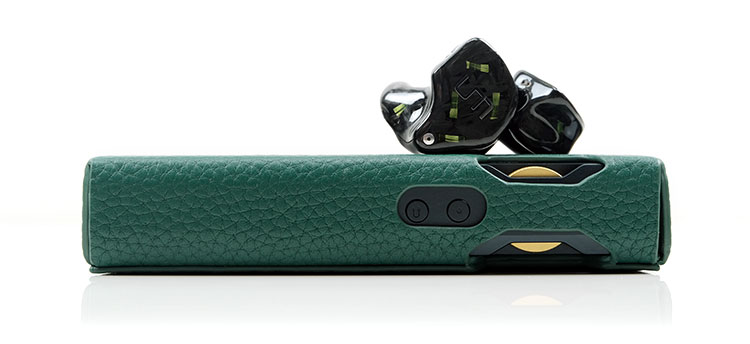
Looking at the custom options available from UM, I do not believe you can get the same design for the Mest Jet Black. This is a special carbon fiber material called ‘Carbon Fiber & Green Fiber’, but you can also select gold, purple, and silver designs.
I am a big fan of green, so this design for the Mest MKII has a special place in my heart, but I have to recognize the stronger visual pop of the Mest Jet Black Ambilight red finish.
The form factor is more or less the same, though I could class my Mest Jet Black shell finish as slightly thicker around the nozzle, creating slightly more pressure in the ear canal as a result.
There is one design commonality, and that’s the vent on the faceplate. They look slightly different, with the Mest MKII more like a metal hat than the petal design on the MEST Jet Black.
What that means is both can act a bit like wind noise magnets, though in the case of the Mest MK II, it is not quite as pronounced. Otherwise, they both offer excellent passive isolation.
The last key difference is the cable selection, with the Mest MKII coming with a UM Copper M2 cable as mandatory, whereas that is not the case with the MEST Jet Black, making it cheaper to buy if you already have a cable.
If you do buy a cable, the UM Dreamy has a similar 24AWG gauge OCC copper 4-wire geometry with black PVC coating, but has a snazzier gold finish to its barrels rather than matte black.
Performance
The Mest Jet Black is a huge upgrade on the Mest MKII. I enjoyed the MKII at the time, but I have to admit the dynamic range, combined with a far more holographic and wider staging quality, gives the Mest Jet Black a far more complex and immersive sound.
The Mest MNKII is slightly softer in tone, with vocals that lack a bit of comparative sparkle and bloom from a softer set of highs. Staging width is narrower with upper-register note contrast sounding slightly subdued compared to the clarity and sparkle of the Mest Jet Black.
The one area where the Mest MKII might have a slight edge in quantity is sub-bass presence and bass warmth in general, but there are pros and cons to that.
You get a fuller sound on the lows from the Mest MKII, but the Mest Jet Black sounds more controlled and articulate, especially with the Jet Link cable. The Mest MKII bass response sounds slightly fuzzier and slower, with longer note decay and more bloom.
You could argue that perhaps the MKII is quite well suited to slower, deep bass recordings. However, I would honestly choose the cleaner Mest Jet Black sound because of its improved low-end definition and slightly punchier or more explosive performance.
Overall, unless you prefer a fuller bass response, there is no reason why you would not opt for the Mest Jet Blacks’ superior dynamic range, more energetic sound, and improved staging complexity.
Unique Melody Maven Pro
The Maven Pro was launched in 2023, with our review of the custom version coming out shortly after.
Technical
The Maven Pro is also a hybrid driver IEM in universal and custom formats. However, it’s quite a different and simpler configuration with 10 non-vented balanced armature drivers per side and a dual EST array.
There are no dynamic or bone conduction drivers inside the Maven Pro. Instead, it has a configuration of 4 larger woofer armature drivers for the lows, two full-range drivers for the mids, a quad pack of BA drivers for the highs up to around 8-10k, and the dual EST for the ultra-highs.
The Maven Pro is rated at 30Ω and 112 dB SPL @1KHz, so it has a higher impedance but seems to be more sensitive on paper than the Mest Jet Black’s 12.6Ω and 106 dB SPL rating.
With the DX340/AMp15 in a low-gain balanced output mode setting, I could not hear much of a difference between these two monitors in terms of loudness and dynamic range, so both will drive well from similar dongles and DAPs.
Design
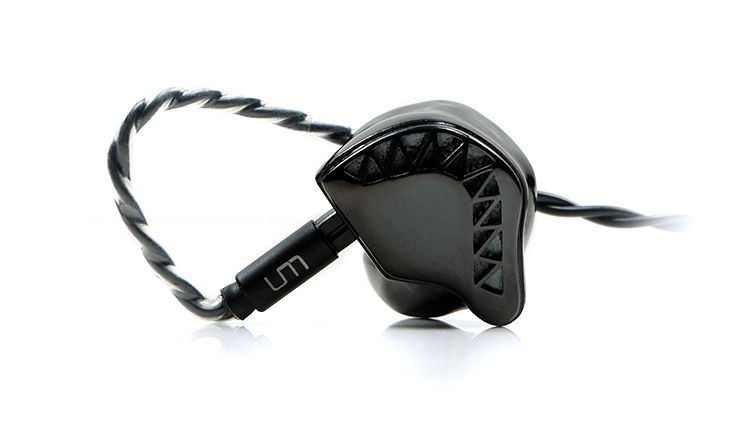
Because the Maven Pro uses a similar 3D-printed medical-grade titanium metal alloy as the Maven II Crescent, many of my observations on how it differs from the Mest Jet Black will follow a similar pattern.
Just to note, the Maven Pro finish I have here is the black version. You can also get this in Blue or Gold, with the Blue being the cheapest of the 3 options and the one they use for the universal format shell.
As with the Maven II Crescent shell, the Maven Pro version is more robust, heavier, and denser than the Mest Jet Black resin shell.
If weight is an issue and you want more pop in your colors, then go with the Mest Jet Black shell. If not, the unique craftsmanship and higher durability of the titanium shell are more of a taking point than regular resin.
The isolation from the titanium shell is outstanding and as good as the resin for the Mest Jet Black. Perhaps more so given the petal vent on the Mest Jet Black plate amplifies wind noise a bit.
However, given that the Maven Pro has no vents (all BA drivers), the vented hybrid Mest Jet Black passive isolation performance should be commended.
Again, just the UM Copper M2 cable with the Maven Pro, and it is mandatory. It’s a similar 24AWG OCC copper 4-wire geometry but with a black PVC jacket as opposed to matte black with gold finishing on the UM Dreamy cable.
Performance
The Maven Pro has a more aggressive sound signature with particular emphasis on the mid-bass from 60-100Hz and a stronger pinna gain elevation around 2k, pushing vocals into intimate territory compared to the Mest Jet Black.
However, the Mest Jet Black’s sub-bass reach from its dynamic driver is more audible. The BA subwoofers on the Maven Pro lack a bit of substance right at the very lowest FR milestone, with more aggression on the mid-bass, a region that is nicely defined on the Mest Jet Black but not as in-your-face.
Vocal imaging is more neutral on the Mest Jet Black with a slightly leaner, higher contrast tonal quality. The Maven Pro images closer, but it is not as airy or tall-sounding.
There is a noticeable dip in the upper-mids tuning of the Maven Pro between 3-6K, which kind of sucks out a little bit of air and provides less ‘detail fill’ compared to the more sparkling and expressive nature of the Mest Jet Black’s equivalent range.
Perhaps the biggest difference is the staging dimensions of these two monitors. No question the Mest Jet Black extends deeper, wider, and taller. It sounds more holographic and complex, stretching everything beautifully, particularly its treble performance down to the upper-mids percussion layering.
The Maven Pro sounds more restricted and intimate with mid-bass and vocals closer to your ear than anything else. The muted treble sparkle and dipped upper-mids to lower-treble transition also draws some of the percussion energy and presence out of the equation.
My Verdict
The Unique Melody Mest Jet Black has the company’s most mature tuning to date in the long-running Mest series. It delivers a balanced sound signature across the board with improved dynamic range and a very expansive, holographic soundstage.
Whilst the custom version is more expensive than the universal, you get more flexibility in design choices and excellent comfort and passive isolation.
The flexibility to buy with or without cables is innovative and shows a nice level of budget sensitivity. Should you wish to get a cable, you have two distinct options: the smooth and weighty Dreamy and the neutral, resolving Jet Link, allowing you to choose the best sound signature for your setup.
Overall, this is a monitor that presents a very likable sound signature backed by excellent staging capability.
Unique Melody Mest Jet Black Technical Specifications
- Driver Configuration:
- 1 Dynamic Driver (Low Frequency)
- 2 Balanced Armature Drivers (Mid Frequency)
- 2 Balanced Armature Drivers (High Frequency)
- 2 Electrostatic Drivers (Ultra-High Frequency)
- 2 Composite Balanced Armature Bone Conduction Drivers (Low & Mid Frequency)
- 1 Piezoelectric Bone Conduction Driver (High Frequency)
- Impedance: 12.6Ω
- Sensitivity: 106 dB/Vrms @1kHz
- Crossover:
- Air Conduction: 4-Way Crossover
- Bone Conduction: 2-Way Crossover
