

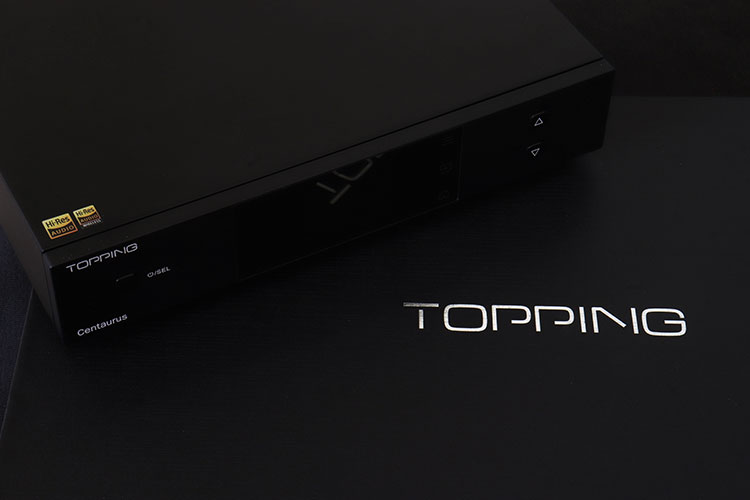
Synergy
Power
I never caught the Topping Centaurus running hot, although it’s fed by a thick 120V power cord. It’s always cool or slightly warm to the touch.
I could mention some DAC models that run hot with a similar power source. That means that power efficiency is high within this model, typical of Topping gear.
As far as the output, there are adjustments within the menu that give the end user two power output levels for each of the RCA and the XLR outs.
I couldn’t tell a difference in output when switching between 2 volts and 2.5 volts on the RCA outs. I also obtained similar results when switching from 4 volts to 5 volts on the XLR output ports.
The stock settings were on the lower voltage settings, and that’s where I kept my unit.
Pairing
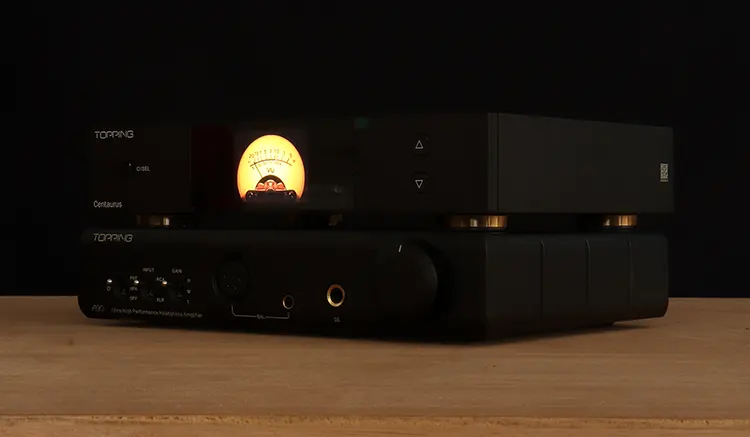
My first impulse was to use a Topping amplifier like the L70, which is a clean, powerful, albeit analytical and somewhat gelded amplifier. However, I decided to try the A90 Sabre, and the overall product was smoother, albeit cleaner and more cogent sonically.
Then I used the SMSL SU-X, which usually sits on my desktop, and things got interesting. It was a meeting between the digital and analog worlds in that the Centaurus supplied a natural character to the SU-X, which to me sounds analog-like due to the large Op-Amp output array it employs.
Something like an iFi audio amplifier would also work, since that would add some warmth. However, I would be hesitant to use Xbass or a bass mod on this DAC.
Why? Every headphone has different frequency variations, and a one-size-fits-all solution would be inferior to the parametric 10-band PEQ that’s built into the Centaurus, which can perform custom corrections for each headphone you own, and then you can store them as presets.
I can already see some owners swapping EQ configurations for certain popular headphones. This flexibility is what takes this DAC to another level, at any level. The naturalism of the timbre and the focused soundstage are the icing on the cake.
Select Comparisons
Topping D90 III Sabre
Technical
The D90 III has been on the top shelf of the Topping DAC product lineup for some time now. However, it has been dethroned by the Centaurus, something I’m sure most will agree with me on once they listen to both side by side.
The D90 III Sabre variant uses a dual ES9039Q2M Dac setup. The first D90 variant used a set of AK4499. The Sabre is the smoother of the two sonically, but the Discrete is even more refined. Both models from the D series are compatible with Topping’s PEQ app.
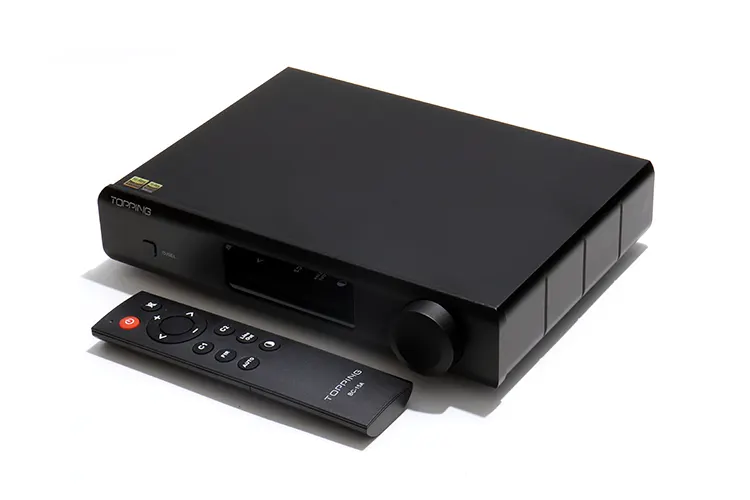
The D90 III has other similarities with the Centaurus. For example, they both come with a very similar remote control. And with identical IO ports on the rear panel. They even share the use of the Altera Max 2 chip.
Design
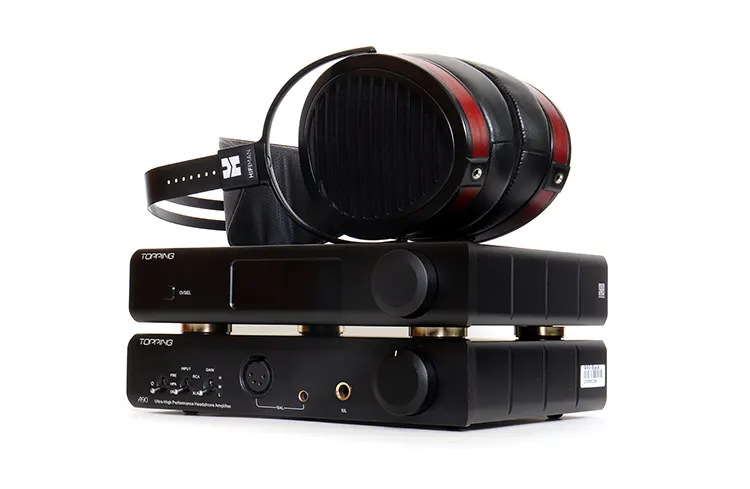
The D90 III Sabre is dressed up in the most artistic-looking chassis. It sports rounded edges and has more lines and cues than the utilitarian appearance of the Centaurus.
However, a unique styling could clash with most designs, and the Centaurus design could fit in with other components more so.
Another aspect that is a different implementation is the volume control although the control scheme is similar with a push button on one side and a multifunction volume knob on the other, and they both require two-hand operation.
Performance
These two DACs use two distinct approaches to DA conversion, but the D90 III is the more analytical of the two. The Centaurs I would consider the more musical of the two models, and it does so by producing insightful bass, natural vocals, and a more engaging profile.
What the Centaurus brings to the table is a more focused aura around each element, and it gives the listener a sense of precision in the presentation and a better soundstage.
The timbre has changed as well. The Centaurus is natural and musical versus a more neutral and analytical character produced by the D90 III Sabre. I prefer the Centaurus for more due to this one reason.
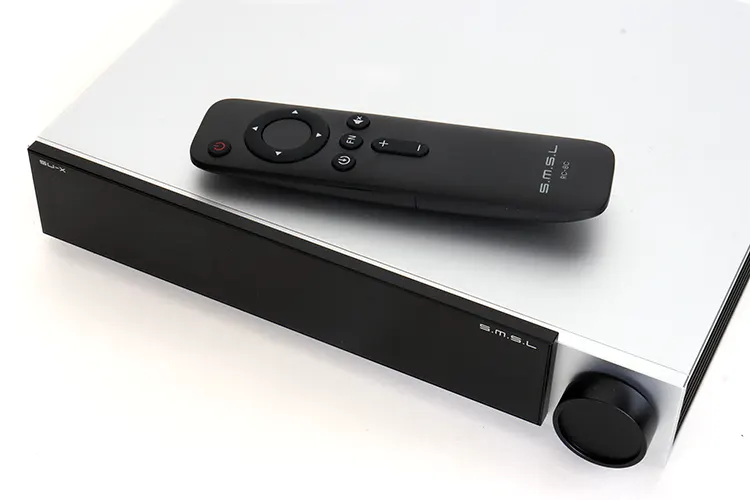
SMSL SU-X
Technical
Don’t let the name fool you. SMSL surprised many when they released the SU-X because the model exhibited an esoteric vibe and displayed a high level of craftsmanship and manufacturing savvy from SMSL
Performance-wise, it’s no slacker either. It uses dual ES9039MS Pro in a dual-channel design fed by a hefty power supply section.
SMSL was able to create an eight-channel DAC circuitry similar to the Centaurus, except that the SMSL can handle MQA and MQA Studio files while the Centaurus cannot. The Centaurus strictly sticks to PCM and DSD formats.
The SU-X also has some sound customization options, but they’re mostly filters that are subtle in effect. You don’t get a full-featured 10-band parametric EQ that has an adjustable frequency, gain, and Q factor. That’s a lot of flexibility that can help you fix some headphone deficiencies.
Design
The SMSL SU-X is a hefty device assembled using a single thick sheet of aluminum, similar to what HIFIMAN did with their EF600, in that they took a thick sheet of aluminum and gave it a U-shape, to then slip in all the components.
The SU-X construction has some unique features like the off-centered glass with a clean front panel and a right-side mounted multi-function volume knob that is too utilitarian looking for this unit and for the tier it sits in.
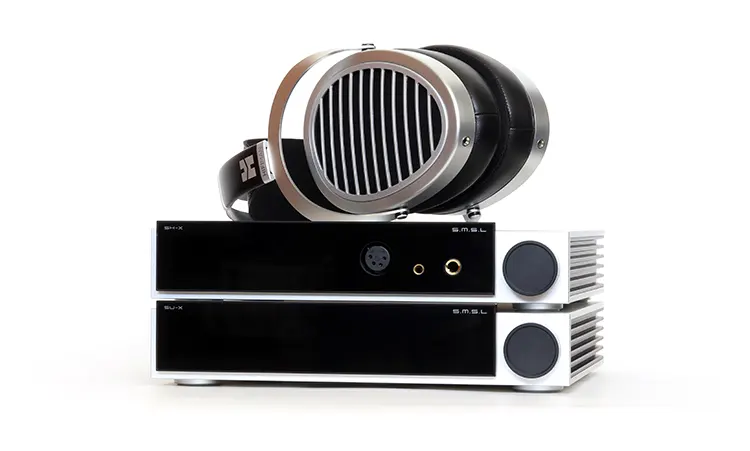
The design matches their SH-X amplifier, but these models used two different screens, which threw off the look when paired with each other.
I would say that the SU-X is a good-looking unit, but it will only match up with the SH-X amplifier, while the Centaurus uses a design that’s more universally accepted.
Performance
The SMSL SU-X is one of the widest-sounding DACs I have in my collection, but not by a very large margin compared to the Centaurus. It’s noticeable when you do an AB comparison.
The SU-X produces lots of height alongside a full spectrum frequency response that seems to originate a few inches closer to the listener, making it sound more intimate. The Centaurus also does that, except with a reduced height capability.
Besides the differences in their soundstage, the SU-X seems more inclined to produce a sonic signature that caters to precision and transparency over the Centaurus’ musicality and increase in focus.
One can tell that the precision in positioning and focus is enhanced on the Centaurus, plus it sounds more natural, closer to analog, versus the ultra-clean SMSL SU-X presentation.
My Verdict
The Topping Centaurus is the company’s best desktop DAC I have heard to date. It delivers a sonically clean and natural output with a focused soundstage. It also offers lots of sonic flexibility via features like PEQ.
The R2R implementation within the Centaurus allowed Topping to produce tonal accuracy, with an analog-like smoothness combined with digital accuracy.
Yes, analog meets digital, and the composition is exquisite.
Topping Centaurus Technical Specifications
- THD+N @A-wt: 0.0002% @1kHz
- SNR @ A-wt: RCA 126db / XLR 130db @1kHz
- DNR @ A-wt: RCA 126db / XLR 130db @1kHz
- Frequency response: 20 to 20kHz ±6db / 20 to 40kHz ± 2.2db
- RCA output level: 2.1v RMS @0dbfs / 2.6v @0dbfs
- XLR output level: 4.2v @0dbfs / 5.2db @0dbfs
- Noise @ A-wt: RCA -1.2 µVrms / XLR 1.4 µVrms
- Channel crosstalk: RCA 121db / XLR 130db @1kHz
- Channel balance: 0.3 dB
- Output impedance: RCA 50Ω / XLR 100Ω
