

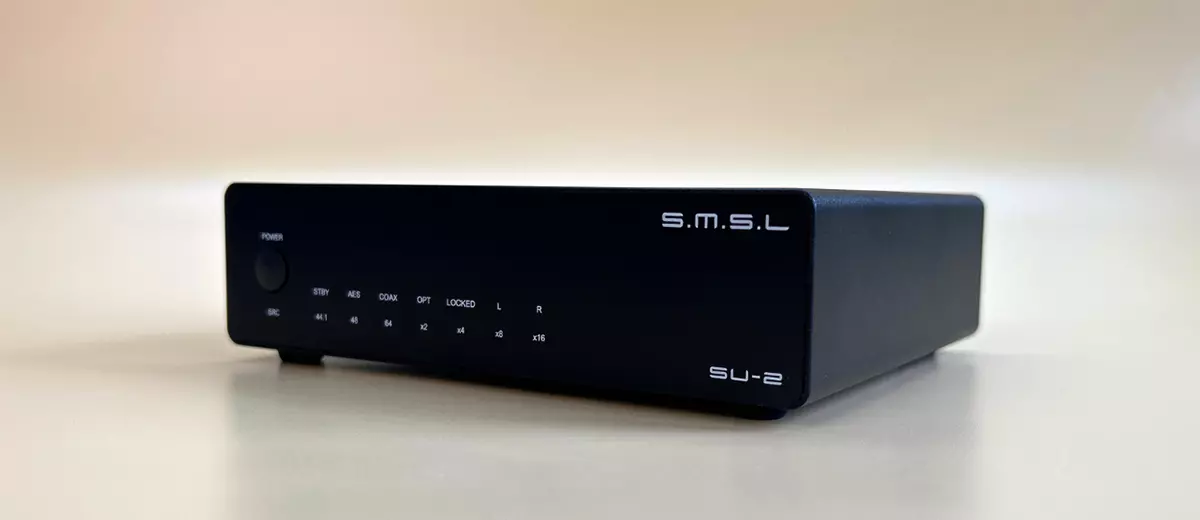
Meldrick reviews the SMSL SU-2, a compact and affordable $99.00 desktop ES9039Q2M DAC with SPDIF and AES input support.
Disclaimer: I received this sample in exchange for my honest opinion. Headfonics is an independent website with no affiliate links or partnerships. Thank you to Shenzhen Audio and SMSL for their support.
Click here to learn more about the SMSL products we have previously reviewed on Headfonics.
This article follows our current scoring guidelines, which you can find in more detail here.
SMSL has long occupied a dependable corner of the Chinese audiophile market, with products like the SU-1, D-6S, and DO200 MKII establishing the brand as a steady source of competent DACs at competitive prices.
The SU-2 is the latest entry in the SU series, stepping up from its predecessor by swapping the AK4493S chip for the newer ESS ES9039Q2M and replacing the USB input with a professional AES/EBU connection.
Priced at $99.99, the SU-2 sits at the low end of what a balanced desktop DAC typically costs, making it a noteworthy product at its price point.
It competes with the likes of the SMSL SU-1, SMSL D1, and Fosi ZD3. Does the trade-off of USB for AES/EBU make sense at this price? Read my full review below to find out.
Features
At the core of the SU-2 sits the ESS ES9039Q2M DAC chip from the Sabre family, giving it a measured THD+N of just 0.00006% and a SINAD of 123.5 dB on its balanced output.
Its fully balanced architecture is also a meaningful departure from its predecessor, sporting four Texas Instruments OPA1612A operational amplifiers arranged in a symmetrical layout across the left and right channels
The most significant addition over the SU-1 is the professional AES/EBU digital input, which provides superior noise rejection and supports extended cable runs, giving the DAC more versatility towards studio set-ups and high-end CD systems
Both balanced XLR and single-ended RCA outputs are included, offering 4.7Vrms and 2.3Vrms, respectively, giving the SU-2 sufficient output voltage for both consumer amplifiers and pro-grade active monitors.
Design
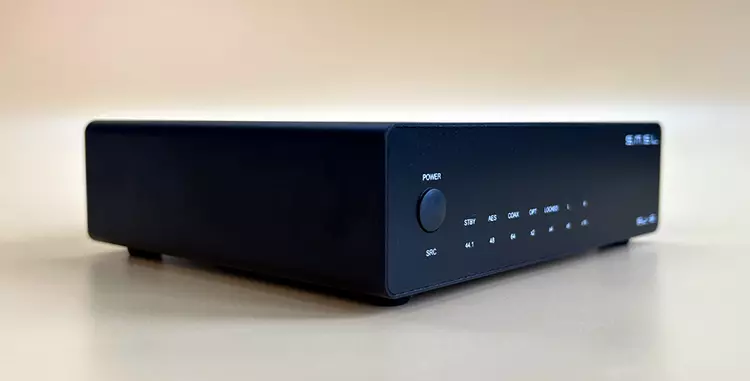
The SU-2 follows SMSL’s established utilitarian design language with an understated, functional, industrial design that is devoid of anything that could be called decorative.
The chassis is constructed from machined aluminum with a clean anodized finish, available in black. At 150 × 42.5 × 133.1mm and weighing approximately 532g, it has a surprisingly solid, planted feel for a budget unit.
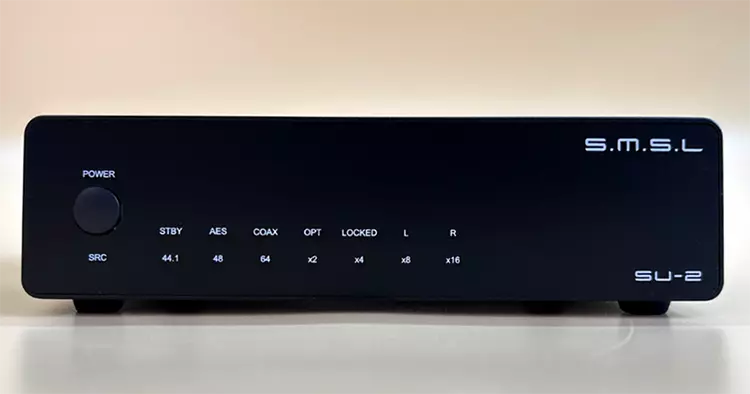
Where the SU-2 deviates most noticeably from rivals like the Fosi ZD3 or SMSL D-6S is its complete absence of a display.
There is no screen, no readout, and no menu system, just a row of front-panel LEDs that communicate input selection, signal lock status, left and right channel activity, and sampling rate in real time.
It is functional feedback rather than decoration, and while it works, users accustomed to a proper display will notice its absence immediately.
There are no physical buttons beyond a single input selector/power button on the front panel, and no remote is included.
This minimalism is consistent with the unit’s predecessor and studio-adjacent positioning, where sources are typically set and left, but it does limit convenience in a typical desktop listening setup.
Four rubber feet on the underside provide good stability, and the overall fit and finish are solid for the price, with tight panel tolerances and quality connectors throughout.
I/O
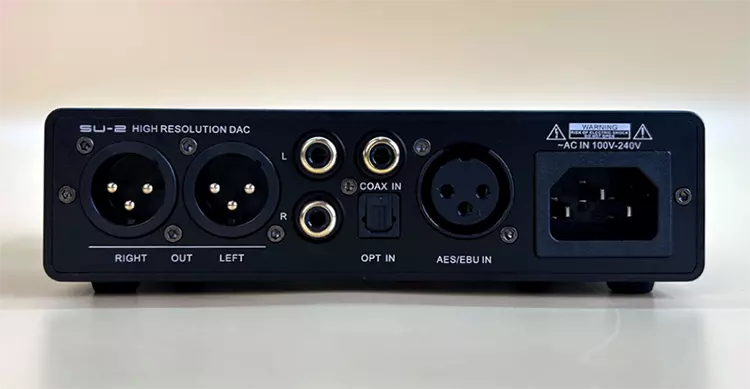
The SU-2’s rear panel is straightforward. On the input side, a C14 IEC power inlet handles mains power via the included AC cable, and three digital connections are offered: AES/EBU via XLR, coaxial S/PDIF, and optical TOSLINK.
All three support PCM up to 24-bit/192kHz and DSD64. Notably absent is USB of any kind, a deliberate trade-off that SMSL made to introduce the AES/EBU connection.
On the output side, balanced XLR outputs deliver 4.7Vrms, while the RCA single-ended outputs provide 2.3Vrms. Both output levels are fixed; there is no selectable gain or preamp mode here.
Frankly, the omission of USB inputs at a sub-100USD price point is just baffling. Seeing as most users looking to purchase a desktop DAC at this price range will pair it with a desktop, laptop, or mobile source, this seems like a missed opportunity.
Granted, the addition of the AES/EBU port expands its use case to a narrow range of studio setups and high-end CD-based setups, but I struggle to find a pro-audio use case that would require connecting a mixer or interface into a DAC with XLR outputs.
Whereas audiophiles invested in premium CD players with the disc collection to match, they are most likely shopping for DACs significantly above the price range of the SU-2.
I acknowledge that not every budget DAC must be catered to a computer-based system, but I just struggle to find the use case of the SU-2.
Controls
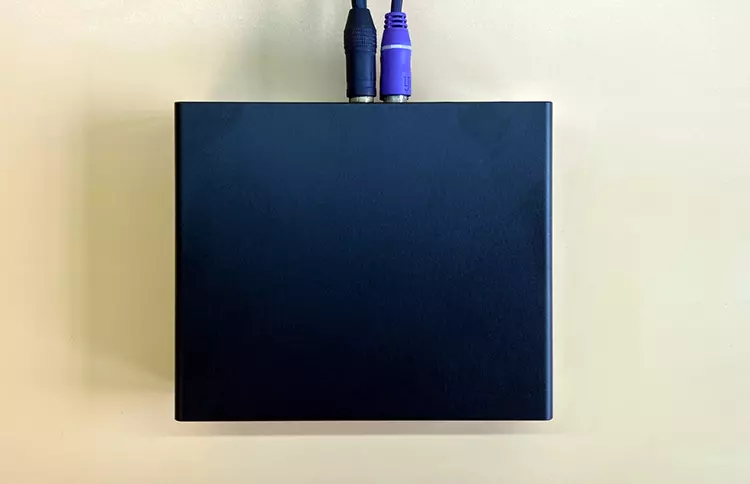
The SU-2’s control scheme is about as minimal as it gets. A short press on the front-panel button cycles through the three available inputs: AES/EBU, coaxial, and optical. The active selection is reflected on the LED array.
Long-pressing the same button turns the unit on and off. The indicator LED on the standby column shines red when the unit is turned off, while a white LED on the active input shines white when the unit is turned on. That is the extent of on-device control.
There is no volume adjustment, no remote control, no mode switching, and no app support.
While this simplicity aligns with the SU-2’s purpose as a transparent conversion stage in a fixed monitoring chain, it can feel restrictive in a more typical desktop audiophile context where input switching and volume management are regular activities.
Users operating the SU-2 in a desktop headphone setup will need to ensure their amplifier handles all volume and input management, as none of that responsibility lives on the SU-2 itself. For a studio or active speaker setup, however, this is a non-issue.
Packaging & Accessories
The SU-2 arrives in a compact white retail box with minimal external graphics and key specifications printed on the exterior.
Inside, foam inserts hold the unit securely in place during shipping, and the unit arrives wrapped in a protective plastic sleeve with no movement or rattling in transit.
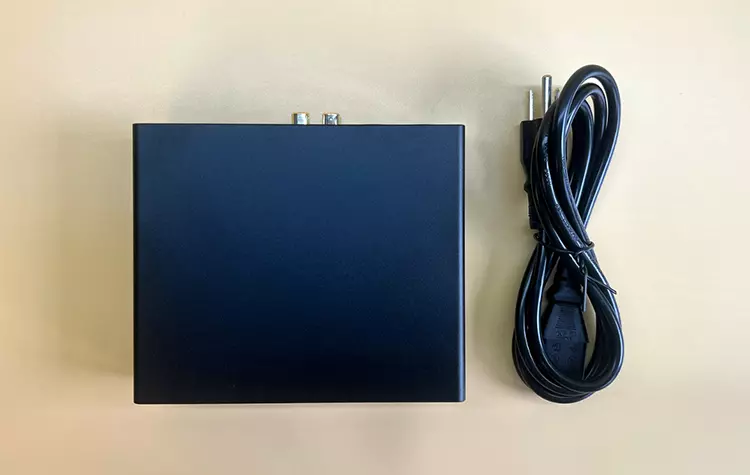
The package includes the SU-2 unit itself, an AC power cable, and a brief user manual covering input selection and LED indicator meanings.
The inclusion of a mains power cable rather than a USB-based power solution reflects the SU-2’s step up in power supply design relative to the bus-powered SU-1.
What is absent is notable: no digital cables of any kind are included. No coaxial, no optical, and no AES/EBU cable, meaning users will need to source their own before getting any audio out of the unit. No analog interconnects are included either.
For a device with no USB input, first-time users may find themselves needing to purchase cables before they can use it at all, which is worth planning for in advance.
Sound Impressions
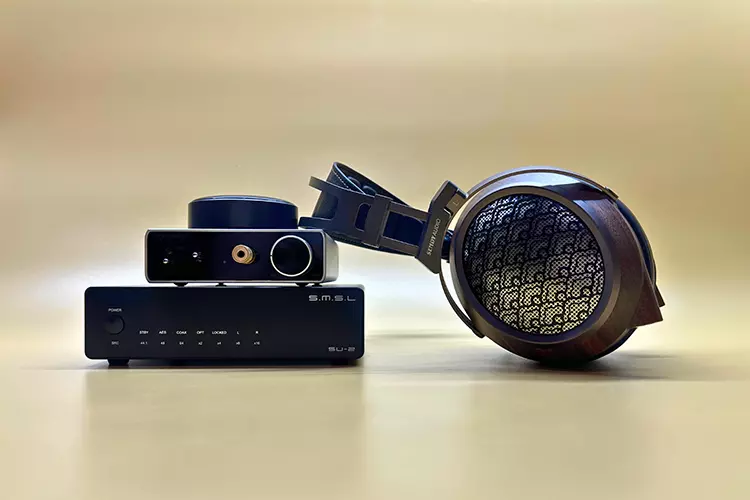
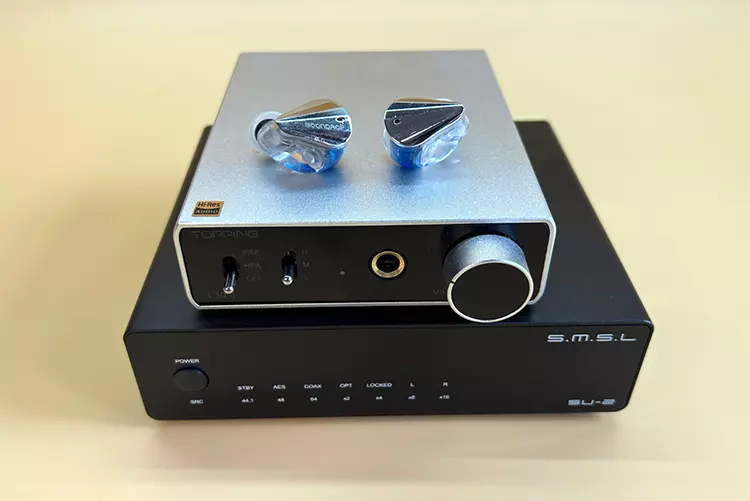
The following sound impressions were conducted using the Topping L30 II headphone amplifier, the Sennheiser HD 600, Sendy Audio Egret, and Modhouse Argon Mk3 headphones, and the MOONDROP Blessing 3, Yanyin Canon II, and Kiwi Ears Orchestra II IEMs.
Summary
The SMSL SU-2 presents a clean, neutral, and transparent sound signature that prioritizes tonal accuracy above all else. There is very little tonal coloration on offer.
Bass is tight, linear, and well-extended into the sub-bass region without warmth or bloom. Kick drums and bass guitars render with good definition and articulation, though the presentation skews toward control over richness.
The midrange is clear and transparent, with vocals and instruments reproduced with natural timbre and good separation.
There is no upper-midrange glare and no unwanted forwardness, though the presentation may register as slightly cool compared to warmer-sounding alternatives.
Treble is extended and detailed without tipping into harshness. High-hat strikes and cymbal transients are rendered with appropriate shimmer and decay, and the top end contributes to a sense of openness and resolution without becoming fatiguing.
Soundstage width is respectable for the price, with imaging that is precise and stable even in busy mixes. Dynamics are solid, with good macro-dynamic swing and adequate resolution of finer detail.
Timbre
The SU-2’s timbral presentation leans toward the colder end of neutral, consistent with the characteristics typically associated with ESS Sabre implementations.
Bass notes are precise and articulate, electric bass lines and kick drums are rendered with texture and control, though they stop short of the mid-bass fullness that warmer DACs add.
In electronic and jazz material, sub-bass depth is impressive given the price, extending cleanly without audible roll-off or artificial emphasis.
Acoustic instruments fare well through the SU-2’s midrange, with piano strikes carrying appropriate weight in the lower registers and violin tones maintaining good body without sounding thin.
Male vocals display adequate chest resonance, while female vocals are rendered with clarity and good breath detail, though the overall presentation has a slightly clinical edge.
The upper-midrange and treble regions exhibit the controlled extension that characterizes well-implemented DAC designs.
Snare drums have good snap, guitars carry texture without harshness, and brass instruments maintain their character without becoming piercing. Cymbal crashes exhibit fine shimmer and decay, lending recordings a sense of air and space that benefits well-mastered material.
On poorer recordings, the SU-2’s revealing nature can expose compression artifacts and recording flaws more readily than warmer alternatives would.
Staging & Dynamics
The SU-2 delivers a respectable soundstage with good width and adequate depth for its price range. Imaging is stable and precise, with instruments placed accurately within the field.
In simpler recordings, placement feels locked and defined, while in denser arrangements, the SU-2 maintains good separation without smearing.
Dynamic performance is decent, particularly in the way the unit handles macro-level contrasts between quiet passages and louder crescendos.
Micro-dynamic resolution is good, and listeners moving up from very budget sources will find the SU-2 a meaningful step forward in perceived realism and engagement.
Click on page 2 below for my recommended pairings and selected comparisons.
