

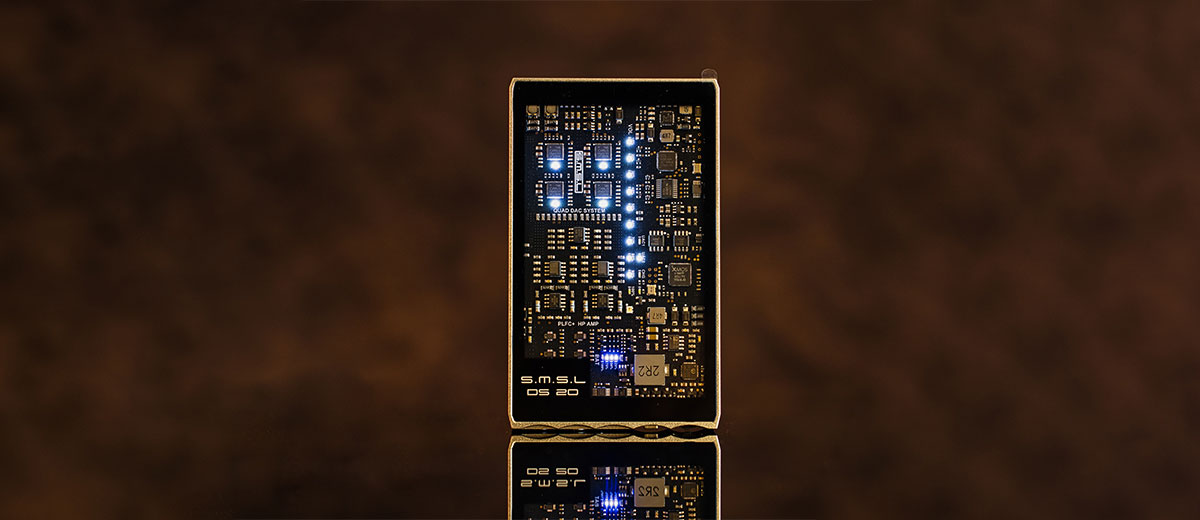
Synergy
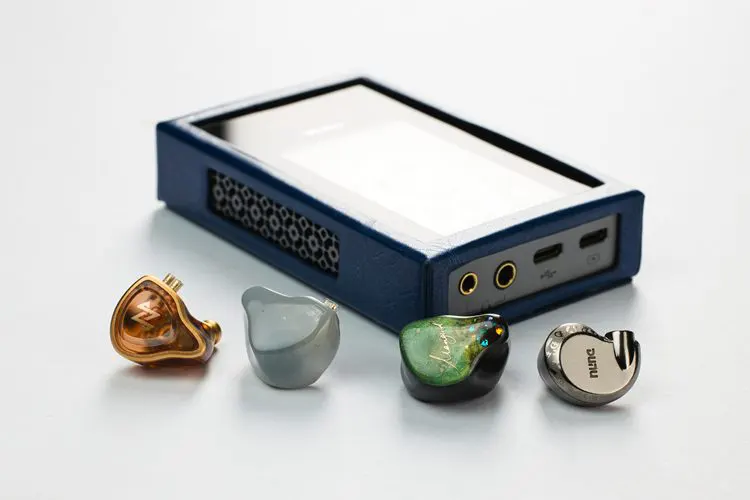
The DS20 drove my IEMs to very loud volumes without distorting or introducing noise. The 500 mW output power should be adequate for any IEMs except for low impedance and low sensitivity, bass-focused IEMs that come out on the market occasionally.
With Sennheiser HD 6XX, it drove it to an uncomfortable volume, but the synergy is not so good, because it doesn’t sound as refined as with other sources that match it better.
Therefore, I couldn’t recommend it with the 300-ohm Sennheiser HD 6XX headphones.
Though in general, the DS20 is a versatile-sounding DAC/ amplifier that will sound good with the majority of IEMs and Headphones.
However, I would be wary about using it with bright-sounding IEMs and difficult-to-drive headphones, as it will make them sound even brighter due to its slightly forward treble presentation.
It is a little bit unrefined due to its moderate power output capability, especially when playing at medium to high volumes.
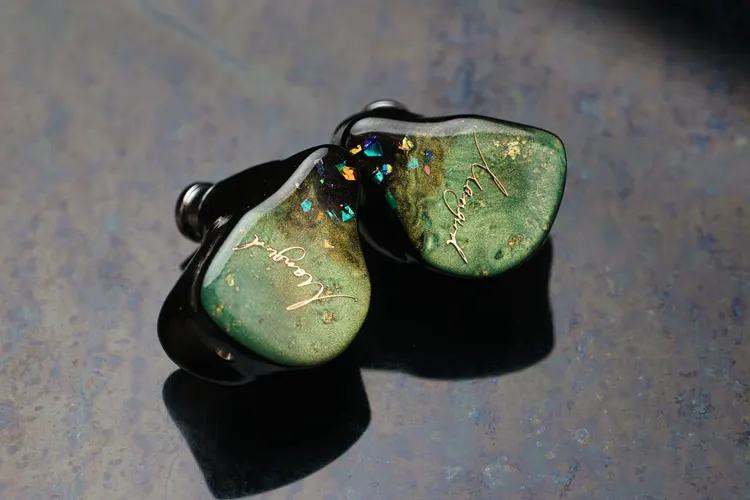
IEM Pairings
I found a good pairing with the DS20 and the single dynamic driver IEM, DUNU Falcon Ultra Ti ($220).
The DS20 seems to enhance the Falcon Ultra Ti by elevating the treble and making it sound more extended. It also helped the Falcon Ultra Ti project produce very defined images and a wider soundstage.
It is not as good as the next IEM, though. Which was mentioned before, the hybrid of 1 dynamic driver and 6 BA, Kiwi Ears Astral.
The DS20 exacerbated the hump in the frequency response of the Astral around the 8 kHz region. I couldn’t say I wouldn’t recommend this pairing; it’s not that bad. It’s just a minor quirk with this pairing observed through repeated critical listening.
As for the last IEM in this group, the hybrid single dynamic and BA driver Xenns Mangird Top, sounds fantastic with the DS20.
This is the best pairing in this group, the slight politeness in the upper treble on the Xenns Mangird Top matches so well with the forward treble presentation of the DS20.
The excellent bass control of the DS20 also produced a good bass performance from the Xenns Mangird Top.
On other DAC/ amplifiers, the Xenns Mangird Top sounds boring, but not with the SMSL DS20. It sounds lively and musically engaging, indicating an excellent pairing.
Headphone Pairings
I would not recommend the SMSL DS20 pairing with the famous but difficult-to-drive Sennheiser HD6XX headphones.
The DS20 does not sound comfortable driving the HD 6XX. It can drive it to a loud volume for sure, but the characteristics of the sound are unrefined; it lacks smoothness in the treble, the midrange sounds colored, and the bass lacks clarity. Indicating a bad pairing.
Select Comparisons
Topping G5
Technical
The Topping G5 is a Bluetooth-capable battery-powered DAC/ amplifier combo with a whopping 1200mW output power.
It uses the ESS ES9068AS DAC chip for digital-to-analog conversion. It also has a 4000mAh battery and up to 10 hours of battery life per charge as a DAC/ amplifier.
It uses 2nd generation XMOS, USB supports up to PCM 32bit/768kHz, and DSD512 native. And a QCC5125 chipset to support LDAC/AAC/SBC/APTX/APTX LL/APTX HD/ APTX Adaptive protocol.
Though priced more expensively at $299, it includes more features like Bluetooth wireless capability and can act as a stand-alone DAC or amplifier with its extra I/O feature.
Now, if we discount all those features and count only the DAC/ amplifier section, they should be about equal or closer in price to each other, and thus, the reason why I’m comparing them here.
Design
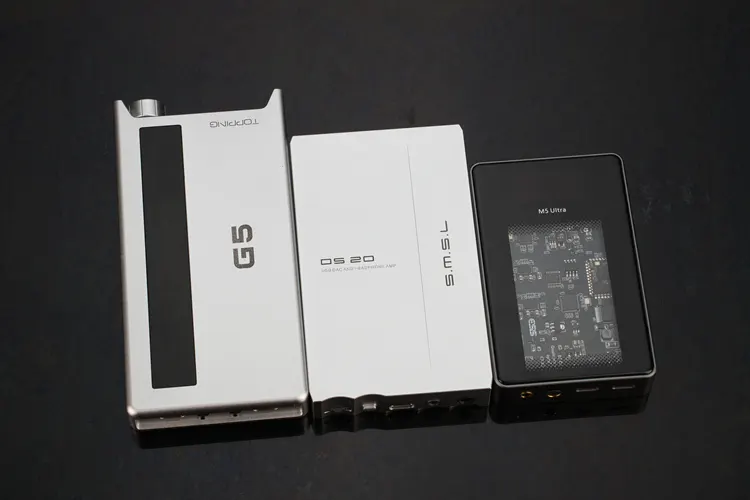
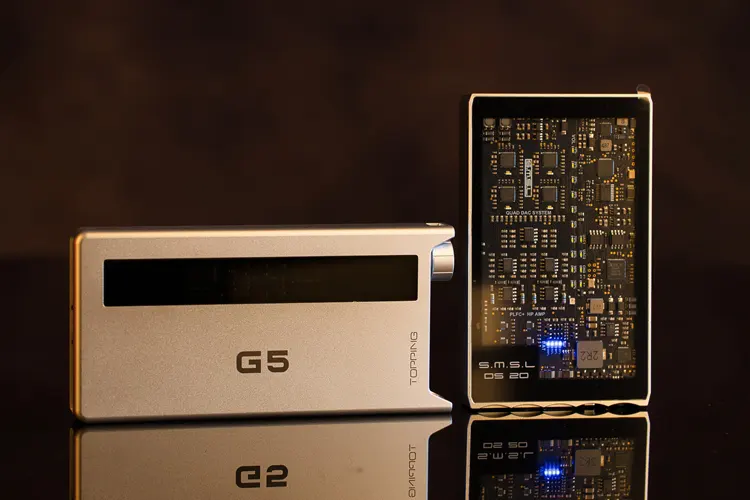
It is similarly shaped to the DS20 but taller; it has a small glass window at the front, an analog volume together with the phone I/O jacks at the top, guarded by metal protrusions on both sides.
A mode switch, a gain switch, a USB-C charging port, and a USB-C data port can be found at the bottom.
Performance
From the get-go, the Topping G5 is more powerful-sounding; its 1200mAh is not only 3 times as powerful on paper, but it is perceptible in actual listening.
The G5 easily drives the Sennheiser HD 6XX, while the DS20 has more challenges, due to its moderate power output rating. But as long as you stick within its power limit and listen to IEMs only, the DS20 should be able to compete with the G5.
They have different sound signatures; the G5 is very neutral to the point of sounding boring and lacking in upper treble energy, while the DS20 is V-shaped, with more exciting dynamics and vivid musical presentation.
I found myself listening to the DS20 longer than with the G5 due to its lively and engaging sound characteristics.
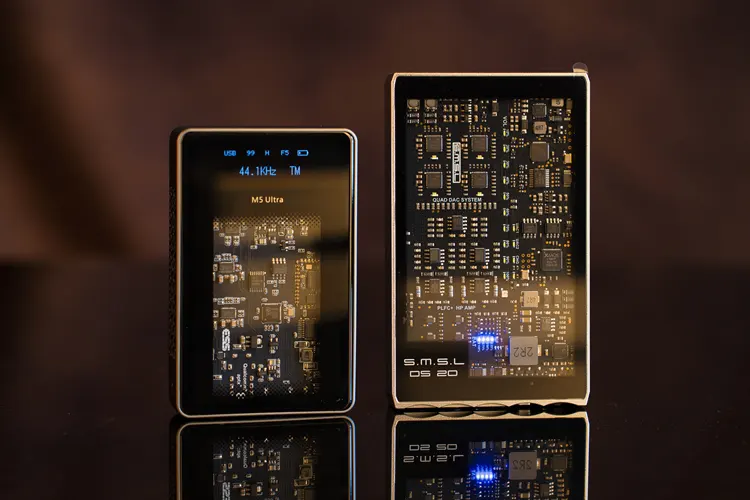
MUSE HiFi M5 Ultra
Technical
The MUSE HiFi M5 Ultra is smaller than the DS20 but has 2 Jan 6418 tubes as an output option, and an ESS ES9038Q2M Chipset Crafted Independently For 6418 Tubes, according to their website.
It also has a 3000mAh battery with 10-plus hours of battery life per charge and wireless Bluetooth capability with the QCC5125 Bluetooth Chipset.
It is priced at a more expensive $289, but as with the Topping G5 above, the M5 Ultra has more features like Bluetooth and 2 vacuum tubes, over the DS20, which has simple features but is more solidly built.
If you discount all those extra features from the M5 Ultra and count only the DAC/ amplifier section, they should be about the same in price. Thus, my reason for this comparison.
Design
The M5 Ultra body is made of a single piece of aluminum and is covered at the back with a black tempered glass, and the front with a clear tempered glass, allowing you to see the circuit board and the small display near the top.
All the controls are located on the right, while a heat vent for the tubes is on the left; all the I/Os are located at the bottom, leaving the top empty.
Performance
I like the neutral sound in its M5 Ultra’s solid-state mode, and even more at times, in its vacuum tube mode, which makes the sound less technical but more musically engaging.
But even in its most neutral solid state mode, I still find it warmer-sounding compared to the DS20, due to its more forward sound presentation.
I would deem the M5 Ultra more suitable for relaxed sound listening, especially in its vacuum tube mode, while the DS20 is for a more energetic and fun sound experience, but also good for critical listening with the right IEM pairing.
My Verdict
SMSL has an esteemed reputation in the desktop DAC market, with products that measure at the leading edge in terms of technical performance. Which caused the reason for my high expectations. And I’m glad to say the DS20 didn’t disappoint
It’s exciting to know that one of the top value-oriented makers of desktop DACs and amplifiers is now making portable DAC/ amplifier combos.
With a design and build inspired by their high-end desktop line, the DS20 is a very solid-feeling piece of gear and feels like a more expensive product than its price.
I love the energetic bass and the neutral midrange, but I wish the treble were smoother and more laid-back in presentation, so that it sounds more neutral and has pairing compatibility with more IEMs and headphones.
Nonetheless, I still think the SMSL DS20 offers excellent value for money, as the issues mentioned above are minor and the overall sound and build quality that you get is beyond expectations for a $190 DAC/ amplifier.
SMSL DS20 Technical Specifications
- USB Transmission: Asynchronous
- Operating Systems: Windows 7/8/8.1/10/11, macOS, Linux, Android, iOS
- USB Compatibility: SONY PS4 / PS5, Nintendo Switch
- Bit Depth: 1-bit, 16–32-bit
- Sampling Rates: PCM 44.1kHz–768kHz, DSD 2.8224MHz–11.2896MHz
- Battery Capacity: 6000mAh (22.2Wh)
- Dimensions: (W×H×D)71×17×118.5mm
- Weight: 275g
- Inputs: USB
- Outputs: 3.5mm Single-Ended Headphone Out, 4.4mm Balanced Headphone Out
- Output Level: 3.5mm 3Vrms, 4.4mm 6Vrms
- Output Power: (per channel)16Ω 500mW, 32Ω 500mW, 64Ω 350mW, 150Ω 240mW, 300Ω 120mW, 600Ω 60mW
- THD+N (Unweighted): 0.0002%
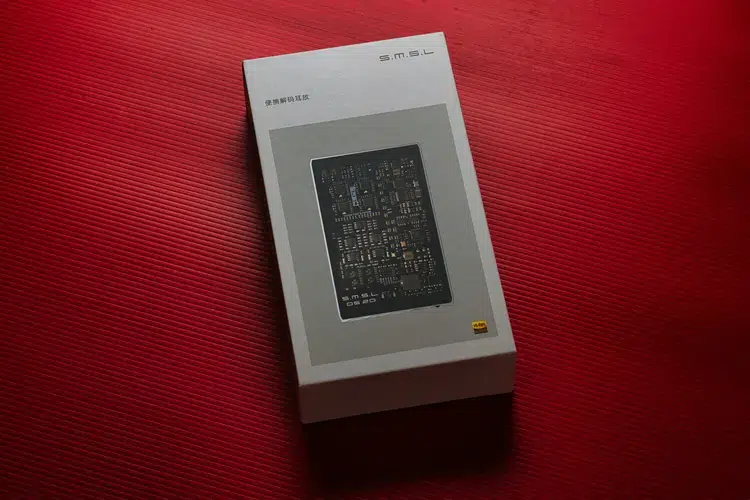
- Inside the Box: 1 x SMSL DS20, User Manual
