

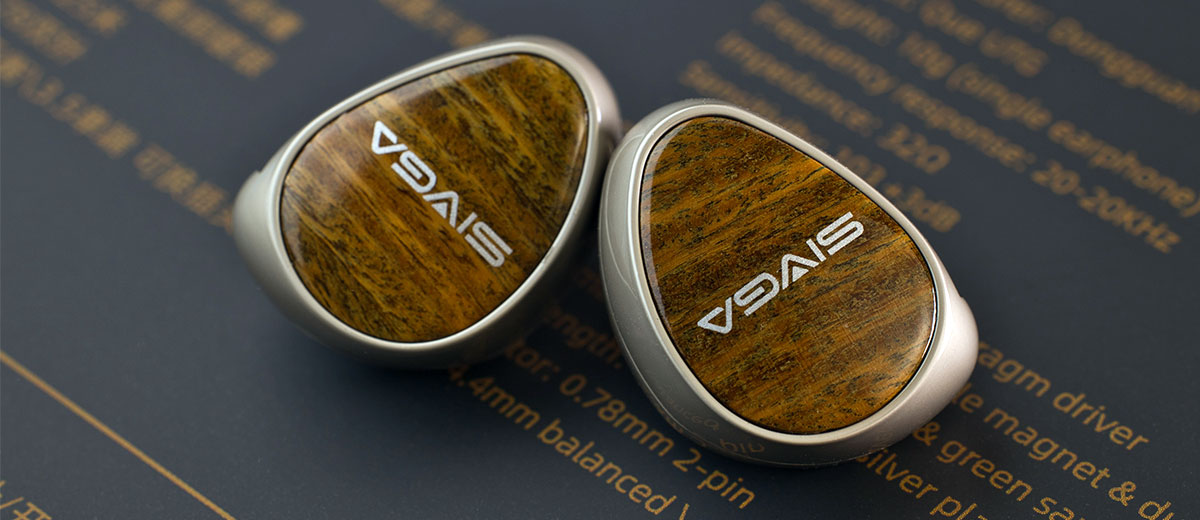
Today’s feature is Marcelo’s full review of the SIVGA Que UTG, a new, affordably priced, 10mm flat glass diaphragm dynamic driver universal in-ear monitor. It is currently priced at $89.
Disclaimer: This sample was sent to me in exchange for my honest opinion. Headfonics is an independent website with no affiliate links or status. I thank SIVGA for their support.
Click here to learn more about SIVGA products previously reviewed on Headfonics.
This article follows our latest scoring guidelines, which you can read in more detail here.
I’ve always been intrigued by SIVGA’s headphones, particularly the Robin SV021. I’ve heard many great things about it and the company. Somehow, I haven’t had the final urge to buy one, or any other headphones, due to being busy reviewing IEMs.
Luckily, they have been releasing IEMs in recent years, some of which are reviewed here at Headfonics, including the Nightingale and the Que, the predecessor of the IEM in review today, the Que UTG.
What’s special about the Que UTG is that it uses a 10mm flat glass diaphragm driver, which is supposed to improve the transients and upper treble details. Whether this claim is true or not, we will find out later in this review.
Priced competitively at $89, I wonder how it compares to other popular IEMs in this price range, such as MOONDROP Starfield 2, DUNU Titan S2, and the older but popular Simgot EA500. Check out my review below to see how it performs.
Features
The SIVGA Que UTG features a new and unique 10mm dynamic driver with an ultra-thin, flat glass with a flexible PU suspension surround diaphragm. This is pure innovation, and SIVGA deserves recognition for this.
It is ultra-lightweight and super rigid, which pushes the diaphragm breakup mode higher in the frequencies, presumably into the ultrasonics, which are inaudible by human beings.
This is supposed to reduce distortion and congestion caused by the breakup, which usually occurs around 8 kHz in more conventional drivers. In turn, it improves transient response and upper treble details.
The SIVGA Que UTG is rated at 32Ω and 103 dB, but there is no mention of mW or Vrms in the specs. That being said, it’s an easy-to-drive IEM and, like most dynamic drivers, has a modest amount of scalability with improved power.
Design
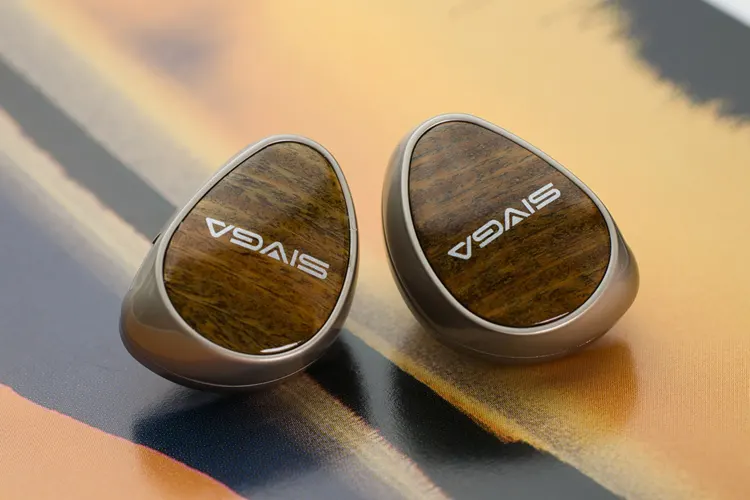
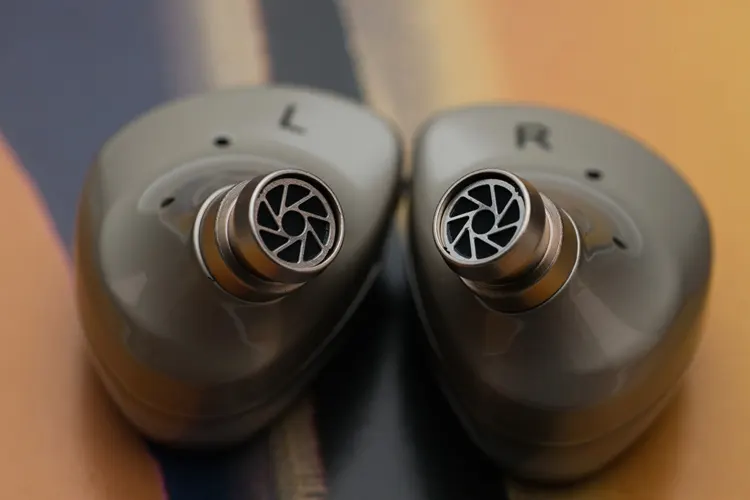
The SIVGA QUE UTG has a nice-looking South American Green Sandalwood Wooden Face cover that covers the faceplate. I love that it has a modular plug system. The user can change the plug between 3.5mm and 4.4mm connectors included in the package.
I like the simple, understated, and unassuming design of the Que UTG shell with its simple curves and a glossy, warm, titanium-like color paint finish.
The Que UTG uses a metal zinc-alloy shell, which feels slightly heavy at 9.6 grams, where I would consider 6 grams to be average.
Two vent holes serve as a pressure release for the ear canal, and the back of the driver can be found adjacent to the attractive-looking nozzle grill.
A 2-pin connector at the side and a gloss finish wooden faceplate cover to complete the shell. The included silver modular cable suits the Que UTG perfectly. This is a 4-core cable with 1.5 mm-thick per wire, which is neither too thick nor too thin for any use, and doesn’t tangle easily.
Comfort & Isolation
One of the most important features I’d like to mention, but often ignored in reviews, is the inclusion of a properly working pressure release for the ear canal in the Que UTG.
I hate it when my listening enjoyment is ruined by pressure build-up and constant change in air pressure in my ear canal, which causes nausea during a walking exercise on an otherwise great-sounding IEM. The Que UTG doesn’t have that problem.
The slight heaviness of the shells never causes any discomfort in an extended listening session; they are light enough to be held by the cable’s hook and ear tips, so you do not need to readjust during walking and mild running.
The ergonomically shaped shell never pressed any part of my ears to cause discomfort.
External sound isolation is average, like any other IEMs I’ve tried lately, which is nothing to complain about.
Packaging & Accessories
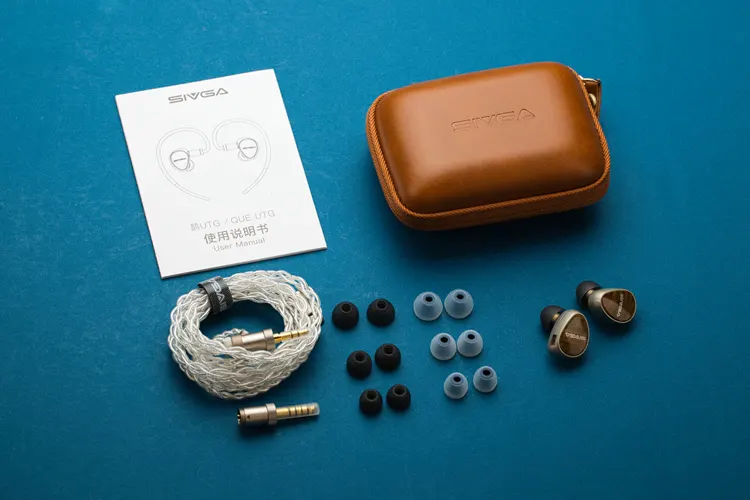
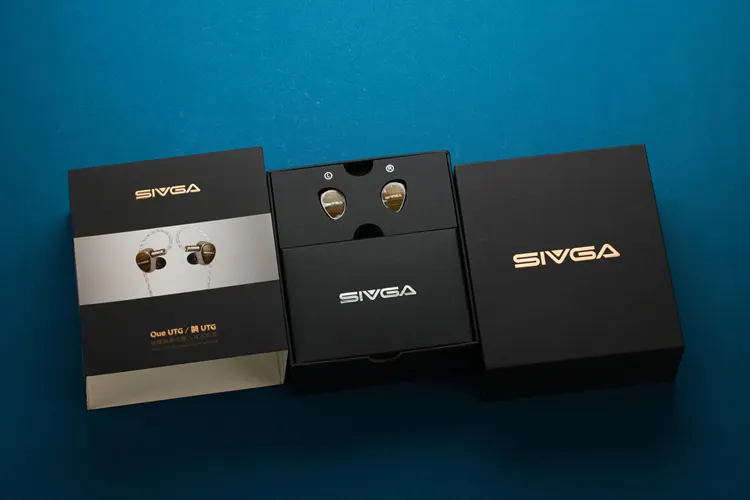
Efficient and innovative, the Que UTG packaging is nicely done for the price. It doesn’t waste too much material, yet conveys a sense of quality above its price range.
A rigid black box with a black sleeve displays the IEMs when opened. It includes the manual, cable, a 4.4mm plug, 6x ear tips, a leather carrying case, and a pair of IEMs.
Sound Impressions
The following sound impressions of the SIVGA Que UTG were completed with a mix of the LETSHUOER DT03, the iBasso DC-Elite dongle DAC, and the Shanling M3 Plus.
Summary
First, I did a 24-hour burn-in by letting it play with a spare DAP for hours, but the sound didn’t change much; it still sounded slightly harsh and glassy. Then I did eight more hours of burn-in at a higher volume, and the sound became smoother.
Of the two ear tip types included, I prefer the sound of the factory-installed black tips; it is the most neutral and smooth. The white ear tips have a narrower bore and a U-shape sound, elevating the sub-bass and upper treble, making the sound harsher and brighter.
I used the UAPP and Poweramp music player app for this review, without any EQ or sound enhancement.
The stock cable 4.4mm balanced connector was used to maximize the power from the sources. I also used a 4.4mm balanced connection for the other IEMs in this review for equality.
The Que UTG’s clarity of sound is impressive for a single dynamic driver in this price range. The ultra-thin flat glass driver diaphragm delivers, and I commend SIVGA for this innovation. I hope this kind of driver technology will become widespread soon.
Upon learning that I would be reviewing a glass diaphragm single dynamic driver IEM, I was afraid that the sound might be unnatural. Fortunately, I was wrong; the Que UTG is a bright-leaning dynamic driver with much higher-than-average resolving power.
Bass
The Que UTG sounds like a normal, good-sounding, neutral-tuned single dynamic driver IEM. Nothing about it indicates that it is coming from an unusual (for now) driver material.
The sound is clear, fast, deep, and powerful when needed, and not obstrusive in slow songs or classical music. There is always excellent texture and articulation, which never becomes muddy or mixed up in complicated music.
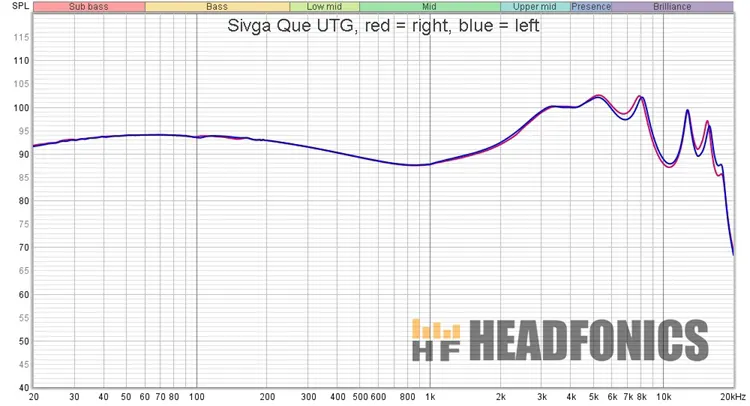
The bass level is very neutral. I don’t hear the midbass and lower midrange warming up the overall sound, but they are not thin-sounding either, and they always have good presence in the music. It sounds natural overall.
Midrange
The Que UTG has the ideal midrange sound for neutrality, in my opinion. Where there is a lack of warmth in the lower midrange, the SIVGA Que UTG avoids that kind of sound that many audiophiles dread.
It is neither laid-back nor forward, thin nor flabby. It sounds smooth and lush in a natural way. There is an appropriate note weight for each instrument and vocals.
The instrument decay is not too fast but does not linger too long, giving me an accurate picture of the music in the midrange.
That kind of midrange performance is expected from an IEM with a similar measured frequency response. Still, I also suspect that the benefits of the ultra-thin-glass diaphragm’s low distortion and high rigidity contribute dearly to the excellent midrange sound that I’ve been hearing.
The upper midrange is boosted in frequency response by 12 dB, which is still neutral as far as my hearing is concerned; it’s not shouty or colored sounding, it sounds clean and clear, and I attribute this to the driver’s low distortion. Everything has excellent clarity, but it does not sound sterile or cold.
The Que UTG’s energy presentation is neutral. I didn’t notice any exaggeration in how the drummer hit the drums, especially the snares. It doesn’t sound polite either. It walks the fine line between having too much or too little.
Treble
Outstandingly detailed, extended, and airy for the price. Many could mistake the Que UTG for a hybrid IEM where balanced armature drivers handle the treble. It has the extension of hybrids without the inter-driver coherency issues that could arise when multiple drivers are used.
There’s a gentle rise in the treble response starting from 3 kHz, and the treble presentation is forward, but not in your face. This gives the Que UTG its character; needless to say, it is not a neutral treble.
Despite its forward treble, the Que UTG is not fatiguing, thanks to the low distortion of its ultra-thin glass diaphragm. The treble arrives with accurate details and musical information, not noise and distortion.
It has excellent speed. I’ve tried complex music at loud volumes, and it never became congested and confused.
I must say, though, that the forwardness in the treble could make the sound unbalanced and too bright with poorly recorded music, regardless of the genre.
Fortunately, only a small percentage of my music collection fits in the poorly recorded category, and those are not good songs.
Soundstage
The Que UTG has a wide open sound. There is an excellent lateral expanse with a good depth, especially when played loud. I’m immersed in an open, clean, and natural sound field, which is rare, if not unprecedented, at this price.
The soundstage size is easily above average, regardless of price; it is slightly wider than deep, with a good sense of height. It is easy to imagine that the sound field is outside the head, not in between the ears.
There is good instrument and vocals spatial separation within the soundstage. But the overall imaging performance is merely average, not bad at all.
The Que UTG lacks the image focus and definition of the best I’ve heard and might have sacrificed some imaging performance to achieve an excellent macro staging performance.
Click on page 2 below for my recommended pairings and selected comparisons.
