


Marcus reviews the Shanling EC Zero AKM, a new entry-level wireless-capable portable CD player with an AKM DAC and solid-state amplification. It is currently priced from $319.00.
Disclaimer: This sample was sent to me in exchange for my honest opinion. Headfonics is an independent website with no affiliate links or status. I thank Shanling for their support.
Click here to learn more about Shanling Audio products previously reviewed on Headfonics.
This article follows our current scoring guidelines, which you can read in more detail here.
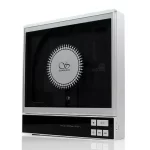
After just a few weeks of testing and awarding the flagship EC Zero T CD player from Shanling, I now have the more affordable EC Zero AKM portable CD player in front of me.
The EC Zero AKM is a stripped-down version of the EC Zero T but still retains a wealth of features from its bigger sibling, including a similar retro design, form factor, and physical control suite.
Most important of all, the EC Zero AKM delivers the familiar smooth Shanling ‘house sound’ that is a firm favorite of many of the company’s fans.
At $319, it’s still a premium price over previous standards such as the MOONDROP DISCDREAM Ultra 2 and only just a few dollars less than the multifaceted EC Mini from 2024.
So, where exactly does the EC Zero AKM sit in Shanling’s fast-growing range of portable CD players, and how does it stack up against the 3rd-party opposition? I found out in my full review below.
Features
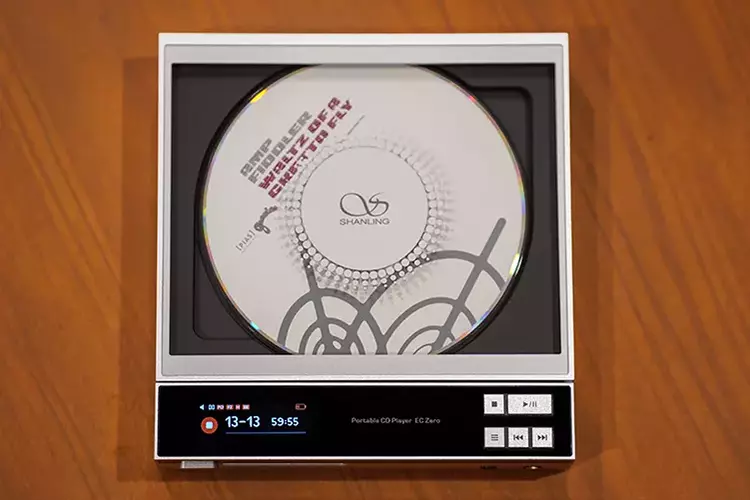
As with the EC Zero T, the new EC Zero AKM is primarily pitched as a modern portable CD player for headphone and IEM users, complete with accented classic styling to capture the recent community’s thirst for all things ‘retro’.
To that end, the 2nd generation in-house designed CD mechanism and servomotor are the same, and thus, you will find no noticeable difference in its top-loading and anti-shake performance.
Inside is a similar-sized 5300mAh battery to keep things chugging along at up to a more impressive 10 hours balanced as opposed to just 7 hours from the EC Zero T. And, there is also a separate external power mode (P Mode), allowing you to bypass and prolong the life of the battery with a separate DC input.
Like the EC Zero T, the EC Zero AKM can also function as a USB-DAC and deliver an analog lineout in balanced and single-ended formats with provision for digital output to transform into a CD transport.
As before, the EC Zero AKM can deliver audio wirelessly via a BT5.3 transmission module capable of up to aptX Adaptive decoding, with a similar listed total run time of up to 18 hours, compared to the EC Zero T’s BT performance.
DAC
This is where we take a step down from the flagship player with a single delta-sigma AK4493S DAC chipset implementation as opposed to the R2R resistor array inside the EC Zero T.
It is still a solid DAC, but a less emotive variant and one that is simpler to engineer and rollout than R2R.
Decoding support is just as good as its bigger brother, with the EC Zero AKM capable of handling up to PCM 32-BIT/768kHz and DSD512 with coaxial and optical support
You are not losing out here in terms of USB-DAC playback capability, and it can still rip CDs at up to 1X in WAV format if you so require it.
Amplification
This is the second step down, though with a far lower sub-ohm output impedance for IEMs and headphones, some might argue that the EC Zero AKM’s amplification is an upgrade.
Still, the choice of transistor or tube is eliminated. Instead, we have a single solid-state output courtesy of dual SG Micro SGM8262 op-amps, capable of delivering up to 836mW into a 32Ω load, balanced via external power, and 525mW into the same load on battery power.
Balanced and single-ended line-level output is fixed at 2.05Vrms and 4.1Vrms, standardizing the EC Zero AKM for slotting easily into most HiFi systems, should you wish to use it as a transport and DAC.
Design
If you have played with the EC Zero T, the form factor of the EC Zero AKM will be quite familiar. At 158 x 150 x 28.6 mm, the housing is not exactly FiiO DM13 compact, but it’s tidy enough to throw in a bag or set up in a confined desktop space.
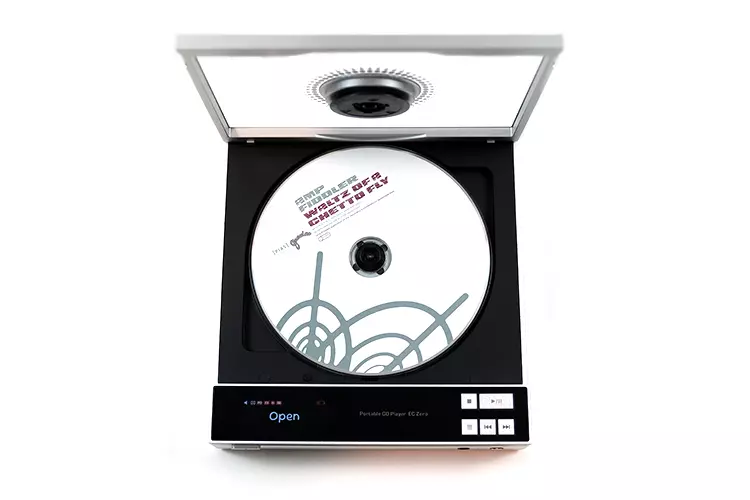
The boxy exterior, transparent lid, and control button aesthetic still has a retro vibe to it. However, the missing dual tube window on the front control panel diminishes the niche fun-factor a little.
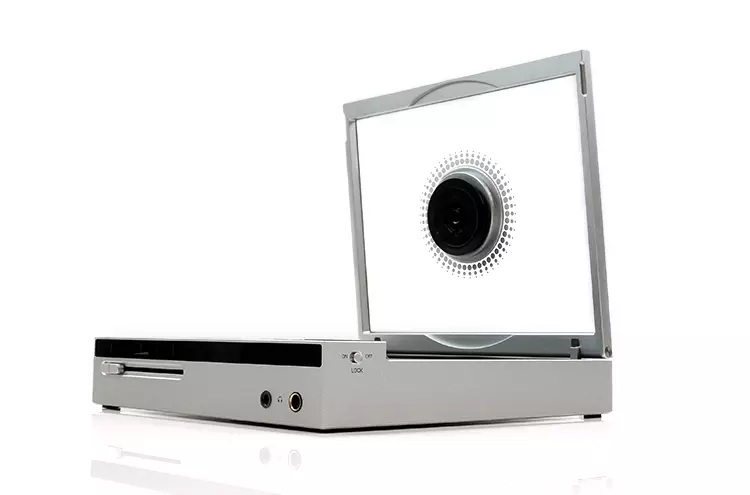
Technically, the EC Zero AKM is a top-loader, which I much prefer, though it will not run CDs with the lid open. Shanling has provided a small open lid kit for about $20 if you want to do that.
A transparent lid, however, should satisfy most gazers, and to that end, it’s a very smooth 2nd-gen mechanism with a decent anti-shake buffer and a small lock on the side of the lid to keep it secure.
Housing flex and hinge noise is minimized with good damping. There is just a single purposeful click when you lift the lid beyond a certain angle that instructs the player to stop the CD rotating.
This particular EC Zero AKM sample is finished in silver. I already have the EC Zero T in black, so it is nice to see the contrast between the two.
The silver feels more like a classic player, but the black finish on the Zero T reminds me more of the old Sony players from the early 80s.
I/O
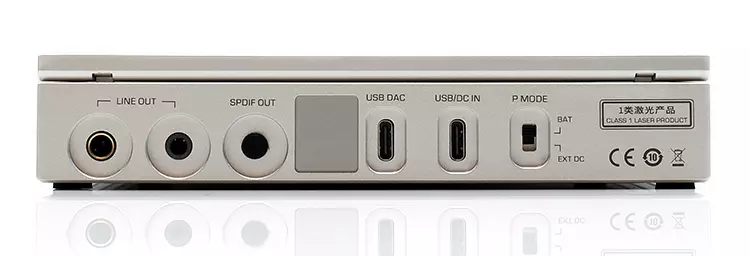
I have zero complaints regarding the EC Zero AKM’s inputs and outputs because they match the more expensive EC Zero T options, meaning you are getting a lot of value here.
You get 4.4mm balanced and 3.5mm single-ended line output, SPDIF, two USB-C sockets for data and charging, and the external power mode switch to allow you to use an external DC brick and bypass the battery.
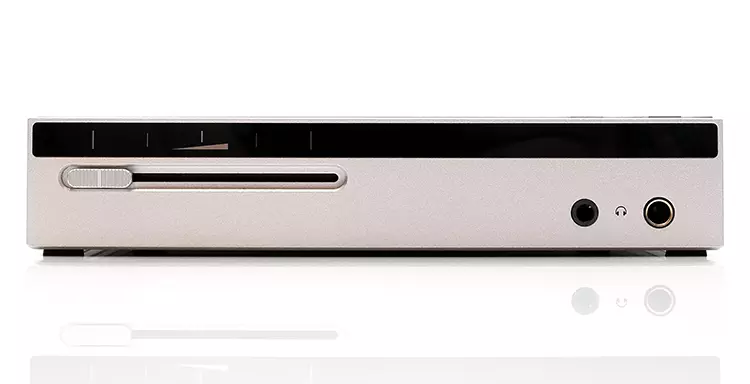
On the front, you have the same retro-style volume slide with a 100-step incremental increase range and 3.5mm single-ended and 4.4mm balanced, sub-ohm PO outputs for headphones and earphones.
If I have one critique of the EC Zero AKM volume slider, based on my experience with the EC Zero version, the level of resistance when moving it is rather light, meaning you can accidentally knock it forward and dramatically increase the volume.
This is where the small lock on the right side of the panel comes in handy, as it will also safeguard you from accidental volume hikes, as well as prevent skipping from unintended button presses.
Controls
The EC Zero AKM has the same colorful 1.68-inch LCD screen as the EC Zero T and is positioned on the left-hand side of the front panel and controlled by physical buttons on the far right.
The menu options are similar, with the major change being the loss of the tube mode option and the switch from NOS/OS filtering to the 5 filters built into the AKM DAC.
The EC Zero AKM does not come with any remote control or wireless Eddict app integration, which is a bummer for those looking to use it as part of their HiFi system and plan on sitting back a bit from the player. Everything is manually controlled by hand.
Options for the uninitiated include a two-stage gain control, filters, channel balancing, a screen dimmer, and headphone, line-level, or SPDIF output options. The power mode is controlled by a manual switch positioned on the back panel.
Volume and power are also separated from the software system with the manual slider on the front panel and a small power switch on the left panel.
Packaging & Accessories
The Shanling EC Zero AKM is packaged similarly to its bigger brother and comes with an equally sparse selection of accessories.
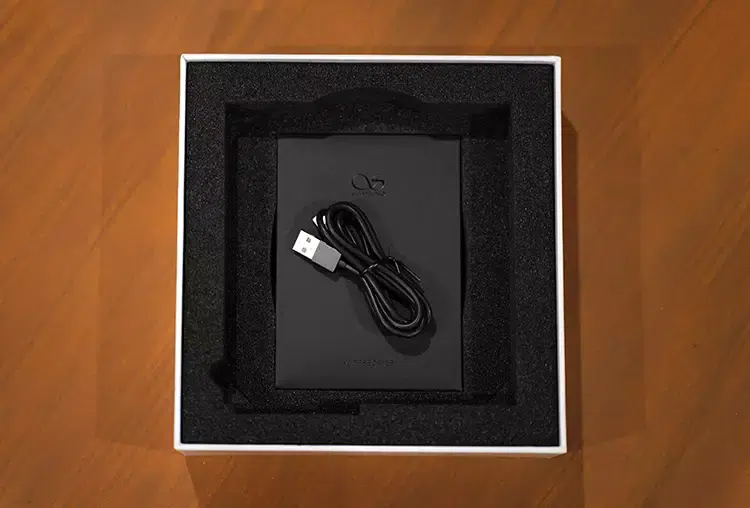
The mid-sized box has a plainer exterior, just a picture of the CD player itself at the front, with copious amounts of protective foam inside to protect the unit during shipping.
The player is on a top layer inside with the accessories box just underneath, which contains a USB-C to USB-A cable, guides, and warranty cards.
There is no cloth pouch this time. However, you can purchase a carry case, ranging from the more expensive but compatible leather EC Zero T version or a cheaper PU leather carry case for around $40-50.
The leather orange case I have here is a neat fit, with almost every control accessible, and decent thickness to protect it against accidental knocks. Its lid design means you can quickly lift it to allow you to change CDs rather than having to slide the CD player out of the case first.
I do not have the PU leather version to test and compare, but it looks equally functional on paper.
Click on page 2 below for my sound impressions and recommended pairings.
