

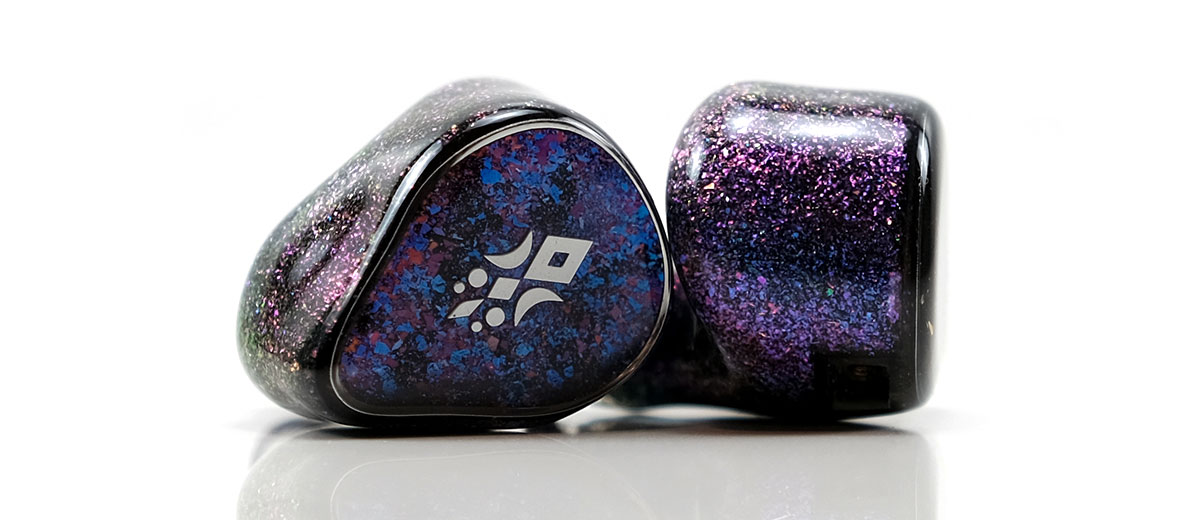
Marcus reviews the Rossi&Wing Lua Serendipity, a new universal IEM featuring the company’s R&W “Magna Resonus” MR10 dynamic driver. It is currently priced at $590
Disclaimer: This sample was sent to me in exchange for my honest opinion. Headfonics is an independent website with no affiliate links or status. I thank Rossi&Wing for their support.
Click here to read more on Rossi&Wing products that we have previously reviewed on Headfonics
Note that this article follows our latest scoring guidelines, which you can read in more detail here.
The Rossi&Wing Lua Serendipity has an excellent dynamic driver but is loaded with a niche tuning that might limit its appeal in its stock format.
With PEQ, everything changes. Though you are not limited to V-shaped profiles, I found my own personal sweet spot there with a very competitive and powerful tuning without any noticeable distortion.
Rossi&Wing entered the audiophile market in 2024, aiming for the high-end with their smooth-sounding First Light flagship IEM.
With First Light, the company was very clear about its tuning direction: warmth and emotion, with less emphasis on reference-tuning.
The main problem was that First Light’s minimum $5,000 price point put it out of the reach of many audiophiles’ budgets.
Enter the more affordable Lua series in 2025, a more accessible lineup of 3 IEMs with the same tuning philosophy; the Serendipity at $590, the Synchronicity at $790, and the flagship $1870 Celestian.
I have the Serendipity and the Synchronicity here in the office, with this review focusing on the entry-level Serendipity.
And yes, the TLDR is a beautifully designed IEM inside a wonderful unboxing experience, but with a strong L-shaped tilt towards warmth and power.
The tuning is not for everyone, but it is a driver that responds well to PEQ, with some surprising flexibility in its performance.
There is some stiff competition around this price, not least from the likes of Sennheiser’s IE 600 and HIFIMAN’s ‘evergreen’ RE2000 Silver Pro, so I will be comparing the Serendipity to these two stalwarts in my full review below.
Features
There is not a huge amount of detail regarding the precise acoustical implementation inside the Lua Serendipity shells.
What I can tell you is that it uses a single proprietary 10mm dynamic driver called an R&W “Magna Resonus” MR10. This 10mm driver has a beryllium-coated diaphragm with an ‘on-paper’ focus on power, depth, and texture.
The Lua Serendipity is rated at 23Ω for impedance with an SPL of 112 dB/mW @ 1kHz, so it doesn’t need a huge amount of power to sound good.
Design
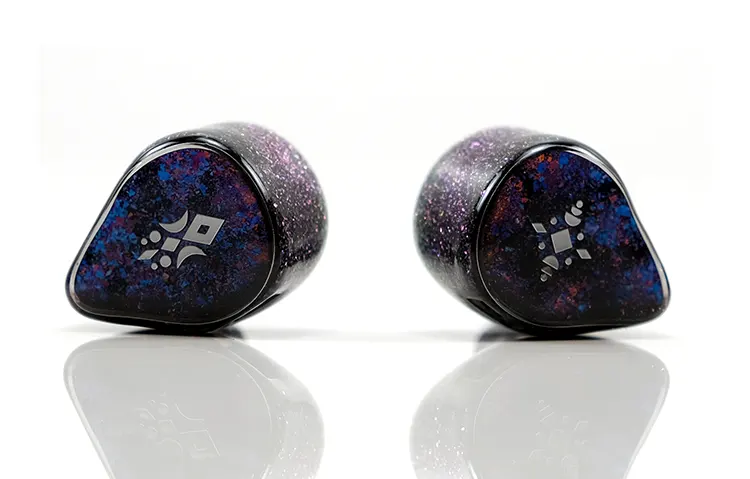
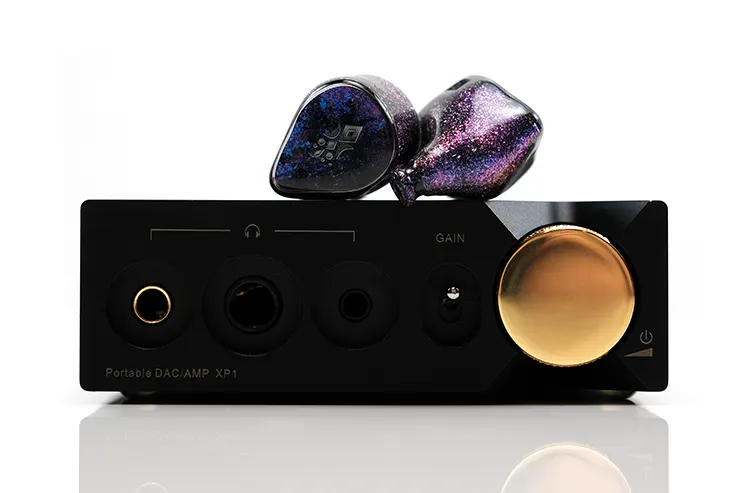
I have to say this is a very attractive-looking IEM, particularly at this price point.
It’s not just the speckled, harmonious purple and blue hue of the entire shell that, by the way, reminds me a little of the Jome Audio Salsa. It’s also the spotless, polished finish throughout that gives the Serendipity a much classier look when studied up close.
It also smells good, which is an unusual comment to make for an IEM, but more on that later in the packaging and accessories section.
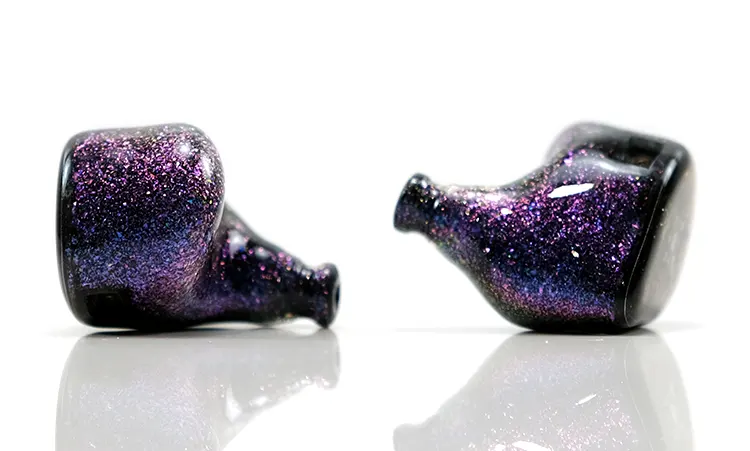
From the exterior, the Serendipity seems to be a 2-piece construction consisting of a singular molded resin main shell and nozzle, combined with a matching inset faceplate with silver logo inserts just under the polished exterior.
The form factor is relatively deep with a long nozzle but compact in size, and with a flush 0.78mm 2-pin connection system mounted on top. Its shape has some decent contouring for a comfortable fitting experience.
The Serendipity shells are not that heavy either, which is understandable given it’s a single driver inside. Venting is very discreetly done within the four ‘hollow’ corners of the CM sockets.
Comfort & Isolation
The Lua Serendipity are super comfortable in my ears with excellent passive isolation, which might indirectly confirm to me that there is no venting on these shells.
The resin contouring holds up well in my ear’s concha basin with only a small amount of protrusion beyond the ears. They are not the smallest, but they feel compact enough and will not be too distracting for your daily commute.
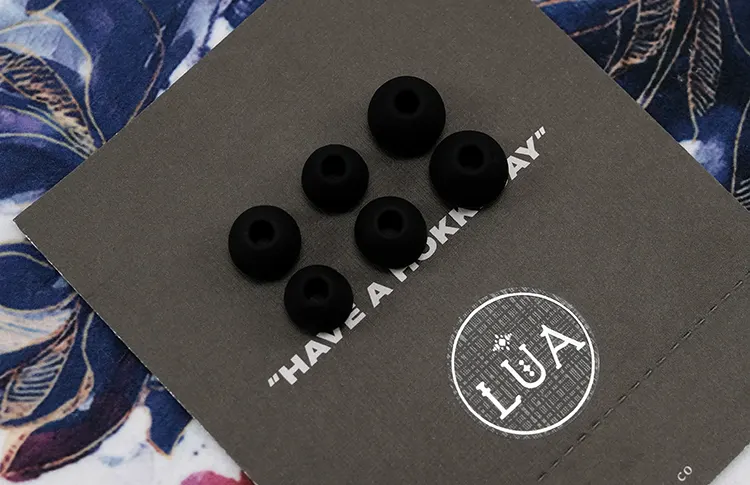
The supplied ear tips are a different, albeit anecdotal story. The Serendipity comes with a single set of 3 single flange narrow bore silicone tips in small, medium, and large.
They have a reasonably stiff stem and a pliant hood, and although they are quite comfortable for some reason, I could not get an exact fit on any size.
At one point, I was using a medium in one ear and a large in the other, but the seal in each ear did not seem equal.
Some tip rolling solved the immediate issue with a set of Final E tips coming to the rescue. I suspect their slightly denser silicone material offered more grip in my ear canal, improving the passive isolation and keeping the shells steadier in my ear.
Changing the tips didn’t really have a huge effect on the tuning of the Serendipity. If anything, the Final E presentation was a little clearer and more immediate, but this is likely due to the enhanced isolation and improved seal.
Stock Cable
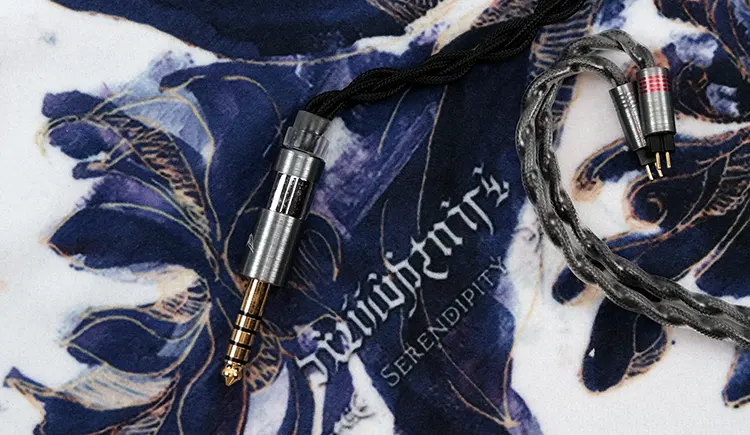
The Lua Serendipity comes with a 1.2m cloth-jacketed cable with a neat, braided finish and terminated with a 4.4mm Pentaconn plug by default.
There is no real information on what this cable has inside in terms of wiring, but what I can tell you is that it uses 26AWG 4N Silver-Plated 6N OFC Copper Wire in a 4-wire geometry.
The finishing reminds me a little of PWAudio’s grey/black cloth jacket styling, though the aluminum barrels for the plug, connectors, and splitter are markedly different and branded with the Rossi&Wing logos.
This is a soft, pliant, and easy-to-manage cable with a quality finish to a small chin cinch that helps keep everything under control during daily use. Microphonics are non-existent.
The only critique I have here is the slightly heavy nature of the 4.4mm barrel and the copious amounts of silicone for strain relief and memory setting on each end of the cable.
Packaging & Accessories
This is where Rossi&Wing get top marks. The Lua Serendipity unboxing is more like a multi-sensory experience, with olfaction and visual stimuli being challenged.
Not only do you get a set of 3 silicone tips, the cable, and IEM inside a neatly designed box, but it also comes wrapped in a beautifully branded Furoshiki Japanese wrapping cloth. Everything, and I mean everything, smells gorgeous.
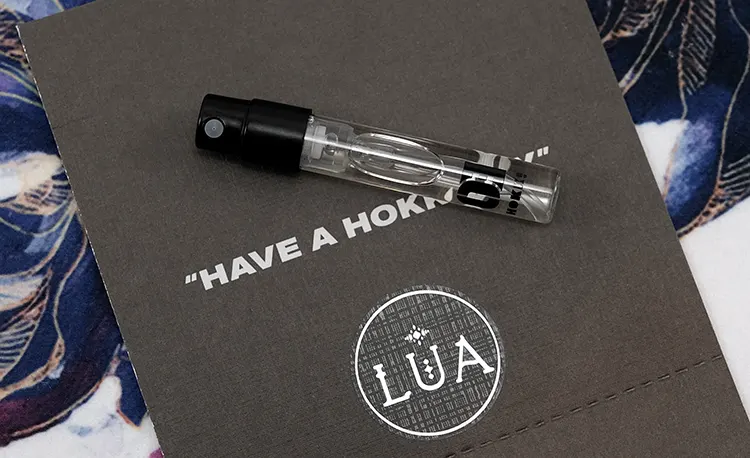
I include the IEMs and cable in that statement because the Serendipity also comes packaged with a sample fragrance from HOKKI called No. 3.
HOKKI Fragrance is a Taiwanese artisanal fragrance house, and it is my first experience with their products.
I would consider myself to be a bit of a ‘fragaddict’ over the last few years, and I am always on the lookout for unique scents with decent sillage and projection.
From the notes of No. 3, it has lemon, blackcurrant, pine, and bergamot top notes, with some orange and mint underneath, and a slightly denser woody base note.
Its projection and sillage are good, and given that the Serendipity shells still have their aroma after 3 days, its longevity seems excellent.
I have yet to try it on the skin, but since it feels like a summery daytime scent rather than an evening or cold-weather perfume, it is likely the sample size will end up in my travel bag.
Sound Impressions
The following sound impressions of the Rossi&Wing Lua Serendipity were completed using a mix of the iBasso DX340/AMP15, the HiBy R8 II, and the Cayin N6iii with the R202 Motherboard.
Apps used for PEQ included iBasso Mango, HiBy Music, and FiiO Music.
Stock Tuning Summary
The Lua Serendipity sound signature is a tale of two experiences: the stock tuning and the PEQ’ed performance.
With the stock tuning, it delivers an L-shaped presentation, somewhat heavier on the lows from 20Hz to 200Hz, with plenty of warmth coming up into the mids and a noticeable dip in the 2-3k and the 5-7k region, which creates a fairly rounded note timbre and a somewhat dark sound signature.
Air is an issue, especially when the low-end gets energized or when pairing with a naturally weighty and warm amplifier.
Vocals do have a bump around 1-2k, they sound relatively juicy and full-bodied, but they lack contrast from an attenuated upper-mids and lower treble tuning, meaning it’s mostly even-harmonic than balanced sounding.
That can work with sparse a cappella tracks or soulful vocal-led tracks where heavy bass notes are few and far between, and you want a closer singing position.
The difficulty lies more in the height and treble fill when percussion strikes, steps in. There is not enough reach or sparkle to create an accurate representation, so they sound very brief and, at times, equally masked in detail as the vocal performances.
Depth is excellent, but the bloom and drop into the mids can make it seem distracting and overwhelming. Vocal imaging, whilst reasonably bumped at 1-2k, is secondary to the bass bloom and treble fill, even further behind save for a minor 9k bump.
Overall, Lua Serendipity stock tuning has a thick, rounded sound with difficulties in midrange detail and separation, creating a deep but muddy presentation that only really appeals when there is little to no low-end energy in the recordings.
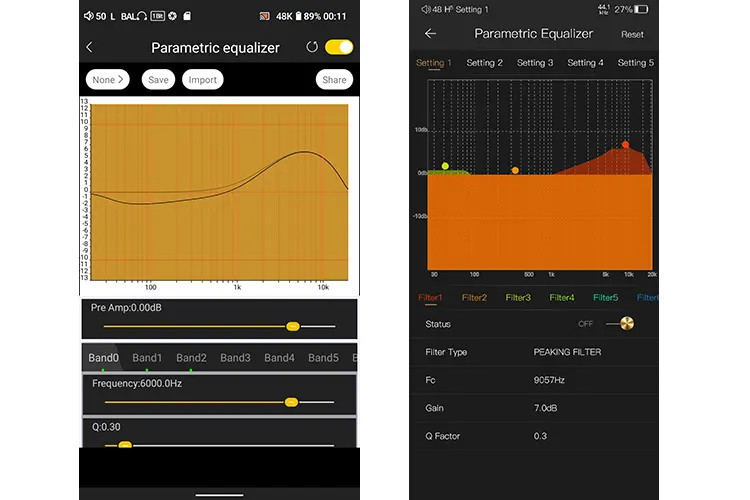
PEQ Tuning Goal
It is not all doom and gloom. This is actually an excellent dynamic driver with plenty of flexibility for PEQ to deliver a quality modern V-shaped or a more Harman-centric response curve.
Which is exactly what I did using the most popular PEQ apps for smartphones and DAPs: iBasso Mango, HiBy Music, and FiiO Music.
Once adjusted, the Serendipity sounded very competitive with excellent power, a more convincing level of bass-to-mids separation, a clearly separated and forward vocal presence, and the necessary treble fill to add more air, height, and sparkle.
With PEQ, I would consider the Serendipity to excel in EDM, deep bass tracks, and some aspects of metal and rock where depth and clarity via enhanced contrast in percussion are often required.
The Adjustments
The PEQ adjustments I made are broadly universal to the three apps, requiring small dB or Q Factor adjustments depending on the source AMP/DAC sound signature.
I used three peaking filters, set at 30Hz, 500Hz, and 6kHz, with a Q Factor of 0.7, 0.3, and 0.3, in that order. For the dB gain adjustment, I used 2 dB, -2 dB, and 6 dB in the same sequence.
The resulting curve is a fairly standard FR with an elevated sub-bass up to 60Hz, less mid-bass presence, and some suck out coming into the lower-mids to drain the excess warmth and improve separation.
The pinna gain region got a huge boost, but peaking just above at those stock-tuned muted areas to enhance the treble fill and clarity for percussion and vocals.
This produced more vocal separation, a smooth vocal tuning, but one with improved contrast and treble sparkle. The perception of height and depth improved, vocals were very clear, and percussion had impact.
I would still argue that other monitors, such as the Sennheiser IE 600, have more percussion energy. However, given that Rossi&Wing want a smooth-sounding monitor, I opted to stay closer to the vision rather than ‘stiffen’ the treble too much.
Click on page 2 below for my recommended pairings and selected comparisons.
