

Synergy
Power
Power is not Waltz XM10 Ltd’s forte, but that doesn’t mean it is weak in output power.
In practice, it can still handle various low-to-medium impedance IEMs well, but it is not recommended to pair with planar headphones, which require strong swings and potentially a lot more current draw with bigger driver membranes.
With around 8 hours of playback time, the output power is satisfactory, though considering the size, if you value portability more than anything else, then you will probably think it is well done.
Pairings
The Waltz XM10 Ltd has a lovely, warm character, and even though it has a little bit of power constraint, surprisingly, it does pair quite well with various IEMs I put on it.
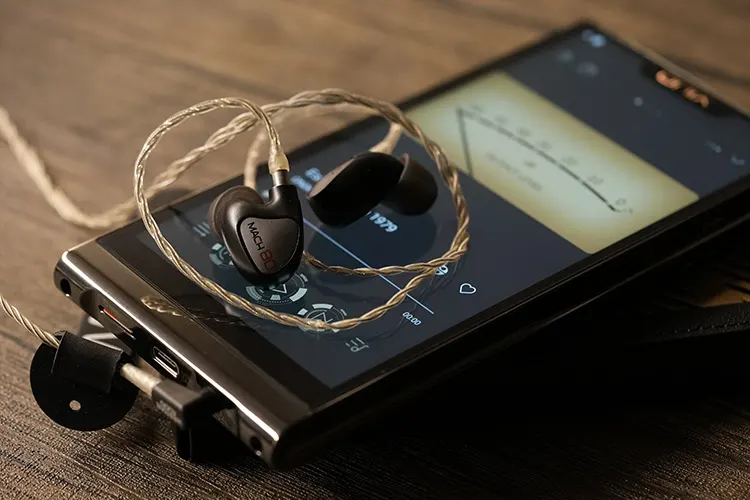
With the Westone Audio Mach 80, which sounds rather neutral, accurate, and fast with nice extension in the treble, it gets slightly smoothened out in the upper register and the mid-bass bumped up for more fullness and air.
This makes it more engaging with vocal works, pushing the performer more closely to the audience, and rendering guitars more up-close and fuller.
With dynamic IEMs like the DUNU Falcon Ultra, the coloration effect is even more obvious, with the XM10 Ltd thickening the vocal body, giving nasal notes and chest voices a good boost in presence as it nicely reveals details in the mids.
It imbues both female and male singers with good power and fullness, as well as acoustic guitars and double bass, sounding expressive and weighty. This pairing can maintain sufficient separation between the backing instruments and the singer, without overly thickening or polishing the mids.
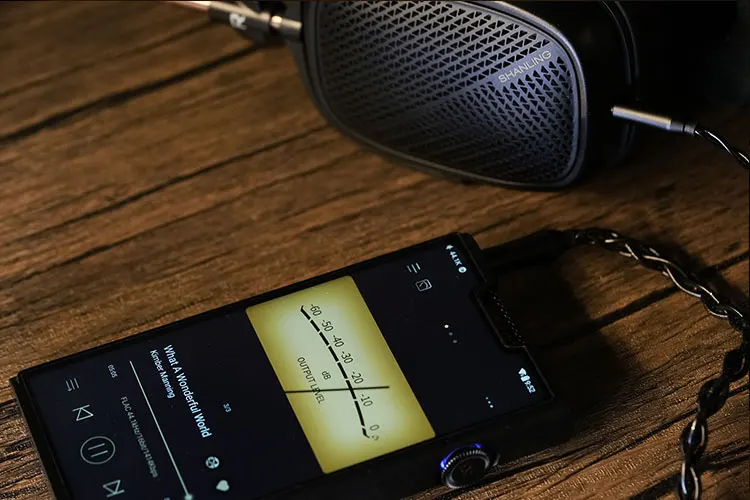
Lastly, the downside, if you are using small headphones such as the Shanling HW600, then I am not going to recommend the XM10 Ltd.
I found this pairing to struggle to sound as defined as the more powerful competitors, when you push up the volume when listening in a noisier environment. It sounded flattened and smoothed out in the treble.
I also tested with the 90Ω Westone Audio Mach 30, and the XM10 Ltd also struggles to open up, or sound firm in the two ends, or well separated in the mids.
Connectivity
Bluetooth
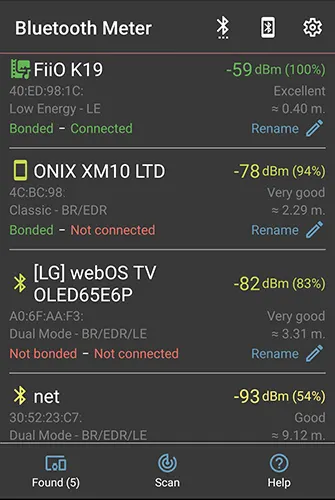
I tested the Waltz OM10 Ltd with the Bluetooth strength meter and used it in a crowded train scenario. While the XM10 Ltd has a stainless housing, the connection is stable, possibly because the antenna is below the glass panel at the back, and it doesn’t affect the signal.
The volume is separated on the phone I streamed from and the XM10 Ltd. When changing between Codecs, it would require quitting the Bluetooth receiving mode and re-entering.
Nevertheless, I experienced some stuttering and confirmed with ONIX that they will be updating the firmware soon to fix this issue. So, if you are already a user, be reminded to update to the latest firmware later to enjoy these functionalities.
WiFi
The Waltz XM10 Ltd supports 2.4/5GHz connection, and it is fast and responsive for streaming videos and high-resolution music from online. Also, downloading large files at high speed, at a few meters apart from the signal source, remains satisfactorily strong.
USB-DAC
The Waltz XM10 Ltd can be used as a DAC for Macs (Driver-free) and Windows PCs. You can download the USB driver from the Shanling Website if required. You need to turn it to USB decoding mode within the work modes menu, with the output quality comparable to local playback.
USB-OTG
Since the Waltz XM10Ltd is intended to be used in a docked design as a digital source, it can be hooked up to other USB decoders as a digital source as well, or you can insert another USB-C storage device for photo viewing/file transfer.
This time, I put the FiiO BTR15 in Phone mode and connected to the XM10 Ltd, and without any extra settings, I can hear it playing back on the BTR15. The volume can also be adjusted on the XM10 Ltd in the settings menu since the BTR15 is paired in slave mode.
Select Comparisons
Onix XM5
Technical
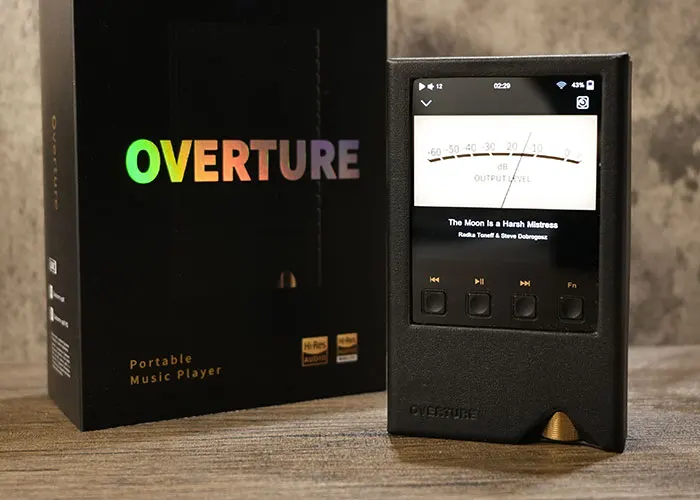
The Overture XM5 Pure Music Player is ES9039Pro equipped and is able to output over 1W of power, running on a custom OS. The XM5 comes with a 7000mAh battery and could play back up to 12 hours on balanced.
Design
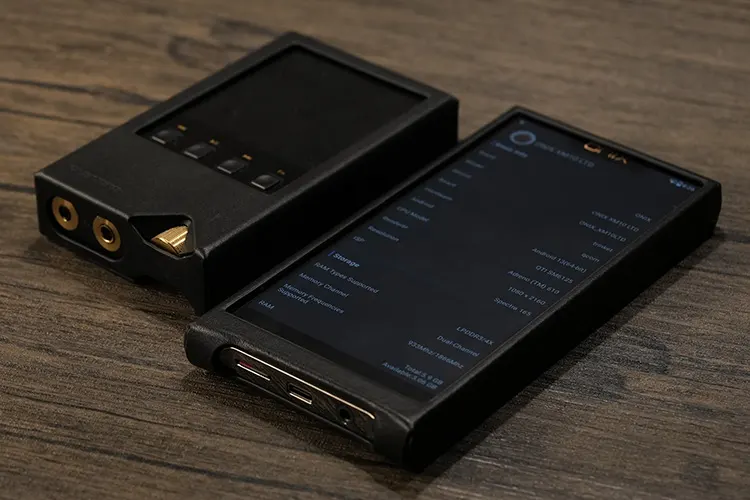
The color theme on the two players is consistent however, the XM10 Ltd looks much more luxurious with a glossy finish and a huge screen. The volume and weight aren’t too far off for these two, but the actual dimensions are vastly different.
It is quite easy to tell that the XM10 Ltd is designed for those who look for a full-function OS experience, more visuals, and a sleek design, whereas the XM5 is optimized for power and playback time.
Performance
In my experience, I find that it takes a lot more effort for an Android player to surpass a pure music player’s audio quality, usually due to the system’s complexity.
I think both players here are doing a good job focusing on their technical strengths; the XM5 outlines the transients and attacks more firmly and clearly, and the XM10 Ltd is more expressive and engaging.
Both players carry good warmth in their tuning, and comparing the two with the DUNU Falcon Ultra, I would say the XM5 is sounding more controlled with its faster, cleaner impacts and well-weighted bass.
The XM10 Ltd is more relaxing, airy throughout the mids to the treble, and with a bit more brilliance up the top, which colors it more vocal-forward and expressive.
In terms of micro-details, the XM5 feels marginally stronger as you can hear every instrument clearly.
However, it lacks the relaxing decay of the XM10 Ltd, or the emphasis on the vocal body that gives the singer the center stage instead of pushing it back amongst the band or the orchestra. So, if you are a vocal lover, you may find the XM10 Ltd more enjoyable.
Shanling M8T
Technical
The M8T comes with dual 4499EX and dual AK41914EQ for decoding, and is tube-equipped. It is also a dual operational mode player, so it can be switched to pure transistor amping and comes with 2 different sub-modes for the tubes.
There are technically 3 different tuning profiles in one device. The M8T also runs on Android 13 OS, and as you can guess, it is much thicker, though the operating time is roughly 50% more.
Design
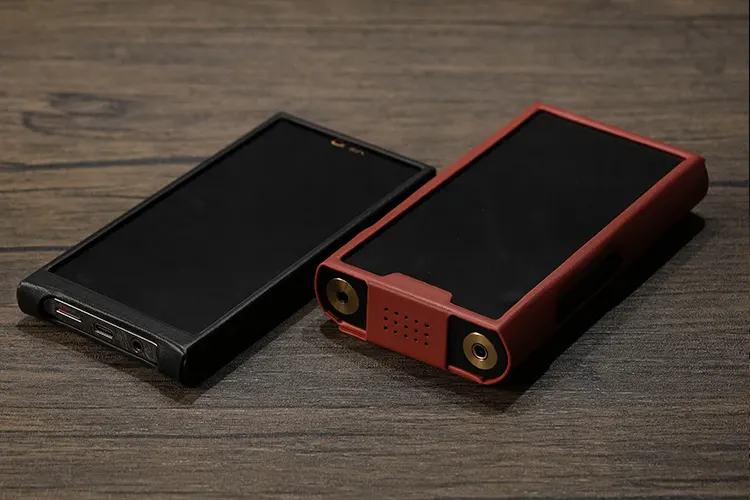
Putting the two devices together, it is clear to tell the Waltz XM10 Ltd is much sleeker and less geeky, whereas the Shanling M8T feels more professional and nicely showcases the tube through the top open window.
You can easily tell the difference in positioning for the two players. However, if you ask me to pick a design without considering all other aspects, the XM10 Ltd would be the coolest and most futuristic one here, with the choice of material, the glowing logo, and of course, the sleek design.
Performance
Comparing the tube modes on the M8T to the XM10 Ltd, there is stronger coloring and elaboration on the vocal harmonics for the M8T, and with a stronger sense of depth rendered.
The XM10 Ltd sounds relatively more mid-centric and thickened in the vocal body, whereas the M8T is smoother and textured differently.
I prefer listening to weaker, softer voices on the XM10 Ltd, rendering it more pronounced and sweetly rolled off. Voiceing has more rigor and sternness with the M8T, which would present it in a more structured, precise manner.
In tube mode, the XM10 Ltd surpasses the M8T in terms of dynamics, as there is inevitably a bit of hiss in the background. Therefore, it is better to pair the M8T with IEMs that are not too sensitive, unlike the XM10 Ltd, which can yield better results with such pairings.
Putting the M8T in transistor mode, they come closer in performance, and the M8T sounds more refined and balanced. The XM10 Ltd sounds more uplifting, punchy in the bass, and engaging.
Details retrieval is superior on the M8T, but not by a large margin. However, if you ask me which one I will take out for daily listening, I prefer the XM10 Ltd as it can compensate for the ambience and allow the mids to sound clearer and meatier on the go. But again, use sensitive IEMs for the best pairing experience.
My Verdict
Onix is one of the few DAP makers that combines a luxurious appearance with a sleek design rather than building a brick to boost the specs.
The Waltz XM10 Ltd has a form factor that I once wished DAP manufacturers could achieve. If only they could also use a universal 4.4mm socket inside the player, that would be even nicer. The extender cord isn’t a big deal, as long as you don’t have an L-shaped plug on your IEM cable.
Frankly, I thought the space constraints might have compromised the output quality, but ONIX managed to pull it off, and it sounds adequately engaging, expressive, and resolving, especially when testing it with some sensitive IEMs, which don’t need that much power.
For those who prefer a relaxing, vocal-elaborated signature and are happy to sacrifice some fidelity for portability and coolness, then the Waltz XM10 Ltd will be a fitting candidate.
ONIX Waltz XM10 Ltd Technical Specifications
- DAC: AKM AK4499EX with AK4191
- Opamp: Dual AD8397
- Output Power – 3.5mm Single-Ended: 220mW @ 32Ω;
- Output Power – 4.4mm Balanced (via adapter): 880mW @ 32Ω
- CPU: Snapdragon 665
- RAM: 6GB
- Screen: 6-inch 2160 x 1080 FHD touchscreen
- USB Solution: XMOS XU316
- Bluetooth: Two-way Bluetooth 5.0
- Battery Capacity: 4300mAh
- Charging: Supports 18W QC & PD fast charging
