

Selected Comparisons
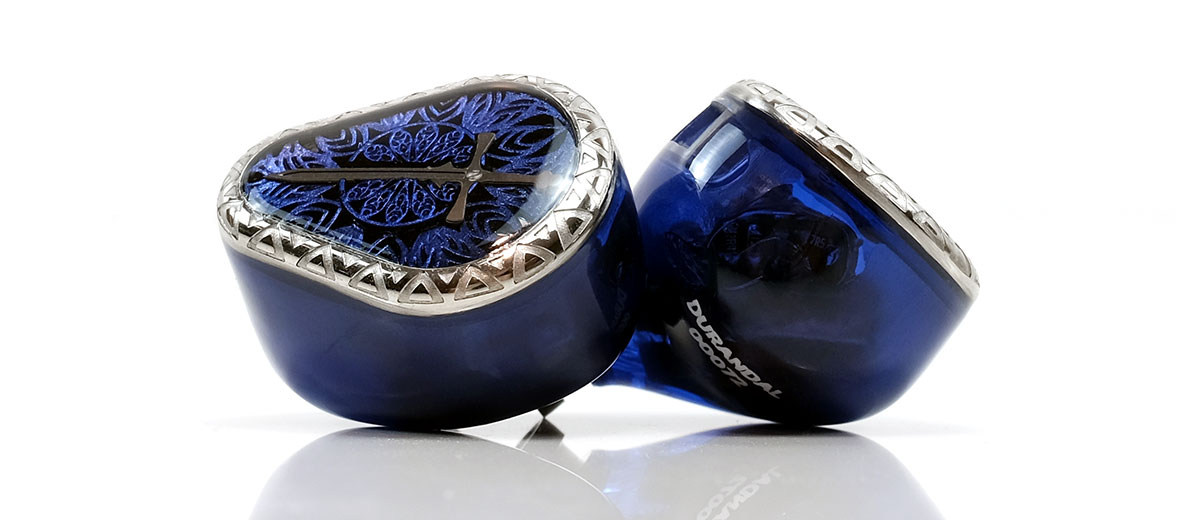
The following comparisons to the Nostalgia Audio Durandal were completed using a mix of the iBasso DX340 and the Cayin C9ii, the stock cable, and the Royal Blue Symbio W ear tips.
Nostalgia Audio Tesseract
The Tesseract was initially launched as a limited-run IEM in 2023, though Nostalgia Audio still has it for sale on the website. By price alone, this is the company’s flagship monitor.
Technical
The Tesseract is a hybrid as opposed to the tribrid Durandal. What is missing is those bone conduction drivers with a ‘simpler’ mix of BA and EST inside the Tesseract.
Inside, there are a lot of drivers, more than the Durandal, with no less than 6 EST and 10 BA per side using a 5-way crossover. The precise split is 2 BA for lows, 2 BA for low-mids, 4 BA for mids, 2 BA for highs, and the 6 EST drivers for the ultra-high frequencies.
Arguably, people will point to the Durandal’s 9.2mm dynamic driver as something multiple BA’s for the lows cannot compensate for.
Others might prefer the tighter, punchier sound of BA lows, and with the Tesseract’s LPL 3D-printed 72 mm ultra-long bass duct structure, it does deliver more realism than other BA IEM lows.
The two IEMs share some in-house technology, namely, SFD or Spiral Flow Device technology, which is a ridged helical formation in the tubes that produces a spiral soundwave flow to maximize midrange resolution and vocal performances.
The Tesseract is rated at 18Ω impedance with an SPL of 118 dB/mW, which is a similarly light load and high enough sensitivity on paper compared to the Durandal’s 15Ω and 115 dB/mW rating.
In practice, despite having power-hungry EST drivers, the Tesseract stayed true to its sensitivity rating, sounding slightly more sensitive than the Durandal.
Design
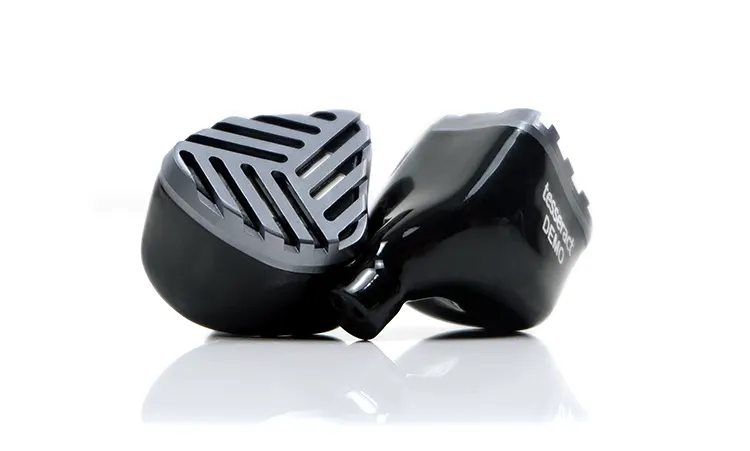
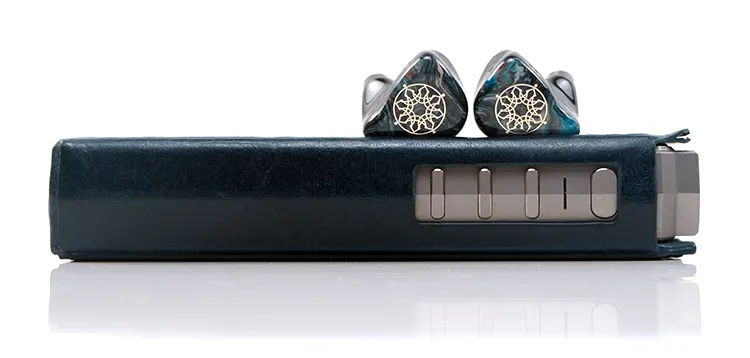
I did say on page 1 that I felt the Durandal was slightly above average size. Well, it’s kind of small compared to the size of the Tesseract.
Not surprising really, given that the Tesseract is packing in 16 drivers plus multiple EST energizers compared to 7 inside the Durandal. Side by side, the Tesseract is noticeably taller on the rear of the main shell with a wider diameter on the top side.
Both have relatively stubby-looking nozzles, but the Tesseract will stick out a bit more courtesy of that enhanced shell size. Since the Tesseract has no dynamic driver venting, it has a superior passive isolation performance to the Durandal and no driver flex.
Aesthetically, both are incredible-looking IEMs. This will come down to personal preference. I admire the Tesseracts’ unique 3D-like grill patterns, giving it a very cyberpunk-themed look, consistent with its luxury packaging, which is probably one of the best I have seen from any IEM.
The Durandal plate and shell mix is more intricate, more colorful, more in keeping with Nostalgia Audio’s bias to historical themes, with an excellent accessory line-up but perhaps a little more conservative on the packaging.
Both have proprietary stock cables with striking designs, though I believe the Tesseract version is not a 3rd party collaboration.
Its 4-strand 22AWG high-purity silver wire mix is a more neutral performer compared to the warmer, richer performance of the 21.3AWG 4N OCC silver and silver-plated 5N LC-OFC copper Hruodland.
Performance
I prefer the tonal balance of the Durandal, but the technical capability of the Tesseract, particularly its imaging and instrumental separation through the mids, is superior. How you view the pros and cons of that will depend on how you like to listen to your music.
For example, the enhanced lows of the Durandal dynamic driver deliver more power, weight, and gravitas for bass-centric or rhythmic recordings.
The Tesseract has a very punchy mid-bass and, like the Durandal, it has an elevated 100- 500 Hz upper-bass and lower-mids creating some warmth and body in midrange instrumental timbre. What it lacks is sub-bass extension and presence, both of which are much more noticeable from the Durandal.
The Durandal’s slightly stronger lower treble elevation also introduces a bit more contrast into midrange instruments and vocals, which gives them a slightly more accurate tonal quality compared to the smoother, more rounded sound of the Tesseract equivalent.
However, the mids of the Durandal are not as open or holographic sounding, with less width in its stereo field. Vocals are more believable than the smoother Tesseract to my ear, but they sit closer to instrumental positioning on the stage.
Tonal bias is more to the lower-order harmonics in the Durandal mids. If a piano string strikes, you hear the bass note of any string chord quicker than the middle or upper notes. The Tesseract fleshes out the chords more evenly with more air and a slightly lighter touch, so it’s more of an accompanying instrument than a dynamic attention seeker.
Despite the lack of sparkler from the Tesseract EST drivers, they do sound like they offer more headroom than the Durandal. The latter’s treble tuning is more focused on creating improved instrumental harmonic contrast in the mids.
SWEEAR SR11
The SWEEAR SR11 is another Hong Kong IEM launched back in 2023 and has a similar price point to the Durandal.
Technical
The SR11 is a tribrid, but unlike the Durandal, it has no bone conduction drivers. Instead, it has a mix of dynamic, BA, and EST inside with a slightly larger 10mm dynamic driver for the sub-bass frequencies only and 2 BA for the mid to upper bass tuning.
The Durandal 9.2mm driver covers the entire low-end range, which is a more traditional grouping for the lows. There are some manufacturers, like SWEEAR, who mix BA and dynamic for the lows to try and capture the natural sub-bass dynamic decay with the tighter BA mid-bass punch.
The SR11 has 4 BA for tuning beyond, with 2 for the mids and 2 for the mid-to-high frequencies, whereas the Durandal uses 2 for the mids and 2 for the highs. What is missing from the Durandal driver array is the SR11’s quad electrostatic driver array for the highs/ultra-highs.
The SR11 is rated at 14Ω and 112 dB @1kHz mW, which is not that far from the Durandal’s 15Ω and 115 dB/mW rating. However, with EST drivers, I found in practice that the SR11 needed a little bit more volume from sources such as the Cayin C9ii and the DX340/AMP15.
Design
There are several talking points in their design differences, but the two that stand out for me are the form factor and passive isolation capabilities.
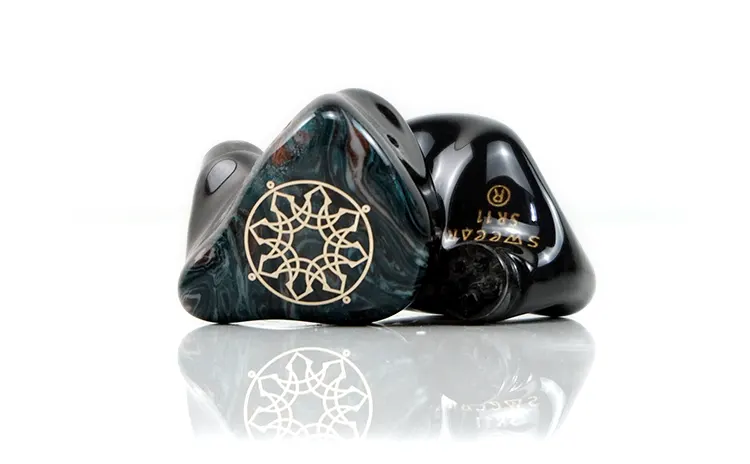
In both instances, the SR11 has a small advantage. Despite being a vented hybrid, similar to the Durandal, its more compact size and aggressive resin contouring produce a tighter fit, increasing the passive noise isolation capability.
The Durandal’s bigger form factor and gentler curves do not seal quite as well, though it is arguably close with the Symbio W tips.
The flip side is the design. From the box to the accessories and shell designs, the Durandal is miles ahead of the SR11. Honestly, the SR11 looks a bit cheap beside the Durandal’s more intricate finishing. The Durandal looks like an expensive IEM, the SR11 less so.
The same is true for the stock cable choices. The SR11 cable is an 8-wire high-purity silver-plated copper Litz geometry sheathed in a very soft translucent braided jacket, with a key advantage of having swappable jack heads.
However, it’s one of those cheaper-looking 8-wire cables you see knocking around with mid-tier IEMs with dated-looking chunky carbon fiber printed aluminum barrels.
It performs ok where you need it to with low microphonics and nice handling, but it’s a league below the aesthetics and finishing of the Durandal’s Hruodland stock cable.
Performance
Two very competitive IEMs here, and technically, there is not much to separate them. I think it will come down to how you like your mids and highs as the deciding point.
The SR11 is far more neutral and drier-sounding through the mids and highs, but with the larger dynamic driver and a stronger lower mids dip, its bass-to-mids separation and slightly stronger sub-bass linger are more noticeable.
The Durandal also has an elevated sub-bass response, but you can tell it’s a slightly smaller driver, sub-50Hz, where it leans back slightly compared to the SR11 equivalent performance.
What it has over the SR11 is more upper-bass and lower-mids elevation, which carries more warmth and richness into the midrange performance.
The SR11 vocals are forward-sounding, but they carry less weight and textured detail. The Durandal mids are lusher-sounding, richer in detail, and more emotionally engaging. The SR11 is more precise through the mids, perhaps more accurate in placement and imaging, but conveys less engagement.
I would say the SR11 treble is more filled-in compared to the Durandal. Yes, there is contrast from the highs of the Nostalgia Audio tuning, but it’s not as pristine or sparkling as the SR11 treble tuning.
You get more contrast and perceived speed from the SR11 treble, which in turn creates more focus on percussion and string attacks. Whereas the even harmonics of the Durandal’s lows have more presence, creating a more natural sound with slightly less intensity in the highs.
Noble Audio Onyx
The Noble Audio Onyx was launched last year and, like the Durandal, it comes with bone conduction drivers, albeit at a slightly higher price point.
Technical
The Onyx is the only one of the three comparisons that uses a bone conduction driver alongside dynamic, BA, and EST. You could argue that this is a quad-brid, with the Durandal using only dynamic and BA and no EST.
The Onyx has a slightly larger 10mm dynamic for the lows, with 4 BA split evenly between the mids and highs, and dual Sonion ESTs for the ultra-highs.
It uses a single PZT Bone Conduction driver for some additional mid and treble texture, whereas the Durandal invests a bit more with 2 Sonion dual-diaphragm bone conduction drivers targeting the lows and mids.
The Onyx is rated with an impedance of 14Ω and an SPL of 108 dB/mW @1kHz, which feels about right as it is slightly harder to drive than the 15Ω and 115 dB/mW rated Durandal. However, the Onyx EST driver arrays require a bit more gain or volume to get them up to adequate listening levels.
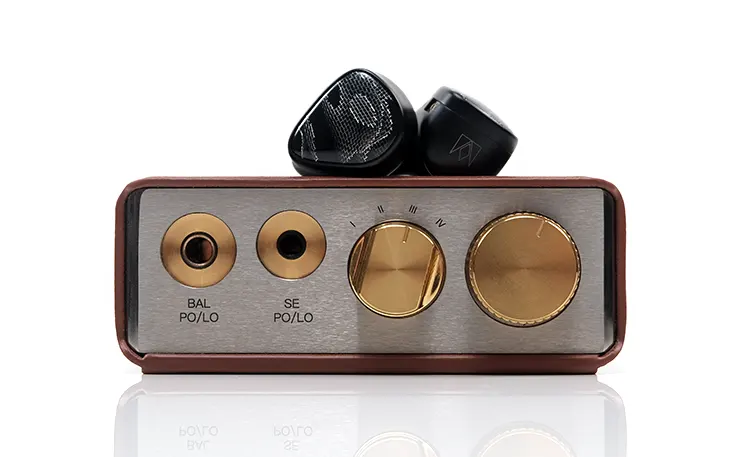
That being said, it’s not an IEM that needs heavy-duty amping. A good quality dongle, such as the iBasso DC-Elite or the Cayin RU7, on a high-gain balanced connection will drive both quite well.
Design
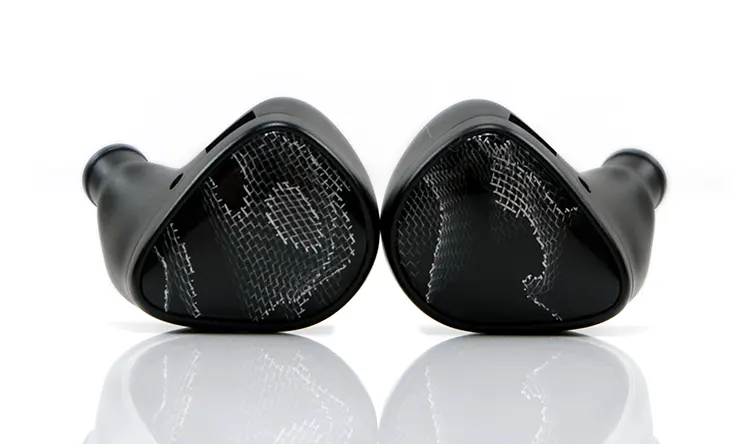
Both Nostalgia Audio and Noble put a lot of stock in their IEM designs, though the Onyx is perhaps one of their darkest and most low-profile releases to date.
This is an ‘adult’ noire aesthetic versus geekier, intricate, and brighter. I understand preference is wholly personal, there is no denying that the Durandal stands out more with its silvery shimmer of sword and rim versus the 3-dimensional weave effect from the Raffir-partnered composite faceplate.
The Onyx is also a little bit bigger, but it does own Noble’s penchant for long nozzles, giving it a slight edge in passive isolation despite using tougher but less malleable aluminum for the shell.
These shells have a little more aggression in their contouring compared to the Durandal, but it’s more about the careful positioning of the nozzle that creates an excellent seal. Sweet spotting is important for the onyx to work well, something which is less necessary for the Durandal.
Both IEMs come with excellent cables. I would say Durandal’s Hruodland has the more thematic identity, but Noble’s partnership with Eletech has produced a lighter and just as exquisitely designed cable called “Courage”.
The internal geometry of the Hruodland is a class above with its 21.3AWG Type 9 Litz configuration, but the Courage’s smaller 24AWG gauge OCC silver-plated copper wire should still have a high ‘N’ rating in terms of purity.
Performance
The Onyx is a darker-sounding L-shaped monitor compared to the Durandal’s more V-like listening experience.
What is missing from the Onyx is energy and sparkle from 2k onwards, which the Durandal has more of. The Noble tuning does rise a bit more to neutral from 6k onwards, but it’s nuanced rather than overt to ensure the tonal quality of the instrument and vocal is not overly rounded or suffocated.
So, the Onyx can sound spacious, but at the same time, your ear does not really gravitate to its highs because the bump is subtle.
The Durandal sounds more balanced. It is not as heavy on the lows, something which the Onyx excels in. And though both have some mid-bass and upper-bass lift, it’s the Onyx that is more emphasized, creating that L-Shape sound signature.
The Durandal keeps it tighter with more of a dip in the same region to enhance its bass-to-mids separation. Combined with a noticeably more lifted midrange and stronger mid-treble amplitude, the contrast in the Durandal timbre is more noticeable, giving it a livelier sound for percussion.
The Onyx is heavy-handed on the lows but rather relaxed in the mids, with vocals that remain clear and easy to pick out but not as vivid as the Durandal vocal tuning.
I would describe the overall Onyx mids as relaxed, sibilant-free, with decent body, and surprisingly good separation and space. The Durandal is equally as spacious, certainly a lot more articulate in the highs, though not quite as deep-sounding.
My Verdict
The Nostalgia Audio Durandal is a beautifully designed high-end tribrid IEM with a deep and powerful sound signature and richly textured vocal performances aimed at modern music-loving audiophiles.
Those who like a more nuanced, open sound, or perhaps an airier, lighter tone with more width, might prefer to have a look at the excellent Tesseract. The Durandal is more ’emotionally’ driven to my ear than the flagship presentation.
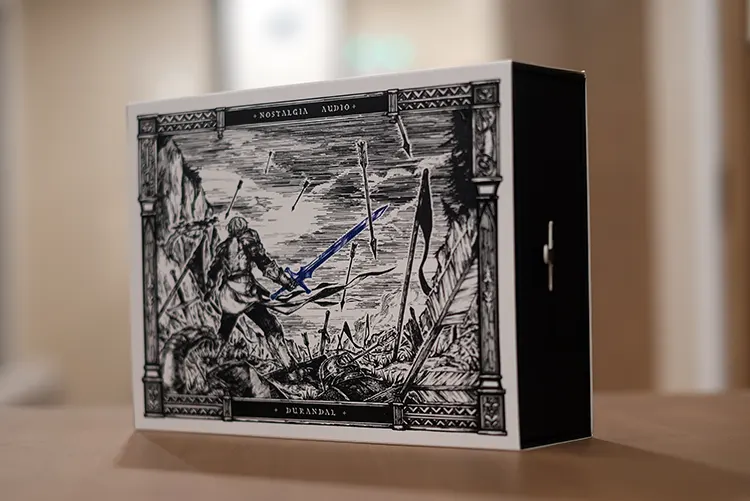
Beyond the sound, everything about the Durandal is properly thought out. From the packaging theme to the design and the tuning, there is so much attention to detail from Nostalgia Audio. Like the Tesseract, you certainly feel like you are buying a premium package
Nostalgia Audio Durandal Technical Specifications
- 7 Individual Drivers, Tribrid Design
- 1 Dynamic Driver – Bass
- 2 Bone Conduction Vibrator – 2 Mid-Low
- 4 Balanced Armature Drivers – 2 Mid-High, 2 High
- 4-Way Crossover Design
- Spiral Flow Device
- Impedance: 15 Ohms @ 1 kHz
- Frequency Response: 12 Hz – 30 kHz
- Sensitivity: 115dB @ 1 kHz, 1 mW
