

Synergy
Power
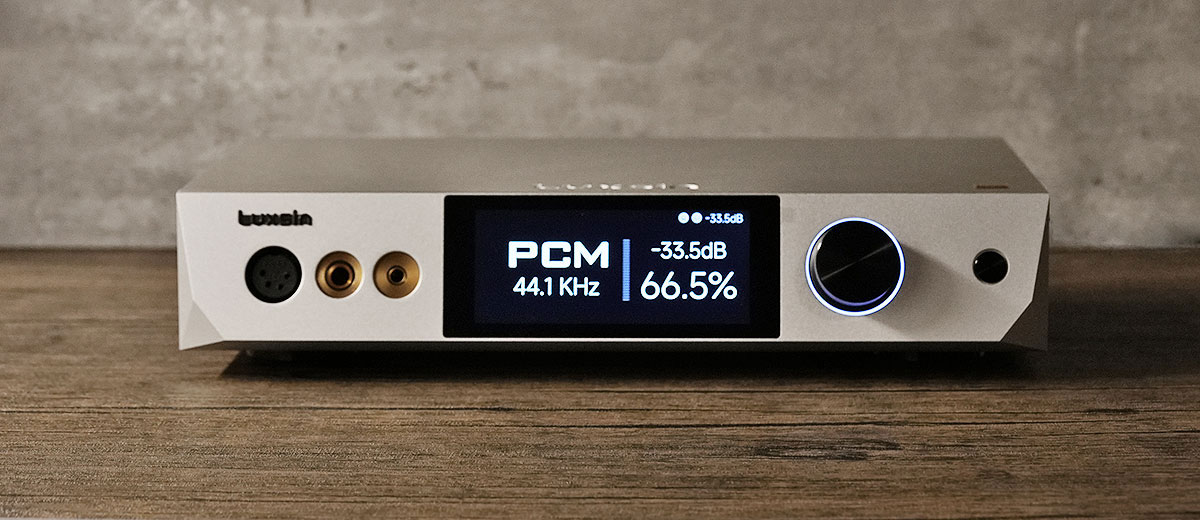
The Luxsin X9 can deliver up to 6.4W per channel into 16ohms, dropping down to 3.5W into 32 ohms, which is powerful enough for most headphones in the market. The preamp output also displays satisfactory power with solid, firm kicks, also definitive power.
While the max output power is decent, the lower gain level is probably set for sensitive gears, and you may manually adjust the gain level, as the impedance sensing feature is just a reference, and various drivers may respond to power differently.
The Luxsin X9 is dead quiet at all gain levels, even when pairing it with sensitive IEMs. There is good dynamics maintained with all gears paired with it for tests, and at low volume, there is no channel mismatch at all, thanks to the R2R ladder volume.
For sensitive gears, you can switch to 0.5dB per volume step, which would allow adjustment to the finest output intensity if such precision were needed.
As mentioned, the design allows automatic impedance detection to give a suggested gain ratio and allow better efficiency. While the tuning doesn’t intentionally stress the two ends, it allows details across the whole spectrum to be revealed.
The output is also very responsive, which allows fast, consecutive current draws when listening to large-scale recordings and fast double-kick drumming to be clearly and powerfully presented.
Pairings
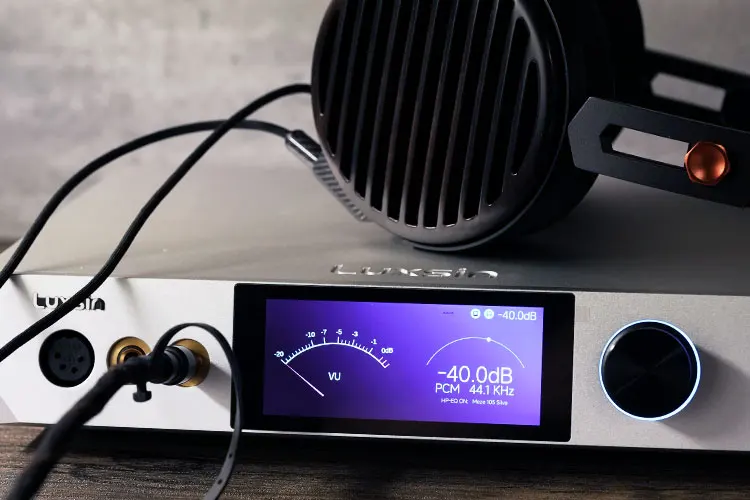
The Luxsin X9 shines with its HP-EQ presets and has sufficient power and control to sound enjoyable, while allowing easy adjustments to suit personal preferences.
Without DSP, the decoding quality is fair and is unlikely to stand out from the competition. With DSP on, the dynamics will immediately improve without compromising distortion performance, and this works with a wide range of gears that are not commonly achieved by traditional amping devices.
When tested with the current-demanding MOONDROP COSMO, also the HIFIMAN ISVARNA, the X9 delivers a natural output without obvious distortion at large volume listening to large arena-like recordings. The soundstage is wide, and the bass response is quick and punchy.
With the more sensitive FiiO FT7 planar headphones, the bass is more agile, while the treble adds brilliance and penetration. This results in a dynamic presentation that makes woodwinds, brass instruments, and cymbals exciting yet well-controlled.
Testing with large bells reveals nicely captured resonance overtones, free from peaking or distortion, even during intense bowing and fast-paced bass attacks.
Without any DSP options enabled, there can be a slight digital glare with sensitive, clean-sounding gear like the Meze 105 SILVA. However, applying the curve profiles significantly enhances the engagement.
With warmer headphones like the HD 800s or Meze 105 AER, the sound becomes lusher and more organic, which I prefer, especially at higher gain levels, as it sharpens upper vocal frequencies.
DSP isn’t magic, and can’t fix issues like strong impedance skews, but it does help different headphones sound more natural and smooths out unwanted spikes in this case.
The Stereo Width setting is also worth exploring, as it spreads the sound image, creating a more relaxed listening experience. The effect feels natural; in fact, it can be difficult to tell that DSP is active, especially with unfamiliar tracks.
Additional Headphones
For headphone models that are not yet included in Luxsin’s database, they also provided a submission channel where users can request to have their models added.
Select Comparisons
FiiO K17
Technical
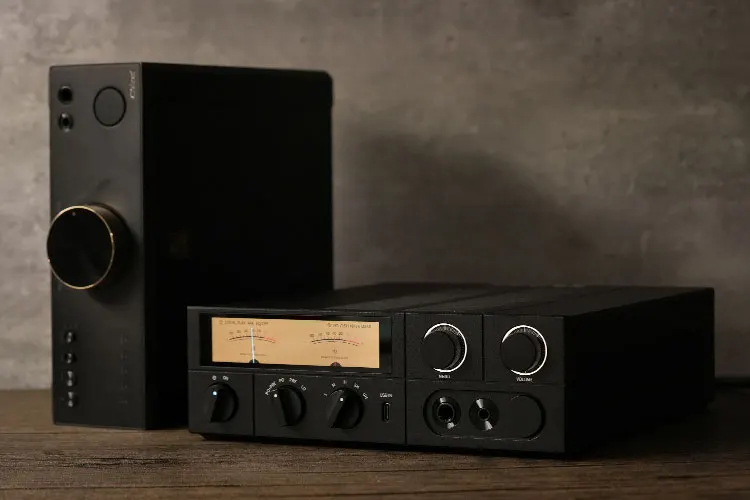
The FiiO sub-flagship K17 packs in 4000mW per channel output power and features a touch panel display. The K17 uses the AK4191 and AK4499EX*2 combo for decoding, supporting up to DSD512 and 32-bit/768kHz.
For DSP tweaks, it features a discreet M21586Q chipset for user-configurable PMEQ, and it can be configured over a graphical UI on a PC.
I am not going to drill deep into the numbers as the performance are beyond hearing thresholds, but it is obvious the X9 doesn’t double up the AK4499EX and uses AKM’s DSP chipsets, as well as using a more precise volume control methodology.
It is more about the implementation after all, and comparisons will be made in the sound session below.
Design
The K17 remains one of the coolest designs, blending retro and modern elements in a sleek package. Like the X9, it can be controlled with a phone app, and the design supports local music playback, which makes it a simple-to-use player.
Considering just the housing design, both look well-built. The X9 uses thicker materials than the bent sheet metal on the K17, which should allow better physical damping and anti-interference performance. The tilted screen also makes it easier to operate when standing.
For the DSP features, the X9 is a clear winner here with plenty of pre-loaded profiles. You can combine different DSP effects and switch some of them off at any time.
This requires much less effort and knowledge in tweaking the output, since you don’t need to look up the curves of the headphones and experiment from scratch.
Performance
On stock tuning, without any DSP or equalization activated, the X9 feels slightly flatter-sounding compared to the K17 and not as polished in the vocal range.
However, it offers a faster transient response and a cleaner, tighter bass attack, which delivers stronger definition to the bass. The K17, on the other hand, has more warmth, which adds body to vocals and brings them forward in the mix, providing a more expressive decay.
When testing the HD 800s on the X9 with HP-EQ enabled, the output becomes more contrasting and naturally articulated, thanks to the various selectable target curve profiles.
The upper register, particularly for percussion, sounds more polished, and the experience becomes even more immersive with cross-feed activated.
The K17 delivers a denser, fuller bass punch and creates a stronger stereo image, but I still find the X9 to be more engaging overall with its stronger outline and agility.
Testing both devices with the MOONDROP COSMO, rated at 15Ω and more challenging for amplifiers, the X9 once again excels with sharper transients that yield better clarity.
The K17 renders vocals with more fullness in its stock setting, but the image gets more dispersed. The X9 provides a more distinct, separated image with a stronger sense of focus and control, with less alteration to the midrange frequencies.
If you have a large selection of headphones, the X9 offers significant advantages in adaptability. However, if you prefer not to engage with any EQ, I recommend the K17 over the X9, as it sounds nice and engaging in stock settings with various gear and includes more system features beyond DSP.
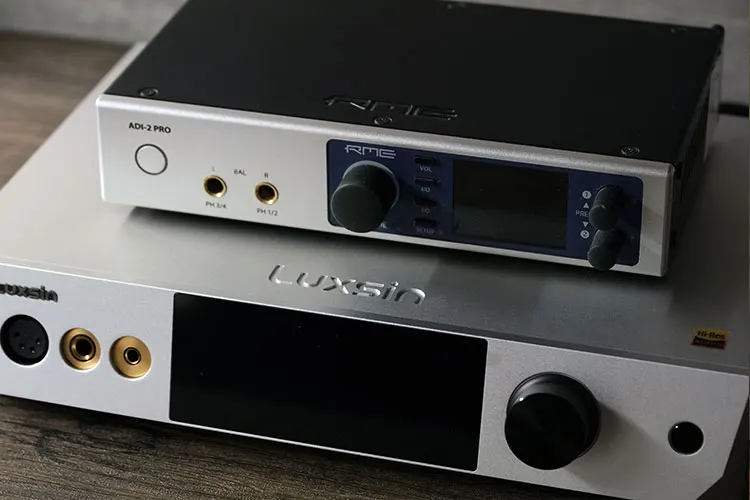
RME ADI-2 Pro
Technical
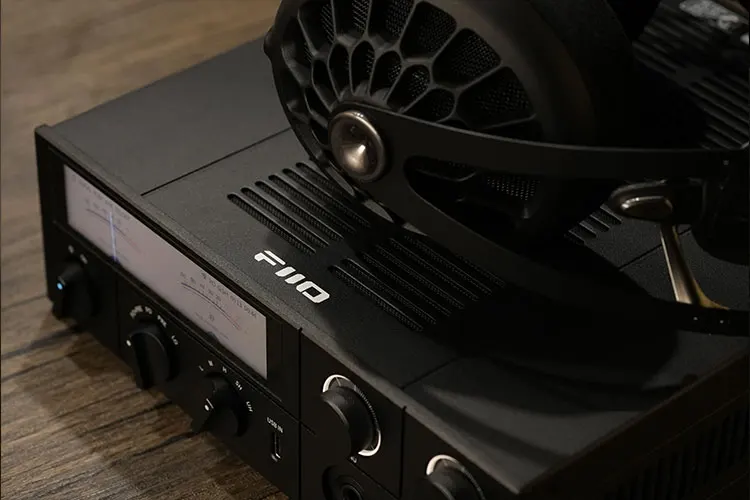
The RME ADI-2 Pro is one of my own benchmarks for comparison, and it has some merits, such as a 0.1Ω impedance, which works very well for sensitive monitoring earphones.
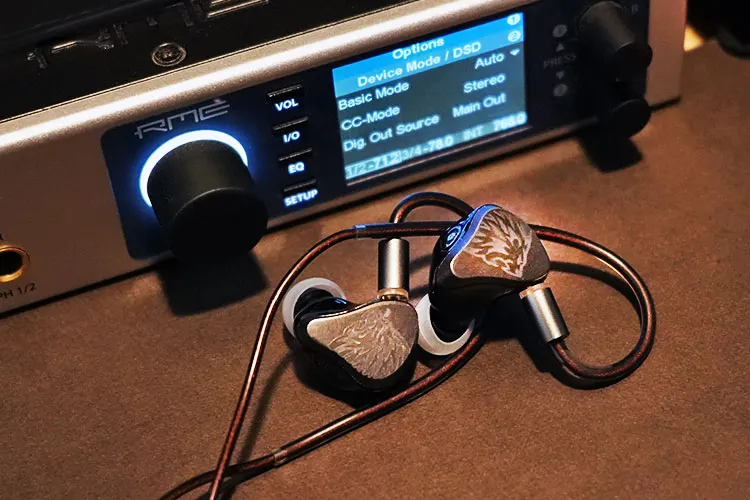
It is also an early example of practical EQ implementation and has multiple switchable profiles, which can be configured on the device as well as over an intuitive UI on Macs. The ADI-2 Pro has an external power supply, unlike the X9, which has everything built in.
Design
The ADI-2 Pro is much more compact and allows you to navigate the menu using a multi-function knob and buttons. However, I’m not a fan of the control layout as it feels comparatively confusing.
Since the ADI-2 Pro is designed for professional use, with options to connect instruments for recording, I won’t drill too deeply into comparisons.
However, for most users, the X9 is significantly easier to operate and features a more advanced user interface.
Its larger touchscreen supports gesture control and includes built-in presets for various headphones, making it accessible for more people to enjoy the benefits of DSP without a steep learning curve.
Performance
The ADI-2 Pro has long been a reference for me, as it provides a strong sense of control, bass texture, and excellent tonal balance across various pairings.
It consistently reminds me that single-ended (SE) output can be more engaging than balanced (BAL) output, even if its power sometimes falls short.
When connected to very sensitive IEMs, such as the Hiby Zeta, Westone’s MACH 70, as well as headphones like the Meze 105 SILVA, the synergy with the ADI-2 Pro is excellent.
It delivers a dynamic sound, layered with distinct stereo imaging that is precise, well-separated, and free from harshness.
Instrument positioning and layering, along with vocal outlines, are well executed, although the overall firmness in attack and definitive power, as well as extension, don’t quite match the X9.
The strengths of the X9 become more apparent with higher-impedance loads, such as the HIFIMAN ISVARNA, MOONDROP COSMO, and the HD 800s, which require stronger swing and current to perform at their best.
With the combination of digital filters and DSP, the X9 delivers a crisp, textured sound that is well-controlled, offering punchier bass and more definitive power than the ADI-2 Pro, which can struggle with resolution and may sound compressed or congested with larger ensembles.
Additionally, I tried to compare the Pre-out connecting to speakers; the difference is quite obvious. The ADI-2 Pro has a dark, smoothly articulated pre-out output which focuses more on the mid-lows to sound delicate and clearly imaged
The X9 has a higher output level, sounding more powerful and firmer in the bass punch, with stronger technicalities, and is overall cleaner and more detail-rich.
My Verdict
It feels like the future is here with the Luxsin X9, which truly brings DSP features to the masses, making them much more approachable and intuitive to use.
Having listened to many headphone amplifiers, few offer the same flexibility in manipulating output tone and provide graphical correction as quickly and easily as the X9.
The comprehensive I/O options, including dual sub outs and HDMI Arc inputs, are also great additions if you want to integrate it into the home system.
While the decoding quality is satisfactory and the output is free from distortion, it’s important to note that if you leave the DSP untouched, the X9 may not feel as competitive or engaging as some other gear on the market, possibly because of its flatter base tuning.
However, when the DSP is activated, the output tonality becomes convincing, and it can sound much more engaging. Other practical and enjoyable DSP features on board are not limited to the compensation of curves.
After all, this is a pioneering, practical implementation of DSP, which makes the experience much more enjoyable.
I would readily recommend this to those who frequently switch between a diverse collection of gear with varying power requirements, as well as those who always get bored with the stock tuning on traditional decoders and amplifiers.
The Luxsin X9 is more impressive when continually testing with more gear, and I look forward to seeing future versions, perhaps featuring even stronger DAC chips and more advanced DSP capabilities.
Luxsin X9 Technical specifications
- Decoding: DSD512, PCM 768KHz 32-bit
- Bluetooth receiver mode: BT5.0, support AAC/SBC
- USB-B audio input: Support Windows (10, 11), Android, IOS
Optical/Coaxial audio input: Support PCM 192KHz 24-bit, DoP64 - HDMI ARC: Support PCM 192KHz 24-bit
XLR Audio Output
- Output level: 4.2Vrms@0dBFS
- Dynamic Range:> 128dB
- Signal-to-Noise Ratio (SNR):>128dB
- THD+N:<0.000096% (-120.3dB) @ Unweighted
- Crosstalk:>-117dB
RCA Audio Output
- Output level: 2.1Vrms@0dBFS
- Frequency Response:20Hz~20KHz (±0.25dB)
- Dynamic Range:> 125dB
- Signal-to-Noise Ratio (SNR):>125dB
- THD+N:<0.00010% (-119dB) @ Unweighted
- Crosstalk:>-114dB
Headphone Audio Output
- Output level: 4-15Vrms@0dBFS
- Frequency Response:20Hz~20KHz (±0.25dB)
- Dynamic Range:> 128dB
- Signal-to-Noise Ratio (SNR):>128dB
- THD+N:<0.00016% (-116dB) @ Unweighted
