

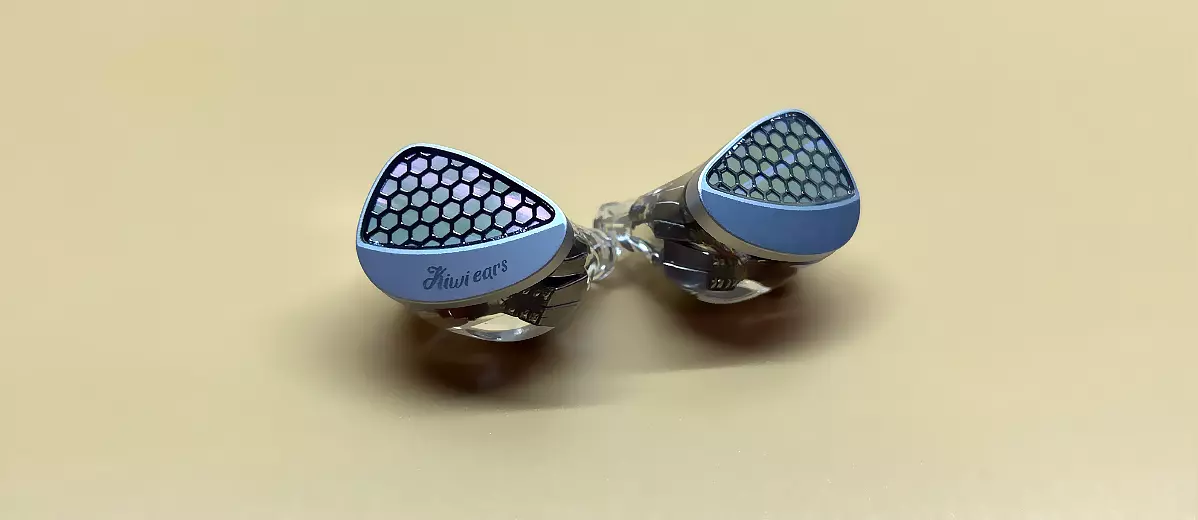
Meldrick reviews the Kiwi Ears Orchestra II, a second-generation universal IEM with 10 balanced armature drivers and currently priced at $349.00.
Disclaimer: This sample was sent in exchange for my honest opinion. Headfonics is an independent website with no affiliate links or services. I thank Linsoul and Kiwi Ears for their support.
Click here to read up on the Kiwi Ears gear previously reviewed on Headfonics.
This article follows our scoring guidelines, which you can read in more detail here.
Kiwi Ears has been steadily building its reputation in the Chi-Fi space, particularly with its Orchestra and Orchestra Lite IEMs. The original Orchestra launched at $500 in 2021, followed by the more affordable Orchestra Lite.
Now, Kiwi Ears returns with the Orchestra II, packing 10 custom-designed balanced armature drivers into each shell at an impressive $349 price point. This represents a significant upgrade in driver count over the original while simultaneously dropping the price.
This places it squarely in competition with contenders such as the MOONDROP Blessing 3, Yanyin’s Canon II, and the 7Hz Aurora. To see if the Orchestra II’s all-BA approach can hold its own against hybrid driver alternatives, you can read my full review below.
Features
The Orchestra II packs an impressive 10 balanced armature drivers per side, all custom-designed in-house by Kiwi Ears.
The driver configuration consists of 2 transparent low-frequency BAs, 4 mid-frequency BAs, 2 high-frequency BAs, and 2 ultra-high-frequency BAs.
What sets these apart is Kiwi Ears’ proprietary transparent acrylic bass driver housings.
Unlike conventional metal-encased BA woofers, these clear acrylic constructions are said to minimize acoustic resonance while also offering visual appeal through the transparent shells.
All 10 drivers are routed through a sophisticated 4-way crossover system with three acoustic channels leading to the nozzle.
This complex internal architecture is implemented to ensure proper phase alignment and frequency division across the entire audible spectrum.
Unlike vented dynamic driver designs, the all-BA configuration requires no external venting. Ideally, this allows for superior passive noise isolation, as the sealed shells effectively block ambient noise without compromising driver performance.
Design
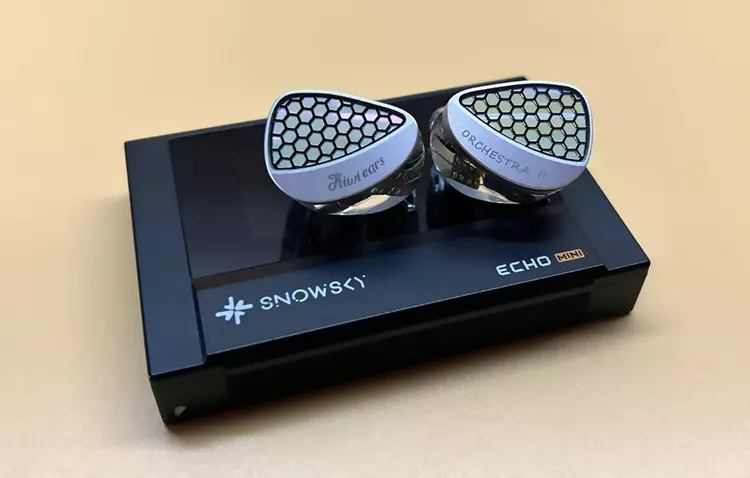
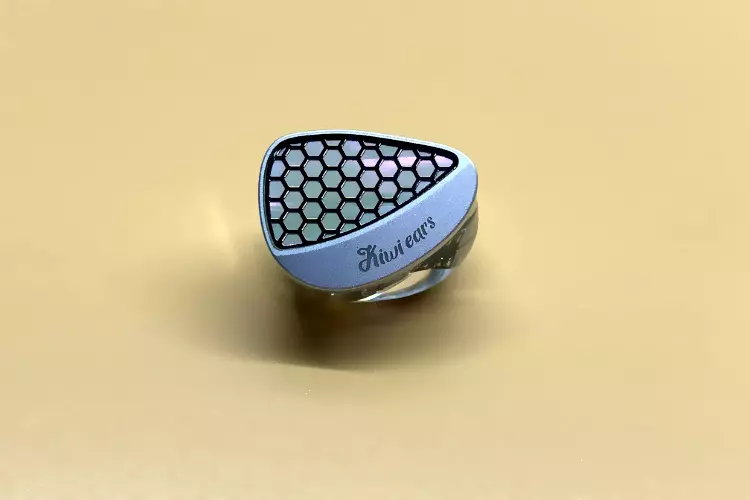
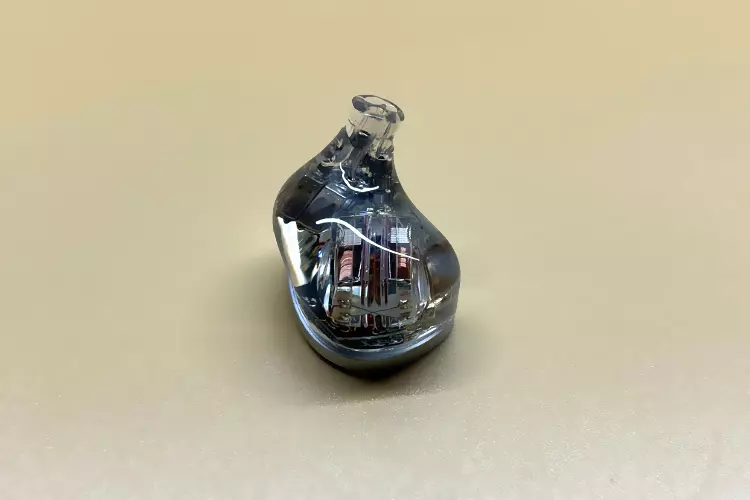
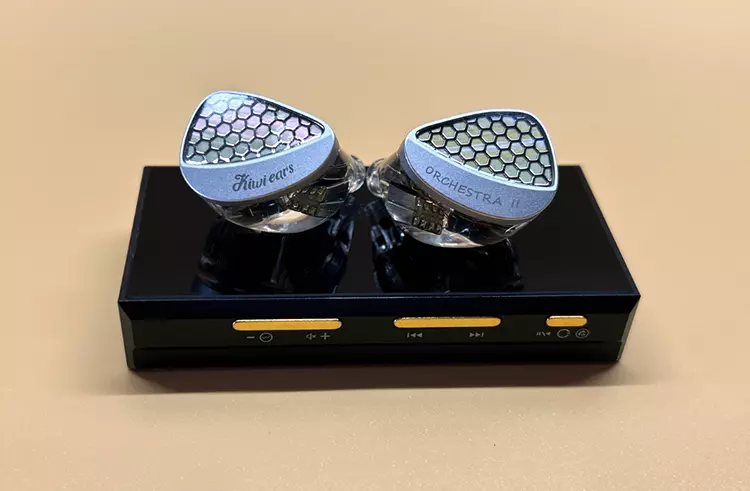
The Orchestra II showcases a striking aesthetic in which function complements form. The shells are crafted from transparent medical-grade resin, allowing full visibility of the internal driver array and circuitry.
This “see-through” design has become increasingly popular in the audiophile space, and Kiwi Ears executes it beautifully.
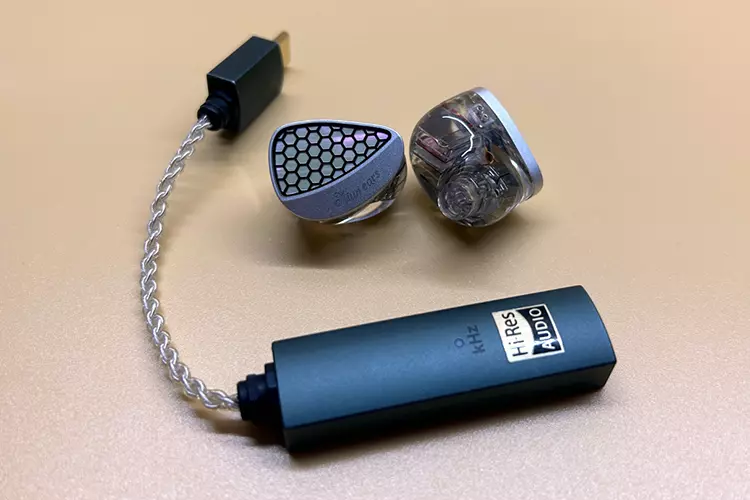
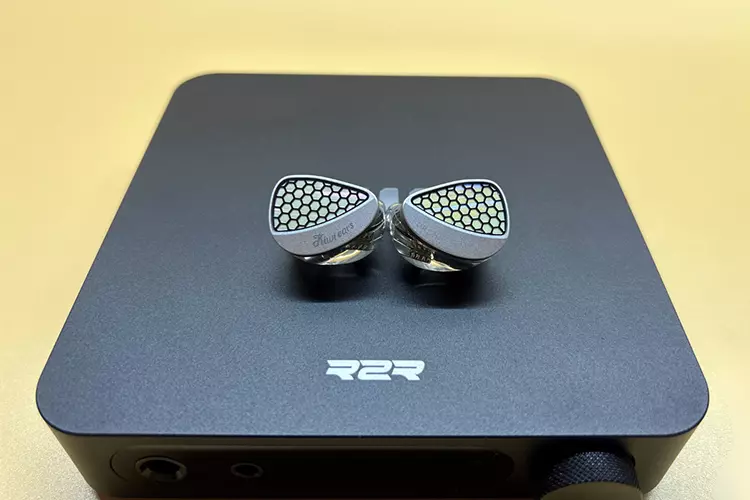
The faceplate features a hexagonal honeycomb mesh pattern in aluminum, overlaid with an iridescent, pearl-like finish that shifts colors under different lighting conditions. This gives the IEMs a premium, jewelry-like appearance that stands out without being too gaudy.
Through the crystal-clear shells, you can observe all 10 BA drivers, including the distinctive transparent bass drivers with their visible copper coils and metal plates, designed to be visible through the transparent housing.
The 2-pin connectors sit flush with the shell surface and feature the same clear resin construction, maintaining aesthetic consistency throughout the design.
The shells themselves are on the larger side, measuring approximately 7 grams each. The rounded shape extends noticeably from the ear, though the ergonomic contouring helps distribute weight evenly. The solid construction adds both mass and superior noise isolation properties.
Comfort & Isolation
Despite its substantial size and 10-driver configuration, the Orchestra II manages surprisingly good comfort for extended listening sessions.
The rounded shell shape follows the natural contours of the ear, and the weight distribution prevents any specific pressure points from developing.
I was able to wear the Orchestra II for 3–4-hour sessions without significant discomfort, though the larger shell size did require some adjustment compared to more compact IEMs.
The smooth resin finish prevents any sharp edges or hotspots, and the shells warmed to body temperature quickly.
However, the 6.6mm nozzle diameter and overall shell bulk may present challenges for users with smaller ear canals.
I found myself twisting and adjusting the Orchestra II more than usual just to find a good seal. This is not inherently a con, but it does make it slightly more inconvenient than other, more compact IEMs
The isolation performance is exceptional, ranking among the best I’ve experienced with universal IEMs. The combination of solid resin construction, gel-filled internals, and sealed BA design blocks external noise remarkably well.
I found it effectively attenuated office conversations, keyboard typing, and even moderate street noise when worn outdoors.
However, the lack of venting means that no driver caused some pressure buildup during my testing.
After twisting and adjusting the IEMs, the pressure reduced significantly, but I still noticed a measurable difference compared to the vented IEMs I’m more accustomed to.
Stock Cable
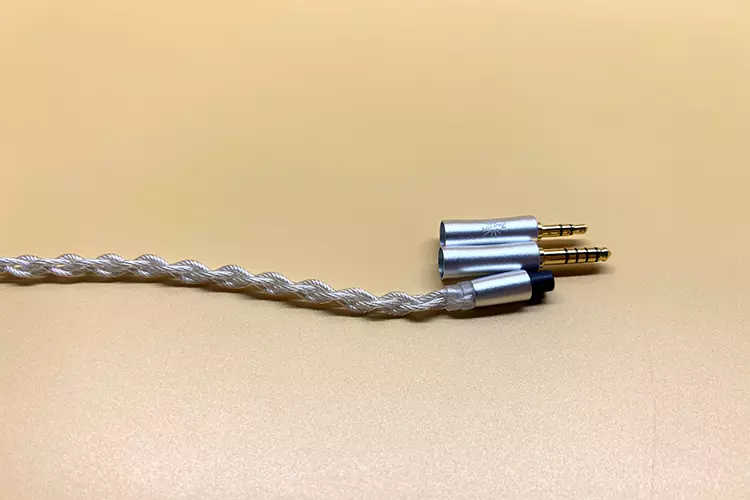
The Orchestra II includes a high-quality 4-wire single crystal copper silver-plated cable that immediately impresses with its construction and aesthetics. The shiny white braided design complements the transparent shells perfectly.
The cable provides excellent durability while maintaining flexibility. Unlike some braided cables that tangle easily, this one resists kinks and smoothly straightens after being coiled in the carrying case.
During my mixed desk and on-the-go testing, I did not notice any microphonics at all. The cable remained firm enough to remain straight even on long walks, and it retained its position properly during desk usage as well.
The standout feature is the modular termination system. Kiwi Ears includes both 3.5mm and 4.4mm plugs that attach via a friction-fit mechanism.
While not screw-threaded, the connection is secure and doesn’t accidentally detach during normal use. This modularity offers excellent value and versatility, allowing seamless switching between single-ended and balanced sources.
Packaging & Accessories
The Orchestra II arrives in a moderately sized box with Kiwi Ears’ signature green-yellow color scheme and prominent product imagery on the front. Lifting the lid reveals the IEMs nestled in protective foam cutouts, with accessory compartments beneath.
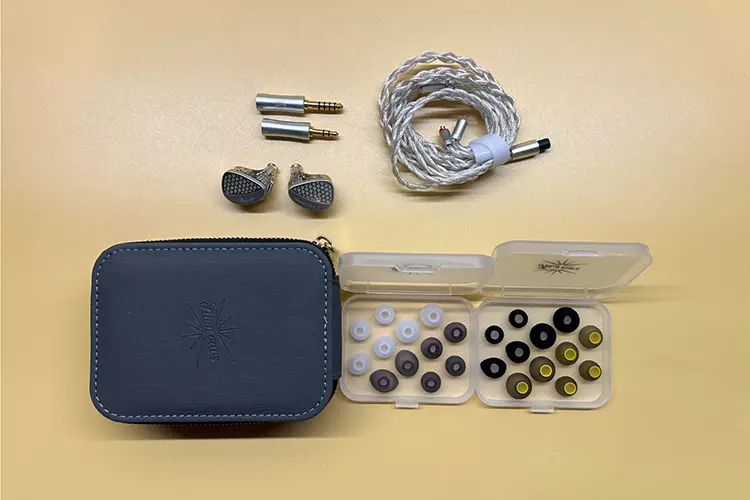
The package includes:
- The Orchestra II IEMs (1 pair)
- Stock cable
- 5mm plug (modular)
- 4mm plug (modular)
- 12 pairs of ear tips in various styles and sizes (S/M/L)
- 2 dedicated ear tip storage containers
- Premium fabric-textured carrying case with suede lining
- User manual and warranty card
The ear tip selection deserves special mention. Kiwi Ears provides four different tip styles. The two included tip containers are far more practical than the plastic bags many manufacturers provide, keeping tips organized and protected.
The carrying case features fabric texture and soft suede interior lining. It’s substantially larger and more premium than typical budget IEM cases. However, this IEM case is much too large to fit in a pocket and will most likely be placed in backpacks or larger slings.
Sound Impressions
Unless stated otherwise, all sound impressions of the Kiwi Ears Orchestra II were conducted using the stock cable with 4.4mm balanced termination and the white silicone tips.
I paired it with the ddHiFi TC35Pro E2, the iFi audio GO link Max, the iFi audio ZEN DAC, the 7HZ Artemis39, and FiiO’s K11 desktop amplifier.
Bass
The Orchestra II delivers a unique bass presentation for an all-BA design, emphasizing subtle yet deep sub-bass impact over thick mid-bass presence. The two transparent custom woofers produce a bass response that prioritizes finesse and precision rather than warmth or bloom.
Sub-bass carries a noticeable bump that only reveals itself when the track demands it. Electronic tracks benefit from this tuning, as the Orchestra II delivers satisfying depth without causing unnecessary bloat in the lower midrange.
Bass drops hit with authority and control, providing a surprisingly engaging low-end experience that defies typical BA bass limitations.
The sub-bass focus makes the Orchestra II particularly well-suited for modern genres. The deeper-hitting sub-bass combined with the elevated treble region creates an engaging presentation that outperforms more neutrally tuned IEMs for hip-hop and trap music.
Mid-bass remains relatively restrained compared to warmer IEMs. While not as full or thick as dynamic driver bass guitars, it provides enough body and weight to give bass guitars adequate presence in the mix.
Bass riffs and electric bass lines come through with slightly elevated energy, though without the same rounded warmth found in competitors like the Canon Pro.
The characteristic BA bass speed and clarity shine through consistently. Bass lines maintain excellent definition and separation, never blurring into the midrange even during complex passages.
The emphasis on sub-bass over mid-bass prevents the low-end from overpowering or masking midrange detail.
Mids
The Orchestra II has a mild U-shaped or smooth U-shaped glide tuning philosophy. The lower treble and upper midrange receive noticeable emphasis, creating a presentation that favors energy and presence over pure neutrality.
Female vocals emerge as a focal point of the tuning. They carry strong energy and forward positioning, standing out prominently in the mix compared to more neutral IEMs.
Higher-pitched female vocals particularly benefit from this tuning choice, though they can occasionally sound slightly shouty or artificially boosted, especially in stripped-down acoustic arrangements.
The elevated upper midrange and lower treble emphasis bring synths forward with impressive clarity and impact.
Electronic productions and synthesizer-heavy tracks sound vibrant and engaging, with excellent detail and resolution in the upper-mid synth region. This makes the Orchestra II particularly compelling for modern pop, electronic, and synthwave genres.
This U-shaped tuning creates trade-offs in the midrange presentation. More delicate acoustic guitars and string instruments don’t receive the same air or detail retrieval as they would on flatter-tuned IEMs.
The microdynamics have less room to breathe, occasionally getting overshadowed by the more prominent upper-mid and treble energy.
In stripped-down acoustic tracks, the peakiness of the vocal midrange can overpower more delicate elements like piano keys or fingerpicked guitar strings. The emphasis on forward vocal presentation sometimes comes at the expense of overall midrange balance and cohesion.
Male vocals and lower-midrange instruments fare reasonably well, maintaining adequate body and presence without sounding recessed. Bass guitars receive slightly more energy than neutral tunings would provide, giving them a satisfying presence in rock and metal tracks.
The Orchestra II handles complex midrange passages with good separation, though the tonal balance clearly favors upper-mid energy over lower-mid warmth.
This tuning choice creates an exciting, engaging presentation that sacrifices some neutrality and natural balance for impact and forward detail.
Treble
The treble region represents one of the Orchestra II’s most distinctive characteristics. The two ultra-high-frequency BA tweeters deliver elevated treble energy that some listeners will find engaging while others may consider excessive.
Trap and snare drums receive a forward presentation, cutting through mixes with authority and presence. The emphasis here brings percussion to the forefront. Snare hits sound crisp, immediate, and well-defined.
Cymbals carry noticeably more emphasis compared to neutral-tuned IEMs. Hi-hat patterns emerge with significant sparkle and energy, and cymbal crashes have a strong presence and sustain. This elevated treble tuning enhances the sense of excitement and detail in percussion-heavy tracks.
The stronger treble region creates an engaging presentation for genres that emphasize high-frequency content. Electronic music, pop productions, and modern hip-hop all benefit from the added treble energy, which brings out production details and adds air to the overall presentation.
However, the treble emphasis reveals some limitations with certain material. In treble-heavy tracks, the Orchestra II occasionally struggles with treble balance, potentially becoming too energetic or overwhelming.
The elevated upper frequencies can highlight recording flaws or poor mastering more readily than smoother-tuned competitors.
Conversely, in simpler, well-recorded tracks, the Orchestra II expertly renders different string instruments with good soundstage presentation and instrument separation.
Violins, cellos, and acoustic guitars display proper timbre and texture when the overall mix isn’t too busy or poorly balanced.
The treble extension provides good air and openness, contributing to the Orchestra II’s overall sense of space and detail retrieval.
The combination of sub-bass emphasis and elevated treble creates the mild U-shaped signature that defines the Orchestra II’s character.
Imaging
The Orchestra II delivers respectable imaging performance with good instrument separation in appropriately recorded material.
Simple tracks showcase their ability to place different instruments distinctly within the soundstage, with clear spatial positioning and good layering.
In well-mastered recordings, particularly those featuring string instruments and acoustic elements, the Orchestra II demonstrates competent soundstage presentation. Individual instruments occupy defined positions, and the stereo image feels stable and coherent.
However, the soundstage width doesn’t extend dramatically beyond the head, maintaining a relatively intimate presentation typical of IEMs in this price range.
The emphasis on forward upper-mids and treble can sometimes compress the sense of depth, bringing elements closer to the listener rather than creating expansive three-dimensional space.
The imaging capabilities prove sufficient for most listening scenarios, offering clear instrument placement and adequate separation, though it doesn’t compete with reference-class IEMs in terms of holographic presentation or exceptional spatial characteristics.
Click on page 2 below for my recommended pairings and selected comparisons.
