

Wireless connection
Bluetooth
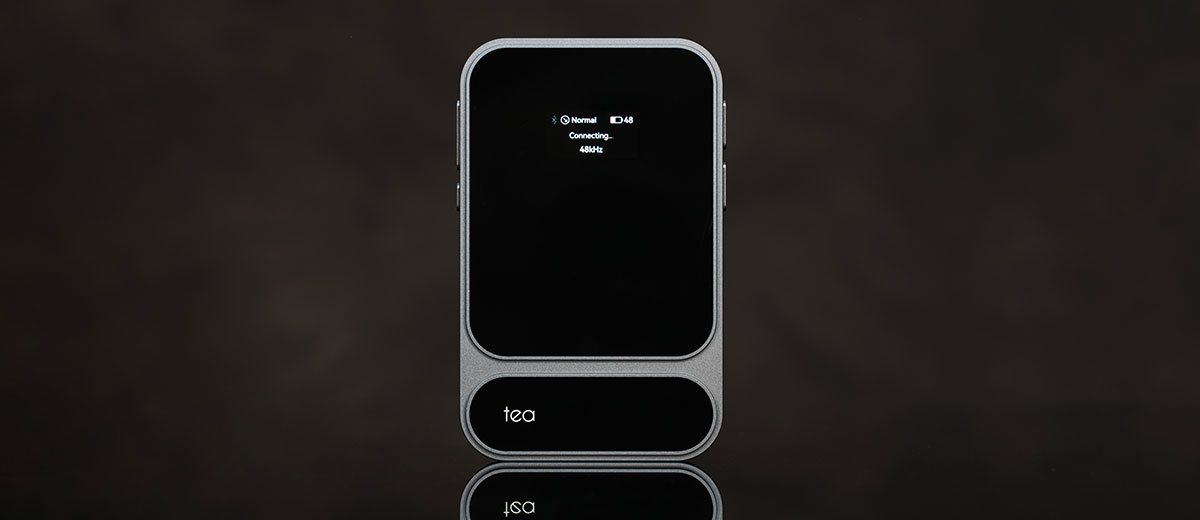
Thanks to Tea Pro’s use of the latest chip, Bluetooth 5.4’s initial pairing and connection times are fast, and the signal strength is high.
I can walk around my house for more than 10 meters away from my phone without sound interruption, even with walls in between.
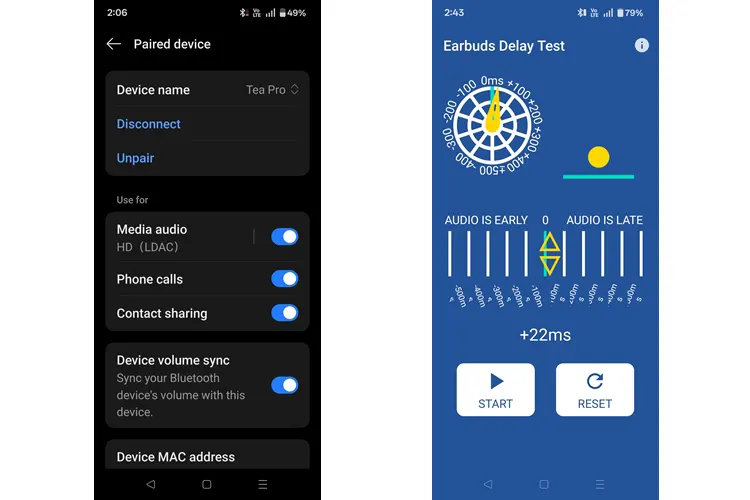
Bluetooth audio connection supports the standard SBC and AAC, as well as the higher bit rate and more recent aptX, aptX Adaptive, aptX HD, and LDAC codecs. This should make the Tea Pro compatible with a broad range of Bluetooth devices.
I’m delighted that the inclusion of the LDAC codec made the Bluetooth sound almost indistinguishable from the wired USB-C connection. Making me enjoy using the Tea Pro in Bluetooth mode.
My phone is equipped with the latest Bluetooth 5.4, same as the Tea Pro, and I get a very low latency connection result of nearly 20ms in my latency test.
This makes the Tea Pro an excellent Bluetooth audio device for gaming. I tried gaming with it, and I couldn’t detect the delay in sound.
Wired Connectivity
USB-DAC
The USB port is received by the XMOS XU316 chip, which delivers ultra-low latency, bit-perfect USB audio with low jitter and high bandwidth. It is compatible with Android, Windows, iOS, and macOS.
There is no need for a control switch to switch between Bluetooth mode and wired mode, as the Tea Pro automatically switches to wired mode once the USB-C plug is inserted and switches back to Bluetooth mode when unplugged.
When plugged in, Tea Pro connects quickly. Then the sound is automatically diverted to the Tea Pro from all my digital audio players (DAPs), including the OnePlus 13 Android phone, as well as my PC and laptop.
The sound automatically diverts back to the PC, laptop, and phone when Tea Pro is unplugged.
Synergy
On the many days I have used the Tea Pro, I have never heard noise from radio frequency interference or the noise floor of its electronics, even though it is magnetically stacked at the back of my phone with WiFi, Bluetooth, and data enabled.
The Tea Pro can comfortably drive all the IEMs in this review, as well as other not in this review, effortlessly to deafening volume levels, and my difficult-to-drive 300Ω Sennheiser HD 6xx to a satisfyingly loud volume.
IEM Pairings
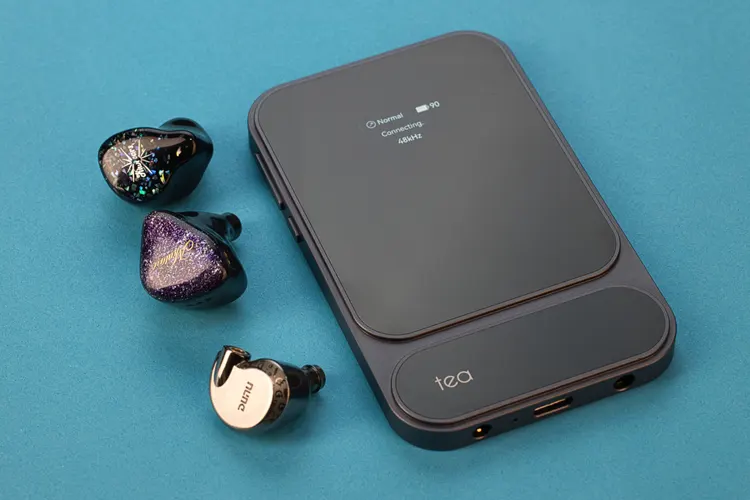
Thanks to Tea Pro’s neutral and transparent sound, it pairs very well with all the IEMs in this review, as it doesn’t add coloration to the sound, letting the IEMs sound as they should. I chose these IEMs for their differences in driver configuration.
When paired with the single dynamic driver DUNU Falcon Ultra Ti, I heard a neutral sound with slightly elevated midbass, extended airy highs, and unhindered dynamics. This pairing sounds good.
With the 1 x DD + 4 x BA hybrid, Kiwi Ears Astral, again, the sound is good, the U-shaped sound signature of the Astral is apparent, it has extended sub-bass and upper treble, the soundstage is enormous, and the dynamics are wide.
Lastly, with the 10mm bone conduction, 6mm DD, and four BA tribrid QoA Martini, which is supposed to be more challenging to drive correctly.
I hear a mildly V-shaped sound signature with well-controlled bass, dense lower midrange, energetic and detailed upper frequencies, and a big soundstage.
Headphone Pairings
The first headphone pairing is with the MOONDROP Horizon. Horizon’s mild U-shaped sound signature is apparent with this pairing; the bass is warm and well-controlled, the midrange is smooth, the upper treble is energetic, and the soundstage is deep.
Horizon is easy to drive for a headphone, and the drivers are sensitive to allow the Tea Pro to overdrive them, so I have to be careful with the volume control.
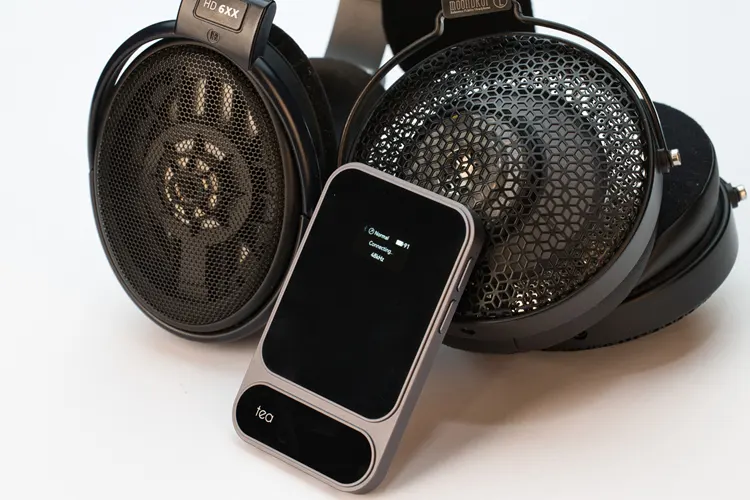
I know my Sennheiser HD6xx is happy with the source when the sound is not lethargic, has well-controlled bass, clear midrange, and crisp treble, and that’s what the HD6xx sounds like when paired with the Tea Pro.
The Tea Pro handles the HD6xx very well, and I think this pairing is very good for a portable setup. I would definitely recommend the Tea Pro with the HD6xx, as it does a competent job in driving these difficult-to-drive headphones. Still, it is not as good as when driven with a more capable desktop system.
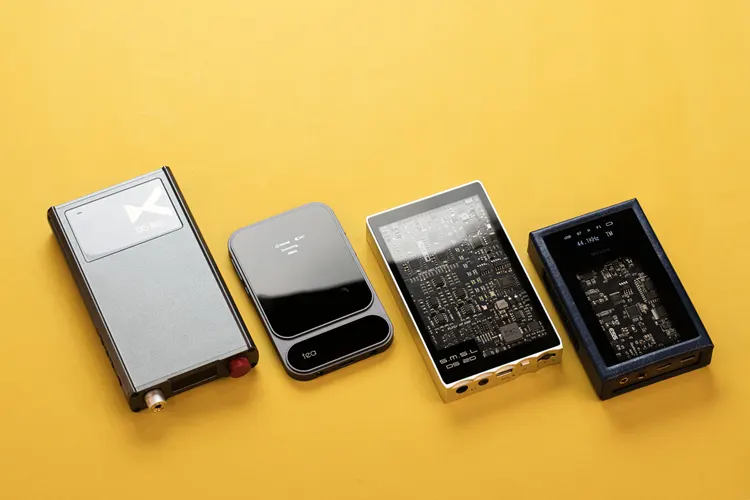
Selected Comparisons
MUSE HiFi M5 Ultra
Technical
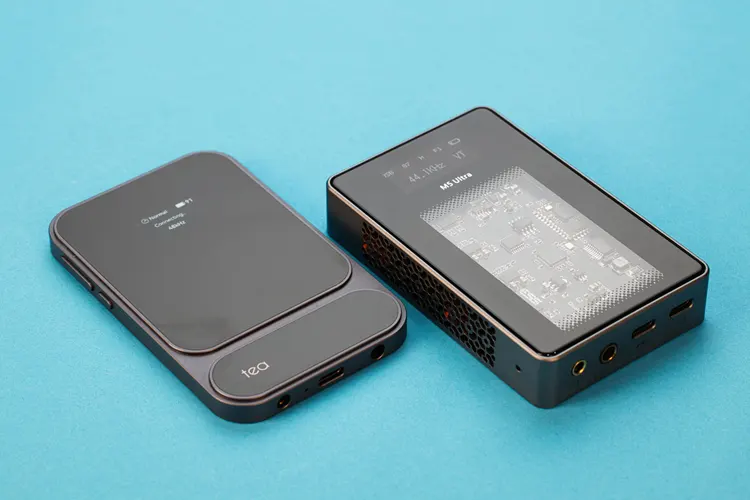
The M5 Ultra is a Bluetooth DAC/amplifier with a selectable vacuum tube output stage using a pair of JAN6418 tubes.
An ES9038Q2M DAC chip converts the digital audio signal to analog, and a Qualcomm QCC5125 Bluetooth Chipset for Bluetooth connection, with about 400 mW of output power per channel and a 3000mAh battery capacity for 10 plus hours of battery life.
Design
The M5 Ultra has a solid aluminum alloy chassis sandwiched by two tempered glass panels on the front and back.
With vents for the tubes on the left, I/O at the bottom, and all the controls on the right. A window on the front shows a small display screen near the top and the circuit board below.
Performance
Whether in vacuum tube mode or solid state mode, the M5 Ultra sounds colored in comparison to Tea Pro; M5 Ultra has a distinct warmth in the lows and a faint haze in the highs, regardless of the operating mode, while Tea Pro is neutral, flat, and transparent.
In terms of staging, Tea Pro has a bigger soundstage, with a wide open feeling of spaciousness, while the M5 Ultra sounds smaller, with a sense of a more intimate space in the soundstage.
Imaging-wise, Tea Pro is more technical, with its more defined and separated images. M5 Ultra has slightly diffused imaging.
Tea Pro is apparently more resolving and detailed compared to M5 Ultra. Tea Pro has more detail and instrument presence. I must say that the M5 Ultra is clearly tuned for a different audience, who like analog sound rather than analytical high-resolution sound.
Both can go loud, but I feel the Tea Pro is more dynamic due to its more bass and treble extension, which makes its sound have more immediacy and speed compared to the warm and slightly relaxed sound of the M5 Ultra.
xDuoo XD05 Basic2
Technical
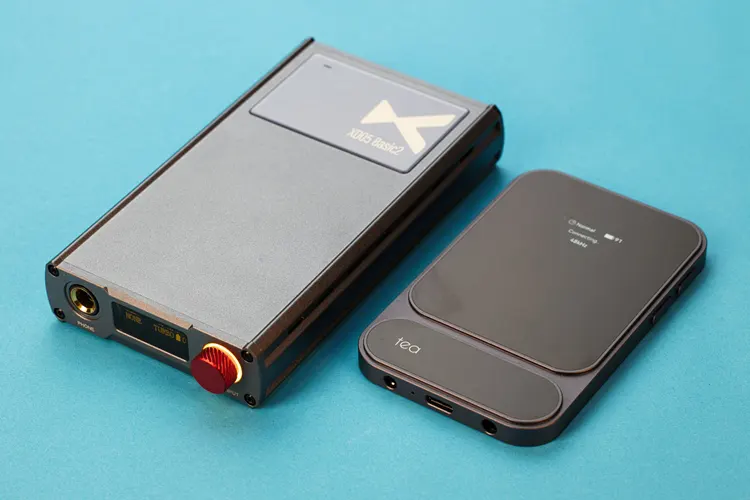
The XD05 Basic2 is a large Bluetooth DAC amplifier featuring a CS43131 DAC chip, replaceable opamps, and supports Bluetooth 5.4 with SBC, AAC, aptX, and LDAC codecs.
It can output up to 700 mW and features a 3000 mAh battery capacity with a battery life of up to 11 hours.
Design
The XD05 Basic2 combines a space-age and retro design aesthetic with a whole-metal body, a red knob, a small screen, and features only a ¼-inch headphone output jack at the front.
There are control buttons on the right side and USB-C ports, a slide switch, a pre-out jack, and a barrel power input jack at the back.
Performance
The XD05 Basic2 has more bass, less upper treble, and an overall warmer sound compared to the flat and neutral sound of the Tea Pro.
In terms of staging, the XD05 Basic2 has a deeper soundstage, while Tea Pro is wider. Spatially, Tea Pro is larger, but in terms of sound presentation, XD05 Basic2 offers a more expansive and grand sound due to its bassy and ballsy presentation and higher power rating.
The Tea Pro sounds more resolving and detailed. The difference in perceived resolution is mainly caused by the Chips they use; the CS43131 and the JRC NE5532 on the XD05 Basic2, versus the ES9039Q2M and the OPA1612 on Tea Pro.
SMSL DS20
Technical
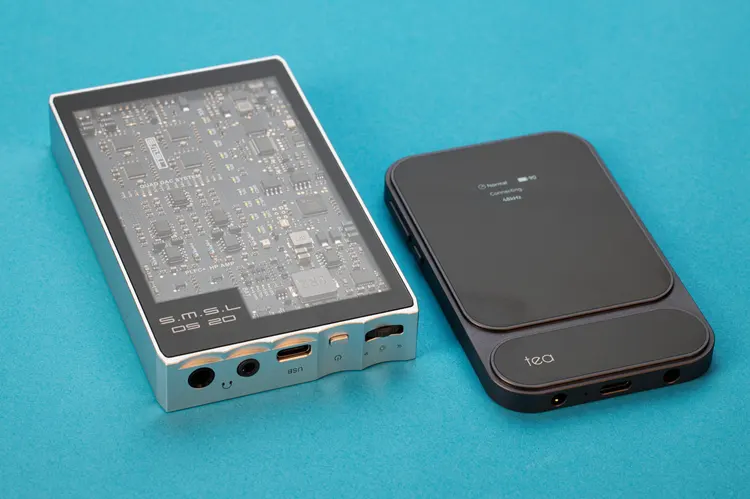
The DS20 is a DAC/amplifier that utilizes four CS43131 DAC chips, a PLFC fully balanced ear amplifier circuit design with up to 500 mW of output power per channel, and a 6000 mAh battery, providing 10 hours or more of battery life per charge.
Design
The DS20 is a clean-looking, solid piece of machined aluminum alloy with a tempered glass front panel and all the I/O and controls at the bottom.
Performance
The DS20 offers more bass control, making the bass sound tighter, which results in a leaner overall sound compared to the neutral Tea Pro. Both have equally extended treble, but I find Tea Pro to be smoother and more resolved.
In terms of staging, I find the DS20’s soundstage wide, but flatter, like a wall of sound in front of the listener, albeit with a slight depth. Tea Pro has a more rounded soundstage with balance in height, width, and depth.
Despite having leaner bass, I find the DS20 to be more dynamic and more powerful-sounding with its tight bass and more forward treble presentation.
My Verdict
In the weeks that I’ve used the Khadas Tea Pro, I felt that it fulfilled its promise of a portable, high-quality Bluetooth DAC amplifier. And I can confirm it’s claimed ability to drive high impedance headphones, as it did a competent job when paired to my Sennheiser HD 6xx.
I like its form factor and size, the MagSafe compatibility, the premium look and feel, and especially the use of premium quality audiophile parts, which resulted in its clean and transparent sound quality.
What I’m not a fan of is the long charging times of more than 2 hours; I wish it could be fully charged in 1 hour.
If only the majority of phones or phone cases had magnetized backs, Khadas Tea Pro would have been the perfect form factor for a battery-powered Bluetooth DAC amplifier, because it is ideal for my personal use.
Still, regardless of the form factor, the Khadas Tea Pro’s sound quality alone, along with the inclusion of the Khadas Audio App for equalizer adjustments, earns my high recommendation.
Khadas Tea Pro Technical Specifications
- Chipset Bluetooth: Qualcomm QCC5181
- USB: XMOS XU316-1024
- DAC: ESS ES9039Q2M
- Operational Amplifier: TI OPA1612 × 2
- Buffer: Ricore RT6863 × 2
- Volume Control: NJU72315 × 2
- 4 mm Headphone Jack:
- Max Output @600 Ω: 41.67 mW (5.0Vrms), THD+N < -90dB
- Max Output @33 Ω: 165 mW (2.33Vrms), THD+N < -90dB
- 5 mm Headphone Jack:
- Max Output @300 Ω: 20.8 mW (2.5Vrms), THD+N < -90dB
- Max Output @33 Ω: 120 mW (2.0Vrms), THD+N < -90dB
- Audio Formats Supports SBC / AAC / aptX / aptX Adaptive / aptX HD / LDAC
- Screen 0.95” Color AMOLED 120 × 240 RGB
- Power & Battery Capacity: 2100 mAh
- Size & Weight 102.7 × 64.0 × 7.85 mm, 96.0 g
