

Synergy
Efficiency
The INAWAKEN Twilight-DS is highly sensitive, with an impedance of 17Ω and a sensitivity of 106dB/mW @1kHz. This combination makes it incredibly easy to drive, requiring very little power to reach high listening volumes.
However, the stock cable is terminated with a fixed 4.4mm balanced plug, which limits direct connectivity with standard devices, as they normally only have a 3.5mm jack.
You will effectively be forced to use a dedicated DAP or a dongle DAC with a 4.4mm jack to use the IEMs out of the box.
Thanks to its excellent dynamics, the sound signature remains consistent across different volume levels. The massive sub-bass rumble stays present even at low volumes, while high volumes remain distortion-free and controlled.
Pairings
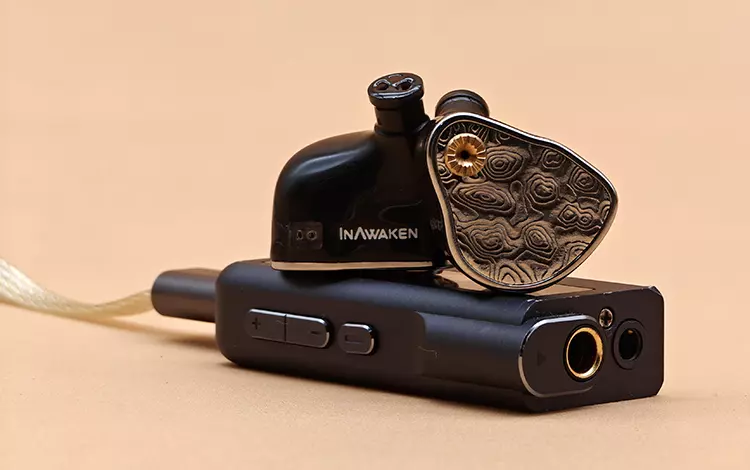
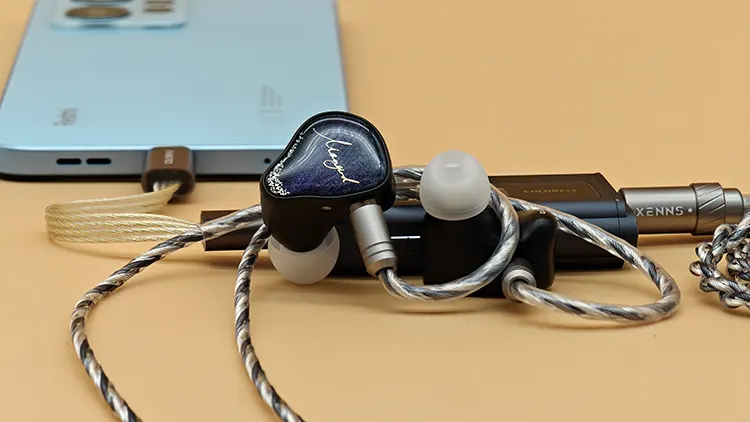
Since standard smartphones lack a 4.4mm jack, I utilized the FiiO SNOWSKY Tiny B to handle the connection. The Tiny B’s inherent brightness and vocal push helped counterbalance the Twilight-DS’s heavy sub-bass, bringing much-needed bite and liveliness to the midrange.
Switching to the HeartField R1 introduces an R2R-based warmth that leans heavily into the Twilight-DS’s existing thickness. This pairing creates a lush and weighty sound, though it tends to smooth over the treble sparkle and make the bass feel even more dominant.
The Colorfly CDA-M2 offers the most technical synergy, utilizing its analytical nature to tighten up the sub-bass control. It enhances the separation and imaging significantly, allowing the Twilight-DS to showcase its detail retrieval without adding extra coloration.
Select Comparisons
ZiiGaat Luna
Technical
The ZiiGaat Luna features an all-balanced armature configuration, utilizing six drivers per side to cover the full frequency spectrum.
It moves away from the hybrid approach found in previous ZiiGaat models in favor of a pure armature setup aimed at reference precision.
Low frequencies are handled by two full-sized Sonion 39AY008 woofers, while the midrange and treble rely on four specific Knowles drivers.
Although the specific crossover details are not disclosed, the driver grouping suggests a traditional three-way split between the bass, mids, and highs.
Design
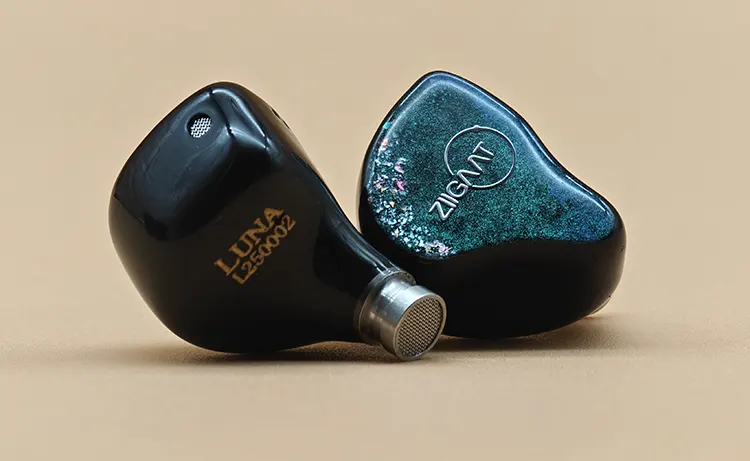
The faceplate utilizes a hand-poured resin finish that mimics a field of flowers, ensuring that every single unit displays a unique visual pattern.
This colorful and swirling design provides a sharp contrast against the fully opaque black medical-grade resin body.
Its shell is 3D-printed with smooth contours to ensure a comfortable fit, featuring a recessed 0.78mm 2-pin connector for added stability.
A short stainless-steel nozzle with a mesh filter completes the build, securing ear tips firmly in place while protecting the internal components.
Performance
The Twilight-DS dominates the low end, delivering a massive sub-bass rumble that adds a layer of immersion the Luna simply cannot match. Mid-bass punch and energy are also superior on the Twilight-DS, leaving the Luna sounding lean and reserved by comparison.
Bass guitars feel properly textured and heavy on the Twilight-DS, making them distinct and easy to track in the mix. The Luna struggles to provide that same tactile feeling unless you actively focus on finding it.
Both IEMs share an excellent sense of timbre, presenting vocals and instruments with a natural tone that avoids artificiality. However, the Twilight-DS offers a livelier experience with more forward vocals, whereas the Luna provides a more relaxed presentation suited for extended sessions.
Detail retrieval is noticeably more impressive on the Twilight-DS, capturing fine nuances and giving percussion a distinct sheen. The Luna takes a safer approach with a relaxed treble response that is friendlier to sensitive ears but less resolving overall.
The Luna secures a clear victory in soundstage, offering superior width along with proper height and depth. While the Twilight-DS competes well in separation, it falls short of the Luna’s precise imaging and expansive soundstage.
Xenns Mangird Tea Pro
Technical
The Xenns Mangird Tea Pro utilizes a hybrid driver configuration consisting of two dynamic drivers and six balanced armatures.
Its dual 8mm dynamic drivers feature a reinforced bio-composite diaphragm designed to deliver a cleaner and stronger sub-bass response.
The six balanced armatures include a mix of genuine Knowles, RAF, and RDB composite drivers, all custom-tuned to improve natural timbre and texture.
This setup was refined based on feedback from the previous Tea models to focus on better micro-detailing.
Design
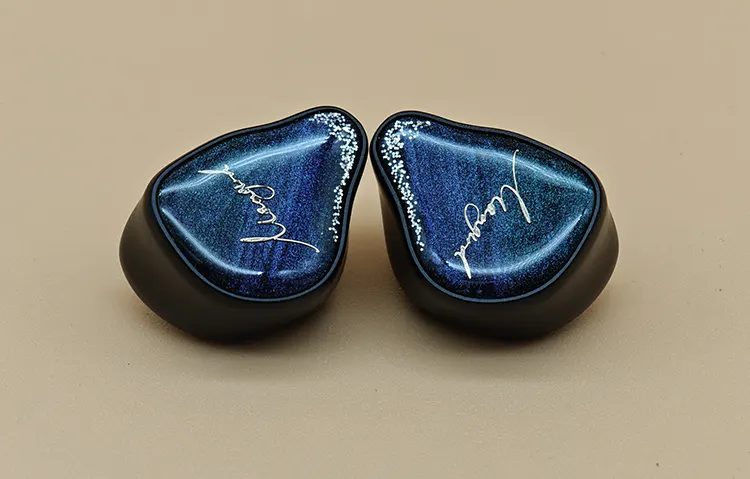
The faceplate features a “Northern Lights” design, shifting between green and violet hues depending on the lighting angle.
It is accented by tiny golden dots and the “Mangird” name printed in gold at the center, mimicking a starry night sky.
In contrast to the vibrant faceplate, the shell is made from simple opaque black resin with the model name printed on the hump.
It maintains a comfortable shape that fits securely, paired with a metal nozzle to ensure tips stay in place.
Performance
The Twilight-DS hits with a significantly heavier and more visceral sub-bass response, offering a semi-subwoofer-like rumble that the Tea Pro does not aim for. While the Tea Pro provides a clean and always-present low-end, it lacks the sheer physical authority and dominance found in the Twilight-DS.
Vocal presentation differs greatly, with the Tea Pro offering a lush, warm, and ethereal tone that feels deeply comforting. The Twilight-DS takes a livelier approach, placing vocals more forward with a cleaner character that highlights nuances more aggressively.
The Twilight-DS pulls ahead in technical performance, delivering superior detail retrieval and a sparklier top end that reveals micro-textures effortlessly. The Tea Pro plays it safer with a relaxed, non-fatiguing treble that sacrifices some of that air and resolution for smoothness.
Both IEMs offer a similar spatial experience, with soundstage dimensions that hover around average to slightly above average. While imaging accuracy is equally precise on both sets, the Twilight-DS takes the lead in separation by keeping complex layers more distinct.
My Verdict
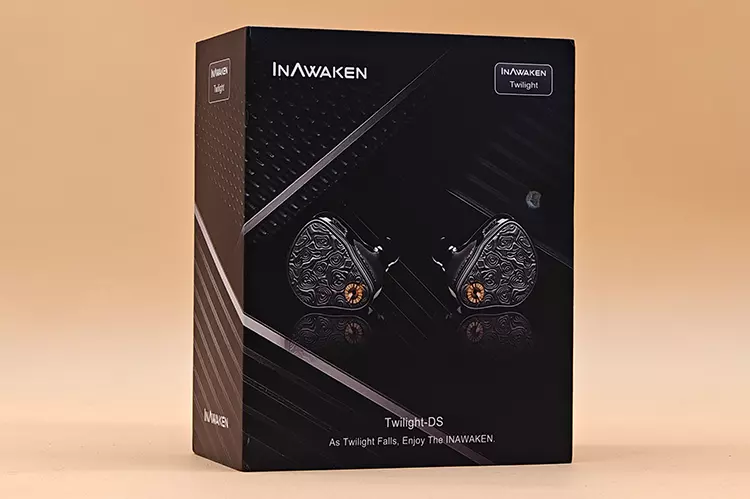
The INAWAKEN Twilight-DS steps up as a bold release that successfully manages its massive driver count to deliver a cohesive and highly engaging performance.
It balances its powerful, semi-subwoofer-like sub-bass with a natural and detailed midrange, resulting in a sound that is both fun and technically proficient.
While its large shell size and weakened mid-bass might not suit everyone, the execution here is nothing short of fantastic for a second release.
This is a great step forward for the brand, offering a unique and premium flagship experience that is befitting of its equally attractive exterior.
INAWAKEN Twilight-DS Technical Specifications
- Driver Type: Four (4x) coaxial dynamic drivers and eight (8x) custom balanced armatures
- Plug: 0.78mm 2-pin with 4.4mm balanced termination
- Frequency Response: 20Hz – 20kHz
- Impedance: 17Ω @ 1kHz
- Sensitivity: 106 dB/mW @ 1kHz
