

Sound Impressions
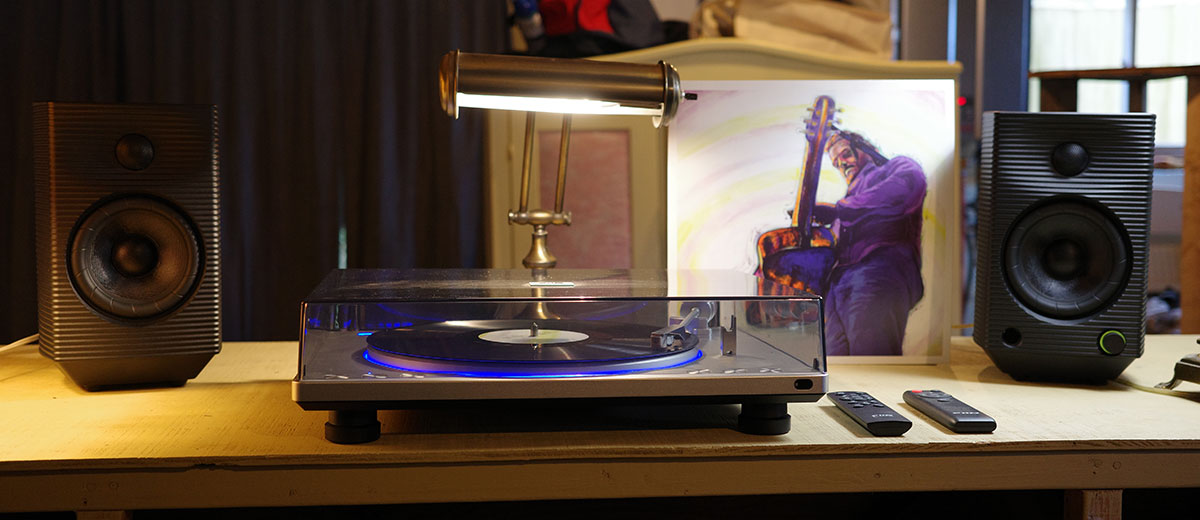
The SP5s were allowed to burn in for 75 hours under a variety of settings before critical listening was made. Sources used included my iPhone 16 Pro Max, my MacBook Pro, FiiO’s M21, JM21, and TT13, the HiBy R4, and the aforementioned Audio-Technica AT-LP120XBT-USB.
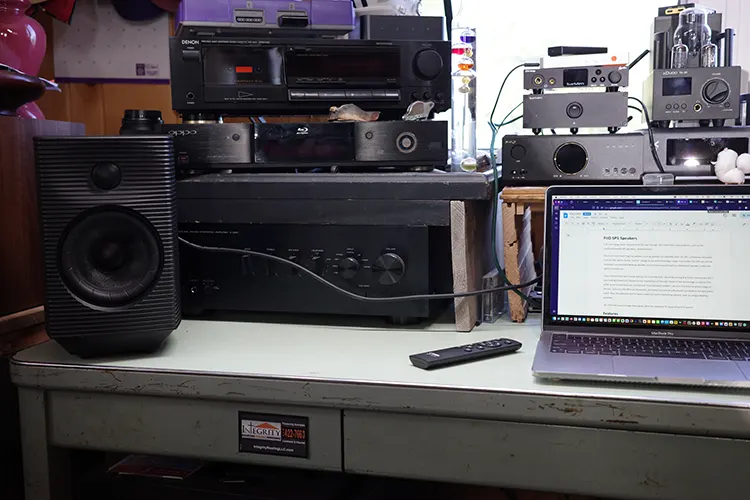
Additionally, I used the xDuoo TA-32 on XLR out, as a standalone DAC, and the Tube Out Aux from the RCA connection, using the Oppo BDP-83 to gauge an external amplifier.
Summary
Using the SP5s as a near-field speaker first, I was surprised that they did not overwhelm the space. The speakers are quite large for such a setting, but they functioned with excellent sonic characteristics.
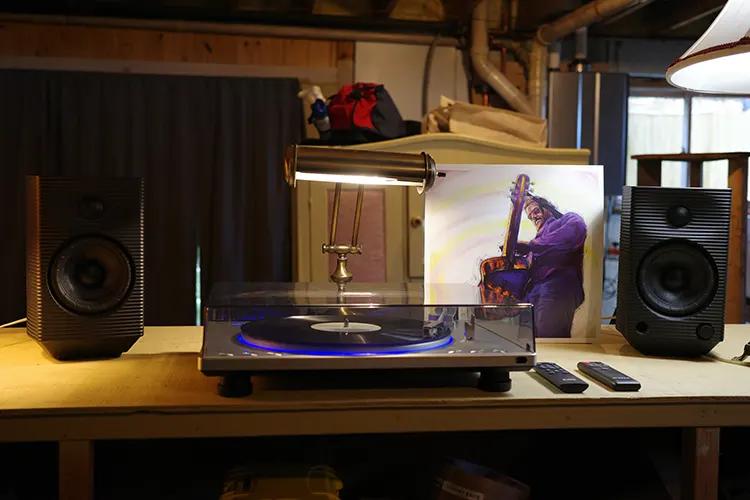
Spacing the SP5 out when using the TA32 or BT TTs did not hinder the quality, and with the ability to fine-tune the spacing and vertical placement, I could zero in on an excellent setup.
The ability to tailor bass, treble, and low-bass reach helps with the setup for multiple situations. Suffice to say, that as a near-field +3dB for bass added just the right amount of low-end grunt.
Using the desktop spacing, the sound focused around a holographic center, but with good 3D expansion.
Raising the speakers a bit helps with treble extension, but even without this adjustment, the treble sounded vibrant and accurate.
Bass
The SP5 can add +3dB or +6dB to each speaker separately, helping the listener tailor the sound to the room. In the near-field experience, I left the bass at +3dB for the majority of the testing.
Tight control, with a reach that matched what each song presented, the larger woofer unit provided a more guttural response, never becoming flabby or uncontrolled.
I was impressed with the amount of detail present in that tightly controlled low-end, which contained nearly equal amounts of attack and decay.
If the song was bass-heavy, the response matched the song. Where a preponderance of bass played out, the SP5 represented the signature nicely and under the control mentioned above.
If that song promoted a deep reach with rumble, the SP5 (even flat) presented the sound with control. Adding either the +3dB or +6dB, of course, added to the feeling, and I could feel the response on my desktop as I worked.
There is virtually no bleed into the midrange, which can be a bit hard to judge on smaller Bluetooth speakers, but the SP5 provided excellent feedback between the layers.
Mids
Having separate power amplifiers for the low and high end can lead to a significant amount of control in the midrange. The crossovers do their job appropriately, melding the trio of spectrums together, making for a thoroughly decent enjoyment.
Set almost equally with either end, the midrange was neither expansive nor compressed. Rather, it was “there” to fill in the necessary missing holes as needed.
Picture a utility person who does many things well, and without bother or accolades. That is how the midrange proceeds to tie both ends together, with a good amount of clarity and levels of detail that are right up there with the best.
Set slightly behind the rest, I do wish they were slightly more forward. But, in the nearfield sense, this makes for a deepening of the soundstage, and the placement of instruments that accommodates the depth that can often be missing from small spacing. A fair tradeoff.
Vocals are a bit lifted, but accurate in presentation, folding neatly into the overall signature, while showing off the voice in a non-intrusive manner. The smooth character of the midrange carries a very melodic response as a result.
Treble
The accuracy of notes does seem a bit compressed when taken singularly, but the smoother character could be the “culprit.” And as such, I appreciate the ability to raise the volume markedly without bother or without having the top end become overly extended or harsh.
The lower treble lends a nice connectivity to the midrange and can move about depending on the source or song.
Sometimes this treble response is placed even with the other mids and lows, while sometimes it is placed a bit higher and more forward, giving the SP5 the ability to perform well across many genres.
I found the treble to be pleasant and listenable, with a richness to it that allowed for a highly musical affair to be had.
Succinct notes carried across the top without a disconnect that can happen with that somewhat smoother overall signature. The visceral connection between those tight notes and the smoothness made for the easy listening mentioned above.
But those who seek accuracy of note that shows with clarity and detail may see this as a bit lacking. This can be accommodated using the +2dB treble response, or a custom EQ setting in the FiiO Control app.
What some think is a lack of top-end music treatment can actually be thought of as a middle ground that allows the user to fine-tune the treble response.
Raising the speakers so the tweeter is at ear level helped with treble response, as expected. Coming across as more pointed, but with very good detail. The treble was never punctuating or too pointed, but rather encompassed the area, providing the finishing touch.
Having the ability to tailor that top end is probably most needed here to accommodate everyone’s tastes.
Staging & Imaging
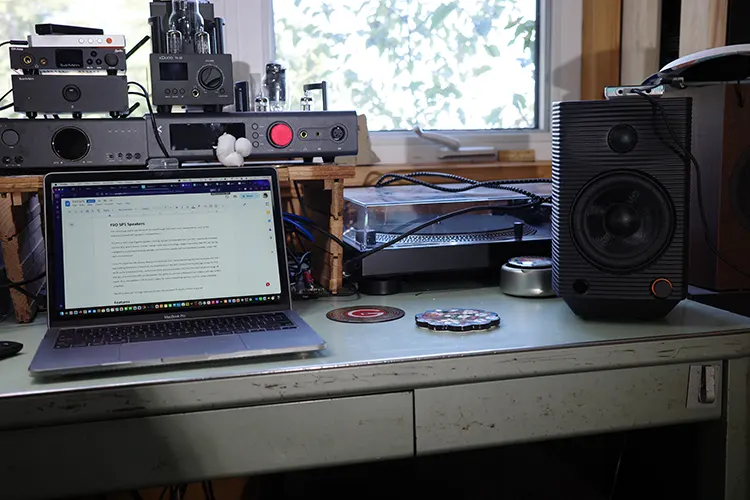
Used as a nearfield, I am astounded at the depth of sound presented with the speakers equidistant from my laptop. At approximately 24” from the center of the speaker to the center of my laptop (roughly 48” apart), it provides excellent depth and height.
The width is limited to that narrower setting, but it never sounded constricting or constrained. Instead, the width allowed the depth and height to come across as a near-cubic effect on the sound, which made for a highly musical setting on the desktop.
Interestingly, though, when the speaker was placed with the tweeter at ear level (5” lifts), the depth suffered a bit, and the height, while more in tune with the overall signature, suffered a bit and became more like a ceiling than an expanse.
Based upon the above, I found the SP5 worked a bit better, for me, with the tweeters below ear level. This also gave a better foundational sound for the speaker to sit upon, adding depth to the bass. All of that said, the preponderance of spatial awareness in the SP5 is quite impressive.
Interestingly, the dimensionality aspect of the soundstage varied by source. In other words, musical response was equally dependent upon the placement as well as the source played.
USB-C sounded exceptional with the speakers at ear level, while BT sounded slightly better below ear level (both at the 48” separation, and 5” lifted desktop situation.

Synergy
Efficiency
Other than the lack of true detail in the tweeter/treble combination, the SP5s are efficient enough to become the centerpiece of a desktop or bookshelf setup.
The lack of detail can, of course, be overcome using the adjustments on each speaker or the FiiO Control app and EQ.
Had FiiO made the SP5 more efficient than it already is, you might run the risk of making for a disjointedness that overshadows the welding together of the whole.
This is a situation where FiiO built in the necessities for very good sound, leaving that final 5-10% to the user and placement, along with any necessary EQ’ing.
Power
The 60W coming from the woofer and 20W fed into the tweeter is plenty of power. Especially when combined with your source or an external amplifier.
I never felt the need for more, even when running one of the two BT turntables used, with the SP5s providing plenty of power to satiate my needs.
Pairings
The majority of listening time was spent using a DAP or the iPhone 16 Pro Max as a source. Typical user usage would concur. The typically warm, richer signature of the HiBy R4 fits the SP5s listening like two pieces of a puzzle that complete the masterpiece.
The FiiO M21 and JM21 provide better detail retrieval and more clarity than the HiBy, but lack a bit of musicality and richness.
Both provided excellent listening options, since that extra juice of detail helped with the SP5’s treble response. The added extension up top provided a more expansive height to the soundstage as well.
Using the FiiO TT13 and Audio-Technica AT-LP120XBT-USB BT turntables, both came across with a warmth and richness that seemingly only vinyl can provide.
Both provided excellent tonal quality, though, with good spatial awareness, especially with the speakers set a bit below ear level. The accuracy in both came about through different directions, though.
The AT has a better cartridge, and it showed, but the FiiO comes with a bit better emotive effect in sound, so it essentially was a wash. Subtle differences that could easily be changed by placement or EQ settings (or cartridges for that matter).
A surprise was hooking the SP5s to the xDuoo TA-32 through the XLR out. With the ability to run a DAP or smartphone via USB-C, the extra power of the TA32 was felt immediately. While I stated that I missed the onboard phono stage, the addition of an XLR input more than makes up for that.
Using the Oppo through Coax into the TA32 was a rewarding option, showing the versatility of having multiple options, such as the SP5 present. With copious amounts of power from the TA32, one is only limited by one’s courage or one’s wife’s response.
