

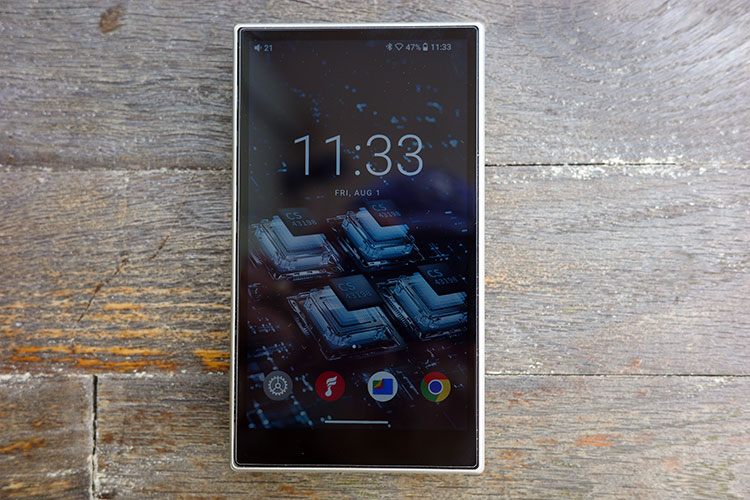
Lynn reviews the FiiO M21, a Walkman-inspired Android 13 DAP with a Snapdragon 680 CPU, quad CS43198 DAC, and 950mW of output power. It is currently priced at $329.99.
Disclaimer: I received this sample in exchange for my honest opinion. Headfonics is an independent website with no affiliate links or services. I want to thank FiiO for their support.
You can click here to learn more about the FiiO audio products previously reviewed on Headfonics.
This post follows our current scoring guidelines, which you can read in more detail here.

Continuing with the release of products, FiiO has put out the M21, which follows from the highly successful JM21, with more features.
Since I reviewed the X5iii eight years ago, I appreciate the way FiiO approaches DAPs. Across the years, the company has produced some excellent DAPs at all levels.
The M21 showcases many of the latest features included with higher-end FiiO DAPs, while keeping the cost down.
The inclusion of a pure desktop option provides a means to isolate the power needs from playback, which many already do. But not having to rely upon the battery helps isolate the two even more.
The M21 comes with a fully balanced two-stage amplification and some other tricks up its sleeve that will be described below.
Features
FiiO stacks four CS43198s running in parallel, with separate left and right positive and negative channels. It’s a truly balanced output, which purportedly lowers noise, enhances current, and lowers the impedance and distortion.
Dual OpAmps (OPA1692) are used, one per channel for voltage gain, followed by two SGM8262-2 buffers for current.
Activating the desktop mode will feed it with a USB-C power input, and the DAP uses the external supply only. The balanced output will give out nearly a watt (950mW) per side into 32 Ω in this manner.
Desktop mode also gives the user a “Super High Gain” option for those harder-to-drive headphones, instead of just low to high. High Gain will give the user 720mW per channel. The super high gain only works with a dedicated fast charger using a PD2.0/PD3.0 fast charging plug
Qualcomm’s now familiar Snapdragon 680 runs the show without a bother, and 4GB of RAM, making streaming options easy to take.
Separate partitioning for analog and digital amplification circuitry is included, too. The path continues to the 5th generation FPGA path with dual Femtoclocks of 49.150 and 45.1584Hz frequencies.
I2S/DSD then leads to the quad chips, or the LDO SPDIF or Coax outputs, which handle 24/384KHz PCM and DSD128.
There are a total of 10 LDOs for the current power supply, with five dedicated to the left and right channels and the DAC analog power, while one bypasses the DC converters from the Pi Filter directly to the DAC analog power.
The other four run from the Pi Filter directly to the digital power. This further isolation keeps crosstalk down as well as sending more “pure” power where it is needed.
Two-way LDAC BT, 8x MQA unfolding, and up to 15 hours of run time round out the features.
Design
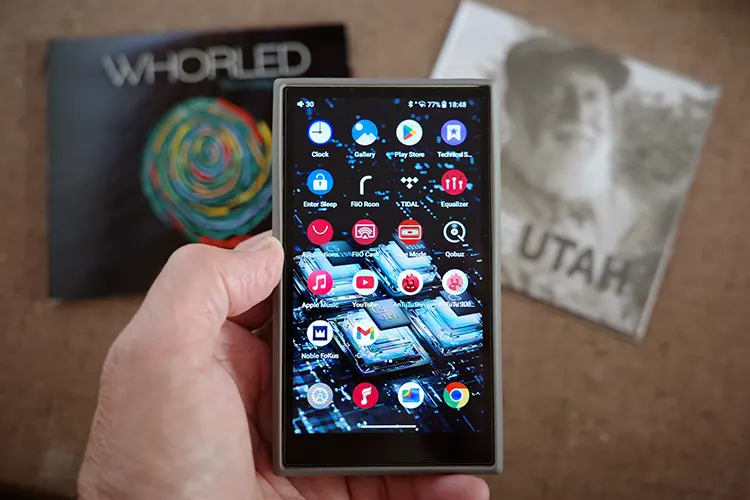
FiiO is known for simple rectangular DAPs that are neither too big nor too small. Purposed for the price point offered, the M21 sits on the same level (roughly) as the HiBy R4, and almost identically to the JM21, except for depth.
The Titanium Gold aesthetic looks the business. A curved backside on the frame makes holding the M21 easier, while the backplate appears to be tough-wearing plastic. A tempered-glass film screen protector comes pre-mounted on the front. No extras are included.
The 4.4mm balanced headphone and LO/PO (same as the 3.5mm se) ports are on top, which frankly I prefer. For those that slip DAPs into a cargo pocket, or a pocket that will have the port sticking straight up, with access to the functions when pulled out.
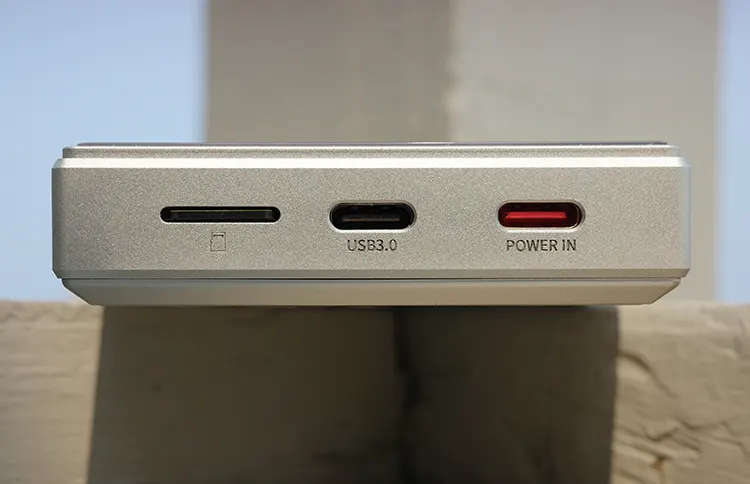
Yes, it may be easier to hold with the headphone ports on the bottom, but functionality keeps the SD card and power hookups, including the USB-C 3.0 port for desktop use, handy.
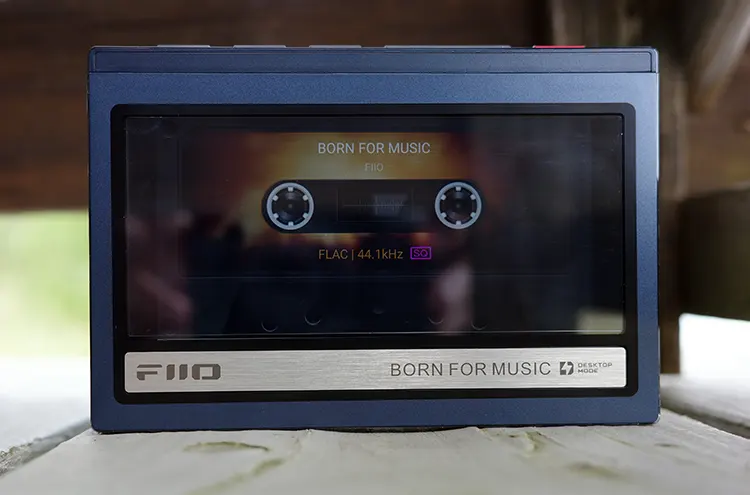
The lower part of the backside has three gold-plated tabs, much like a camera battery. This is utilized when connecting to the SK-M21C cassette case. When inserted into this case, the front panel lights up, mimicking a cassette complete with song and artist playing.
Unfortunately, the touchscreen is not accessible this way, and the cassette case must be opened up for access.
I/O
The M21 has a 4.4mm balanced and 3.5mm single-ended headphone jack on top. The 3.5 jack doubles as the LO if you send the music out to another source, such as a powered speaker or a desktop amplifier.
The bottom has a single SD card slot (up to 1TB), a 3.0 USB-C in the center, and a USB-C external power option for “desktop” use.
When connected by the last method, the internal battery is bypassed (even charging), with power coming from the USB-C power port. This also gives the M21 a “super high gain” option for harder-to-drive headphones of nearly 1W of power.
Controls
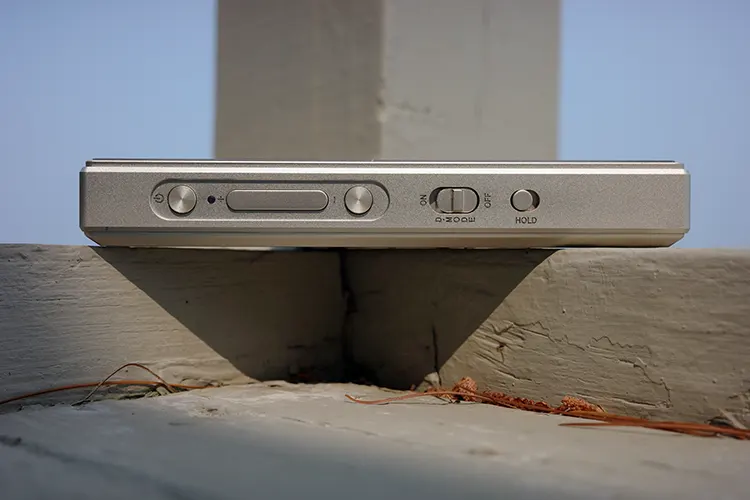
The left side of the M21 has the typical on/off button first, with a nice toggle for volume up and down next.
Below the volume button is a multi-function button for changing a multitude of functions, ranging from deleting the song being played, to changing filter and EQ settings, amongst others.
Below is the desktop mode switch for use with the external power option only. Last is a hold button that freezes all functions to prevent accidental volume or song changes.
The right has the usual FF, play/pause, and REW buttons top to bottom. All buttons except the hold toggle are inset a bit, but still function well with either case on, unlike some DAPs I have tried of late.
Battery Life
FiiO claims 12.5 hours in balanced mode, but the closest I came was 11.25 through three tests. Longer use may condition the battery more. Single-ended usage allowed up to 14 hours, which again may increase with longer usage.
I will add that the standby time was exceptional. After leaving the M21 for a week (household duties called), the battery read 99% upon turning it back on.
Two other DAPs that I have recently reviewed, the V3 Blaze and the xDuoo X5, cannot replicate that. And yes, I know that all should do that, even in standby mode, but the other two failed while the M21 maintained the charge.
Packaging & Accessories
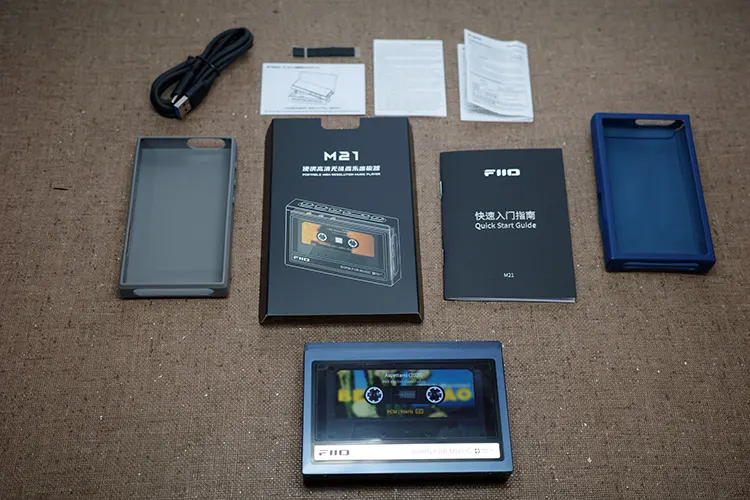
The M21 comes well protected in a sleeve-laden box within a soft foam cutout. Included is a shorter USB-A to USB-C cable for use when charging or with the external power option, a quick start guide, the warranty card, and an inspection card.
If you get the additional case, it comes protected in plastic wrap with a foam insert, helping to keep its shape.
The SK-M21C case comes in its box, inside a plastic tray with stick-on “feet” and an instruction card.
Regular Case(s)
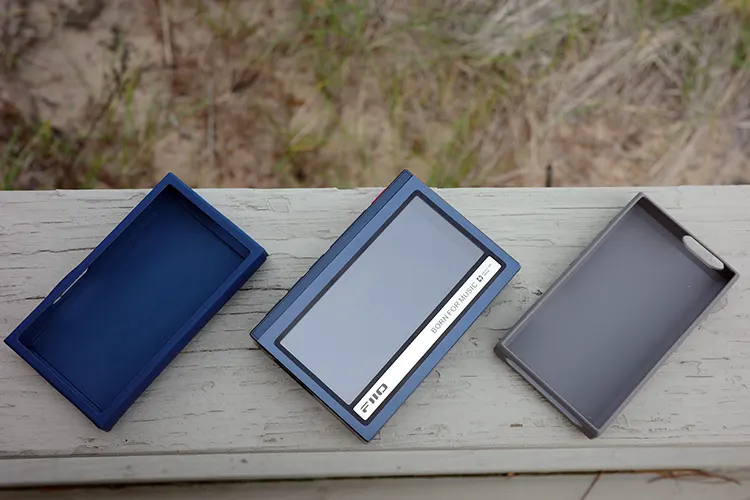
The two regular cases (softer plastic and a pleather case) allow for easy access to all necessary buttons. I found that the plastic case functioned a bit better, with the raised buttons getting a better feel to me.
That said, the pleather case functioned much better than a recent DAP I finished reviewing. Either case worked well and looked the part, too.
SK-M21C Case
The SK-M21C case affords more protection as well. Connection is via the three gold tabs on the back of the M21, which worked without issue.
When inserted, the clear cassette door allows the M21 touchscreen to be seen, which then lights up like a cassette inside, complete with “spinning cogs.” The functionality goes to the top of the case, much like the FP13 or an old Walkman. There is no “record” button, though.
The function buttons on top include a red on/off button, play/pause, FF/REW, and volume +/-, all of which are not lit.
As mentioned above, though, access to the touchscreen of the M21 does not happen unless you open the cassette case door.
If you exit the cassette look, you must go to the home screen and activate the function again, since the function key button is not accessible, should you have it set to “cassette” function.
That said, FiiO added a workaround using the red multifunction button. Short presses turn on and turn off the player, while a long press exits or re-enters cassette mode. This way, you can access the touchscreen with the cassette door open.
Click on page 2 below for my software and sound impressions.
