

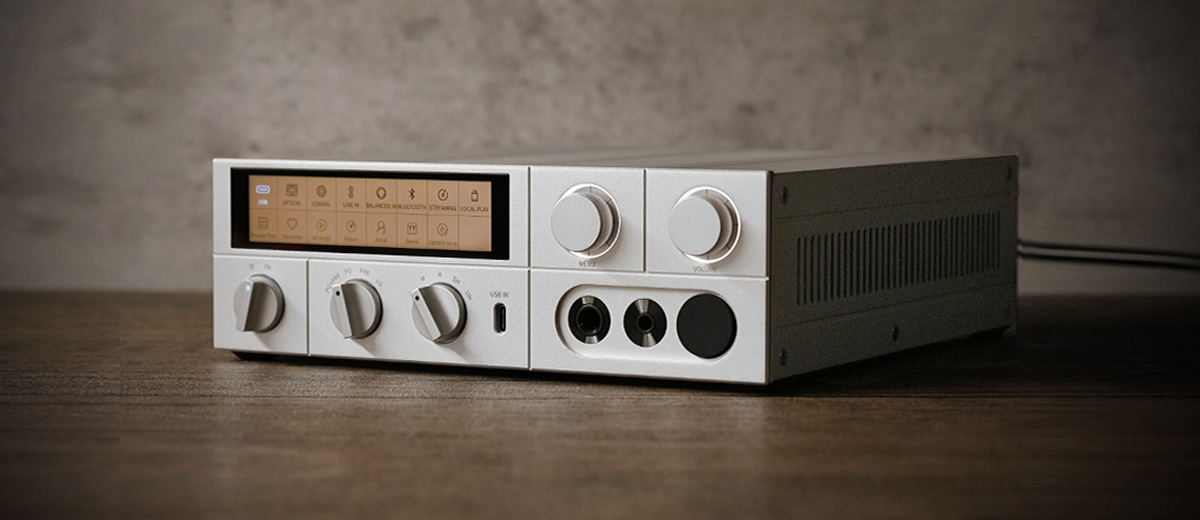
James reviews the FiiO K15, a new integrated desktop dual AK4497S DAC and discrete Class AB headphone amplifier with WiFi and LAN capability. It is currently priced at $549.
Disclaimer: I received this sample in exchange for my honest opinion. Headfonics is an independent website with no affiliate links or services. I thank FiiO for their support.
You can click here to learn more about the FiiO audio products we have previously reviewed on Headfonics.
This post follows our current scoring guidelines, which you can read in more detail here.
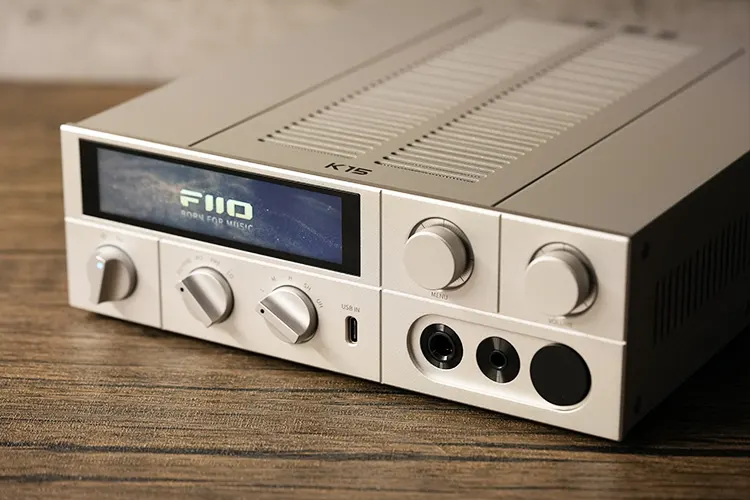
The FiiO K15 is the younger sibling to the previously released K17 desktop integrated DAC and headphone amplifier.
While retaining the visually appealing retro design, several internal components have been revamped, notably with the removal of the dedicated DSP chipset to position the K15 in a more competitive price range.
One other prominent alteration lies in the choice of DAC chips, leading to the FiiO K15 being priced more affordably at just $549. If you appreciate the features of the K17 but prefer to steer clear of equalizing, then the K15 will also be a decent option.
How does it perform and compare to the K17, and should owners of the older K9 ESS put this on their demo list? I found out in my full review below.
Features
Decoding
FiiO replaced the AK4191 and AK4499EX*2 DAC on the K17 with dual AK4497SVQ DAC chipsets inside the K15.
These are newer and superior versions of the highly regarded AK4497 chipsets, which also have DWA (Data Weighted Averaging) Routing Technology from the AK4499EX and produce a higher 129 dB SNR rating.
Similar to the K17, the K15 can decode up to native DSD512 and 32bit/768kHz and support local files playback on a USB drive. There are also two ACCUSILICON AS318-L crystal oscillators for jitter control.
With the less stringent power requirements from the DAC chips, FiiO has swapped out the power supply unit for a new 30W PSU while supporting an external 12V 2.5A linear version.
The K15 has a similar discreet power supply for decoding and amplifying stages as the K17. Its power supply, decoding, and amplifying circuitry are separated into 3 boards with OFC jumpers connecting them.
Amplification
The K15 incorporates discrete amplification circuitry utilizing Class-AB transistors and an OP+Transistor current-boosting design, employing the ON Semiconductor MJE243G/253G transistor pairs for high-current output and a low output impedance design.
While the components mentioned mirror those found in the K17, the K15’s output power is slightly reduced to a maximum of 3000mW per channel (32Ω load balanced).
This adjustment might be attributed to the altered powering conditions due to the switching transformer within the device.
Design
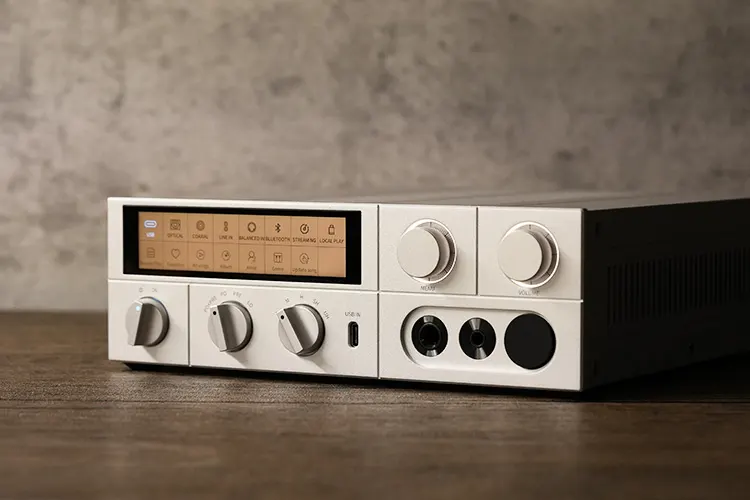
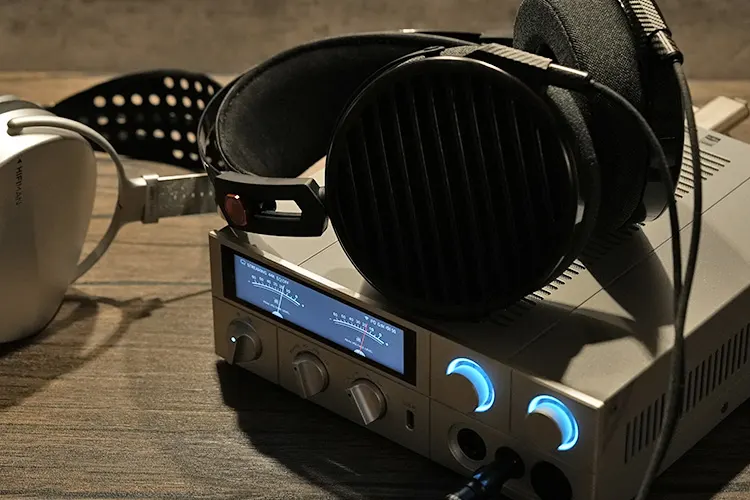
The design of the K15 closely resembles the K17, only this time, I received a silver unit, which appears more refreshing compared to the professional black K17 I previously reviewed.
Once again, this device is easily one of the most stylish and sleek retro designs available on the market.
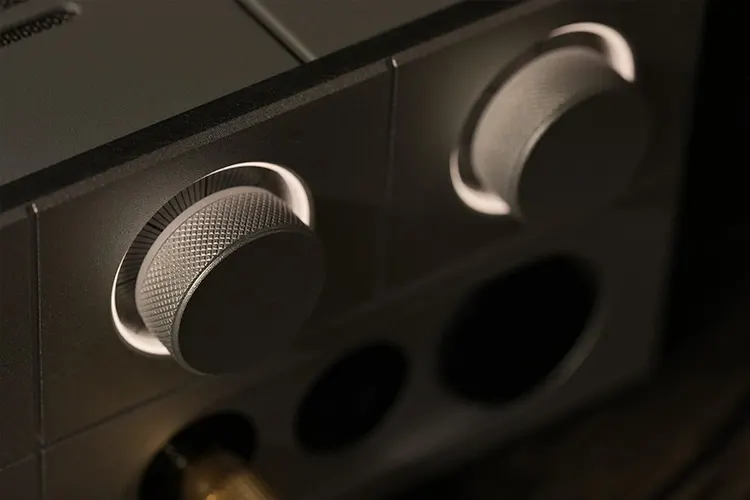
One feature I like is the inclusion of physical knobs, which enables swift switching between gain levels and I/O options without the hassle of navigating through multiple menus.
The volume knob features an LED ring with a small LED indicator, reinforcing the retro aesthetic while also providing users with a convenient way to locate the volume control in dark listening environments.
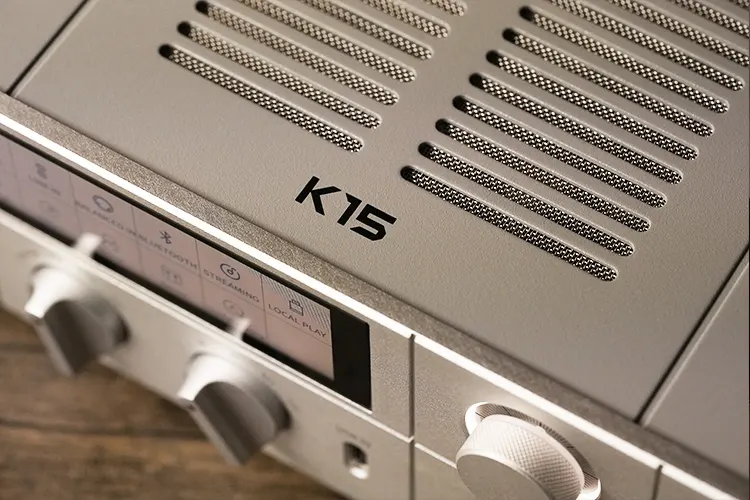
The 3.93-inch touch screen and UI are nicely customized, featuring appropriately sized icons that allow effortless navigation and smooth swiping actions. The color scheme also blends seamlessly with the overall design.
Heat dissipation, on the other hand, is managed with side and top vents protected by metallic meshes. It performs well and only gets warm after an hour of playback, so the measures are sufficient.
I/O
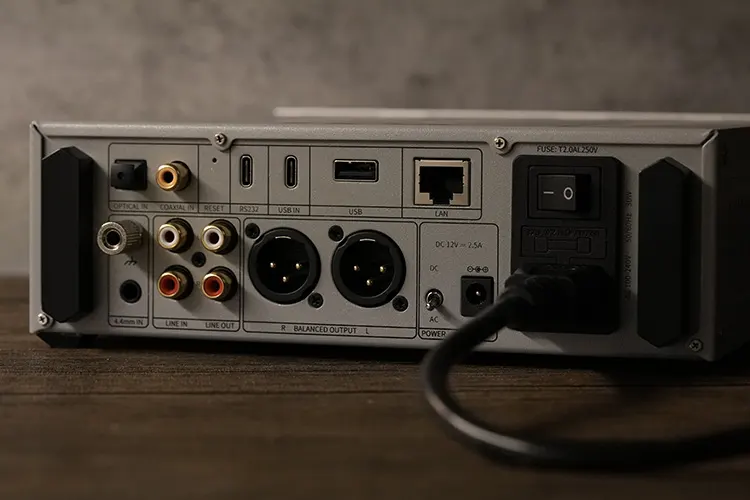
Similar to the K17, the front panel of the K15 features 6.3mm, 4.4mm, and XLR sockets.
Users can leverage the USB-C connection to interface with other USB sources for decoding, and the USB-A socket at the rear is best for local file playback if you are using thumb drives and portable hard drives.
In line with the functionality of the K9 Pro ESS and K17, the K15 also supports analog input for amplification or pre-amplification, with 4.4mm and RCA line-in sockets located at the back.
Additional I/O options include coaxial, optical in/output, RCA, and balanced XLR outputs.
Beyond these, the device is equipped with LAN sockets for a more stable connection to the local network, alongside an antenna jack for stronger signal reception across longer distances.
Controls
The K15 follows in the footsteps of the K17 by incorporating a combination of physical knobs and a touchscreen interface. This blend of old-school knobs and modern gesture controls is fun and practical, making it easy to switch between key functions effortlessly.
The physical knobs allow for seamless cycling through various outputs and gain levels, providing a tactile and intuitive user experience, while advanced features can be accessed with the on-screen menu.
In dimly lit environments, you will find the current settings displayed on screen, so there is no need to rely on markings around the knobs to find out information like current gain level.
Navigating through the touch screen interface is straightforward, enabling users to swipe between playback screens and menus to access playback modes, equalization settings, themes, and a host of other configurations.
Swiping up and down changes the theme, adding to the user-friendly design, although additional visual cues for menu navigation may help enhance the overall user experience.
For added convenience, the K15 includes a remote control, ideal for users looking to place the device in a living room setting or for those who prefer to navigate the device from a distance.
This is also great for desktop usage, as you don’t need to reach out to the device or control apps every time you want to change the volume or jump to the next song.
Connectivity
Bluetooth
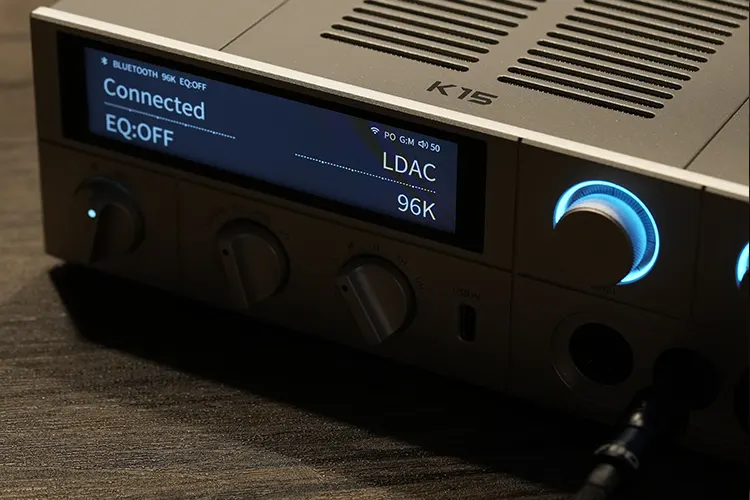
Following the K17’s QCC5125 solution, the K15 also features the same receiver and antenna modules and supports aptX HD, aptX Adaptive, and LDAC codecs that are optimized for various usage scenarios.
As usual, I would recommend using aptX Adaptive for gaming and lip-synced performance, while LDAC will provide you with the best perceived quality, rounded treble, and a slightly fuller body, even though the transmitting range will be limited.
WiFi
The K15 is a practical streamer that features Roon Ready and AirPlay 1 support, similar to the S15, giving it a competitive edge over other streamers at the same price bracket, considering its overall package.
By simply connecting the K15 to your home network, you can easily designate it as an output device. The function is seamless with cover arts displayed, and there is little to no delays.
USB OTG support
Just like connecting to dongles, you can plug your phone or players that support USB output to the K15 and enjoy the higher playback quality on the K15.
Mac users can seamlessly connect without the need for additional drivers, while Windows users will require the USB driver accessible on FiiO’s website.
Similar to the functionality on the K17, if you connect two devices simultaneously to the K15, the front panel input will take priority, automatically disabling the rear input.
Features
You can find a complete rundown of how to operate the FiiO’s K15 features in the user manual hosted on the company’s website.
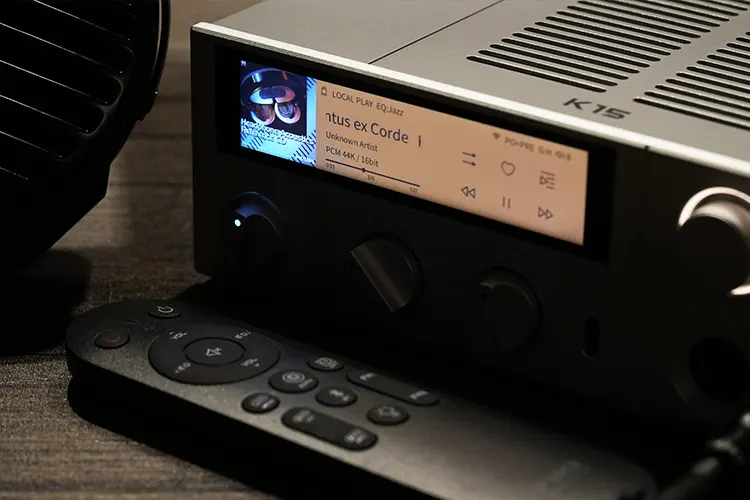
Local Playback
One of the standout features that sets the K15 apart from its competitors is its support for local playback, allowing users to enjoy music without depending on external sources for a minimalist setup.
This capability enables music lovers to maintain a personal library of songs even without internet access, ensuring access to tracks that may not be available on streaming platforms.
This feature blurs the distinction in positioning the K15, almost transforming it into a fully functioning player, albeit without a large screen.
While the tagging and filtering options may not be as extensive, the straightforward user interface is particularly well-suited for individuals accustomed to browsing through folders.
PEQ
The K15 has undergone a significant price reduction compared to the K17, and one of the noticeable features that has been removed is the 31-band equalizer with dedicated DSP chips.
However, despite this change, the K15 still offers support for a 10-band Parametric equalizer for all digital inputs. This means that unless you are utilizing the RCA or balanced analog input, you can still benefit from the DSP adjustments.
To configure the Parametric Equalizer (PEQ), you have two options: you can either use the FiiO Control App or connect the K15 to a PC via the RS232 USB port located at the back of the device.
Then, by accessing the PEQ web control link, you can use the control panel for adjusting the equalizer settings.
Packaging & Accessories
The K15 arrives securely packaged in a well-padded box, ensuring its protection during transit. FiiO maintains its reputation for professionally designed packaging, which includes a range of additional accessories.
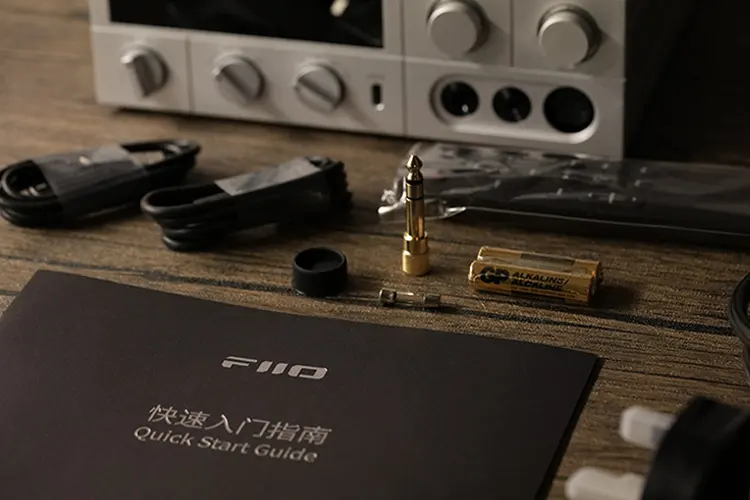
The packaging content consists of an infrared remote control, an extra fuse, two USB-A to USB-C cables, a 6.3mm to 3.5mm converter, and a dust cover for the balanced XLR output.
Sound Impressions
After approximately two weeks of burn-in, primarily utilizing the balanced output, the following impressions were gathered with headphones such as the Meze Audio 105 SILVA, the Sennheiser HD 800s, FiiO’s FT7, and the HIFIMAN ISVARNA.
Summary
The K15 serves as a powerhouse for planar and dynamic headphones, with a robust 3000mW output driven by a discrete class AB amplifying circuit.
This circuit design maintains a low output impedance, allowing it to match sensitive headphones like the Meze 105 SILVA and sound commendably dynamic and layered.
Equipped with newer generation AK4497S DAC chips, the K15 reintroduces a tad bit of analog warmth into the mids while blending it with enhanced transients in a balanced yet engaging manner.
In comparison, the K17, utilizing the AK4499EX and a stronger inbuilt PSU, has stronger technicalities, firmer attacks, and sounds more controlled.
Due to the similar amplifying circuitry design, there are noticeable resemblances in tonality and response speed between the K15 and K17.
The bass on the K15 feels very punchy but isn’t as agile in response, resulting in a neutral-warmish, relaxing, and smoother presentation that may appeal to those seeking a more relaxed signature experience compared to the K17.
Timbre
While the technical aspects, such as the agility in its bass response, are good, it cannot match the K17; the K15 is tuned to focus on musicality.
My first impression is that it sounds more airy and uplifting in the mid-lows than the K17, which uses the AK4499EX, a DAC that has superior detail, weight in the mids, better treble extension, and control.
Decoding with the K15 via USB connection results in a well-defined, moderately responsive presentation that’s textured in the lows and clean articulation to the vocal range. The signature slightly leans towards the bass end, providing a mellow yet defined presentation.
Testing with larger ensembles and instrumentals, the bass remains controlled and impactful with adequate thickness. While the treble has just a little bit of crispiness and control, which works well for retro pop and jazz.
With Techno and House tracks, the K15 can deliver decent depth and air with the subs extending quite low. Paired with the FT7, it achieves a good balance between speed, clarity, and power in bass. The treble is also extending fairly well and is free from sharpness while having good brilliance.
With the Meze 105 SILVA, it sounds even more elaborate in the low end, which allows cleaner voices to cut through nicely.
Possibly because of the single-ended connection, it sounds less separated and layered than on a balanced connection, but still maintains a distinct stereo image and adequate separation.
Overall, the decoding and amplifying quality is satisfactory, with good density and details throughout the spectrum.
The rather neutral signature with natural articulation, good agility in bass, and polished treble allows it to sound clean and dynamic across the various entry to mid-tier headphones tested.
Staging & Dynamics
The K15 has good air and power in the bass, which brings bass instruments and darker voices closer to the listener, enhancing their presence and intensity.
Powerful voices can cut through easily and sound well textured and layered from the bass line, although softer voices may not be as distinctly portrayed.
Along with sufficient sub-bass rumble, depth is nicely rendered, which helps picture a deeper, fairly expanded lecture-hall-sized stage. The width is moderately large when testing with string quartet recordings, and the vocalist has sufficient body to stay separated from the backing.
The upper vocal zone is energized to strengthen penetration power, followed by a gentle roll-off in the higher frequencies. As a result, percussions and voices lack any harshness and are clearly and accurately imaged.
At higher gain settings, the vocal image becomes clearer and firmer, woodwinds and higher-pitched instruments sound more energetic, similar to the experience with the K17.
Lower gain levels may result in a softer and less tightly defined sound in transients, affecting the 3D image of vocal and bass instruments slightly.
When paired with planar headphones like the FT7, the K15 delivers better layering and airiness, which helps define instruments’ position clearly.
Switching to dynamic headphones, however, results in a stronger coloring effect and tilts more to the lows. This change brings about a more lively, deeper, and layered soundstage due to the fuller low-end characteristic.
On another note, the K15 does quite well to sound controlled and dynamic at different gain levels, even when the paired gear is very sensitive. There is sufficient room for equalization without sounding compressed or unnatural.
Click on page 2 below for my recommended pairings and selected comparisons.
