

Synergy
PEQ Software
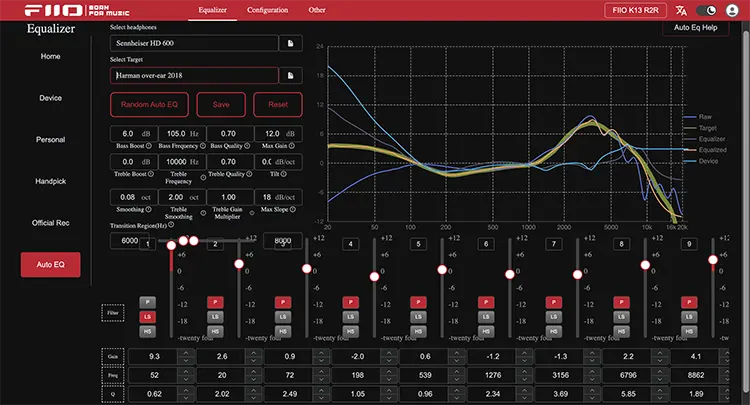
The K13 R2R comes with 10 EQ presets by default, but to fully maximize its PEQ capabilities, users must use either the FiiO control Online interface or the FiiO Control App.
On paper, the FiiO Control online interface sounds quite impressive. Without needing any software installation or drivers, users can fine-tune their preferred EQ settings and even import settings created by other users.
Once I opened the FiiO Control interface, I found the built-in PEQ adjustment dashboard to be quite intuitive. The graph and Freq indicators act as a helpful guide to visualize the effects being applied by the custom EQ.
The “Device” Panel lets users select from one of the 10 presets included, while the “Handpicked” panel lets users select from EQ profiles submitted by the community.
But what excited me the most was the option for Auto EQ, wherein users can simply select their headphone/IEM model and then select their target curve. In concept, this lets listeners try out different tuning curves with the headphones or IEMs they have on hand.
During my testing, I was able to try different industry curves such as Harman Over Ear 2018, Diffuse Field, and JM-1. As someone who was interested in understanding the hype and discourse around these targets, the K13 R2R helped me identify which industry curve I aligned more with.
This feature alone makes it a standout option for audiophiles looking into making more informed purchasing decisions when it comes to purchasing their next IEM or headphones.
The FiiO Control App on my iPhone worked fine as well, letting me select different PEQ options. However, the app did not have the Auto EQ function at all, so I still was not able to try it.
Power/Efficiency
The K13 R2R’s amplifier section provides impressive power for its class, with 2400mW per channel into 32Ω via balanced output.
With the Sennheiser HD 600 connected via the balanced output, the K13 R2R drove the 300Ω full-sized headphones to listening volume at around 30% on high gain, leaving more than enough headroom.
With my more demanding Modhouse Argon Mk3, I had to increase the volume level to around 45% to achieve listenable levels. Even at this volume level, I did not notice any diminished dynamics or detail on either end of the frequency response.
With more efficient headphones like the Harmonicdyne BAROQUE, the K13 R2R was able to drive them to listening volume at around 40%, but this time on medium gain.
Safe to say that the onboard amplification of the K13 R2R is capable enough to power most consumer and audiophile headphones to listening volume.
With sensitive IEMs like the MOONDROP Blessing 3, the K13 R2R’s low gain setting provided excellent results. The noise floor remained imperceptible even with the IEMs’ high sensitivity.
Pairings
The K13 R2R pairs well with brighter or more neutral headphones that benefit from its natural warmth and smooth treble.
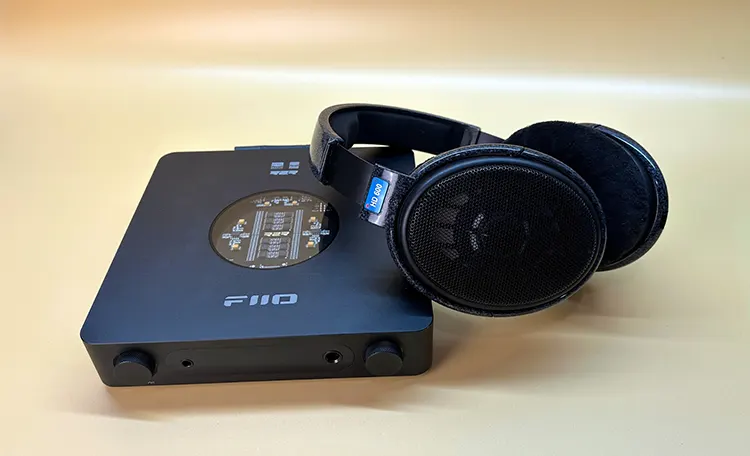
The Sennheiser HD 600 was an ideal pairing for the K13 R2R. During my testing, the HD 600 was permanently attached to the K13 R2R, making it my preferred source for those headphones even well after testing.
The warmth of the K13 R2R was just enough to compensate for the lean mid-bass of the HD 600, and its good soundstage performance complemented the HD600’s more intimate staging presentation.
However, I was not a fan of how the K13’s warmer tuning complemented the more V-Shaped Mod House Argon Mk3. It did not make the headphones unlistenable, but the warmth caused the already bassy headphones to sound a little bloated.
The BAROQUE was a decent pairing. While I occasionally prefer the Baroque with warmer sources, I found that the K13 on its NOS setting muddied the midrange too much. But switching the K13 to its OS setting made it a much better pairing with the Baroque.
The Blessing 3 proved an excellent match for the K13 R2R’s low-gain setting. I observed no hissing at all, and the source’s warmer tonality is in line with my preferred pairings with the Blessing 3.
Selected Comparisons
All selected comparisons to the Fiio K13 R2R were done with the unit connected to an M1 MacBook Air via USB. The FiiO K13 was in NOS mode with PEQ disabled.
Primary headphone pairings were the Sennheiser HD 600 and HarmonicDyne BAROQUE, while the main IEM pairing was the MOONDROP Blessing 3.
FiiO K11 R2R
Technical
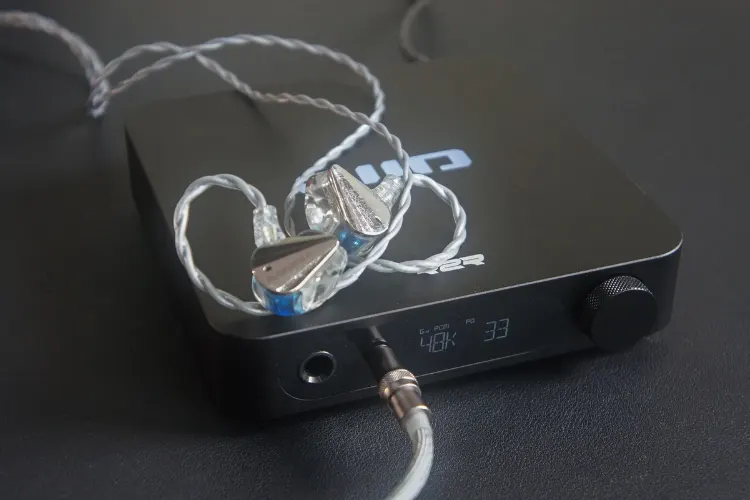
The K13 R2R and K11 R2R share the same fundamental 24-bit R2R DAC module. However, the K13 R2R employs upgraded TI operational amplifiers instead of the SG Microchips in the K11 R2R.
The K13 R2R’s amplifier section delivers substantially more power: 2400mW versus 1300mW at 32Ω balanced, and 600mW versus 400mW single-ended.
Connectivity is another area where the K13 pulls away. The K13 R2R adds Bluetooth 5.4 and balanced XLR line outputs, while the integrated 30W power supply eliminates the external brick required by the K11 R2R.
Design
Both models feature CNC-machined aluminum construction with anodized finishes available in black or silver.
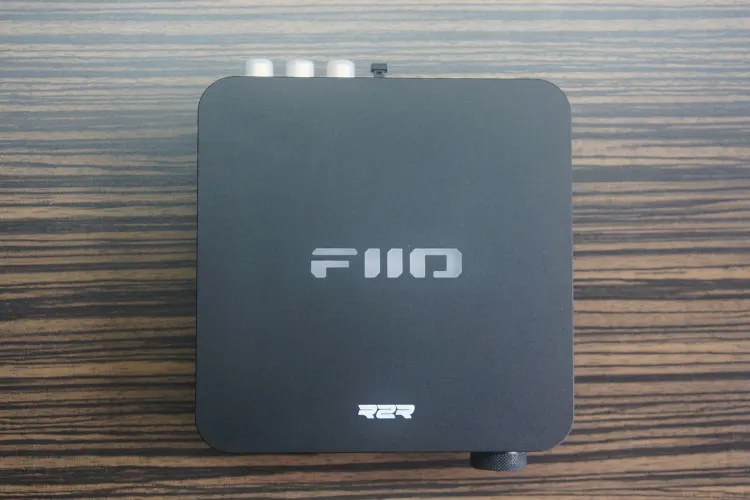
The K13 R2R’s substantially larger footprint (7.5″ versus 5.25″ square) reflects its beefier internal components and integrated power supply.
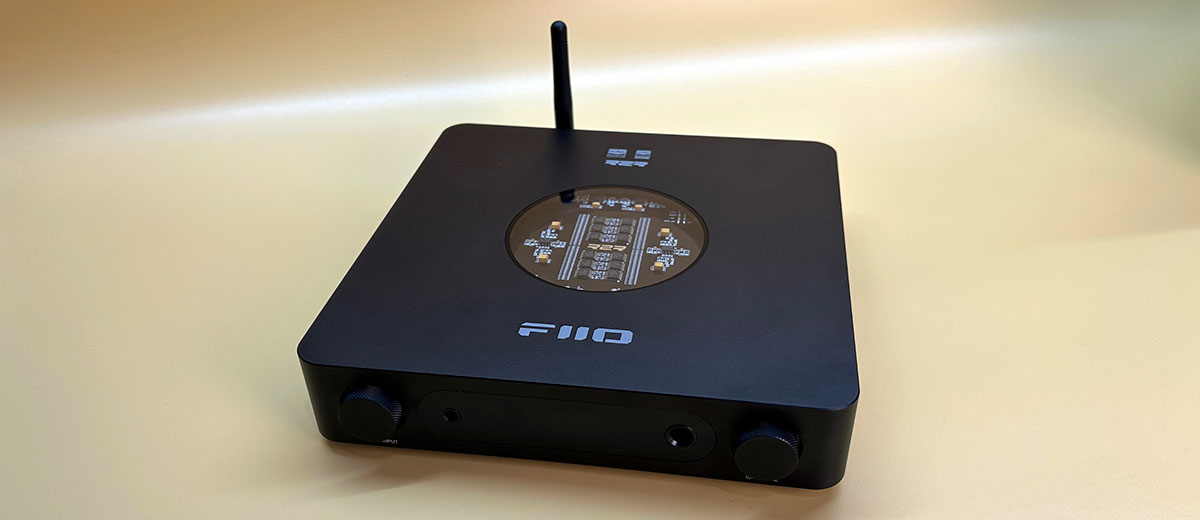
The K13 R2R introduces the signature “skylight” window displaying the R2R resistor array, adding visual interest absent from the K11 R2R’s plain top surface. RGB lighting beneath the window provides a customizable sample rate indication.
The OLED displays are similar in size and quality, though the K13 R2R’s slightly refined menu system with its included IR remote and dual knob configuration is a noticeable improvement over the K11 R2R.
Performance
Sonically, the K13 R2R delivers a more textured and dynamic presentation compared to the K11 R2R. Both share the characteristic R2R warmth and organic tonality, but the K13 R2R extends this quality with improved detail.
Sub-bass performance sees noticeable enhancement with the K13 R2R offering superior texture and control. Low-frequency extension reaches deeper, and complex bass passages maintain better separation between fundamental tones and harmonics.
The mid-range is where I noticed the biggest improvement. On specific tracks, the mid-range on the K11 R2R tended to sound dull or compressed due to a weaker imaging and dynamics performance, but thankfully, this issue is not present on the K13 R2R.
Treble refinement favors the K13 R2R, with improved air and extension compared to the slightly darker K11 R2R. The difference remains subtle, with both prioritizing smoothness over analytical sparkle.
Shanling EH2
Technical
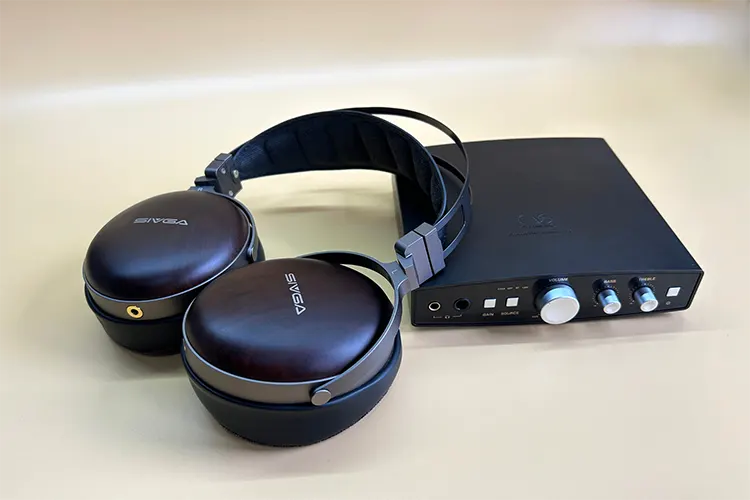
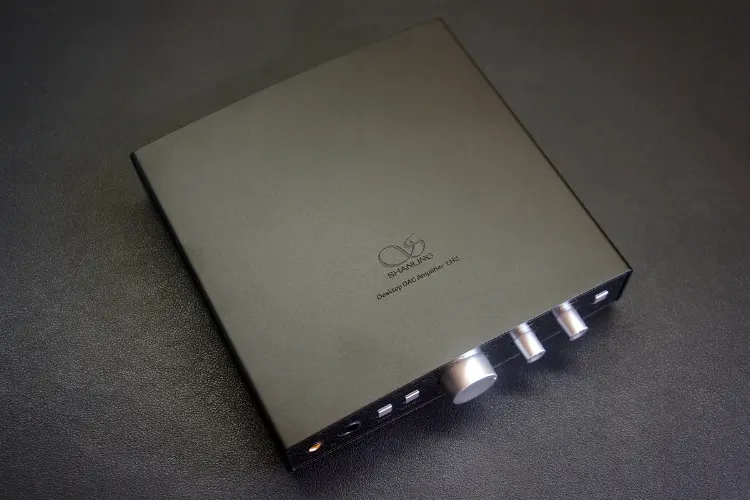
The Shanling EH2 and FiiO K13 R2R represent different approaches to R2R implementation. The EH2 employs Shanling’s proprietary 24-bit R2R module utilizing BD139/BD140 transistors, while the K13 R2R uses FiiO’s resistor array with TPA6120A2 amplifier chips.
Power output favors the EH2 significantly, with 4300mW at 32Ω balanced compared to the K13 R2R’s 2400mW.
The EH2’s dedicated bass and treble knobs offer simpler, more intuitive tone adjustment compared to the K13 R2R’s app-based 10-band PEQ. However, the parametric EQ provides far more precise control and headphone-specific correction capabilities.
Design
The Shanling EH2 adopts a lower-profile curved chassis compared to the K13 R2R’s squared, angular design. The EH2’s overall smaller form factor also occupies less desk space than the K13, making it ideal for more compact set-ups.
The K13 R2R’s “skylight” window provides a distinctive aesthetic element lacking in the EH2’s solid aluminum top. However, the EH2’s piano-black faceplate with gold accents offers arguably more premium visual appeal.
Build quality proves excellent on both units, with well-matched aluminum panels and solid construction. The K13 R2R’s superior rubber feet provide better desk grip than the EH2’s standard pads.
The EH2’s RGB LED ring around the volume knob and dedicated tone control knobs create a more tactile, hands-on interface compared to the K13 R2R’s app-dependent EQ and simpler front panel.
Performance
The Shanling EH2 and FiiO K13 R2R share a warm, organic R2R character but differ in execution. The EH2 leans slightly warmer overall, with more prominent mid-bass warmth and softer treble presentation.
The K13 R2R offers superior bass texture and detail retrieval. Low frequencies sound more controlled and better defined, with improved separation in complex passages. The EH2 counters with slightly more impactful bass slam.
Midrange presentation proves remarkably similar between the two, with both delivering rich, natural tonality. The EH2 edges ahead slightly in resolution and transparency, revealing more textural nuance in vocals and acoustic instruments.
Treble performance favors the EH2 with noticeably better extension and air. The K13 R2R’s more relaxed treble proves less fatiguing but sacrifices some detail and sparkle. Both avoid harshness and sibilance effectively.
The soundstage width favors the K13 R2R in NOS mode, creating a more spacious and atmospheric presentation. However, the EH2 provides slightly better imaging precision and instrument localization within that space.
Fosi K7
Technical
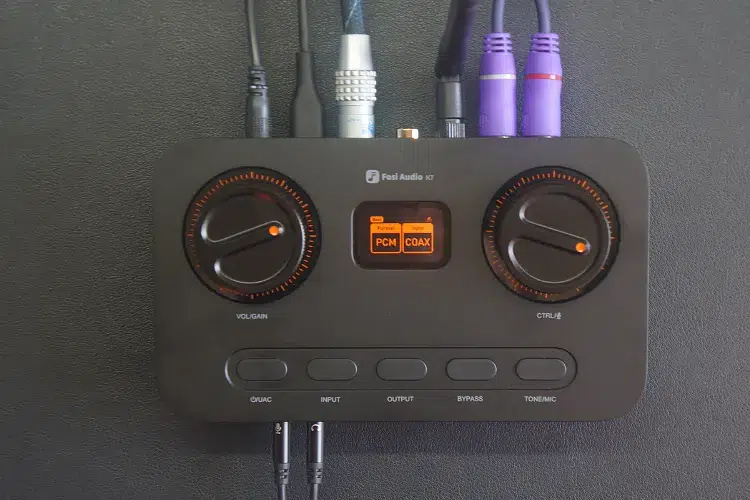
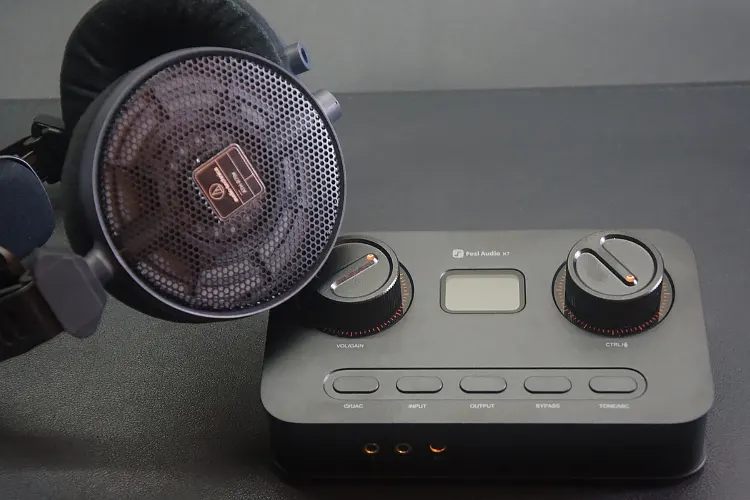
The Fosi K7 and FiiO K13 R2R target different segments despite similar pricing. The K7 employs an AKM AK4493SEQ delta-sigma DAC rather than the K13 R2R’s resistor ladder architecture.
Power output slightly favors the K13 R2R at 2400mW versus the K7’s 2100mW balanced, though both prove adequate for most headphones. The K7 includes a unique microphone input with adjustable gain, a gaming-focused feature absent from the K13 R2R.
Connectivity options prove similar, with both offering USB, optical, coaxial, and Bluetooth inputs. However, the K13 R2R adds XLR balanced outputs, while the K7 provides the aforementioned microphone input.
The K7’s bass and treble tone controls offer simpler adjustment than the K13 R2R’s parametric EQ, though with less precision.
Design
The Fosi K7 adopts more of a “gaming” aesthetic with orange accents and its prominent OLED display. The K13 R2R maintains a more conservative yet elevated audiophile appearance with its subtle lighting and skylight window
Build quality on both units proves excellent, with CNC-machined aluminum construction and solid heft.
The K7’s external 12V power supply requirement creates cable clutter compared to the K13 R2R’s integrated IEC power connection. Both units provide excellent desk stability with quality rubber feet.
Control interfaces differ significantly: the K7’s dual knobs for bass/treble and volume provide more hands-on adjustment, while the K13 R2R’s cleaner two-knob layout relies more on menu navigation and app control.
Performance
The Fosi K7 and FiiO K13 R2R deliver fundamentally different sonic presentations. The K7 sounds notably more neutral and analytical, with cleaner, tighter bass and more extended, airier treble than the K13 R2R’s warmer R2R character.
Bass response on the K7 extends deep with excellent control but lacks the organic texture and natural warmth of the K13 R2R. Electronic music and hip-hop benefit from the K7’s tighter, more impactful low-frequency presentation.
The midrange represents the most significant difference. The K7 sounds leaner and more transparent, prioritizing detail retrieval and clarity over the K13 R2R’s richer, more full-bodied presentation.
Treble extension and air clearly favor the K7, with better sparkle and micro-detail retrieval in the upper frequencies. The K13 R2R’s smoother, more relaxed treble proves less fatiguing but sacrifices some resolution.
My Verdict
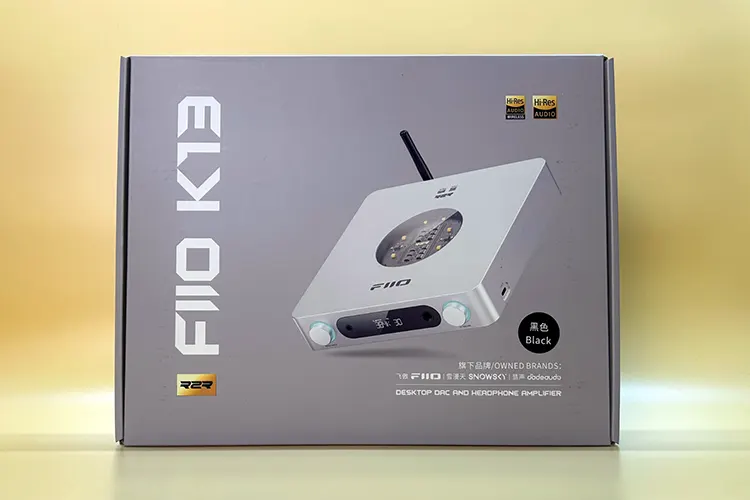
Priced at $319, the FiiO K13 R2R is a compelling evolution of the K11 R2R formula, addressing key limitations of its predecessor, whilst maintaining the unique R2R sound signature of the K11 R2R, and introducing an innovative 10-band PEQ with Auto EQ Support.
It’s not all positive, however. Despite its improved output power vs the K11, it’s hard to ignore the higher output power of competing R2R DAC/AMPs
Despite this, those seeking a warm, organic-sounding DAC/AMP with modern connectivity and a robust PEQ suite to fine-tune how their gear sounds should strongly consider the K13 R2R.
FiiO K13 R2R Specifications
- DAC Architecture: 24-bit R2R resistor ladder (192 precision resistors)
- Amplifier: Dual OPA1642 + Dual TPA6120A2 (fully balanced)
- Output Power: 2400mW + 2400mW @ 32Ω (BAL), 600mW @ 32Ω (SE)
- Input(s): USB-C (x2), Coaxial, Optical, Bluetooth 5.4
- Output(s): 6.35mm SE, 4.4mm BAL, RCA (variable/fixed), XLR BAL
- USB Playback: 384kHz/32-bit PCM, DSD256
- Bluetooth: LDAC, AAC, SBC
- Power Supply: Internal 30W switching PSU, optional external DC input
