

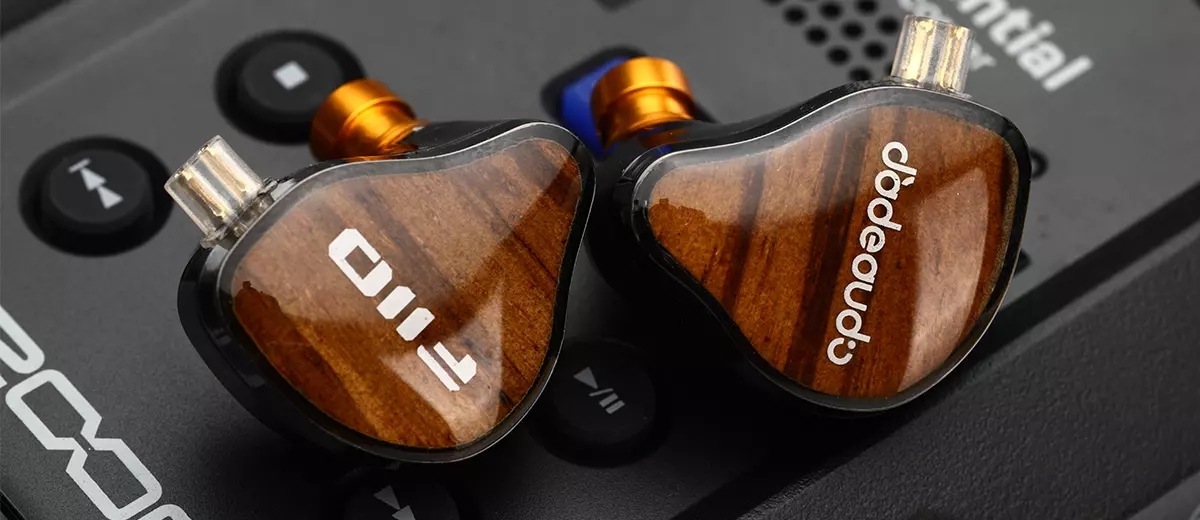
Marcelo reviews the FiiO JH13, a new hybrid 10mm dynamic and dual BA driver in-ear monitor marketed under the Jade Audio sub-brand. It is currently priced at $39.99.
Disclaimer: I received this sample in exchange for my honest opinion. Headfonics is an independent website with no affiliate links or services. I want to thank FiiO for their support.
You can click here to learn more about the FiiO audio products previously reviewed on Headfonics.
This post follows our current scoring guidelines, which you can read in more detail here.
More than two years ago, when I was starting in this hobby, I was always intrigued by affordable hybrid IEMs, including the FiiO JH3 released in early 2022. Still, I never had the chance to hear or buy one.
After more than three years, FiiO finally updated the JH3 with the new Jade Audio-branded JH13, using newer driver technology and priced at a very affordable $39.99.
But how does it compare to other newly released hybrid IEMs, including the MOONDROP MAY and the Hidizs MS2 PRO? You can find out in my full review below.
Features
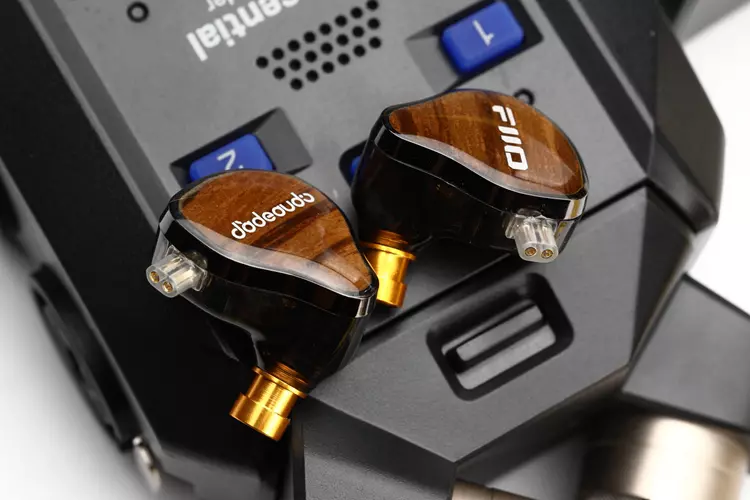
The FiiO JH13 is a hybrid three-driver IEM featuring an updated dual-magnetic, 10mm dynamic driver with a 0.033mm CCAW (copper-clad aluminum wire) voice coil, sourced from Daikoku Corporation of Japan, and a pair of balanced armature drivers for the treble.
The dynamic and balanced armature drivers work together via a specially designed crossover. The JH13 has an impedance of 24Ω and a sensitivity of 110 dB/mW.
The JH13 also features an effective pressure-relief system that prevents pressure buildup in the ear canals, which can cause nausea, headache, and discomfort. During my testing of the JH13, I did not experience any such issues.
Design
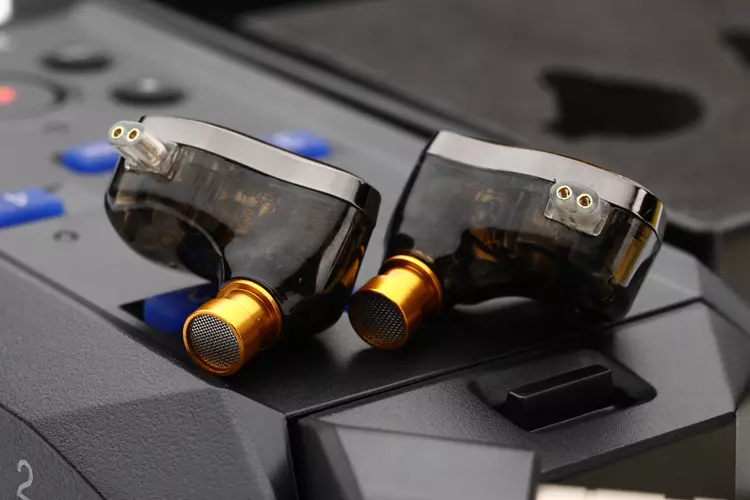
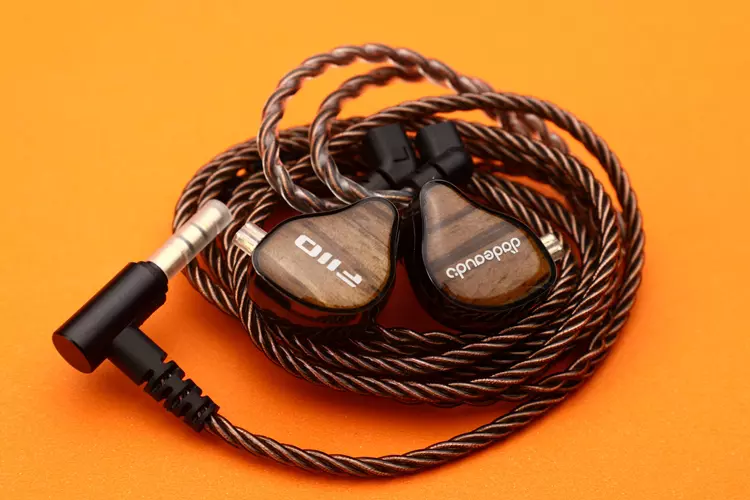
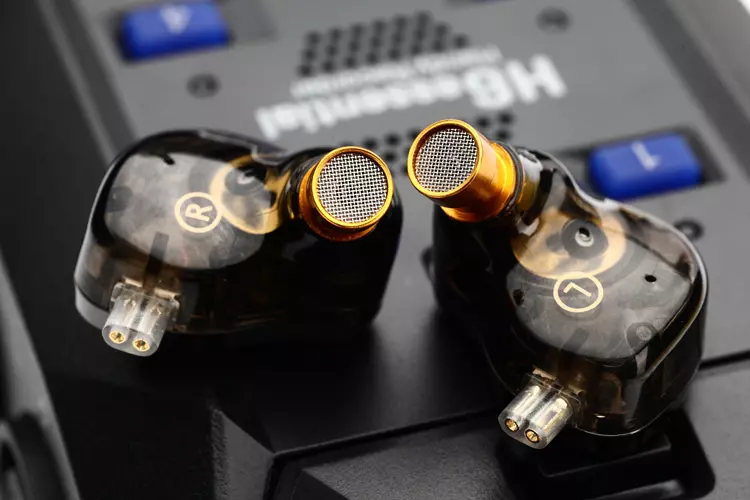
The JH13 features a semi-clear, black-tinted, glossy plastic shell with a real zebrawood faceplate covered in clear, shiny plastic.
There is a small vent hole near the metal nozzle, and the 0.78 mm 2-pin connector near the faceplate is a QDC style 2-pin connector.
I appreciate that FiiO uses real zebrawood, even when it is only a thin layer, as I like the organic look of the faceplate.
I also like the plastic shell, which makes the IEMs light, weighing only 6.2 grams each, and, upon closer look, the finish is flawlessly smooth and shiny.
Stock Cable
The included stock cable is a four-core, spirally braided high-purity oxygen-free copper (OFC) cable, consisting of 120 wires across the four wire cores, and is only available with the 3.5mm plug.
On actual handling, the feel of the cable is fair, neither low nor high in quality by feel. It is not too thin, I like that it is not too thin, making it less prone to tangling.
Comfort & Isolation
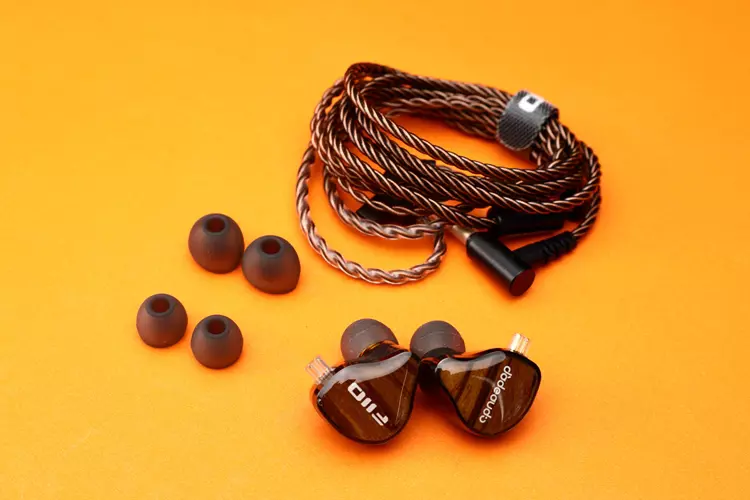
Thanks to the JH13’s lightweight, medium-sized 6 mm nozzle diameter, ear tips, and pressure relief system, it is very comfortable to wear for long periods while listening to music, walking, or at home.
The JH13 sound isolation is average, which, to me, is a good thing, as I still want to hear the ambient sounds when not playing music during walking exercises.
Packaging & Accessories
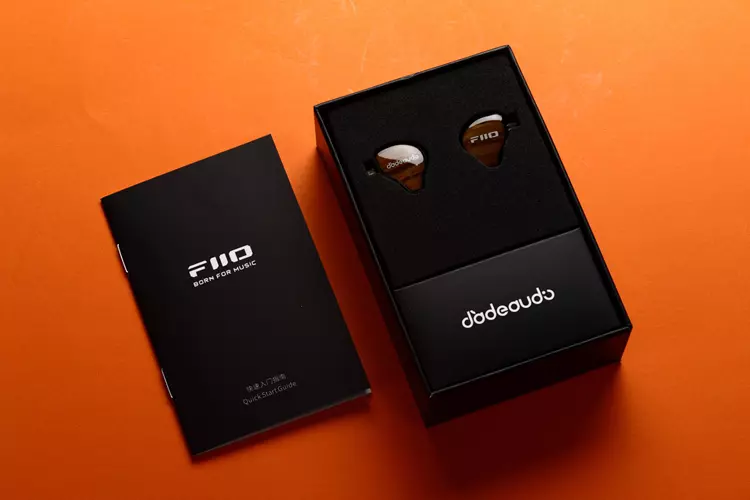
The JH13’s box and packaging, which measure 126 x 80 x 39 mm, are simple, budget-style, but neatly designed. It includes the user’s manual, a 3.5 mm cable, three pairs of ear tips, and a pair of IEMs.
The medium-sized ear tips were already installed when I opened the box, which I tend to prefer for the time saved in picking out tips to start testing. Medium tips are usually my go-to sizing, though YMMV.
The cable was not yet installed, and the left and right indicators on the 2-pins are difficult to see in marginal lighting.
Sound Impressions
I did my standard 24-hour burn-in by letting it play with a spare DAP continuously. I noticed a minute improvement in bass control and in the cleanup of background decay after the burn-in.
For the sources, I used my iBasso DC-Elite and MUSE HiFi M6 Double DAC amplifiers, with my OnePlus 13 Android phone and Sony DAP as my source, and the FiiO M15S DAP, using either UAPP or PowerAmp music player Apps. I used the stock ear tips and the stock cable for this review.
Measurement
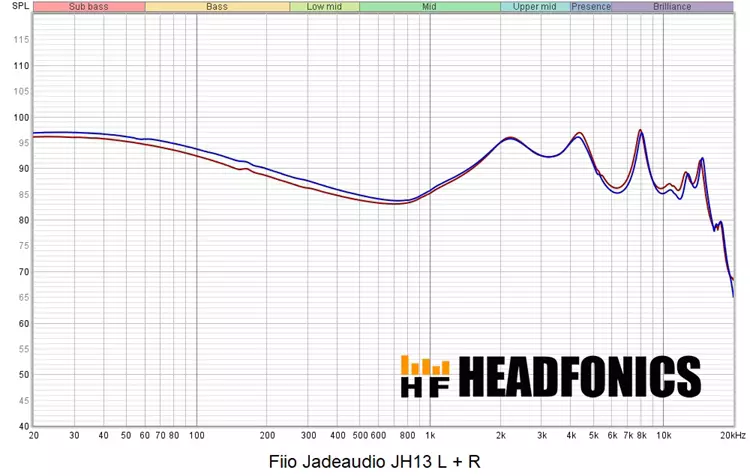
While there is about 1 dB of channel imbalance below 500Hz in the JH13 measured response graph, I never noticed it throughout the review process. The overall graph tells of an IEM with a V-shaped sound signature.
The bass has about 13 dB of boost, and the Pinna gain in the upper midrange also has 13 dB of boost. Those peaks above the pinna gain are audible.
Summary
The JH13’s sound signature is a deep V-shaped one, with prominent bass and treble.
This reminds me of the time when I was a grade school and high school student, I used to adjust the bass and treble on my Sony cassette Walkman to the maximum and enjoyed the boomy bass and tizzy-sounding treble.
Needless to say, the JH13 has a ‘boom n’tizz’ sound characteristics where the sound is dominated by the boom of the bass and the tizz of the treble; the bass is overtly boosted, with an imposing presence and sounding bloated at times.
The treble is airy and extended, but it lacks refinement and sounds peaky most of the time.
Despite the V-shaped sound, the midrange is very enjoyable, with instrument and vocal presence; it is not recessed or buried between the bass and the treble.
Overall, the JH13 has this so-called “fun” sound signature, sacrificing smoothness and refinement for a ‘boombastic ‘sound with good engagement.

Coloration
Aside from the obvious sound signature, I consider a coloration of its own: the V-shape sound signature.
The bass is ‘boomy’ and lacks control at times. Though it is not really slow, I noticed intermodulation distortion whenever the bass is sub-bass dominant and loud; it sounds like the midrange is affected during loud sub-bass passages. The JH13 also sounds bloated at times.
Though the measured graph has high pinna gain, it does not sound that way in actual listening. This is due to the elevation of the higher frequencies, making the pinna gain less prominent during music reproduction.
The treble, though, could sound fun and engaging, but is colored with extra sizzle on top of the music. Those peaks in the treble contribute to a bright, piercing sound at times, though some people prefer it this way, as it adds excitement and liveliness. It is simply not for me.
Though, in fairness, there is a good amount of resolution and details audible in the sound, but not much in terms of micro-details. I must say the JH13 is not for people looking for subtlety.
Soundstage
The soundstage is good; I get a spacious feeling every time I listen to the JH13; however, depth is not so good.
This could be due to treble peaks preventing the instruments from decaying cleanly, making the soundstage shallower. It is like listening to a wall of sound eight feet in front of you, with little depth.
I experience an average imaging performance with the JH13; the instrument separation, placement, and layering performance is average.
I can hear a good center vocal presence, but there is a lack of edge definition and diffused sound, making the overall imaging performance average.
Dynamics
The JH13 is a very dynamic-sounding set, no doubt about it. The bass and treble are always bubbling with energy, regardless of the volume.
However, if I listen to songs with a strong subbass presence at high volume, I have to back off the volume, as intermodulation distortion would creep in.
It is fine with normal songs, though. JH13 could also sound shouty at high volume, especially with complex songs.
Click on page 2 below for my recommended pairings and selected comparisons.
